
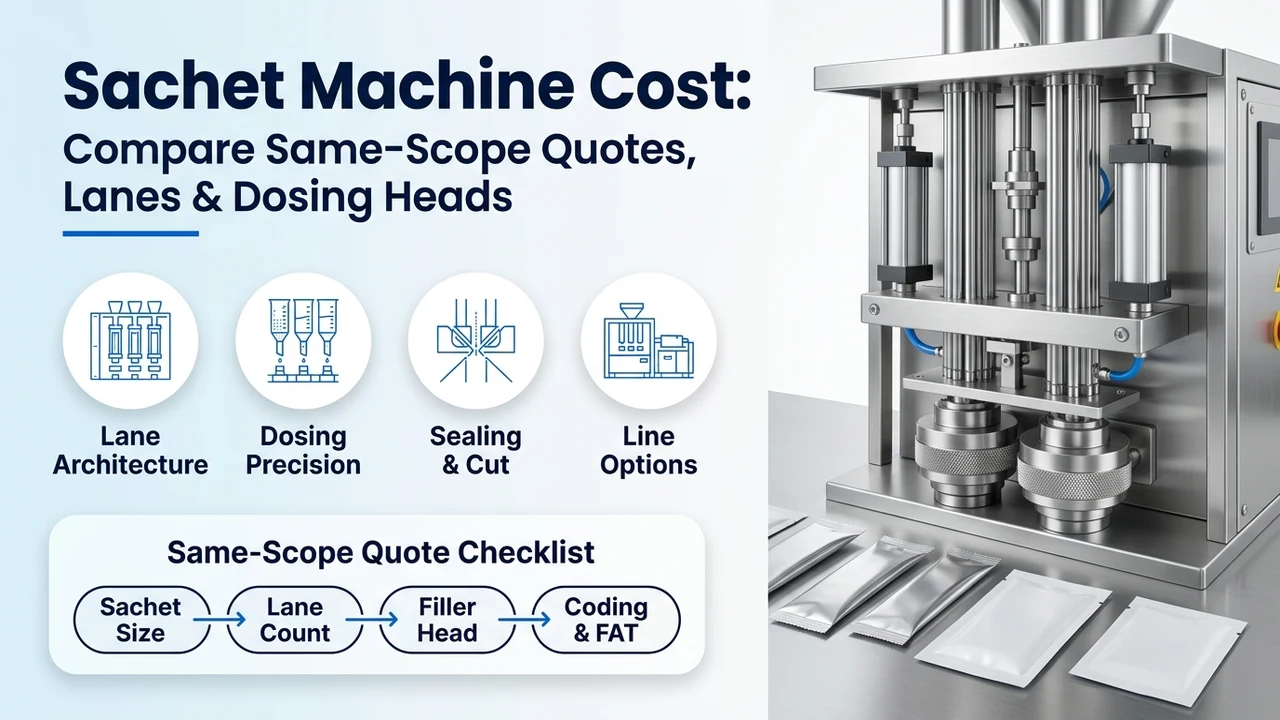
Industrial sachet packing machine cost—whether searched as sachet packing machine price, sachet packaging machine price, sachet machine price, sachet filling machine price or powder packing machine price—is determined by multi-lane mechanical scope rather than a flat catalog number. Across our roll-fed flat sachet platforms (spanning 3-side-seal LV-400F / 680F / 980F, LV-400Y / 680Y / 980Y and LV-400K / 680K / 980K frames at 400 / 650–680 / 950–980 mm max film width, and 4-side-seal LV-500SF / 700SF / 980SF, LV-500SY / 700SY / 980SY and LV-500SK / 700SK / 980SK frames at 500 / 700 / 980 mm max film width across 2 to 16 lanes at 20–40 cuts/min) and global OEM systems, two proposals represent the same purchase only when anchored to identical sachet dimensions, seal style, laminate structure, dosing filler, hazardous-area or dust-control hardware, and Factory Acceptance Testing (FAT) protocols.
| Engineering input | Standard baseline or buyer source | Why it drives quote scope & machine price |
|---|---|---|
| Seal style & finished sachet width × length | 3-side seal (17–110 × 50–180 mm on Y; 25–110 × 50–150 mm on F/K) vs. 4-side seal (50–125 × 45–160 mm on SF/SY/SK; 15–80 mm on LV-450X / LV-350X) | Selects V-plow folding vs. dual-web opposed-roller sealing architecture and sets slit strip width W_strip per lane |
| Product rheology & dosing branch | Fine/cohesive powder (F / SF servo auger), free-flowing granules (K / SK / LV-350X volumetric), or liquid/sauce/paste (Y / SY / LV-450X piston or lobe pump) | Dictates the multi-lane filler top-works, hopper agitation/heating, suck-back valves, and jaw dust extraction |
| Target net output & active lane count | Accepted sachets/min (Q_net) mapped against 20–40 cuts/min reference cycling across 2–4, 3–10, or 4–16 active lanes | Locks parent web frame width (400–500 mm, 650–700 mm, or 950–980 mm) and multiplies nozzles, plows and side-seal rollers |
| Rollstock laminate & inner sealant layer | Parent reel spec (PET/AL/LLDPE, OPP/CPP, KOP/CPP, PT/PE or Paper/PE, 60–120 microns; FDA 21 CFR 177.1520 polyolefin inner sealant) | Governs rotary vertical side-seal roller pressure, PID cross-jaw dwell time, and motorized unwind web tension |
| Seal validation & hot-tack baseline | ASTM F1921 bottom cross-seal hot tack, ASTM F88 cooled peel strength (15 mm or 25.4 mm strip), and ASTM F1140 whole-sachet burst | Establishes quantitative FAT pass/fail thresholds across all 3 or 4 perimeter seals before shipment |
| Format change parts, cut & coding options | Additional sachet width forming plows/spacers, straight/zigzag/shaped die cuts, tear notches, duplex perforations, and multi-lane laser/TTO/TIJ coding | Separates fully tooled multi-SKU production lines from single-width base machines with unpriced options |
| Hazardous-area, CIP & dust-control scope | Explosion-proof electricals for alcohol hand-sanitizer sachets, CIP/quick-release sanitary manifolds for sauces, and vacuum dust hoods for powders | Prevents compliance holds and seal-contamination scrap on specialized chemical, cosmetic, food and pharma runs |
| Utilities, headroom & downstream cartoning | Power (4.0–7.5 kW, 220V/380V/480V 50/60 Hz), dry air (0.6–0.8 MPa at 350–850 NL/min), ceiling height (2,270–3,100 mm + feeder), and cartoner collation | Defines plant electrical/pneumatic drops, floor-to-hopper loaders, and automatic counting/box-loading labor savings |
On this page
Why do two sachet packing machine quotes rarely represent the same mechanical purchase?
Two vendor quotations for a flat sachet packaging project regularly diverge in total scope because one offer covers a narrow-web 3-side-seal frame with a shared dosing drive and bulk chute discharge, while the competing offer covers a wide-web 4-side-seal servo platform with independent per-lane dosing trim, heated agitated hoppers, multi-lane laser coding and synchronized cartoner collation. On our sachet packing machines family page, we build roll-fed flat sachet equipment across six core multi-lane series and three frame sizes (2–4 lanes, 3–10 lanes and 4–16 lanes, all rated at 20–40 cuts/min): 3-side-seal frames (LV-400F / 680F / 980F for powders, LV-400Y / 680Y / 980Y for liquids and sauces, and LV-400K / 680K / 980K for granules) and 4-side-seal frames (LV-500SF / 700SF / 980SF for powders, LV-500SY / 700SY / 980SY for liquids and sauces, and LV-500SK / 700SK / 980SK for granules), alongside specialized 4-lane configurations such as our LV-450X cosmetic lotion machine and LV-350X granule machine. Those series specifications establish the baseline for the forming-and-sealing frame; the exact lane count, dosing manifold, format tooling and Factory Acceptance Testing (FAT) scope must be locked around your physical product and laminate.
Across international OEM multi-lane sachet architectures—including Matrix / INVpack (MVA4 EVO 400 mm web / 1–5 lanes, MVA9 EVO 900 mm web / 3–10+ lanes, and MVA12 1,200 mm web / 4–15 lanes), Viking Masek (SA300 4-side-seal sachet platform across 1–6 lanes, 6.8–8.0 kVA, 30 CFM at 6 bar), and Mespack (ML Series intermittent and MLC Series continuous 4-side-seal machines up to 1,000–1,200 mm web width across 4–14 lanes)—equipment capital cost shifts at five distinct mechanical boundaries:
| Quoted machine & web-width class | Standard engineering baseline & included boundary | Items frequently omitted from low headline quotes | Dominant field failure mode & mechanical prevention |
|---|---|---|---|
| Compact 3-side-seal multi-lane class: 400 mm web, 2–4 lanes (LV-400F / LV-400Y / LV-400K baseline) | Max parent film width 400 mm; 2–4 lanes; sachet width 25–75 mm (F/K) or 17–75 mm (Y); length 50–150 mm (F/K) or 50–180 mm (Y); 20–40 cuts/min; 4.5 kW; 500 kg; 700 × 1,375 × 2,380–2,560 mm | Overhead vacuum powder loader or jacketed liquid tank, jaw dust hood, multi-lane coder, and extra-width V-plow folding assemblies | Failure mode: Asymmetric V-plow folding skew on narrow 3-side sachets when parent web tension fluctuates, leaving one side-seal margin <3 mm. Prevention: Specify an automatic ultrasonic/optical web edge guide (EPC) with dancer-arm unwind tension control and precision-machined lane folding plows verified during FAT. |
| Compact 4-side-seal multi-lane class: 400–500 mm web, 2–4 lanes (LV-500SF / LV-500SY / LV-450X / LV-350X / MVA4 / SA300 baseline) | Max parent film width 400–500 mm; 2–4 lanes (up to 5–6 lanes on MVA4/SA300); sachet width 50–125 mm (SF/SY), 15–60 mm (LV-450X) or 30–80 mm (LV-350X); length 45–180 mm; 20–40 cuts/min (up to 70 cpm on MVA4); 4.0–6.8 kW; 650 kg; 0.6–0.8 MPa air at 350–850 NL/min | Dual-web registration alignment for front/back printed art, suck-back nozzle valves, SUS316L contact upgrade, and duplex perforation knives | Failure mode: Front-to-back web curling or longitudinal wrinkle channels along the four perimeter seals when front and back film ribbons experience unequal pull path tension. Prevention: Require synchronized servo pull rollers, independent front/back web tension compensation, and matched knurled vertical side-seal roller pressure. |
| Mid-range 3-side & 4-side multi-lane class: 650–700 mm web, 3–10 lanes (LV-680F / LV-680Y / LV-700SF / LV-700SY baseline) | Max parent film width 650–680 mm (3-side F/Y, 25–100 or 17–100 mm sachet width) or 700 mm (4-side SF/SY, 50–125 mm width); 3–10 lanes; 20–40 cuts/min; 5.5–6.0 kW; 650–850 kg; height 2,340–2,960 mm | Independent per-lane servo auger or piston trim, traversing multi-lane TTO/laser coder, static eliminators, and lane-by-lane reject gates | Failure mode: Center-span jaw deflection and temperature droop across a 650–700 mm horizontal cross-seal bar, producing micro-channel leaks at the 4-layer corner intersections where side seals meet cross seals. Prevention: Mandate multi-zone PID heater cartridges across the cross-jaws plus center-supported toggle clamping verified by ASTM F1140 burst tests on every lane. |
| Wide-web & ultra-wide multi-lane class: 900–1,200 mm web, 4–16 lanes (LV-980F/Y / LV-980SF/SY / MVA9 / MVA12 / ML1000 baseline) | Max parent film width 950–980 mm (LV-980 series, 4–16 lanes, 7.0–7.5 kW, 800–1,000 kg, height up to 3,100 mm on LV-980SF) up to 900–1,200 mm (MVA9 / MVA12 / ML1000, up to 14–15 lanes) | Split dual-infeed powder/liquid manifolds (preventing outer-lane starvation), powered floor reel hoist, splice table, and overhead mezzanine | Failure mode: Outer-lane fill-weight starvation across a 1-meter wide hopper trough and high parent-roll splice scrap during manual reel changes. Prevention: Specify symmetrical twin-port manifold feeding with level-controlled cross-augers or recirculating liquid headers plus a motorized reel lift and splice table. |
| Integrated multi-lane sachet-to-cartoner line (Multi-lane sachet VFFS + counting/collation + horizontal cartoner) | Primary multi-lane sachet packager synchronized via flat-pouch stacking/shingling chutes and indexing bucket conveyors to an automatic horizontal cartoner (e.g., TL6 60 cartons/min class, 2,500 kg, 4,400 × 2,900 × 2,000 mm) | Single-lane reject diverters upstream of collation, incomplete-stack purge logic, checkweigher, metal detector, and hot-melt carton closer | Failure mode: Flat sachets shingling, flipping or jamming inside discharge chutes when warm seals stick together, stalling the downstream cartoner. Prevention: Install active air-cooling bars at the horizontal cross-seal discharge, positivized vertical drop guides, per-lane optical drop sensors, and single-lane reject gates before the collation buckets. |
Before comparing any two lines on a quotation, confirm that both suppliers are quoting a roll-fed flat three-side or four-side seal sachet machine. If one supplier quoted a narrow tubular back-sealed stick pack, settle the format boundary first on our stick pack vs. sachet comparison and what a sachet is. If one supplier quoted pre-converted stand-up or spouted bags, move that proposal to the premade pouch machine cost guide. If your project packs leaf tea into an inner filter bag and outer envelope, review the dedicated inner and outer bag tea packaging configuration rather than a flat multi-lane sachet frame.
Step 1 — How do 3-side vs. 4-side sachet geometry, parent web width and net output set the frame size?
Every flat sachet machine quotation is governed by two geometric equations: the parent film web width (W_web) required to form N_lanes across the machine, and the net accepted output (Q_net) delivered after accounting for OEE availability, reel splices and quality rejects. On a 3-side-seal sachet machine (LV-400F / 680F / 980F, LV-400Y / 680Y / 980Y, LV-400K / 680K / 980K), each slit ribbon is folded over a V-plow so one vertical edge is a clean fold and the opposite vertical edge is heat-sealed. On a 4-side-seal sachet machine (LV-500SF / 700SF / 980SF, LV-500SY / 700SY / 980SY, LV-500SK / 700SK / 980SK), the master roll is center-slit into separate front and back webs (or fed from dual reels) that are brought face-to-face and sealed along both vertical edges by knurled heated side-seal rollers:
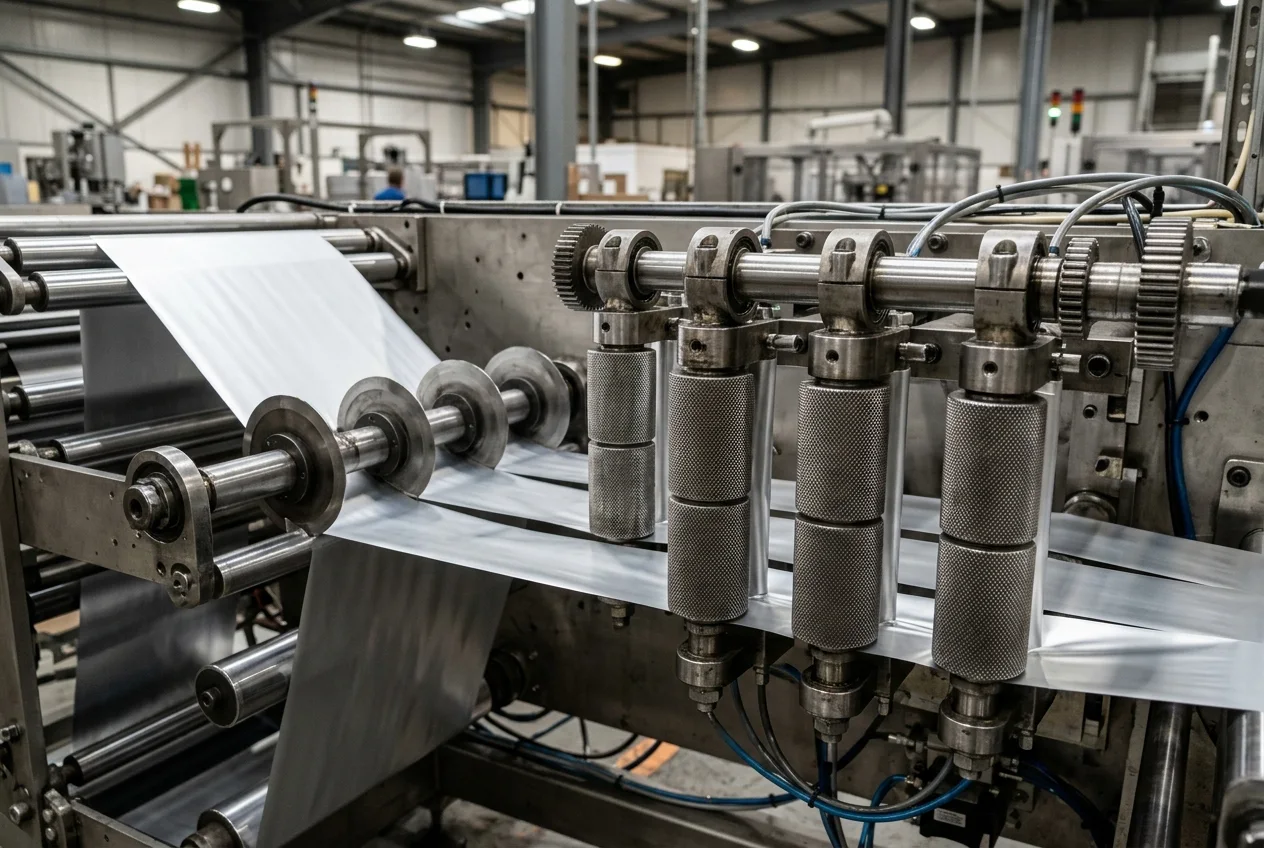
- Formula (3-Side vs. 4-Side Slit Strip Width & Multi-Lane Parent Web Width): For a 3-side-seal folded sachet, W_strip_3side (mm) = (2 * W_sachet) + S_fold_ allowance ( typically 2 * W_sachet when the side seal is included inside the finished flat width W_sachet, plus 2–4 mm fold tracking allowance). For a 4-side-seal sachet slit from a single master roll, each lane requires front and back panels of width W_sachet, so W_strip_4side (mm) = 2 * W_sachet, and total parent web width is W_web (mm) = (N_lanes * 2 * W_sachet) + E_trim, where E_trim (15–25 mm) is the outer edge-guiding/trim margin. Furthermore, the usable internal fill pocket width on a 4-side-seal sachet is W_cavity_4side (mm) = W_sachet - (2 * b_side), where b_side (6–10 mm) is each vertical side-seal border width.
- Worked Example (Parent Web Width & Frame Step-Up): Suppose you are quoting a W_sachet = 60 mm wide × L_sachet = 90 mm long 4-side-seal powder or sauce sachet across N_lanes = 6 lanes with E_trim = 20 mm outer web margin and b_side = 7 mm vertical side seals (W_cavity_4side = 60 - 14 = 46 mm active fill cavity). Each lane consumes W_strip_4side = 2 * 60 = 120 mm of parent film, requiring a master roll width of W_web = (6 * 120) + 20 = 740 mm. Because 740 mm exceeds the 700 mm max film-width ceiling of an LV-700SF or LV-700SY frame, running 6 full lanes of a 60 mm sachet requires stepping up to the LV-980SF or LV-980SY (980 mm max film width) frame—or running 5 lanes (W_web = 5 * 120 + 20 = 620 mm <= 700 mm) on an LV-700SF/SY frame.
- Formula (Multi-Lane Net Accepted Output & Minimum Active Lane Count): Q_gross (sachets/min) = N_cpm * N_lanes, Q_net (accepted sachets/min) = N_cpm * N_lanes * OEE_line * (1 - R_splice - R_reject), and N_lanes_min = ceil(Q_target / [N_cpm * OEE_line * (1 - R_splice - R_reject)]), where N_cpm is sustained knife cycles per minute (cuts/min), OEE_line is shift availability across film splices and hopper refills, R_splice is startup/registration cut loss, and R_reject is seal or weight reject fraction.
- Worked Example (Sizing Lane Count from Target Output): If your contract requires Q_target = 180 accepted sachets/min (10,800 good sachets/hr) on a 15 mL ketchup or shampoo 4-side-seal sachet running at a sustained N_cpm = 28 cuts/min (within our 20–40 cuts/min series baseline), with line availability OEE_line = 0.86, splice loss R_splice = 0.02 (2.0%), and reject rate R_reject = 0.01 (1.0%): each lane delivers 28 * 0.86 * (1 - 0.03) = 23.36 accepted sachets/min/lane, requiring N_lanes_min = ceil(180 / 23.36) = 8 lanes—quoted on an 8-lane LV-700SY (for sachet widths <=55 mm, W_web <= 900/700 mm) or LV-980SY (980 mm web) configuration yielding Q_net = 187 accepted sachets/min (11,210 good sachets/hr).
Engineering Rule-of-Thumb (3-Side Folded vs. 4-Side Opposed-Web Sachet Selection Threshold): If finished sachet width W_sachet is below 50 mm (specifically 17–49 mm on liquid/sauce LV-400Y / 680Y / 980Y or 25–49 mm on powder/granule LV-400F / 680F / 980F and K series) → prioritize a 3-side-seal V-plow folding frame over a 4-side-seal frame because placing two 7–8 mm vertical side seals onto a <45 mm dual-web sachet consumes over 35% of the package width and starves the fill cavity; conversely, if W_sachet is 50–125 mm (LV-500SF / 700SF / 980SF or LV-500SY / 700SY / 980SY) or the brand requires flat symmetrical front/back graphics and uniform medical/cosmetic peel borders → prioritize a 4-side-seal opposed-web frame.
Just as on stick pack equipment, changing sachet length (50–150 mm on F/K, 50–180 mm on Y/LV-350X, or 45–160 mm on SF/SY/SK) is handled on the HMI via servo film-pull length and photo-eye registration. Changing sachet width, however, changes W_strip across every lane—requiring repositioned rotary slitter blades, re-spaced vertical side-seal roller rings, new folding plows or filling-nozzle centerlines, and matched discharge chutes. See our how to choose a sachet packing machine guide and spare and change parts page to scope multi-width change kits upfront.
Step 2 — How does product rheology dictate the multi-lane dosing head, hopper and safety scope?
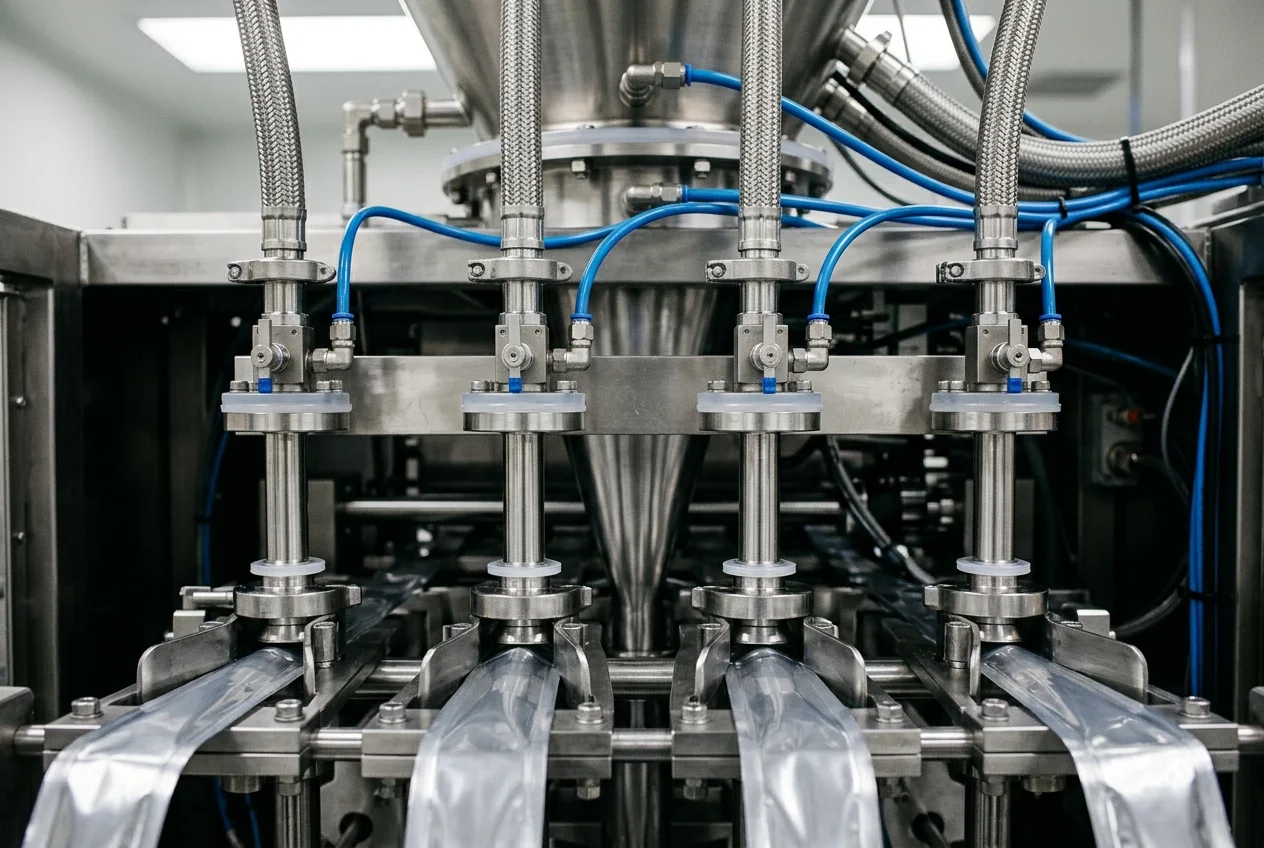
The dosing assembly is the highest-precision mechanical sub-system in a sachet packing machine price breakdown. On a multi-lane sachet machine, the filler must meter an exact gram or milliliter dose into all N_lanes open pouches during the brief dwell window between horizontal cross-seal cycles without splashing liquid, stringing paste, or lofting powder dust onto the 6–10 mm sealing borders. LINEVO separates its sachet catalog into dedicated product branches—F / SF servo auger series for fine powders, Y / SY and LV-450X piston/lobe pump series for liquids, sauces and creams, and K / SK and LV-350X volumetric series for granules:
| Product class & LINEVO baseline series | Dosing mechanism & reference parameters | Auxiliary scope items to verify in quote | Dominant field failure mode & mechanical prevention |
|---|---|---|---|
| Viscous sauces, condiments & particulate pastes (LV-400Y/680Y/980Y 3-side & LV-500SY/700SY/980SY 4-side; ketchup, mustard, BBQ, mayonnaise, honey, sports gel) | Independent piston pumps or rotary-valve/lobe pumps per lane; our LV-500SY/700SY/980SY ketchup configuration covers a 5–100 mL fill range (extendable up to 500 mL); 20–40 cuts/min across 2–16 lanes | Double-walled water/oil-jacketed heated hopper with scraper agitator, pneumatic suck-back anti-drip nozzles, anti-clogging particulate valves, and CIP-ready quick-release tri-clamp manifolds | Failure mode: Viscoelastic sauce tail stringing or mustard seed particulates bridging across the horizontal cross-seal zone, creating oil channels that burst under squeezing pressure. Prevention: Mandate per-lane pneumatic shut-off nozzles with active suck-back retraction, rotary-valve shear cutoff for particulates, and jacketed hopper temperature control. |
| Cosmetic lotions, facial creams and serums & foaming shampoos (LV-450X 4-lane cosmetic configuration & multi-lane shampoo configurations) | Precision servo/pneumatic piston pumps; our LV-450X (/products/4-lanes-cosmetic-lotion-small-bag-filling-machine-multi-lines-facial-cream-sachet-packing-machine) covers a 1–30 mL fill range, 15–60 mm width × 50–160 mm length, <=480 mm film, 0.6–0.8 MPa air at 0.35 m3/min | Anti-foaming bottom-up/submerged nozzle tips for high-surfactant shampoo, suck-back valves for thick creams, SUS316L wetted contact parts option, and recipe memory on HMI | Failure mode: Surfactant micro-foam rising into the top seal nip during shampoo dosing, causing blistered or incomplete ASTM F1921 hot-tack seals. Prevention: Specify low-shear anti-foaming dosing profiles, submerged/low-velocity nozzle tips, and a pressurized constant-head supply tank without air entrainment. |
| Alcohol-based hand sanitizers & flammable topical liquids (4-lane 4-side seal sanitizer & anti-explosion safety configurations) | Multi-lane positive-displacement piston pumps; our 4-lane hand sanitizer configuration covers a 1–50 mL fill range, 30–80 × 50–160 mm sachet size, and <=400 mm film width | Hazardous-area electrical package (Ex d / ATEX / NFPA 70 Class I Div 1/2 motors and junction boxes), intrinsically safe photo-eyes, static-dissipative web grounding, and vapor exhaust hood | Failure mode: Ignition hazard from electrostatic charge buildup on unwinding polymer laminate in the presence of 60–80% ethanol/IPA vapor, or alcohol swelling standard LDPE sealant layers. Prevention: Specify certified explosion-proof electrical components, active ionizing static bars, solvent-resistant elastomers (PTFE/FFKM), and chemical-compatible ionomer/copolymer inner sealants. |
| Fine, dusty or cohesive powders (LV-400F/680F/980F 3-side & LV-500SF/700SF/980SF 4-side; protein, pharma powder, probiotics, coffee, matcha, spices) | Multi-lane vertical servo auger fillers extending into the sachet forming pocket; 25–110 × 50–150 mm (F) or 50–125 × 45–160 mm (SF); machine height 2,550–3,100 mm | Independent per-lane servo auger trim, slow-speed hopper de-bridging agitator, vacuum dust-extraction shroud at nozzle/jaws, nitrogen gas flushing, and overhead screw/vacuum loader | Failure mode: Airborne powder dust coating the inner sealant surface before horizontal jaw closure, dropping ASTM F88 peel strength by >50% and causing powdery seal leaks. Prevention: Require enclosed bottom-of-pouch auger tubes with mechanical shut-off cones, negative-pressure vacuum extraction at the cross-jaws, and anti-static ionizing air knives. |
| Free-flowing granules, salts & drink crystals (LV-400K/680K/980K 3-side, LV-500SK/700SK/980SK 4-side, LV-350X & 4-lane beverage granule configurations) | Multi-lane volumetric telescopic cups or rotary metering gates; our 4-lane solid beverage granule configuration covers 1–30 g (20–60 × 50–180 mm, <=420 mm film); our LV-350X (/products/ds-350x) covers 1–50 g (30–80 × 50–180 mm) | Granule supply hopper with level sensor, vacuum/bucket granule elevator, vibratory flow assist, and quick-adjust telescopic volume plates | Failure mode: Late-falling sugar or salt crystals bouncing into the closing cross-seal jaws, crushing hard crystals through the aluminum foil barrier and creating pinholes. Prevention: Advance volumetric gate cutoff 120–180 ms ahead of cross-jaw closure and size sachet length L_sachet with >=20 mm of clear headspace above the settled fill. |
Engineering Rule-of-Thumb (Viscous Sauce / Cream Stringing & Pneumatic Suck-Back Nozzle Threshold): If liquid or paste viscosity exceeds 1,500 cP at filling temperature (such as tomato ketchup, mayonnaise, honey, cosmetic facial cream on LV-450X, or energy gels on LV-500SY / 700SY / 980SY) or carries solid particulates larger than 1.5 mm (such as whole-grain mustard or relish) → prioritize independent per-lane piston or rotary-valve lobe pumps equipped with pneumatic anti-drip suck-back nozzles and a double-walled jacketed heated agitator hopper over gravity or basic check-valve fillers because drawing the terminal fluid meniscus 2–4 mm back into the nozzle tip at stroke completion keeps oil, sugar and seed strings off the 6–10 mm horizontal seal band.
Engineering Rule-of-Thumb (Dusty Powder Trim & Hazardous Alcohol Vapor Mitigation Threshold): If dry powder contains >15% fine particles smaller than 75 microns or exhibits >±6% bulk-density drift across 6 or more lanes (LV-680F / 980F or LV-700SF / 980SF) → prioritize independent per-lane servo auger drives paired with a jaw-zone vacuum dust-extraction manifold so outer-lane weights can be trimmed on the HMI without stopping the line; conversely, if a liquid formula contains >50% v/v ethanol or isopropanol (such as 60–80% alcohol hand-sanitizer sachets) → mandate hazardous-area explosion-proof electricals, grounded static-elimination bars, and vapor extraction in your initial RFQ specification.
Compare product-specific configurations across our multi-lane powder stick pack and sachet guide (protein powder servo auger sachets, high-precision pharmaceutical powder sachets, and modular quick-change nutraceutical sachets) and our liquid and sauce stick pack and sachet guide (LV-500SY 4-side-seal ketchup sachets, sanitary anti-drip ketchup sachets, mustard sachets for particle-rich sauces, shampoo sachets with anti-foaming dosing, sports gel sachets, and hand-sanitizer sachets with hazardous-area review).
Step 3 — Which sealing standards, film structures, coding units and format parts require itemized quote lines?
A flat 4-side-seal sachet is bounded by two continuous vertical side seals and two intermittent horizontal cross-seals, creating four 4-layer corner intersections on every pouch (or two 3-layer corners on a folded 3-side-seal sachet). When packaging aggressive condiment acids (pH 3.2–4.2), essential oils, alcohol sanitizers or fine nutraceutical powders, visual inspection alone cannot verify hermetic seal integrity. Anchor your quotation's Factory Acceptance Testing (FAT) clause to internationally recognized flexible-packaging test standards:
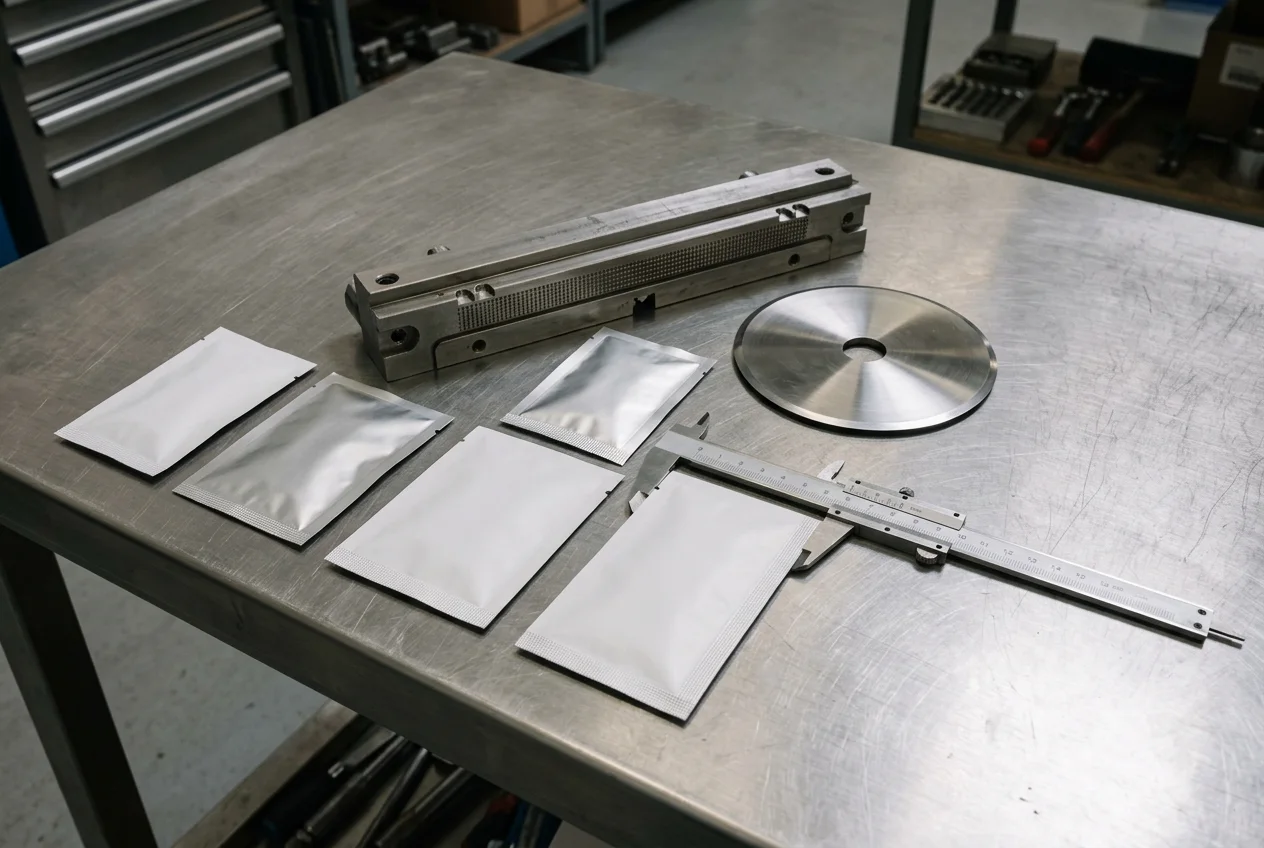
- ASTM F1921 / F1921M (Hot-Tack Strength of Thermoplastic Sealing Surfaces): Measures the immediate peel resistance of the molten bottom horizontal cross-seal within milliseconds of jaw opening—while the incoming liquid slug or powder charge impacts the freshly formed seam. Laminates with metallocene LLDPE (mLLDPE) or ionomer inner sealants provide broader hot-tack windows at 25–40 cuts/min than standard LDPE.
- ASTM F88 / F88M (Cooled Seal Peel Strength) & ASTM F1140 / F2054 (Whole-Sachet Burst/Creep): Under ASTM F88, cooled peel force across the vertical side seals and horizontal end seals is measured on a 15 mm or 25.4 mm (1.0 in.) strip at 200–300 mm/min crosshead speed under unsupported (Technique A), 90-degree (Technique B) or 180-degree (Technique C) tail orientation. Pair ASTM F88 with ASTM F1140 internal air pressurization burst/creep testing or vacuum chamber dye-penetration testing across all lanes (1 through N) to verify corner seal integrity (see how long ketchup and condiment packets last).
- ISO 11607-1 / 11607-2 & FDA 21 CFR 177.1520 Compliance Baselines: Medical, pharmaceutical and unit-dose cosmetic sachets validated under ISO 11607-2 require calibrated monitoring and alarm interlocks on the three critical sealing parameters—temperature, dwell time and jaw/roller pressure (IQ/OQ/PQ). For food and dietary supplement sachets, the inner polyolefin heat-sealant layer (LLDPE, mLLDPE, CPP) in laminates such as PET/AL/LLDPE, OPP/CPP, KOP/CPP, PT/PE or Paper/PE must comply with FDA 21 CFR 177.1520 food-contact extractable limits.
| Option or specification line | Buyer engineering input | What the quotation must state in writing | Dominant field failure mode & mechanical prevention |
|---|---|---|---|
| Wetted contact metallurgy & CIP / washdown fittings (SUS304 vs. SUS316L) | Sauce acidity (pH), salt/brine concentration, cosmetic actives, and dry brush vs. wet CIP washdown SOP | Exact stainless alloy (SUS304 standard vs. SUS316/316L option as on LV-450X) for hopper, pump pistons/rotors, nozzles and manifolds, plus quick-release sanitary clamps | Failure mode: Chloride pitting corrosion on 304 stainless from high-salt soy/ketchup/brine sauces or 2-hour manual wrench teardowns between flavor runs. Prevention: Specify SUS316L wetted contact parts and quick-release tri-clamp manifolds with CIP recirculation loops. |
| Vertical side-seal rollers & horizontal cross-seal jaw profile | Laminate structure/gauge (e.g., PET/AL/PE vs. Paper/PE), side-seal width b_side (6–10 mm), and knurl pattern (diamond, linear or flat) | Independent PID temperature loops per roller pair and cross-jaw zone, knurl engraving pitch, and pneumatic vs. servo jaw actuation | Failure mode: Delamination or foil cracking at the 4-layer corner junction where vertical rotary side-seals pass through the horizontal cross-jaws. Prevention: Machine relief grooves or matched serration pitch at the cross-jaw intersections and specify independent PID temperature control on side rollers and cross-jaws. |
| Knife cut style, tear notch, duplex perforation & shaped dies | Single separated sachets vs. twin/duplex perforated strips, straight vs. zigzag pinking cut, tear notch, or directional pour-spout contour | Included cutter mechanism (flat rotary shear, zigzag anvil, micro-perforation blade for twin packs, or contoured die punch) and tear-notch punches across all lanes | Failure mode: Ragged foil burrs, unsevered laminate strings or drifted tear notches across 8–16 lanes when guillotine blades wear unevenly. Prevention: Specify hardened tool-steel (D2 / SKD11 or carbide) shear knives with individual lane anvil pressure adjustment. |
| Multi-lane batch/expiry coding (Multi-head TIJ, traversing TTO, laser, or hot-foil/embossing) | Lot/expiry format, characters per line, 2D barcode need, print zone coordinates on each sachet, and parent web width (400–980 mm) | Coder type (ribbon printer, TTO, inkjet or laser marker as listed on 4-lane granule & SY configurations), multi-lane gantry/head count, and fume extraction | Failure mode: Quoting a single-lane ribbon printer that prints only Lane 1 while Lanes 2 through N run uncoded. Prevention: Verify in writing that the quoted coder spans all active lanes simultaneously via a traversing TTO gantry, multi-head TIJ array, or wide-field scanning laser. |
| Additional sachet width change parts & printed-film registration | Every sachet width × length SKU on your roadmap, plus eye-mark contrast and repeat pitch on printed rollstock | Photoelectric registration sensor (standard on LV-500SY), rotary slitter blade holders, side-seal roller spacing collars, and forming plows for each listed width | Failure mode: Ordering a machine for 50 mm and 80 mm wide sachets assuming width is a touchscreen recipe adjustment. Prevention: Itemize separate forming plow, nozzle-pitch spacer and side-seal roller change kits for every finished sachet width in the initial purchase order. |
Step 4 — How do rollstock consumption, changeover downtime and downstream cartoning shape 5-year TCO?
Headline machine price represents only 20% to 35% of the 5-year Total Cost of Ownership (TCO) of a multi-lane sachet packaging line. Once running at 8 to 16 lanes (160 to 640+ sachets/min), three operational cost drivers dominate your plant budget: annual rollstock laminate consumption, CIP washdown and width-changeover downtime, and downstream counting and cartoning labor. Use the equations below to model your 5-year line economics:
- Formula & Worked Example (4-Side-Seal Effective Cavity Width & Rollstock Film Consumption per Million Sachets): W_cavity_4side (mm) = W_sachet - (2 * b_side), A_sachet (mm^2) = 2 * W_sachet * L_sachet, and M_film (kg per 10^6 sachets) = 10^6 * (A_sachet * 10^-6) * rho_areal / (1 - R_trim_scrap). For a 60 × 90 mm 4-side-seal condiment or powder sachet with b_side = 7 mm vertical side seals (W_cavity_4side = 60 - 14 = 46 mm usable fill pocket width), each sachet consumes A_sachet = 2 * 60 * 90 = 10,800 mm^2 (0.0108 m^2) of laminate. Running a 105 g/m^2 (rho_areal = 0.105 kg/m^2) PET/AL/LLDPE barrier film with R_trim_scrap = 0.04 (4.0% edge-trim and splice waste), every 1,000,000 sachets consumes 1,000,000 * 0.0108 * 0.105 / 0.96 = 1,181.25 kg of film (17,719 kg/year at 15,000,000 sachets/year). If a poorly tracked machine requires widening the sachet from 60 mm to 64 mm just to prevent side-seal wander, film consumption jumps by 6.67%—wasting 1,181 kg/year (5,906 kg over 5 years) in barrier laminate alone.
- Formula (5-Year Washdown Changeover & Seal-Leaker Operating Delta): Delta_hours_5yr = 5 * N_clean_yr * (T_clean_A - T_clean_B) and Delta_leakers_5yr = 5 * Q_annual * (R_leaker_A - R_leaker_B), where N_clean_yr is annual allergen/flavor washdowns, T_clean_A - T_clean_B is hours saved per teardown via quick-release sanitary clamps and CIP loops, Q_annual is annual volume (sachets/yr), and R_leaker_A - R_leaker_B is seal-contaminated leaker reduction from suck-back nozzles or jaw dust hoods.
- Worked Example (Quote A vs. Quote B 5-Year Operating Delta): Compare Quote A (an 8-lane sauce sachet proposal using bolted pump manifolds requiring T_clean_A = 1.75 hr [105 min] per washdown and omitting pneumatic suck-back nozzles, yielding R_leaker_A = 2.0% sauce-stringing leakers) against Quote B (quick-release sanitary tri-clamp manifold requiring T_clean_B = 0.50 hr [30 min] per washdown plus pneumatic suck-back nozzles, yielding R_leaker_B = 0.35%). Across N_clean_yr = 180 washdowns/year and Q_annual = 10,000,000 sachets/year, Quote B eliminates 225 hours/year of sanitation downtime (1,125 production hours over 5 years) and prevents 165,000 rejected sachets/year (825,000 sachets over 5 years). Multiply those saved line hours and saved sachets by your plant's burdened hourly line rate and unit sachet cost to evaluate the true 5-year TCO.
Engineering Rule-of-Thumb (Manual Pack-Off vs. Synchronized Cartoner Collation Threshold): If net multi-lane output Q_net exceeds 140–180 flat sachets/min (typically 6 to 10+ lanes running at 25–35 cuts/min) or retail display cartons require exact counts (10, 12, 24 or 50 sachets/box) → prioritize quoting an automated multi-lane counting/stacking collation conveyor and horizontal cartoning machine in the initial line layout over manual chute catching because flat sachets shingle and stick together when dumped hot into bulk bins, and manual counting above 160 sachets/min requires 4–5 operators per shift.
| TCO & line-boundary category | What low-headline quotes frequently omit | Plant-floor operational & financial impact | Verification & LINEVO scope link |
|---|---|---|---|
| Upstream product feeding, heating & level control | Prices only the machine top hopper; omits the vacuum powder loader, screw elevator, or jacketed heated liquid supply tank and transfer pump | Manual bucket loading atop a 2,550–3,100 mm frame causes head-pressure swings and ±8–12% dose weight drift across outer lanes | Review feeder scope on the multi-lane powder and liquid and sauce application guides |
| Per-lane dosing trim, suck-back & CIP sanitation | Uses a shared mechanical drive shaft across all lanes, standard check valves that drip, and bolted manifolds requiring wrenches to clean | Outer-lane dose drift cannot be trimmed on the HMI; sauce/cream stringing contaminates seals; washdowns take 90–120 minutes | Specify independent lane trim, suck-back nozzles and quick-release sanitary clamps on sachet packing machines |
| Format width change parts & slitter/jaw wear spares | Covers only one sachet width and excludes spare rotary slitter blades, heater cartridges, thermocouples, PTFE tape and pump O-rings | Running a second sachet width requires a full multi-lane plow/spacer kit; worn knives or seals halt all N lanes simultaneously | Itemize every SKU width and bundle a 12-month wear kit via spare and change parts and the sachet troubleshooting log |
| Downstream counting, shingling & cartoning automation | Ends at a single discharge conveyor with no seal cooling bar, per-lane reject gates, counting stackers or cartoner interface | Packing 200–400 flat sachets/min by hand requires 4–6 operators/shift; one leaking lane contaminates an entire bulk tote | Integrate downstream cartoning machines and cellophane overwrapping (or compare cup filling and sealing for rigid portion cups) |
| Sample testing, FAT seal validation & commissioning | Runs dry cycle checks on empty film instead of testing your actual sauce, cream, sanitizer or powder on production barrier rollstock | ASTM F1921 hot-tack blowouts, powder bridging or corner leaks are discovered only after delivery to your plant | Schedule sample-testing preparation and confirm on-site vs. remote installation and training |
Step 5 — Same-scope quote audit worksheet for Supplier A and Supplier B
Copy the two-part engineering scope worksheet below into your procurement spreadsheet. Send the identical shared basis—product rheology, target dose, dimensioned 3-side or 4-side sachet drawing, rollstock laminate data sheet and target net output (Q_net)—to both suppliers, then mark every row with one of five strict statuses (Included, Optional, Separately quoted, Excluded, or Unconfirmed) alongside the exact quotation clause:
| Scope line | Shared engineering specification to verify | Quote A: status & clause | Quote B: status & clause | Engineering question to resolve before comparing totals |
|---|---|---|---|---|
| Seal style, frame series & parent web width | 3-side seal (LV-400/680/980 F/Y/K) vs. 4-side seal (LV-500/700/980 SF/SY/SK, LV-450X, LV-350X), max film width (400–980+ mm), and active lanes N_lanes | Enter status & clause | Enter status & clause | Do both quotes specify the same seal style (3-side vs. 4-side), active lane count and parent web width with >=15 mm tracking margin? |
| Multi-lane dosing unit & per-lane adjustment | Servo augers (F/SF), piston/lobe pumps with suck-back nozzles (Y/SY/LV-450X), or volumetric cups (K/SK/LV-350X), plus per-lane weight/volume trim | Enter status & clause | Enter status & clause | Can each lane's dose be trimmed independently, and are suck-back or anti-foaming nozzles included for liquids/pastes? |
| Hopper conditioning, feeder & dust/explosion safety | Jacketed heated agitator hopper, floor-to-hopper vacuum/screw/pump feeder, jaw vacuum dust hood, OR Ex/ATEX hazardous-area package for alcohol | Enter status & clause | Enter status & clause | Is the upstream feeder included, does total height fit our ceiling (2,270–3,100 mm + feeder), and are dust or Ex rules met? |
| Initial format tooling & secondary width change kits | Slitter knives, V-plows or dual-web guides, vertical side-seal rollers and nozzle spacers for every listed sachet width × length | Enter status & clause | Enter status & clause | Which exact sachet widths are covered by base tooling, and what is the itemized price for each additional width change kit? |
| Cut pattern, tear notch, perforation & coding | Straight/zigzag/shaped knives, tear-notch punches, duplex perforation blades, photo-eye registration, and multi-lane laser/TTO/TIJ coder | Enter status & clause | Enter status & clause | Does the date coder print across all N_lanes simultaneously, and where does the code sit relative to the seal and tear notch? |
| Wetted metallurgy, CIP clamps & utility drops | SUS304 vs. SUS316L contact parts, quick-release tri-clamp CIP manifold, power (4.0–7.5 kW, voltage/Hz), and dry air (0.6–0.8 MPa, NL/min) | Enter status & clause | Enter status & clause | Are all wetted parts SUS316L where required, and what exact kW and compressed-air consumption must the plant provide? |
| Discharge cooling, lane reject & downstream cartoning | Cross-seal cooling air bar, individual lane chutes, single-lane reject gates, counting/shingling stacker, and synchronized horizontal cartoner | Enter status & clause | Enter status & clause | Where does the primary sachet machine hand off finished packs, and who supplies the counting/cartoning transfer and PLC handshake? |
| Project deliverable | Shared verification requirement | Quote A: status & clause | Quote B: status & clause | Verification question to close |
|---|---|---|---|---|
| Pre-order sample test on buyer product & film | Trial run using production batch powder/liquid/sauce and converter rollstock (shipped after quantity and address are agreed) to verify dosing and sealing | Enter status & clause | Enter status & clause | Is a sample trial with our actual product and film included or optional before freezing nozzle and seal geometry? |
| Pre-shipment FAT protocol & ASTM seal testing | Timed multi-lane run verifying Q_net, per-lane fill accuracy, ASTM F1921 hot tack, ASTM F88 peel strength, and ASTM F1140 burst across Lanes 1 to N | Enter status & clause | Enter status & clause | Are sachets sampled from every individual lane during FAT, and what written inspection report and video record are delivered? |
| On-site vs. remote commissioning & operator training | Unpack, position, connect utilities, safety check, dry run, film run, product run per format, and operator/maintenance training | Enter status & clause | Enter status & clause | Is commissioning on site or remote, and how many technician days, travel costs and training sessions are included in the total? |
| Recommended 12-month wear & spare parts package | Itemized spare list covering cross-sealing jaws, side-seal rollers, heating elements, thermocouples, rotary/cross cutting knives, and pump O-rings/seals | Enter status & clause | Enter status & clause | Does the offer include a configuration-specific wear-parts kit for slitting, forming, dosing and sealing assemblies? |
Cost planning for other packaging formats
Use a dedicated machine family and scope framework if your project involves one of these routes:
- Narrow tubular back-sealed stick packs (20–105 mm width, fin or lap back seal): Tubular stick packs formed around vertical tubes belong on the stick pack machines family page, the stick pack machine cost guide, and the stick pack vs. sachet comparison.
- Pre-converted stand-up doypacks, zipper bags and spouted pouches: Pre-made bags loaded from a magazine or spout rail use a different machine architecture; see premade pouch machines and the premade pouch machine cost guide.
- Leaf tea packed into an inner filter bag and outer envelope: Tea configurations dose tea into an inner bag and enclose it inside an outer envelope with nitrogen flushing and vibratory feeding; see the inner and outer bag tea packaging machine and our tea packaging guide.
- Large single-lane pillow, gusseted or quad-seal retail bags (100 g–5 kg): High-volume retail bags belong on vertical form fill seal (VFFS) machines.
- Single-lane benchtop or laboratory sealing units: All six LINEVO multi-lane sachet series (F, SF, Y, SY, K, SK) start at 2 lanes. State in your inquiry if you require a 1-lane pilot unit.
Frequently asked questions about sachet packing machine cost and scope
What drives the cost of a multi-lane sachet packing machine?
A multi-lane sachet machine's cost scales with seal architecture (3-side V-plow vs. 4-side dual-web rollers), parent web frame width (400–500 mm, 650–700 mm, or 950–980+ mm), active lane count (2 to 16 lanes), dosing filler (servo augers for powders, piston/lobe pumps with suck-back valves for sauces/creams, or volumetric cups for granules), and options like hazardous-area Ex electricals, laser coding and cartoning. We issue an itemized quotation once your shared project basis is defined.
How does a 3-side-seal sachet machine price compare with a 4-side-seal sachet machine?
At the same lane count, a 4-side-seal sachet machine (such as the LV-500SF/SY, LV-700SF/SY or LV-980SF/SY series, 650–1,000 kg) carries a higher mechanical scope than a 3-side-seal frame (LV-400F/Y, LV-680F/Y or LV-980F/Y, 500–800 kg) because 4-side sealing requires center-slitting and registering separate front and back webs, twice as many vertical side-seal roller rings per lane, and wider parent film frames (500/700/980 mm vs. 400/650–680/950–980 mm).
What drives a powder packing machine price for sachets compared with a liquid or sauce sachet machine?
Multi-lane powder sachet machines (LV-400F/680F/980F and LV-500SF/700SF/980SF) require precision vertical servo augers, hopper de-bridging agitation, jaw-zone vacuum dust extraction, static eliminators and taller frames (2,550–3,100 mm) to house the overhead auger drive. Liquid and sauce sachet machines (LV-400Y/680Y/980Y, LV-500SY/700SY/980SY and LV-450X) require positive-displacement piston or lobe pumps, pneumatic suck-back or anti-foaming nozzles, double-walled heated agitator hoppers and SUS316L CIP manifolds.
Does changing finished sachet width or length require buying change parts?
Changing sachet length within the series window (50–150 mm on F/K, 50–180 mm on Y/LV-350X, or 45–160 mm on SF/SY/SK) is an HMI servo film-pull and photo-eye registration adjustment requiring zero mechanical parts. Changing finished sachet width alters the slit strip width W_strip on every lane—requiring repositioned slitter knives, new V-plow folders or side-seal roller spacing collars, adjusted nozzle pitch and matched chutes. List all target widths in your initial RFQ.
What extra scope is required when quoting an alcohol hand-sanitizer sachet machine?
Formulas containing 60–80% ethanol or isopropanol generate flammable vapor in the dosing and heat-sealing zone. Your quotation must explicitly itemize hazardous-area electrical components (explosion-proof motors, heaters and enclosures rated to your facility's ATEX / IECEx / NFPA 70 classification), active web static-elimination bars, local vapor extraction, and solvent-compatible inner sealant validation.
When should our sachet machine budget include automatic counting and cartoning?
Whenever net accepted output exceeds 140–180 flat sachets/min (typically 6 or more lanes at 25–35 cuts/min) or retail boxes require exact counts (10, 12, 24 or 50 sachets/carton). Flat sachets shingle and stick if dropped warm into bulk totes; adding a cross-seal cooling air bar, single-lane reject gates, a counting/stacking conveyor and a synchronized horizontal cartoner eliminates 4–5 manual packers per shift.
What to send, and what happens next
Send your completed scope worksheet—or your product details, finished sachet drawing, laminate structure and target shift output—through the project brief checklist or WhatsApp below. Mark any undecided item as open. Our engineering team reviews your brief to recommend the exact 3-side (F / Y / K) or 4-side (SF / SY / SK / LV-450X / LV-350X) series, frame width, active lane count and dosing head, and confirms whether a sample test is needed before issuing an itemized quotation.
Always agree the trial product and film quantities and the receiving address with our team before shipping any physical samples.
Sources
LINEVO equipment specifications and project service boundaries in this guide cover our sachet packing machines (LV-400F / 680F / 980F 3-side powder series, LV-500SF / 700SF / 980SF 4-side powder series, LV-400Y / 680Y / 980Y 3-side liquid/sauce series, LV-500SY / 700SY / 980SY 4-side liquid/sauce series, LV-400K / 680K / 980K and LV-500SK / 700SK / 980SK granule series across 2–16 lanes, 17–125 mm sachet widths, 45–180 mm lengths, 400–980 mm max film widths, 20–40 cuts/min, 4.0–7.5 kW, and 500–1,000 kg), our multi-lane powder stick pack and sachet guide, our liquid and sauce stick pack and sachet guide, the LV-450X cosmetic lotion configuration (/products/4-lanes-cosmetic-lotion-small-bag-filling-machine-multi-lines-facial-cream-sachet-packing-machine), the LV-350X granule configuration (/products/ds-350x), our project brief checklist, and our sample testing, installation and training and spare parts programs.
Industry comparison benchmarks, web-width scaling, and seal validation protocols reference Matrix / INVpack MVA Series (MVA4 EVO 400 mm web / 1–5 lanes, MVA9 EVO 900 mm web / 3–10+ lanes, MVA12 1,200 mm web / 4–15 lanes, up to 70 cycles/min) and TL6 horizontal top-load cartoner specifications (60 cartons/min, 2,500 kg, 6 bar air); Viking Masek SA300 multi-lane 4-side-seal sachet specifications (1–6 lanes, 40–250 mm sachet width, 6.8–8.0 kVA, 30 CFM at 6 bar); Mespack ML (intermittent) and MLC (continuous) multi-lane 4-side-seal sachet specifications (4–14 lanes, up to 1,000–1,200 mm web width); ProFill and Rovema NA 3-side and 4-side-seal sachet engineering notes; ASTM F1921 / F1921M (Hot Tack Strength of Thermoplastic Sealing Surfaces); ASTM F88 / F88M (Flexible Barrier Seal Peel Strength at 200–300 mm/min); ASTM F1140 / F1140M and ASTM F2054 (Whole-Package Internal Pressurization Burst and Creep Resistance); ISO 11607-1 / 11607-2 (Packaging Seal Process Validation); and FDA 21 CFR 177.1520 (Olefin Polymers for Food-Contact Sealant Layers).
What to send us
Send what you have and mark what is still undecided. Discuss your application with LINEVO.
| Item | Why we need it | Example format |
|---|---|---|
| Product rheology, density or viscosity & safety data | Selects the F/SF servo auger, Y/SY/LV-450X piston/lobe pump with suck-back nozzles, or K/SK volumetric filler, plus Ex review for alcohol | Powder bulk density & fines %, granule size, or liquid viscosity (cP) at filling temperature; SDS for alcohol sanitizers |
| Seal style & finished sachet width × length drawing | Selects 3-side (17–110 mm) vs. 4-side (50–125 mm) series, calculates parent web width W_web, and scopes width change parts | 3-side or 4-side seal, 60 × 90 mm with 7 mm side seals, tear notch or duplex perforation, and sample sachets |
| Rollstock laminate structure & reel specifications | Sets rotary side-seal roller pressure, PID cross-jaw dwell, ASTM F1921/F88 seal parameters and unwind shaft dimensions | Laminate spec (e.g., PET/AL/LLDPE 90 um, FDA 21 CFR 177.1520 inner sealant), eye-mark layout, and max reel OD/core ID |
| Target dose per sachet & net shift output (Q_net) | Determines pump cylinder or auger screw sizing, active lane count N_lanes (2–16 lanes), and frame class (400/500, 680/700 or 980) | 15 mL or 5 g per sachet; target accepted sachets/min or per 8-hr shift (e.g., 180 good sachets/min) |
| Contact metallurgy, coding, dust/CIP & change parts | Itemizes SUS316L wetted parts, quick-release CIP manifolds, vacuum dust hoods, multi-lane laser/TTO coders and extra SKU kits | SUS304 vs. SUS316L requirement, washdown SOP, code format/position, and all secondary sachet widths to price |
| Upstream feeding, downstream cartoning & site limits | Scopes floor-to-hopper loaders, cross-seal cooling bars, counting/cartoning integration, ceiling height and utilities | Clear ceiling height (mm), 220V/380V/480V power, 0.6–0.8 MPa dry air, and loose discharge vs. 10/24/50-count carton spec |