
On this page
Identify the machine and part
Provide the machine nameplate, model, serial number and configuration revision where available. Include a clear component photo, part marking and its function on the machine.
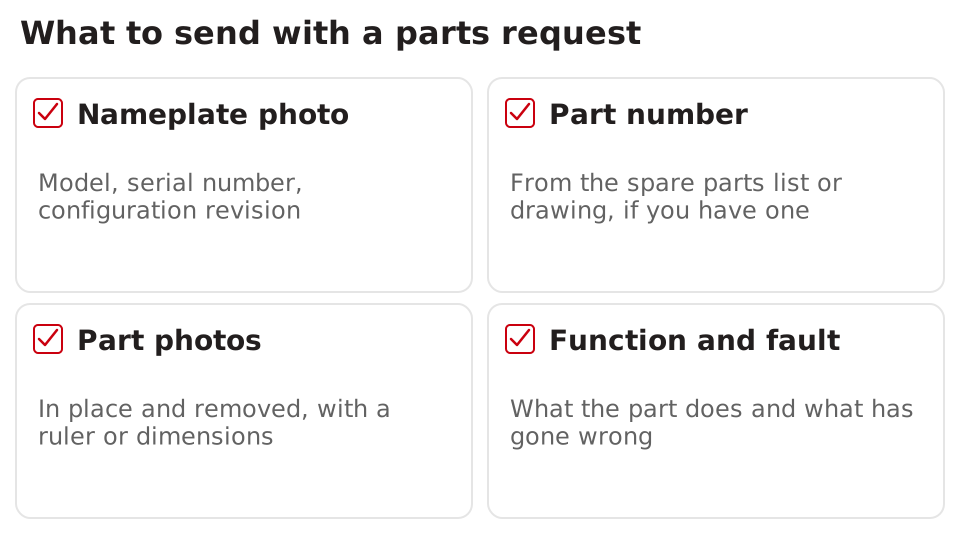
- A photo of the nameplate
- The part number from the spare parts list or drawing, if you have one
- Photos of the part in place and removed, with a ruler or dimensions
- What the part does and what has gone wrong with it
Main parts, wear parts and change parts by machine type
Use the machine type below to identify the main assembly, wear items and format parts. Our team checks the part against your model, serial number and drawings before preparing the parts recommendation.
| Machine type | Main assemblies | Typical wear parts | Change parts for a new format |
|---|---|---|---|
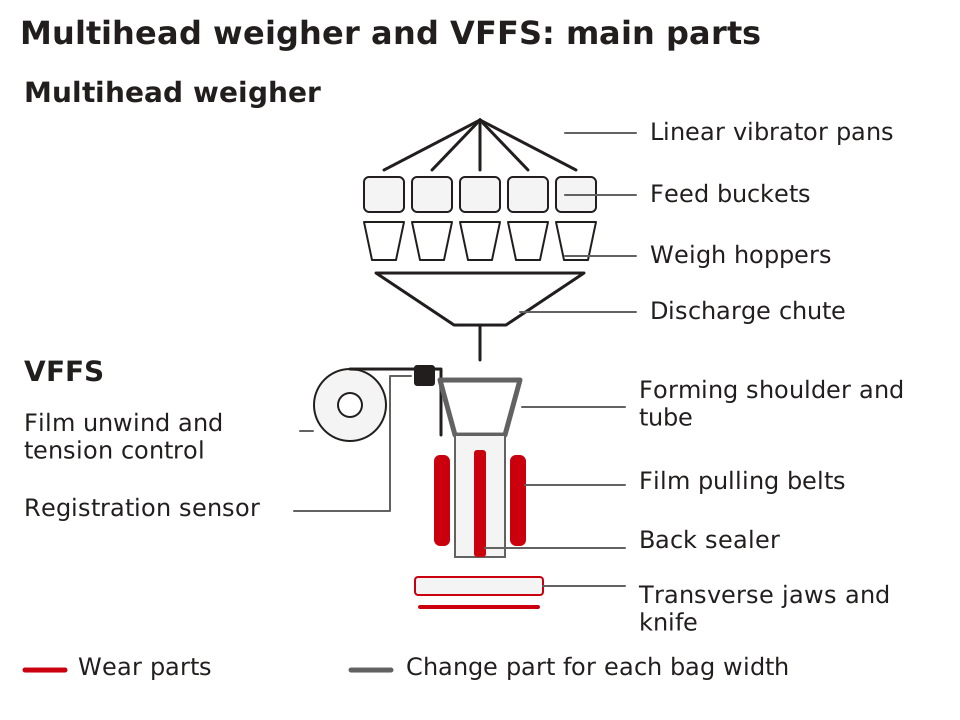
| Vertical form fill seal (VFFS) | Film unwind and tension control, registration sensor, forming shoulder and tube, film pulling belts, back sealer, transverse jaws and knife | Sealing jaws, heating elements, PTFE sealing cloth or tape, knives, pulling belts | A forming set for each bag width |
| Multihead weigher | Linear vibrator pans, feed buckets, weigh hoppers on load cells, collection and discharge chutes | Identify from the machine serial number and parts drawing | Contact parts with dimpled or coated surfaces for sticky products, where the product needs them |
| Auger filler | Product hopper, with an agitator where fitted, and a servo-driven dosing screw in a closed vertical channel | Identify from the machine serial number and parts drawing | Screw tooling, which depends on the powder |
| Multi-lane stick pack and sachet | Film slitting into lanes, forming for each lane, auger or pump dosing for each lane, cross-sealing jaws, cutting | Sealing jaws, heating elements, cutting knives, seals and O-rings in pumps and nozzles | Lane arrangement and cutting parts when the width changes |
| Premade pouch | Pouch magazine, grippers, opening by suction and air, filling station, top sealer | Suction cups, sealing parts | Grippers adjusted or changed for each pouch width |
| Flow wrapper | Infeed conveyor with pushers, film unwind, forming box, fin seal wheels, rotary end-seal jaws | Sealing parts, cutting knives, belts | A forming box for a product of a different cross-section |
| Cartoner | Carton magazine, carton erecting, carton chain, product buckets, pusher or pick-and-place loading, leaflet unit where fitted, flap closing | Suction cups that pick the flat blank | Carton chain, product bucket and folding guide parts for each carton size |
| Cellophane overwrapper | Film unwind and tear tape reel, folding plates, heat sealing of the side seam and ends, heated finishing belts or plates | Suction cups, sealing parts | Change parts and adjustments for each box size |
| Labeler | Container conveyor, label unwind and application, with guides that hold the container | Select wear items against the labeling station and machine parts list | Guides or holding parts for a new container or label |
Coffee and snack packaging machine parts
A coffee or snack bagging line combines rows from the table. Whole beans and snacks are usually weighed by a multihead weigher above a VFFS machine, and ground coffee is dosed by an auger filler, so the parts list covers the bagger plus that dosing unit. Optional devices such as a degassing valve applicator, gas flushing or date coding add their own parts, so include them when you ask for a spare parts list.
Wear parts to plan for
Some parts wear in normal use and are best kept in stock at the site. Which ones apply depends on the machine; typical examples are listed below.
- Heat-sealing jaws, heating elements, temperature sensors and PTFE sealing cloth or tape
- Cutting knives and perforation blades
- Film pulling belts and conveyor belts
- Suction cups on pouch fillers, cartoners and overwrappers
- Seals and O-rings in pumps, pistons and nozzles
- Springs, bearings and fuses
Agree a recommended spare parts list
Ask for a recommended spare parts list with the quotation. Decide which items to keep on site from the start, taking into account how many shifts the machine runs, how long parts take to reach your site and which parts can be sourced locally.
Treat a new format as a configuration review
A change in bag, pouch or container dimensions can affect more than one component. Share the new material and dimensions so forming, feeding, dosing and sealing interfaces can be reviewed together, and see our packaging change-part carts and format kits checklist.
- VFFS: a new bag width usually needs a new forming set
- Stick packs and sachets: a new width can change the lane arrangement and cutting parts
- Premade pouches: a new pouch size can need new grippers or settings
- Cartoning and overwrapping: a new carton size needs its own change parts and settings
- Labeling: a new container or label can need new guides or holding parts
Change-part kits, storage carts and format handover
A format kit is the agreed set of removable parts for a particular machine and packaging format; the cart stores and moves that set, and a shadow board assigns visible locations to its components. On a cartoner, some components are exchanged, some remain installed and are adjusted, and others are shared across jobs, so the machine's format list should identify each category. Durable storage for packaging line change parts starts at the contact points because a rigid cart can still damage a part if a holder bears against a sensitive mating face or allows adjacent parts to strike each other.
A shadow board helps reveal an empty storage position, whereas physically excluding a similar wrong part requires a holder or mounting feature designed and checked for that task. During production, empty positions on a board may be correct because their parts are installed; record the kit state at handover, account for shared parts separately, and reconcile any returned kit with an unexplained empty position before marking it ready. In SMED staging, before the planned stop, confirm the next format, account for required and shared parts, review condition, and prepare the setup reference; after handover, reconcile returned parts, record cleaning or inspection needs, and update kit availability.
To review format-change storage and changeover requirements, send the machine and format-parts list, each part's mass and support needs, target changeover time, and shared tooling and route details. When reviewing cart movement and route requirements, compare the total loaded envelope, individual holder loads, stated cart load limits, handles, casters and brakes along with the actual floor, thresholds, turns, parking area and operator reach. State the intended cleaning method and chemicals before selecting frame, board, inserts, labels, casters or covers, and check drainage, access around holders and drying of stored parts.
- In a format-kit register, the machine and format record covers machine model, serial number, revision where available, job identity and carton drawing to keep the kit tied to the intended machine and finished pack.
- In a format-kit register, the physical part record includes the part identifier, drawing revision, quantity, station and orientation where relevant, while the storage position record includes the named holder or board position, part dimensions, mass and permitted support surfaces.
- In a format-kit register, the setup reference records the controlled setup sheet or recipe reference, named adjustment points and their settings to connect the removable kit with adjustments still required on the machine.
- In a format-kit register, shared tooling records the formats that use the same physical component, its location and reservation rule to prevent two kits being marked ready while relying on one shared part.
- In a format-kit register, condition and state tracks whether a kit or part is stored, staged, in use, returned for cleaning or held for inspection.
Confirm scope before ordering
Discuss compatibility, quantity, drawings or dimensions and delivery requirements. A similar appearance is not enough to establish interchangeability.
Send a parts request
Email the machine details, part information and quantity, or send them by WhatsApp with photos. Include your reference ID if you have one from an earlier enquiry.
What to send us
Send what you have and mark what is still undecided. Discuss your application with LINEVO.
| Item | Why we need it | Example format |
|---|---|---|
| Product and its behavior | Powder, granule, liquid, paste or solid pieces decide the dosing method and the parts that touch the product. | Free-flowing granules, with a photo of the product |
| Finished pack and fill | The pack style, its size and the fill per pack set the format and the dosing range. | Pillow bag, 100 × 150 mm, 50 g per bag |
| Target output | Output per minute or per shift decides the number of lanes and the model size. | 60 good packs per minute, one shift per day |
| Packaging material | Film or container type affects sealing, forming and the settings we confirm. | Laminated roll film, 250 mm wide, or the film datasheet |
| Site and destination | Power supply, compressed air and destination country decide the electrical and utility scope. | 380 V, 3-phase, 50 Hz, delivery to Germany |