Sauce cup filling and sealing
Precision Filling & Sanitary Sealing for Industrial Sauce & Condiment Production.
View configuration
Packaging Machinery & Systems
Updated November 2026
Cup and cap-cavity filling machines for sauces, honey and powders.
Discuss your application with LINEVO.

LINEVO supplies filling machines for sauce cups, honey cap cavities and powder micro-doses in closures. Choose a configuration below, or use the route table for stick packs, sachets, pouches, bags and bottles. Send your product, finished pack and target dose for a recommendation.
Equipment selection
Precision Filling & Sanitary Sealing for Industrial Sauce & Condiment Production.
View configurationAn equipment configuration for dosing honey into cap cavities, sealing with foil and arranging downstream packaging.
View configurationMicro-Auger Dosing, Thermal Foil Sealing & Packaging for Matcha Pods, Tea Capsules & Functional Bottle Closures.
View configurationChoose the finished container first, then match the dosing system to the product. The three featured configurations fill and foil-seal cups or cap cavities; the other formats below lead to their own equipment families.
| Product and pack | Dosing system | Configuration or family | Dominant Failure Mode & Prevention |
|---|---|---|---|
| Sauces and condiments in preformed cups | Servo piston | Sauce cup fill-seal | Drips on the sealing rim: review nozzle cut-off with the sauce at its filling temperature. |
| Honey in cap cavities and spoon caps | Servo volumetric piston or peristaltic pump | Honey cap-cavity line | Stringing into the rim: review the dosing nozzle and cavity together. |
| Matcha and other fine powders in closures | Servo micro-volume auger | Powder cap-cavity fill-seal | Dust at the sealing flange or poor powder flow: review the micro-funnel, dust extraction and agitation options. |
| Powders in stick packs or flat sachets | Auger; per-lane servo augers on several configurations | Multi-lane powder routes | Powder in the seal: confirm product flow and dosing-to-sealing behavior with the intended film. |
| Liquids, sauces and gels in stick packs or sachets | Pump or piston | Liquid and sauce routes | Liquid on the seal: review the dose, filling temperature and nozzle cut-off. |
| Liquids in spout pouches | Filling through the spout | Premade pouch machines | Mismatch at the spout or cap: provide both drawings and specify capping scope. |
| Powders in retail bags | Auger on a vertical bagger | VFFS machines | Powder flow and bag-seal contamination: review the product, auger and bag together. |
| Bottles and jars | Filler selected within the line scope | Filling and labeling lines | Unspecified hand-offs: define feeding, filling, capping and labeling responsibilities. |
The full catalog at the end also includes shisha tobacco equipment: a bottle filling line and two semi-automatic weighers. Use hookah and shisha packaging machines for that product. For gravity or overflow bottle filling, send the container, liquid and output requirements for an application review.
A filling machine measures product and delivers a dose into a container or pack. A piston meters a set volume; a peristaltic pump moves liquid through tubing; an auger dispenses powder by screw rotation (see our auger filler guide). The selected dosing arrangement must suit the product and the opening it fills.
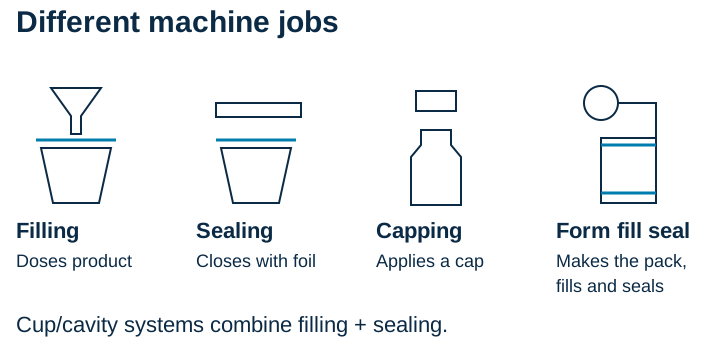
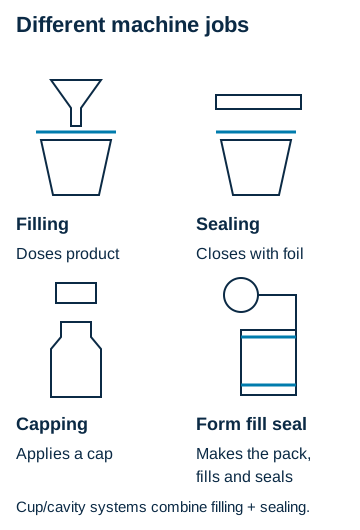
Filling and closing are different operations. A foil sealer closes a cup or cavity, a capper applies a cap to a bottle or spout, and a can seaming machine closes a filled can with its lid. A form fill seal machine also makes the pack from roll film. Specify which of these operations the quotation must include.
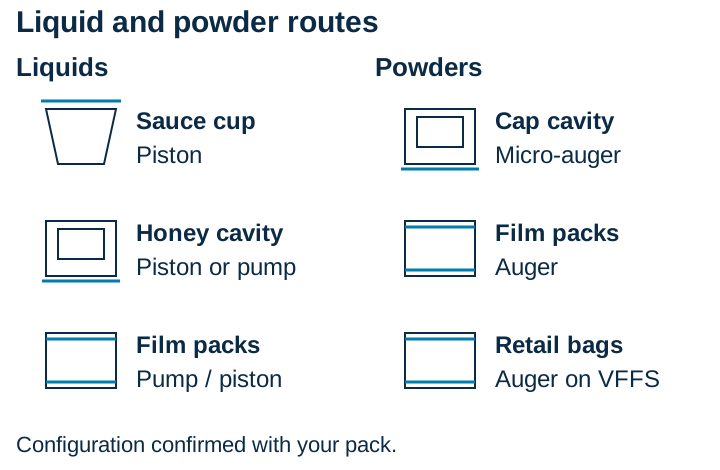
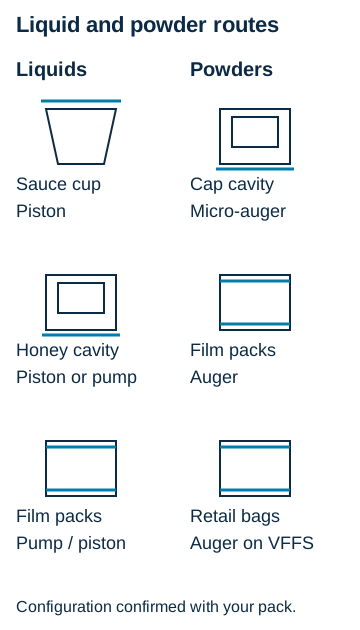
The sauce configuration doses by servo piston; the honey configuration offers piston or peristaltic pump alternatives; the powder closure configuration uses a servo micro-auger. Each route then closes the cup or cavity with thermal foil sealing.
Provide the container drawing and foil specification together. The proposal must identify the feeding arrangement, carriers, dosing unit and sealing equipment. Inspection, coding and outer packaging are separate items to agree. We specify speed, dose range, accuracy, utilities and changeover requirements for your product and selected build.
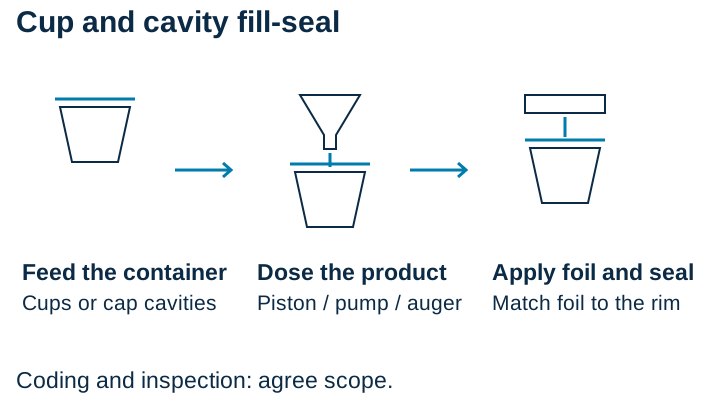
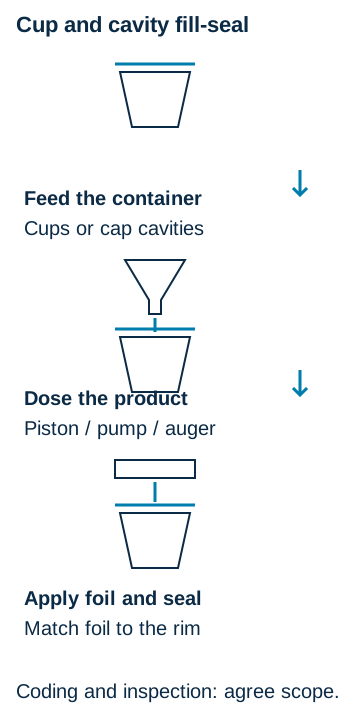
For powder in a closure, start with the cap-cavity micro-filling configuration. This configuration uses a servo micro-auger, agitation and load-cell feedback, with dust extraction around the filling point. We match these functions to your powder, target dose and cavity in the proposal.
For single-serve film packs, compare the multi-lane powder stick and sachet machines. For retail bags, compare an auger on a vertical form fill seal machine. LINEVO can supply a station within its published range; describe your existing containers and interfaces if you need the filler alone.
For liquids, send viscosity at the filling temperature, foaming behavior and any particles. Honey and sauces can change viscosity with temperature, so the product name alone does not define a dosing arrangement.
For powders, send bulk density if measured, the required dose and a description of flow or moisture sensitivity. For either route, include the opening, cavity or cup dimensions, fill level and how containers arrive at the machine.
For pesto and oil-suspension pastes, use the pesto and oil-suspension paste filling guide to prepare your agitation, valve and dosing brief.
Match the foil sealing layer to the cup or closure material and keep product off the rim. Ask the proposal to identify the lidding material, opening requirement and how the finished seal will be checked.
Agree which seal measurement you need. ASTM F88/F88M-23 measures the force required to peel a sealed test strip, whereas ASTM F2824 measures the force required to pull an entire lid off a round rigid or semi-rigid container. Specify the agreed method and acceptance criterion for your pack.
LINEVO can supply a single station for an existing line as well as a complete line. Within the published range, specify the filling and sealing units on this page or the units on the labeling family page.
For a station, provide the container infeed and outfeed, conveyor height and direction, required line speed and machine signals. Assign responsibility for each hand-off. For a complete line, identify feeding, filling, closing, labeling and downstream packaging separately.
Price follows the dosing method, container tooling and number of heads or lanes, plus the sealing and downstream equipment included. Compare quotations against the same product, formats and required output.
| Quote item | What to confirm | Cost left outside the machine price |
|---|---|---|
| Product and dosing | Piston, pump or auger; product-contact parts, heating or agitation where required | Product used for trials, start-up and cleaning |
| Container and format changes | Carriers, nozzles and sealing tooling for every agreed format | Additional formats and time spent changing and cleaning |
| Sealing and finished packs | Foil supply, sealing arrangement and agreed checks | Foil, containers and rejected packs during setup |
| Line integration | Included feeding, capping, coding, labeling or outer packaging; hand-off responsibilities | Conveyors, utilities or downstream equipment outside the quoted scope |
| Project support | Trial scope, pre-shipment checks, documents, shipping terms, installation, training and spare parts | Freight/import, agreed travel or remote support, site preparation and spares not included |
The sauce cup configuration offers stainless-steel product-contact construction and cleaning-in-place provisions. We specify the contact materials, cleaning provisions and access around your product and cleaning procedure. Record the planned cleaning and format changes when comparing operating costs.
LINEVO is a packaging machinery manufacturer supplying cup and cap-cavity fill-seal equipment alongside stick pack, sachet, pouch, vertical bagging and combined filling/labeling routes. The application review establishes the configuration and the interfaces to quote.
For a plant in the United States, state the destination and your documentation, utilities and start-up requirements. Shipping terms, installation location, remote support and operator training are agreed per project.
Each application page compares packaging routes, equipment arrangements and product-specific engineering considerations.
Yes. LINEVO can supply a single station within the published equipment range. Send the product and container details, the units required and the existing line interfaces so the quotation defines what connects to your equipment.
Discuss the production cups or closures, foil or lidding film and representative product with the team. Include viscosity and filling temperature for liquid, or powder bulk density if known. Agree quantities, handling and shipping instructions before sending samples.
The dosing unit and product-contact parts must suit both products, and the cleaning between them must be acceptable. Send both products and the intended containers for review before treating them as one configuration.
Dose range, output and accuracy are confirmed for the selected product, container and configuration. Send the target fill and required good containers per minute; include the conditions and measurement method you need the quotation to cover.
Send what you have through WhatsApp or the project brief checklist. Mark undecided details. We use the brief to propose a route and configuration and identify whether a sample test is needed. The table below lists the files and units to prepare.
Updated 21 October 2026. Our sauce cup, honey cap-cavity and powder closure configurations define the dosing and sealing routes on this page. We select the equipment, product-contact parts, container tooling and cleaning provisions through the project engineering review.
Seal-strength evaluation references ASTM F88/F88M-23 for strip peel testing and ASTM F2824 for whole-lid pull-off testing. We agree the test method and acceptance criteria for your foil and container during sample testing.
Open a model to review its machine configuration, specifications and engineering options.
6 / 6 configurations

An equipment configuration for dosing honey into cap cavities, sealing with foil and arranging downstream packaging.
View configurationMicro-Auger Dosing, Thermal Foil Sealing & Packaging for Matcha Pods, Tea Capsules & Functional Bottle Closures.
View configuration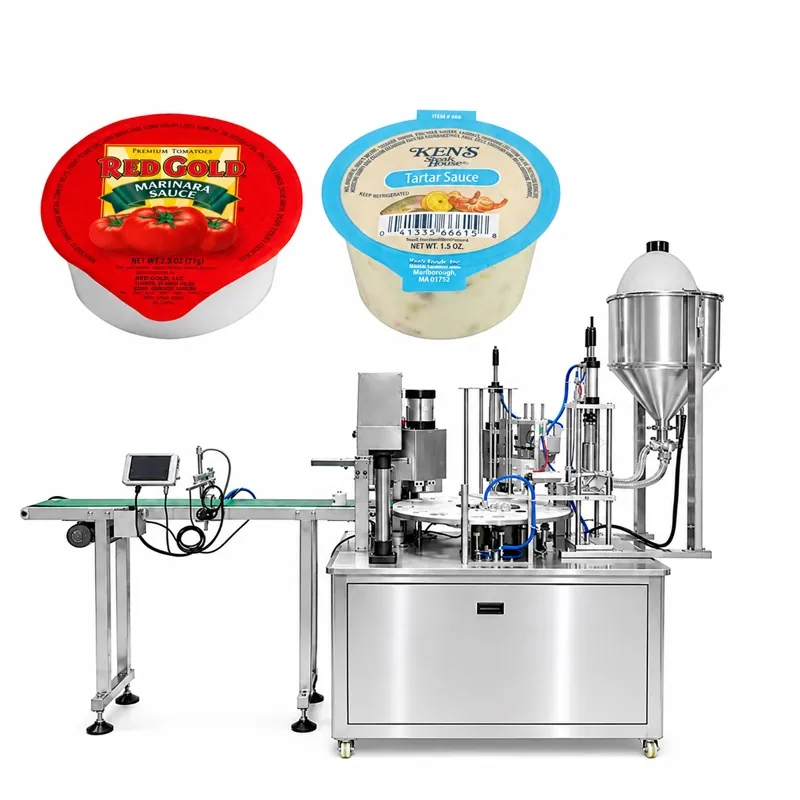
Precision Filling & Sanitary Sealing for Industrial Sauce & Condiment Production.
View configuration
Bottle line for shisha: unscrambler, indexing conveyor, auger filler, screw capper and labeler take empty bottles through to labeled ones.
View configuration
Floor-standing semi-automatic weigher for 50–1000 g of shisha tobacco or paste. The operator places each bag; the machine weighs and fills it.
View configuration
Floor-standing semi-automatic weigher with two discharges for 1000–2500 g shisha packs. The operator places each bag; the machine weighs and fills.
View configurationRelated pages and example machines
Send what you have and mark what is still undecided. Discuss your application with LINEVO.
| Item | Why we need it | Example format |
|---|---|---|
| Container or closure drawing and samples | Defines the carriers, opening, cavity and fill level | Dimensioned PDF in mm; cup or cap-cavity photos; agree sample quantity before sending |
| Product properties at the filling point | Checks the dosing method and product handling | Viscosity in mPa·s at temperature in °C and measurement method; powder bulk density in g/ml and flow description; mark unknowns |
| Dose and permitted variation | Defines the fill requirement for the selected configuration | Target in g or ml per pack; required tolerance and how it will be measured |
| Foil or lidding material | Checks the sealing layer against the cup or closure rim | Supplier material specification; reel or pre-cut lid; peel-opening requirement |
| Target output and formats | Defines the production requirement and change parts to quote | Required good containers per minute; each cup, cavity or pack size |
| Station scope and existing-line interfaces | Separates single-station supply from a complete line | Units required and purpose; infeed/outfeed drawing, conveyor height in mm, direction and line signals |