
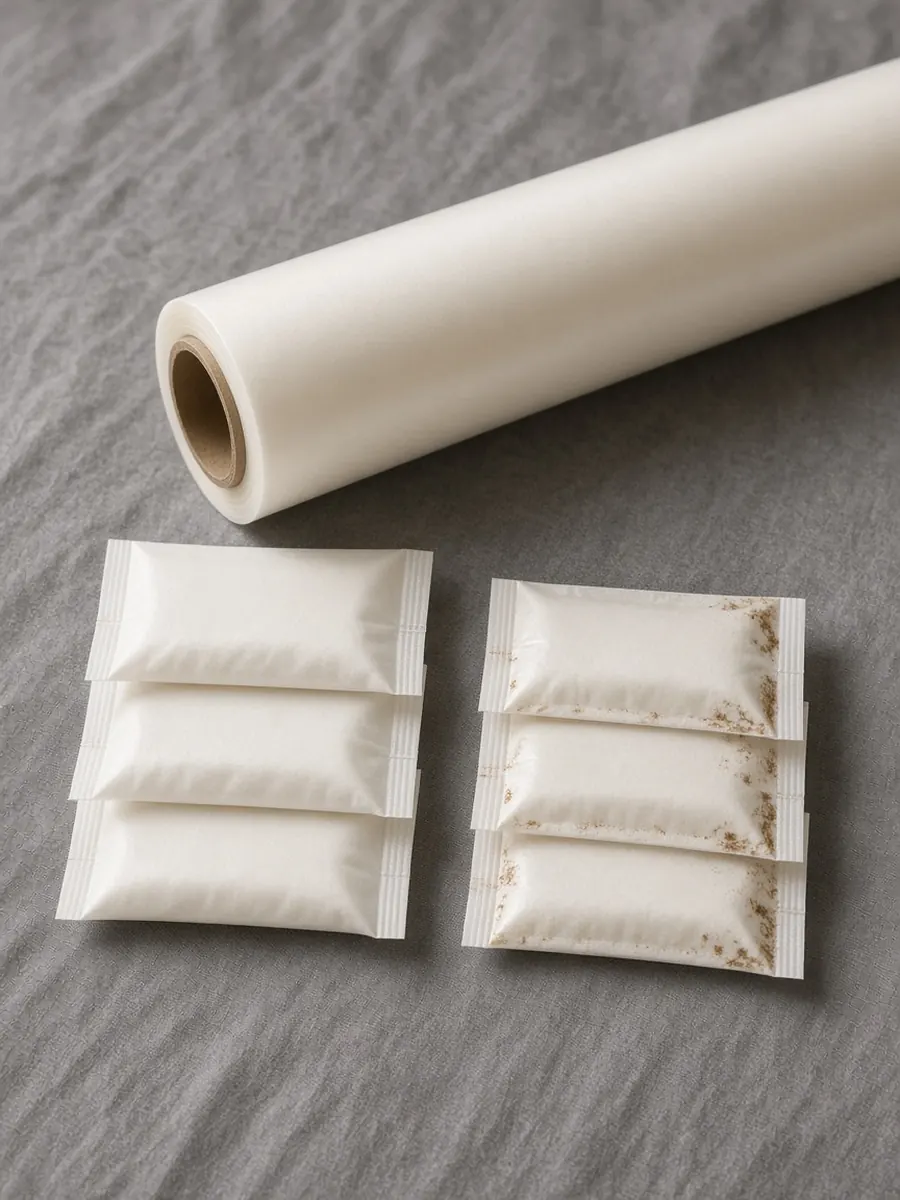
A blank film roll beside three clean sachets and three sachets with powder on them.
Record the lane, the last good pack and the film lot before you ask why a sachet leaks, drifts in weight or cuts off the print. A multi-lane sachet machine pulls film from one reel, forms a sheet for each lane, doses each lane, seals, and cuts. On the published sauce configuration, a photo-eye follows the printed mark so the cut stays with the print, and one knife cuts every lane at once. A film change can shift every lane together. A dose or product on a seal can belong to one lane. Keep one row for the lane that changed and one row for a lane that is still good. Photograph the mark against the cut, the seal if product is on it, and the dose samples from each of those lanes. Copy the error text as the screen shows it. Send that record with the photos.
On this page
What do you record before a diagnosis?
Name the lane, the last accepted pack on that lane, and the film lot on the reel. Add the same three facts for a lane that is still making good packs. Those two rows are what a diagnosis needs in order to separate a shared film change from a dose or a seal that belongs to one lane.
| Symptom | Observation on the log | What you may note | What confirms it | Send the row when |
|---|---|---|---|---|
| Leak | Seal photo of that lane, taken before the seal is wiped | Product is in the seal, or the seal looks clean and the film lot changed | The photo, the film lot, and the last good pack | The lane row and the seal photo are both filled |
| Weight drift | Dose samples from the changed lane and from a lane still in range, kept separate | The drift is one lane, or it shows on every lane after a product or film change | The written weights and the recent-change cell | Both lanes are on the log and the weights are not averaged |
| Cut off the print | Mark and cut in one photo, plus the same check on a still-good lane from that time | Every lane shifted together after a film change, or only one lane shifted | The photo and a word for the offset: above, on, or below the cut | The offset is described in words, with no new bag length entered |
The cycle those notes refer to is the one on sachet packing machines: film from the reel, a sheet for each lane, a dose, a horizontal seal, and a cut. The liquid and sauce machines page describes the photo-eye and the shared knife on the ketchup configuration.
What goes in the fault log?
Copy one row per lane into your own sheet. The cells below say what to write. They are a format, not a measured case, and the table on this page is the working copy.
| Lane | Timestamp | Last good pack | Film lot | Mark/cut offset photo | Dose samples | Seal contamination photo | Error code | Recent change | Manual reference | Evidence to send |
|---|---|---|---|---|---|---|---|---|---|---|
| Changed lane | Local time you first saw the fault | Last accepted pack on this lane, as a count or a clock time | Lot code printed on the reel label | Photo with the printed mark and the cut both visible; write above, on, or below | Weighed sachets from this lane only, weights written beside them | Close photo of this lane's seal before anyone wipes it | Characters on the screen, copied as shown, or none | New reel, splice, new product batch, lane stopped, or none | Heading in the manual supplied with your machine, or blank | This row, both photos, and the weight list |
| Still-good lane | Same timestamp if you checked it with the changed lane | Last accepted pack on this lane | Same lot, or the lot if this lane is on another reel | Photo only if the mark sits differently from the changed lane; otherwise write matches | Samples only when you are comparing weight; keep them off the other lane's list | Write clean if the seal is clean; photograph it only if it is not | Same screen text, or none | none, unless this lane had its own change | Same manual heading | This row, so the changed lane has a comparison |
Send the changed lane and a still-good lane, with the film lot on both rows, through WhatsApp before you ask for a diagnosis.
What do you note about film tracking?
Write the lot on the reel that is running, and say whether a new reel or a splice came after the last good pack. That note goes in Film lot and in Recent change.
If the film edge at the former sits somewhere else than it did on the last good pack, photograph the edge with a fixed part of the machine in the frame so the shift is visible. Leave the film where it is for that photo. A web that has walked can show up on one lane even though the reel is shared, so the lane rows still matter.
Unprinted film has no mark to follow. Write no mark in the photo cell and photograph the cut against the seal, so the cut still has a reference on the pack.
What should the registration-mark photo show?
The photo shows the printed mark and the cut on the same sachet. In the cell, write whether the mark sits above the cut, on the cut, or below it.

One blank sachet with a solid dark mark above a cut line, between plain seal bands.
On the published ketchup configuration, a photo-eye follows the printed color mark so each cut lands in the same place on the print. When the mark and the cut no longer agree, the photo is the record. Bag length stays in the manual supplied with the machine. Compare the changed lane with a still-good lane from the same time: the same offset on every lane points to a shared cut, and an offset on one lane stays on that lane's row.
What do you record about the bag cut?
Write whether the sachets left as separate packs or stayed joined. If they stayed joined, photograph the join and write still joined in the mark/cut cell.

Three separate blank sachets beside a strip of two blank sachets still joined.
The sachet packing machines page says a cutting device separates the sachets. The liquid and sauce page says the knife on the ketchup configuration cuts every lane at once. A cut that is off by the same amount on every running lane is a shared cut: write that on each row. A cut that looks different on one lane is that lane's photo. Photograph the cut edge on the pack. Knife work, and anything hot, stays with a person qualified for that machine.
How do per-lane notes differ?
A leak, a weight drift, and a missed register ask for different evidence. Put each one on the lane it came from.
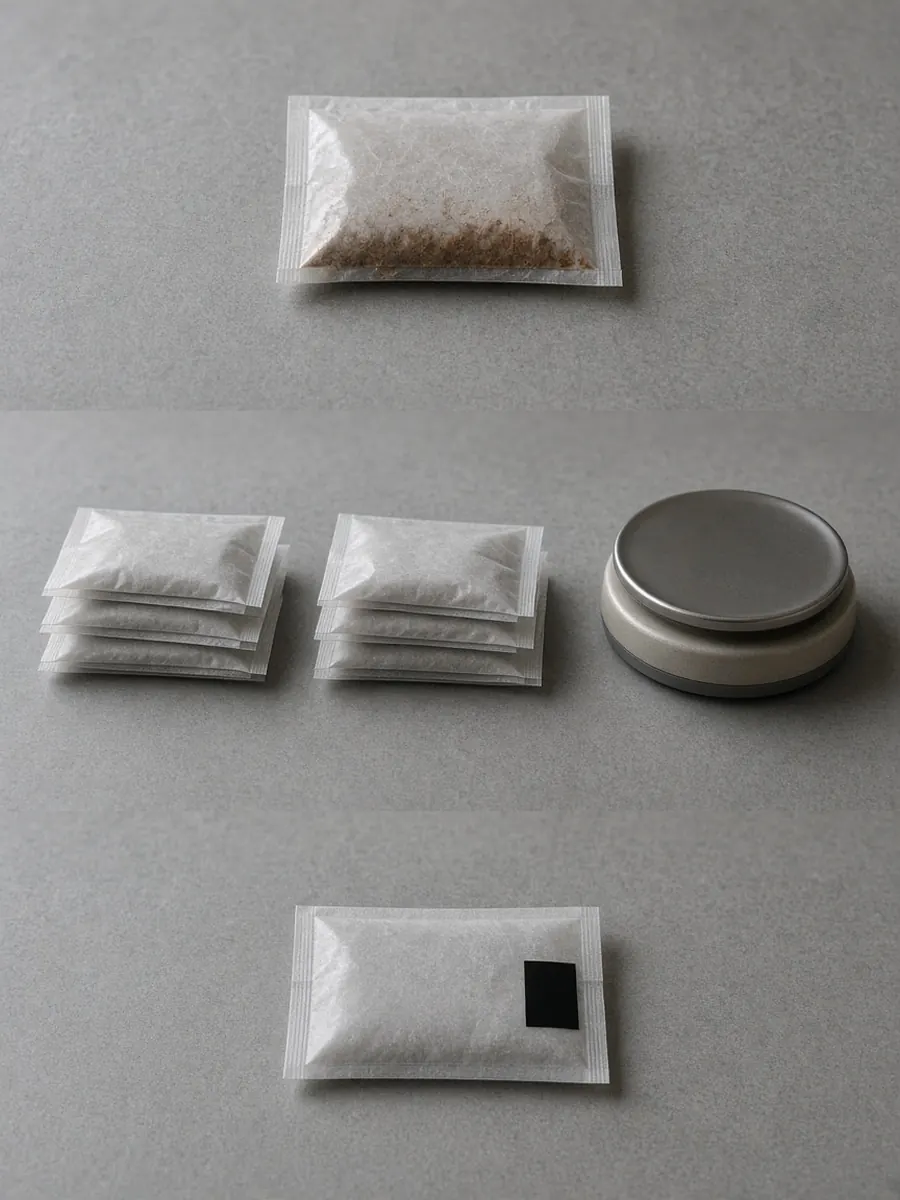
A sachet with powder in the seal, two piles of sachets beside a scale with a dark display, and a sachet with a solid mark at one edge.
For a leak, photograph the seal before anyone wipes it, and write whether product is in the seal. The sauce page treats product on the film the sealer is about to close as a common reason a seal leaks. The photo shows whether that is what you see on this lane.
For weight, keep the changed lane's sachets and the still-good lane's sachets in two lists. Write each weight next to the sachet it came from. An average of the two lanes hides which dose moved.
When does this log not apply?
Use this log on a multi-lane roll-film sachet line that is already making packs. Tea machines that dose an inner bag and then an outer envelope are a different process on the sachet family page; say so if that is your machine.
A line that is not running yet has no lane, pack, or film change to record. Start from sachet packing machines and send the product, the sachet, and the film for a quotation.
Seal temperature, jaw pressure, torque, live electrical work, and hot parts belong in the manual supplied with your machine and with a person qualified to do that work. Leave those cells for the manual heading only. If you see smoke, exposed conductors, or a guard open over a hot jaw, stop and follow your site procedure. Finish the log from packs you already have.
Method and sources
Updated 12 October 2026. The cycle, the photo-eye on printed film, and the knife that cuts every lane are taken from LINEVO's published sachet packing page and liquid and sauce page, read that day. This page adds the lane log. It reports no LINEVO trial, no speed, and no power or dimension figure.
- Covered: film lot and web position, the registration mark against the cut, whether the bag cut separated the sachets, and a separate note per lane.
- Left in your manual: temperature, pressure, torque, sensor setup, and any work on live or hot parts.
- The working copy is the table above. Copy it into your own sheet and send the rows with the photos.
What to send us
Send what you have and mark what is still undecided. We reply within 24 hours.
| Item | Why we need it | Example format |
|---|---|---|
| Lane rows | A shared film change and a single-lane dose look different only when each lane has its own row. | One row for the lane that changed, one row for a lane that is still good, same timestamp |
| Film lot and last good pack | Shows whether the fault started with a reel, a splice, or a pack count you can find. | Lot code from the reel label; last accepted pack as a count or a clock time |
| Mark and cut photo | Shows where the printed mark sits against the cut on that lane. | One sachet, mark and cut both in frame, with above, on, or below written on the row |
| Seal photo and dose samples | A leak photo and a weight list answer different questions, and they stay on the lane they came from. | Seal photo before wiping; weights written beside sachets from the changed lane and a still-good lane |
| Error text, recent change, manual heading | The screen text and the last change tell us which record to read with you. | Alarm text copied as shown, or none; new reel, new batch, or none; the heading in your machine manual |