
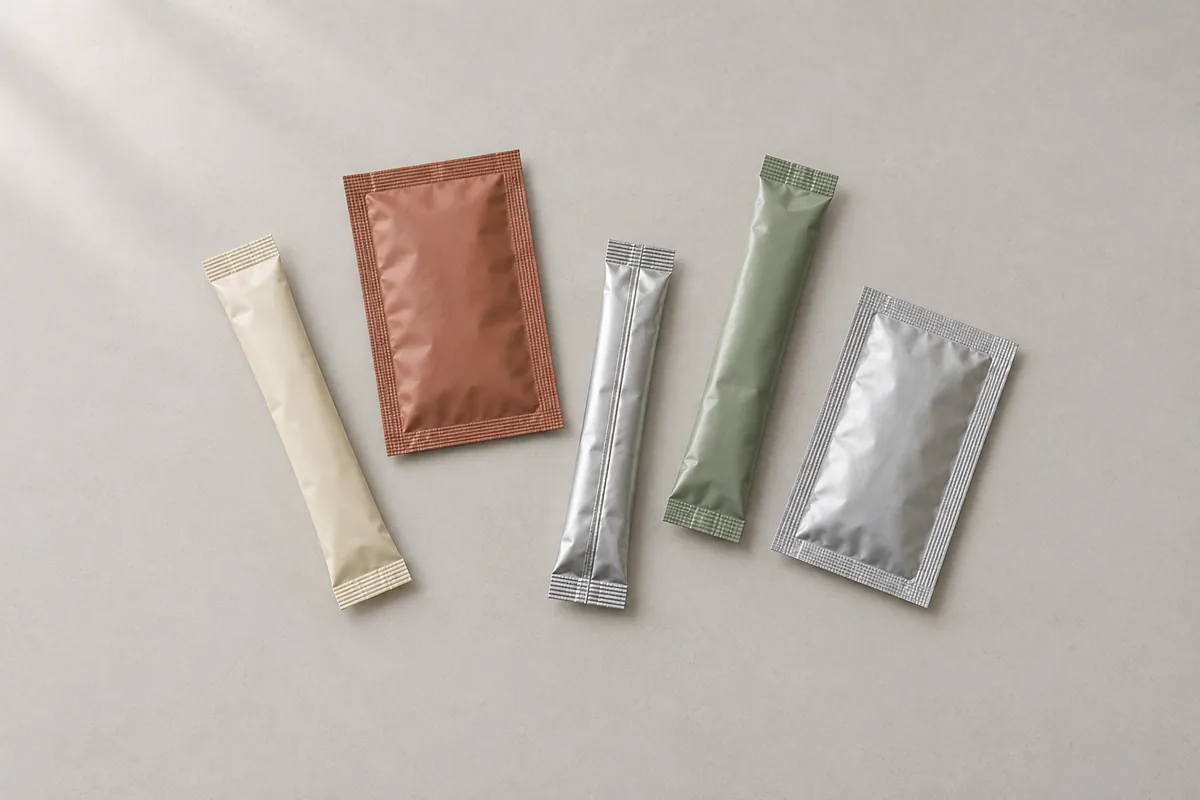
Three narrow stick packs in cream, silver and green beside two flat sachets in terracotta and silver, all with crimped edges, on a pale tabletop.
The wrong single-serve format means a pack that fills badly or a machine that cannot make it. A stick pack is a long, narrow tube sealed along the back and across both ends. A sachet is a flat packet sealed on three sides plus a fold, or on all four edges. Neither name sets the dose, the film or the machine. In the LINEVO catalog (checked 10 October 2026), the powder series list finished widths of 20–105 mm for back-seal sticks, 25–110 mm for three-side sachets and 50–125 mm for four-side sachets, so your pack width alone can rule a format out. This comparison is compiled from public builder descriptions and LINEVO's published listings, not from a LINEVO test. Start from the width, then confirm product, dose, film and changeover pattern with a sample.
| Input | Typical value or condition | Why it matters |
|---|---|---|
| Seals | Stick: back seam plus two end seals. Three-side sachet: fold plus three sealed edges. Four-side sachet: four sealed edges. | Sets where product must stay out of the seal and what a drawing has to mark. |
| Finished width (powder series, listed) | Stick 20–105 mm; three-side 25–110 mm; four-side 50–125 mm. | Your width may allow only one format. |
| Finished length (powder series, listed) | Stick 50–150 mm; three-side 50–150 mm; four-side 45–160 mm. | Sets the fill volume and the film used per pack. |
| Print area | Our reading: a stick's seam sits on the back, so the front face stays clear. One builder says a four-side pack prints on both panels. | Decides where artwork, code and tear notch can go. |
| Dosing | Follows the product in either format: auger for powders, pump for liquids and sauces. | Changing the format does not change the dosing unit. |
| Machine route | LINEVO lists separate series for sticks (BF, BK, BY), three-side sachets (F, K, Y) and four-side sachets (SF, SK, SY). | Ask in writing whether one frame runs more than one pack style. |
| Size change | Width follows film width and lane layout. No changeover time or procedure is published. | List every size you run before comparing quotations. |
| Speed figure | 20–40 cuts per minute in every listed series. A cut is not a good pack. | Convert to good packs per minute at a stated lane count. |
On this page
What is the difference between a stick pack and a sachet?
The difference is the seal layout, and the rest follows from it. A stick pack is formed around a tube, so its film edges meet along a back seam and two end seals close it. A flat sachet is made from a folded web (three-side seal) or two plies (four-side seal) and is sealed along its edges.
Neither name fixes a fill weight, a film structure or a machine. Builders and suppliers also use the words loosely. Several pages describe a stick pack as “sealed on three sides”, a different use of the term from a flat pouch folded on one edge and sealed on the other three, and one builder's flat-sachet machine page quotes output in “stickpacks per minute”. If a quotation says “three-side”, ask for a sketch or a sample that shows which edges are sealed. The sachet definition guide sets out the flat-pack terms used here, and the stick pack definition guide covers the stick format on its own.
| Feature | Stick pack | Three-side seal sachet | Four-side seal sachet |
|---|---|---|---|
| How the film is formed | Folded around a forming tube so the two outer edges overlap | One web folded along one edge | Two film plies joined at every edge |
| Sealed edges | Back seam along the length, plus a seal across each short end | Three sealed edges; the fold is the fourth side | All four edges sealed |
| Seam detail to specify | Lap seam (flat) or fin seam (projecting) | Which edge carries the fold | Seal width on all four edges |
| Shape | Long and narrow; pours from one end | Flat, with a clean fold edge | Flat and symmetrical |
| LINEVO powder series | LV-400BF / 680BF / 980BF | LV-400F / 680F / 980F | LV-500SF / 700SF / 980SF |
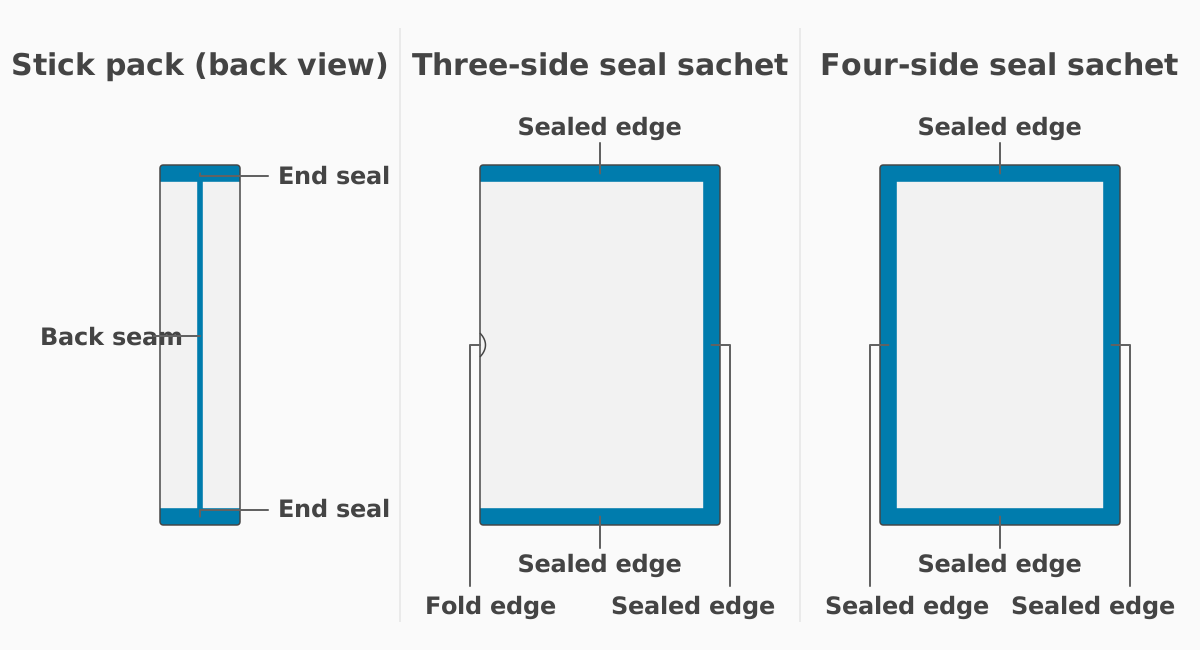
Seal layouts of three packs compared: a stick pack with a back seam and two end seals, a three-side seal sachet with a fold edge and three sealed edges, and a four-side seal sachet with four sealed edges.
How do they differ in look, print area and opening?
A stick is narrow and pours from one end, with its seam on the back. A flat sachet gives a wider panel. LINEVO's published guidance is to choose from the product, the dose and how the pack is used: sticks for narrow pour-out portions, flat sachets for pastes, lotions and larger print areas. Both formats can carry a tear notch, so the notch alone does not choose the format.
On print area, one builder says its four-side pack allows full-surface graphics on both panels, and another describes the fold side of a three-side pack as a clean, uninterrupted surface. Our reading is that a stick's back seam also leaves its front face unbroken, but a narrow pack leaves less room for artwork. Check the artwork at the real finished width before you fix the format.
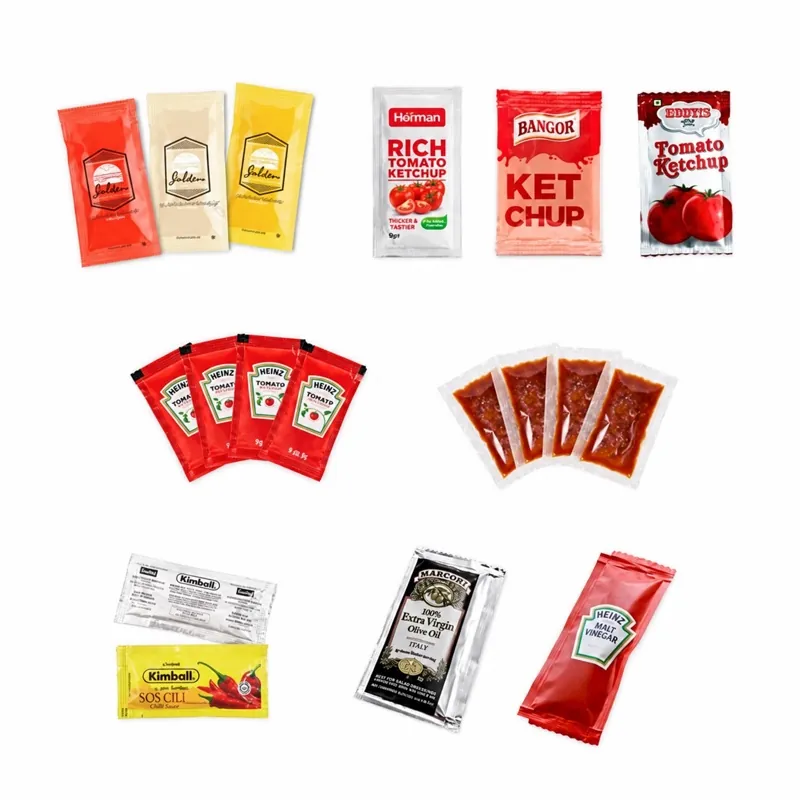
Catalog photograph of small condiment sachets in several seal layouts, sizes and printed designs.
| Check | Stick pack | Flat sachet |
|---|---|---|
| Print area | Narrow; seam on the back, front face can stay clear | Wider panel; a four-side pack is built from two plies |
| Cut and notch options | Straight, zigzag or round cuts; tear notch or microperforation | Tear notch, rounded corners; shaped and twin packs |
| Where to ask | Seam type and notch position on the drawing | Fold edge, notch edge and seal width on the drawing |
LINEVO lists straight, zigzag or rounded cuts with a tear notch, and date coding, as options on individual configurations. Ask whether each one applies to the series and lane count you are quoted; the powder stick pack and sachet page shows where those options are listed.
Which finished sizes and fill does each format cover?
In LINEVO's published powder series, back-seal sticks list widths of 20–105 mm and lengths of 50–150 mm. Three-side sachets list 25–110 × 50–150 mm and four-side sachets 50–125 × 45–160 mm. These are series ranges for the largest models, not trial results, and grams alone do not give a pack size: the same dose can need different pack interiors.
| Listed value | Back-seal stick | Three-side sachet | Four-side sachet |
|---|---|---|---|
| Finished width (mm) | 20–105 | 25–110 | 50–125 |
| Finished length (mm) | 50–150 | 50–150 | 45–160 |
| Lanes by model | 2–4 / 3–10 / 4–16 | 2–4 / 3–10 / 4–16 | 2–4 / 3–10 / 4–16 |
| Maximum film width (mm) | 400 / 680 / 980 | 400 / 650 / 950 | 500 / 700 / 980 |
- Powder series, width 20–24 mm: only the stick series lists it.
- Width 25–49 mm: stick or three-side sachet.
- Width 50–105 mm: all three list it. Decide by pack style first, then compare length range, machine size and weight.
- Width 106–110 mm: three-side or four-side sachet. Width 111–125 mm: four-side only.
- Length 45–49 mm or 151–160 mm: only the four-side series lists it.
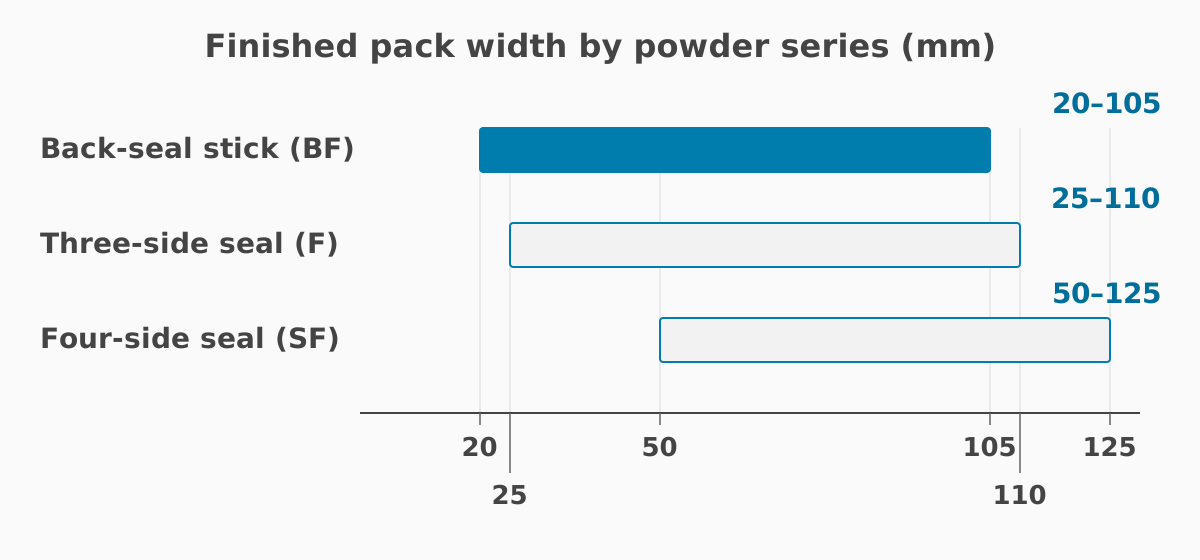
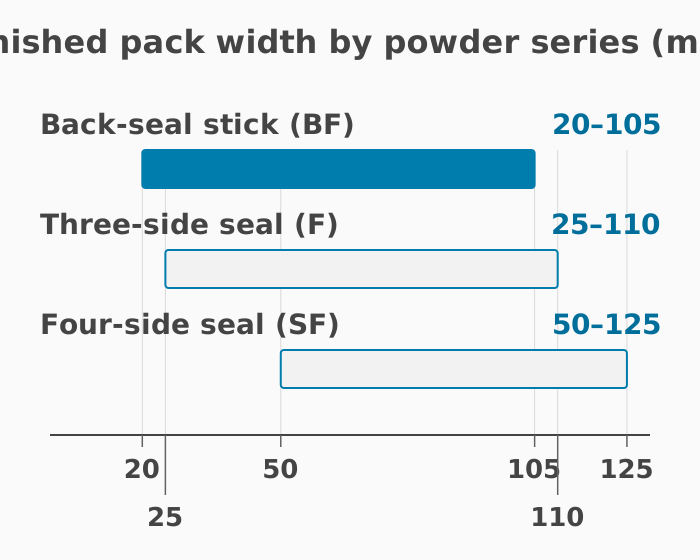
Bar chart of finished pack width listed for the three multi-lane powder series: back-seal stick 20–105 mm, three-side seal 25–110 mm and four-side seal 50–125 mm.
Example, assumed inputs: 5 g of a powder at an assumed bulk density of 0.5 g/ml occupies about 10 ml; the same 5 g at 0.25 g/ml occupies about 20 ml, before any headspace or seal margin. Record the dose, the bulk density and the finished width and length, then check that the dose fits, instead of choosing a pack from grams.
Listed fill ranges belong to configurations, not to formats. The LV-400BF stick configuration lists a 1–30 g fill range with customizable dosing screw tooling, and the sachet family's reference configurations together span about 1–100 ml for liquids and 1–50 g for granules, with no single configuration listing the whole span. They are different products on different configurations, so read them as scale indicators. No fill-accuracy figure is published; it is established by a trial with your product.
Do the two formats need different film and seals?
Not by name. Both are formed from roll film, and the film structure follows what the product needs from the pack. What differs is the geometry the seal has to cope with: a stick has a back seam and two end seals, a three-side sachet three sealed edges and a fold, a four-side sachet four sealed edges.
LINEVO's stick pack page notes that stick seals are narrow, so a small amount of powder or liquid on the seal area matters, and that dust control around the jaws and a clean cut-off at the nozzle matter as much as the sealing settings. Our reading is that the same caution applies to a flat sachet: count the edges the product must stay out of, and have them inspected on the sample.
On film use, one builder says a lap seam uses less material than a fin seam. At the same finished width and length, a stick wraps the product in about two layers of film, much as a folded-web or two-ply flat sachet does, so film use differs through seam and seal allowances and through the size you choose, not through the format name. That is our reading from the geometry, not a measurement. Some suppliers claim a stick saves a third or more of the film (one says 33% less than a sachet) without stating the pack sizes, seal widths or film thickness compared. Treat such figures as a request for the film layout drawing, not as a result.
| Ask for | Why it matters |
|---|---|
| Film data sheet | Laminate structure, sealing layer, thickness and reel width set sealing and protection. A foil-like look does not identify the laminate. |
| Film layout drawing | Film width per lane and the seam and seal allowances let you compare film use on the same finished pack. |
| Seal inspection plan | Which edges are inspected and how; a stick, a three-side and a four-side pack have different edges to check. |
| Product on the seal | Dust, foam, drips or viscosity decide nozzle, extraction and the sample-test checks. |
None of the builder material reviewed here compares the formats on seal strength, barrier or shelf life, and this page makes no such claim. Confirm film and seal performance with your own product in a sample test.
Do they need different machines, and what changes at changeover?
Often yes, but confirm it in writing. LINEVO lists the three pack styles as separate series with different frames, and other builders also list stick and flat-sachet machines as separate products. One builder's page says its sachet machine supports stick packs and flat three- or four-side packs and is easily adjustable. Treat any multi-format claim as a question for the quotation.
| Listed value | Back-seal stick | Three-side sachet | Four-side sachet |
|---|---|---|---|
| Machine weight (kg) | 500–800 | 500–800 | 650–1000 |
| Machine length (mm) | 700–1650 | 700–1650 | 1610–1956 |
| Machine height (mm) | 2680–2950 | 2550–2650 | 2880–3100 |
| Speed | 20–40 cuts per minute | 20–40 cuts per minute | 20–40 cuts per minute |
The four-side models are listed heavier and longer than the stick and three-side models with the same lane range, so check the room as well as the pack. Dosing follows the product in every format: auger for powders, pump for liquids and sauces. A powder auger cannot be turned into a liquid pump by changing settings, and a frame that takes both is confirmed in writing, not assumed. The stick pack machine family and the sachet packing family list the published series for each route.
On changeover, one builder's stick pack machines set film slitters and forming tubes per bag size and offer changeover kits with a storage cart, while another says changing the sachet length on its four-side machine is done on the touch screen. Those are statements about those builders' machines. LINEVO publishes neither a changeover procedure nor a changeover time for its stick or sachet series, and says sachet width follows the film width and the lane layout. The table is therefore a list of questions, not a promise.
| Change you plan | What to ask the supplier | Why it matters |
|---|---|---|
| New width, same format | Which parts change and how long does it take on the quoted machine? | Width follows film width and lane layout, so it can change the lane count. |
| New length, same width | Is it a setting or a part change? | Decides whether short runs of several lengths are practical. |
| Stick to flat sachet, or back | Is it covered by one frame, in writing, with the parts named? | LINEVO lists separate series; a switch is not described. |
| Powder to liquid | Is the dosing unit swapped, and what cleaning is needed? | Auger and pump are different assemblies. |
| Same product, new film | Does the new film need sealing trials? | The sealing window follows the film. |
Also settle what follows the machine. LINEVO lists stick pack cartoning configurations in its cartoning family, while sachets are usually counted into cartons, display boxes or outer bags, so the counting scope is a project item for either format.
Which should you choose? A conditional guide
Start with the finished width and the use. If you want a narrow pour-out portion, or a powder pack under 25 mm wide (only the powder stick series lists it), start with a stick. If a powder pack is wider than 110 mm, only the four-side series lists it. Sauce, paste and liquid series list their own widths, so read those from the liquid and sauce page. In between, decide by product, seal risk, printable area and how many sizes you will run, then confirm with a sample.
- Check 1, fix the finished pack: width, length and how it should open. The width bands above show which formats can list it.
- Check 2, fix the product and dose: powders are dosed by auger, free-flowing liquids on the BY stick series, and sauces and pastes on the Y or SY sachet series. Record bulk density, or viscosity at the filling temperature.
- Check 3, fix the machine scope: the sizes you run, how often you change, and what happens after the machine.
| If your situation is | Start with | Then check |
|---|---|---|
| Narrow pour-out portion of powder, granules or free-flowing liquid | Back-seal stick (BF, BK, BY series) | Seam and notch on the drawing; dust or liquid on the narrow seal |
| Powder pack 20–24 mm wide | Back-seal stick; only the stick series lists it | Length and the lane count that fits the film width. Sauce and paste sachets list narrower widths (from 17 mm on the three-side series), so this band is for powders |
| Flat pack for a sauce, paste or lotion | Three-side (Y) or four-side (SY) sachet | Viscosity at filling temperature. Some gels, sauces and lotions also appear as pump-dosed stick configurations, so say which pack you want |
| Powder pack wider than 110 mm | Four-side sachet; powder widths of 111–125 mm are listed only there | Machine size: four-side models are listed heavier and longer |
| Printable area is a priority | Any format: compare the real flat artwork area, seams and seal bands for each | Builders describe large printable panels on three-side and four-side packs and a narrow face on sticks; request an artwork template from each supplier |
| Both stick and flat packs in one plant | Two series, unless one frame is confirmed in writing | Parts, cleaning and changeover frequency for each pack style |
| Zipper, spout or stand-up presence | Premade pouches rather than a stick or sachet | See the next section |
| A pack larger than a single portion | A vertical bagger rather than a stick or sachet | See the next section |
The powder and liquid and sauce application pages carry the full series tables for each product group. For the machine-side checks, use how to choose a stick pack machine, and compare quotations on the same scope with the stick pack cost guide.
Send the finished pack, the product and dose, and your list of sizes, and we use them to discuss which format and series to review and whether a sample test is needed. We reply within 24 hours.
Which other single-dose formats should you rule out first?
Rule out neighbouring routes by what the pack must do. A zipper, spout or stand-up shelf presence points to premade pouches, a rigid portion with a foil lid to cup filling, and an individually wrapped solid to flow wrapping. Sticks and flat sachets stay the route for single powder, granule, liquid or paste portions formed from roll film.
| Format | Starts from | Choose it when | Read next |
|---|---|---|---|
| Premade stand-up, zipper or spout pouch | A purchased empty pouch | A zipper, spout or stand-up presence is part of the pack | Premade pouch types |
| Cup or cap-cavity with foil lid | A rigid cup or closure | The portion sits in a rigid pot, such as a sauce cup | Filling machines |
| Flow-wrapped pillow pack | Roll film around a solid item | The product is an individual solid item | What is flow wrapping? |
| Larger retail bag | Roll film on a vertical bagger | The pack is larger than a single-serve portion | Vertical form fill seal machines |
When this comparison does not apply
- The ranges are LINEVO series listings for the powder series. The sauce series differ (the three-side sauce series list widths from 17 mm), and individual configurations list their own narrower figures.
- No source used here measures the two formats against each other, so the page does not rank them by price, film use or leak rate. Confirm with a sample evaluation.
- Every listed LINEVO stick and sachet series is multi-lane, from two lanes; only the tea bag machines in the sachet family are an exception. Manual and benchtop filling is outside LINEVO supply.
- A pharmaceutical or other regulated product needs its own process and film review; a format name does not settle it.
- Shelf life, barrier and recyclability depend on the film structure and the product. This page makes no claim for either format.
Questions buyers ask about stick packs and sachets
What is the difference between a pack and a packet?
A pack is the general word for any package, while a packet is a small sealed portion pack, such as a sugar or ketchup packet in US foodservice. A sachet is the same small flat portion pack under its packaging name, and the sachet definition guide linked in the first section covers the terms.
What does “1 sachet” mean?
One packet, not a fixed weight or volume. Read the net contents on the product label; in a machinery brief, give the portion size and the finished packet dimensions as separate items.
Is a stick pack always narrower than a sachet?
No. The format is defined by its seals, and the listed widths overlap: sticks 20–105 mm, three-side sachets 25–110 mm, four-side sachets 50–125 mm in LINEVO's powder series. A 60 mm wide pack can be any of the three, so shape and seams, not width alone, name the format.
Is a stick pack cheaper than a sachet?
Neither is cheaper by default, and no price is published here. Pack cost follows the film layout and seal allowances on your drawing; machine cost follows the quoted scope. Ask each supplier for both on the same finished pack, and use the cost guide linked in the choice section.
What material is sachet packaging made of?
Laminated roll film, with the layers chosen for the product. LINEVO's granule sachet configuration lists OPP/CPP, PT/PE, paper/PE, KOP/CPP and aluminum foil, and a personal care configuration lists multi-layer high-barrier laminates. Those are configuration listings, so confirm the film with your own data sheet and a sample.
Which format suits honey or a gel?
Neither wins by format alone. LINEVO lists honey, gels, sauces and pastes on its three-side and four-side sachet series, and energy gel on a pump-dosed stick configuration. Decide from viscosity at the filling temperature and from stringing or dripping after the nozzle closes, and confirm both on a sample.
Method and sources
Updated October 2026. This comparison is compiled from public sources, not from a LINEVO trial. Seal geometry, print and opening options come from builder pages for stick packs and flat pouches, read in full and re-read on 10 October 2026. They are the builders' own statements (publication dates, where shown, run from 2017 to 2025), and none is independent testing. LINEVO sizes, series, weights and dosing statements come from the catalog and application pages published on the site and are listings, not results for your product.
LINEVO makes both stick and sachet machines, so check each point against your own sample and drawing. Where the page says “our reading”, it is a conclusion drawn from geometry or from the listings, not a measurement. The sources contain no cost, film-use or seal-performance comparison between the formats.
Send the details for your format check
| Item | Why we need it | Example format |
|---|---|---|
| Product and how it behaves | Sets the dosing unit and the seal risk for either format | Powder, granule, liquid or paste; flow, dust, foam, or viscosity at filling temperature |
| Target dose | Sets the pack interior and the fill volume | g or ml per pack, with bulk density or liquid density |
| Finished pack: width, length and shape | Decides which format and series can list your pack | Sample pack or drawing in mm with the sealed edges marked |
| Opening and print | Decides notch, cut shape and the artwork area | Notch position, cut style, printed film sample |
| Film specification | Sets the sealing conditions and the protection | Film data sheet and reel width in mm |
| Sizes and changeovers | Decides the change parts and steps in the quotation | Every width and length you run, and how often you switch |
| Good output and what follows | Decides the lane count, the model size and the counting scope | Good packs per minute or per shift; counted into cartons or an outer bag |
Send the product and how it behaves, the dose, the finished pack with its sealed edges marked, the opening and print needs, the film specification, every size you run and how often you change, and your target good output with what follows the machine. Use WhatsApp for a format discussion, or add the site details with the project brief checklist. Mark anything still open. We use the brief to discuss which series fits, what each size change would need and whether a sample test is needed. We reply within 24 hours.
We reply within 24 hours.
Discuss your stick pack or sachet