LV-BT280 / LV-BT350 reference series
An overwrapping series for cartons and boxed products, with film folding, sealing and a tear-tape arrangement.
View configuration
Packaging Machinery & Systems
Updated November 2026
3D overwrapping machines that fold BOPP or cellophane film around perfume, cosmetic, tea, pharmaceutical and card boxes, with optional tear tape.
Discuss your application with LINEVO.

Choose folded-film overwrapping for a rigid rectangular box. Send your box dimensions, film grade and target output for a configuration review and quotation.
| Input | Typical value or condition | Why it matters |
|---|---|---|
| Box type | Rigid rectangular box, or a stable bundle of boxes | Soft or out-of-square boxes give loose folds |
| Box length × width × height | 40–200 × 20–120 × 10–70 mm across the series | A box outside the range needs a separate review |
| Speed | 30–80 boxes per minute, depending on box size | Confirm the speed for your own box |
| Film and tear tape | BOPP film, cellophane film and optional tear tape | Set the seal temperature and the easy-open feature |
| Change parts | Per box size, quoted for each size you run | Every extra size adds parts and changeover steps |
The LV-BT280 / LV-BT350 Series configuration covers a combined envelope of 40–200 × 20–120 × 10–70 mm. Select the model, box orientation and format tooling together; each box size within the series envelope requires dedicated folding and pushing tooling.
Equipment selection
An overwrapping series for cartons and boxed products, with film folding, sealing and a tear-tape arrangement.
View configurationLV-BT280 / LV-BT350 3D overwrapping machine that wraps single or grouped playing-card boxes in BOPP or cellophane film at 30–80 boxes/min.
View configurationFilm overwrapping with tear tape for playing card, board game and card deck boxes, configured around your box formats and packaging materials.
View configurationUse the named series for baseline dimensions and output. Choose the application configuration by your box, film finish and feed arrangement, then confirm its format tooling and output.
| Configuration | What you can assess now | What the quotation must confirm | Dominant Failure Mode & Prevention |
|---|---|---|---|
| LV-BT280 / LV-BT350 Series | Combined series box dimensions, film types and size-dependent output in the table above | Selected model, box orientation, format tooling and output with your box | Poor folds from a format mismatch: review production boxes and tooling together |
| Playing card overwrapper | Same named series reference and combined baseline | Card-box dimensions, single or grouped wrap, tape position and finish | Uneven bundle folds: check the complete group dimensions and stability |
| Playing card and game box configuration | Application-specific configuration; dimensions and output specified for your boxes | Model, dimensions, output and selected film-feed/tape options | Unmatched film or tape finish: agree the materials and appearance on sample review |
An overwrapping machine wraps a rectangular box in a tight film envelope with folded, heat-sealed ends. It is the clear film finish seen on perfume, tea, playing card and cigarette boxes, usually in BOPP or cellophane film and often with a tear tape.
The 41 configurations in this family include perfume, cosmetic and skincare boxes, pharmaceutical, supplement and healthcare cartons, tea and chocolate gift boxes, face mask boxes, condom boxes, playing cards, cigarette packs and cartons, and CD and DVD cases. The LV-BT280 / LV-BT350 Series is the reference model range.
For a choice between folded ends and a conforming outer film, compare cellophane overwrapping vs shrink wrapping across heat exposure, tear tape and box fit, and review the cosmetics and pharmaceutical carton overwrapping guide before specifying the finish.
Compare the carton, film finish and line interface before choosing options. The quote should identify the covered formats, change parts and output for each agreed box.
Box stiffness and dimensional variation affect how the film lies against the carton. Review production boxes and the film together when agreeing fold and seal appearance.
The reference series has a 30–80 boxes/min baseline depending on box size, with frequency-inverter speed adjustment on selected configurations. Confirm the speed for your own box size.
Operator and maintenance training, the installation sequence and the handover record are planned with the project. The installation and training page lists what to prepare.
Provide the complete wrapped-object dimensions, rigidity and required grouping. Include the intended film and a finished presentation sample where possible.
The reference series uses BOPP or cellophane film, with optional tear tape. Specify the exact heat-sealable film grade and its data sheet; the material name alone does not identify a suitable sealing surface. Cellulose film suppliers offer both heat-sealable and non-heat-sealable grades.
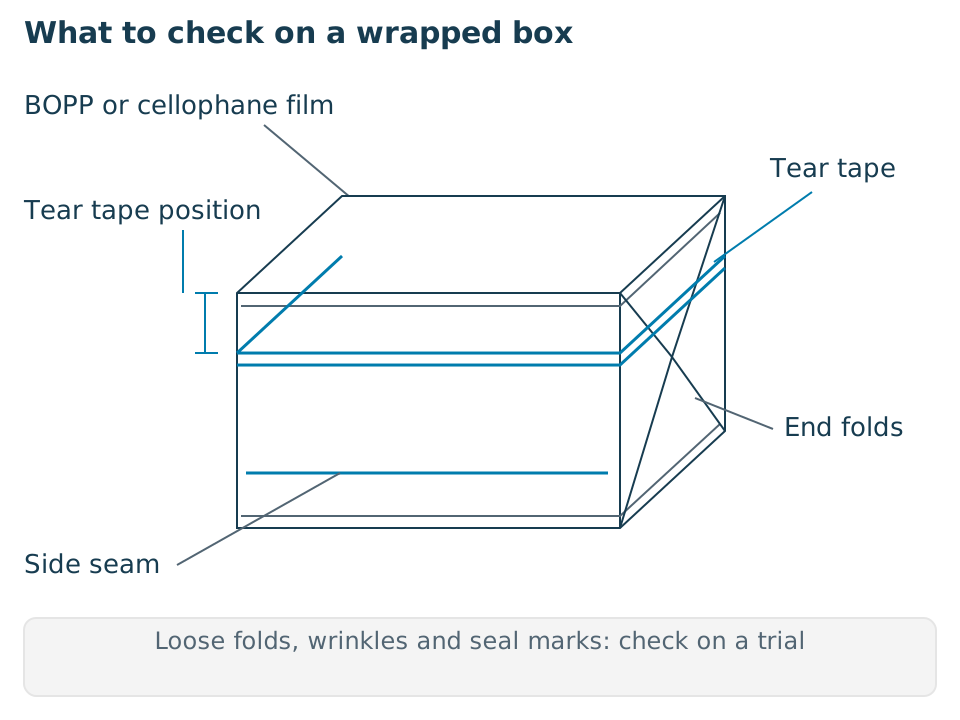
Agree the side seam, end folds and tape position using a wrapped reference sample. Review loose folds, wrinkles or seal marks against box variation, film handling and sealing conditions during a trial with your materials.

Start with the model reference and published data when comparing these two playing card configurations. Confirm the configuration for your boxes before comparing output or deciding which machine fits.
Discuss product orientation, upstream delivery and downstream handling. Confirm the change parts and adjustments needed for each approved format.
Overwrappers often follow a cartoner, which means the two machines must agree on box orientation, pitch and stop signals. When boxes are fed by hand, plan the operator position and buffer.
Use the speed agreed for your box, then allow for format changes, reel changes and line stops. The series maximum is not a shift-output commitment.
Wrapped boxes per shift = agreed boxes/min × (scheduled minutes − stopped minutes). Count only running minutes; deduct rejected boxes separately when planning saleable output.
Confirm your target format speed and planned stoppage allowance for film changes, size changeovers and upstream transfers during project review.
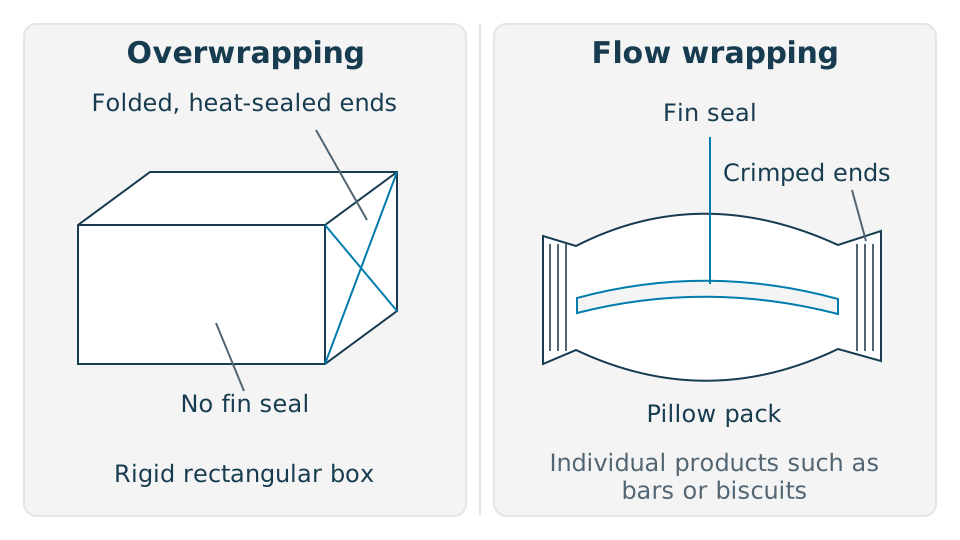
Overwrapping folds film tightly around a rigid box with no fin seal, giving a close, box-shaped finish. Flow wrapping makes a pillow pack with a fin seal and crimped ends, suited to individual products such as bars or biscuits. If the item is not a rigid rectangular box, flow wrapping is usually the route to compare.
| Route | Pack to assess | Dominant Failure Mode & Prevention |
|---|---|---|
| Folded-film overwrapping | Rigid rectangular box; envelope-style end folds and side seam | Loose or uneven folds: check production-box stiffness, variation and format tooling with the intended film |
| Flow wrapping | Pillow pack around a product or tray; longitudinal fin seal and cross seals | Product entering the cross-seal area: review product spacing and infeed with the flow-wrapper configuration |

An overwrapping machine price depends on the formats, output and options included. Ask for an itemized quotation against one box-and-film brief, so a lower equipment price does not hide missing tooling or line-interface work.
The quotation should state the model, the box sizes covered with their change parts, the speed with the box it applies to, the included and optional units, the utilities required, the checks before shipment, the shipping terms, installation and training, and the recommended spare parts.
Plan for these costs beyond the machine, and ask which of them the quotation already covers:
| Cost item | What to record | How to compare quotations |
|---|---|---|
| Format changes | Sizes per shift, change parts and observed setup time | Included tooling and a changeover demonstration for the agreed boxes |
| Rejected wraps and restart waste | Rejected boxes, discarded film/tape and the cause of each stop | Finish acceptance criteria using your production boxes and film |
| Labor and line stops | Manual infeed, reel replacement and upstream/downstream waiting | Operator tasks and the agreed cartoner-to-wrapper transfer scope |
| Utilities and maintenance | Actual running consumption, service tasks and wear-part requirements | Configuration-specific utilities and recommended spare-parts list; do not treat nameplate power as measured energy use |
Use your own shift records and local costs to price these items. The sample-testing service explains the materials to agree for evaluation; the spare-parts service covers the parts information to include in the project.
LINEVO is a packaging machinery manufacturer with 41 overwrapping configurations, from perfume box overwrapping and tea box overwrapping to playing card overwrapping and cigarette packs. Our LV-BT280 / LV-BT350 Series covers boxes 40–200 mm long, 20–120 mm wide and 10–70 mm high across the series. Within that envelope, we build the change parts and settings for your boxes; a box outside it receives a custom engineering review.
Beyond the machine, a project can include a sample test with your boxes and film, a pre-shipment check agreed in the quotation, packing and shipping documents, installation and operator training on site or remotely, and spare and change parts. Each item, and its cost, is set out in the quotation for your project.
LINEVO also builds the cartoners that often feed an overwrapper, so both machines can be quoted together with the interface between them in one scope.
Send what you have through WhatsApp or the project brief checklist. We use it to check your boxes against the series range, propose the change parts and options, and say whether a sample test with your boxes and film is needed. Quantities for any trial are agreed with the team before shipping.
Each application page compares packaging routes, equipment arrangements and product-specific engineering considerations.
Yes, within its range, with change parts and adjustments for each size. List every size so the parts and changeover steps are included in the quotation.
No. It is an option shown on many configurations. Specify it if the consumer needs an easy-open feature.
It depends on the bundle size and how stable it is when pushed. Send the bundle arrangement for review.
Several finished boxes from production, the film you plan to use with its data sheet, the tear tape if you need one, and a wrapped reference box or photos of the folds you expect. Loose folds, wrinkles and seal marks usually trace back to box variation, film tension or seal temperature, so the trial is only meaningful with your own boxes and film.
Updated 21 October 2026. The combined LV-BT280 / LV-BT350 dimensions and size-dependent speed provide our series engineering baseline. We select the model, orientation and tooling around your production boxes and film, and define the format output and acceptance conditions in the project quotation.
The reference series specification retains the combined-range conditions. Futamura’s film range distinguishes heat-sealable and non-heat-sealable cellulose grades. That distinction guides the film data sheet to request; suitability of a particular grade is reviewed with the intended box and wrapping configuration.
Open a model to review its machine configuration, specifications and engineering options.
41 / 41 configurations
An overwrapping series for cartons and boxed products, with film folding, sealing and a tear-tape arrangement.
View configuration
3D overwrapping machine that wraps cosmetic and fragrance boxes in clear cellophane or BOPP film with an easy-open tear tape.
View configuration
High-Speed Cellophane Overwrapping & Packaging Solution with Tear Tape for Face Mask Cartons, Surgical Mask Boxes, and Medical Consumables Packaging.
View configuration
High-Speed Cellophane Overwrapping & Packaging Solution with Tear Tape for Vitamin Boxes, Nutraceutical Packaging, and Healthcare Gift Boxes.
View configuration
3D overwrapping machine that wraps perfume boxes and fragrance gift sets in clear BOPP or cellophane film with an easy-open tear tape.
View configuration
3D overwrapping machine that wraps pharmaceutical cartons in clear film with an easy-open tear tape, for pharmaceutical manufacturers and contract packers.
View configuration
Film overwrapping with tear tape for playing card, board game and card deck boxes, configured around your box formats and packaging materials.
View configuration
3D overwrapping machine that wraps tea boxes, tea tins and gift packs in clear BOPP or cellophane film with an easy-open tear tape.
View configuration
Professional Cellophane Wrapping Solutions for CD Cases and Media Boxes.
View configuration
Overwrapping machine that wraps chocolate gift boxes in cellophane with an easy-tear strip, with tool-free format changeover and Siemens PLC and HMI control.
View configuration
High-Speed 3D Overwrapping Solutions for Cigarette Packs and Premium Boxes.
View configuration
Overwrapping machine that wraps cosmetic and gift boxes in cellophane with an easy-tear strip, with tool-free format changeover and Siemens PLC and HMI control.
View configuration
Professional Film Wrapping Solutions for DVD Cases and Media Packaging.
View configuration
Premium Cellophane Overwrapping for Supplements, Pharma, and Health Care Boxes.
View configuration
Industrial 3D Overwrapping Solutions for High-Precision Healthcare and Condom Packaging.
View configuration
Overwrapping machine that wraps perfume boxes and fragrance gift sets in clear film with a tear tape. Box-size changeover parts are made to your boxes and film.
View configuration
Overwrapping machine for medicine cartons, supplement packs and probiotic kits, applying a tamper-evident film wrap with an easy-open tear strip.
View configuration
Premium Cellophane Overwrapping Solution for Playing Cards and Small Gift Boxes.
View configuration
Professional Cellophane Wrapping Solutions for Premium Tea and Gift Boxes.
View configuration
LV-BT280 / LV-BT350 3D overwrapping machine that wraps tea boxes in clear BOPP or cellophane film with tear tape at 30–80 boxes/min.
View configuration
LV-BT280 / LV-BT350 3D overwrapping machine that wraps condom boxes in BOPP or cellophane film with tear tape at 30–80 boxes/min.
View configuration
LV-BT280 / LV-BT350 series 3D wrapping machine that wraps chocolate boxes in BOPP or cellophane film with a tear tape, at 30–80 boxes/min depending on box size.
View configuration
LV-BT280 / LV-BT350 3D overwrapping machine that wraps single or grouped playing-card boxes in BOPP or cellophane film at 30–80 boxes/min.
View configuration
3D overwrapping machine that wraps game-card boxes and other retail boxes in cellophane with an easy-tear strip.
View configuration
High-Speed Cellophane Overwrapping & Packaging Solution with Tear Tape for Cigarettes, Tobacco Packs, and Regular Box Formats.
View configuration
Premium Cellophane Wrapping Solutions for Cigarette Cartons and Gift Boxes.
View configuration
Professional Cellophane Wrapping Solutions for Premium Food Gift Sets.
View configuration
3D overwrapping machine that wraps fragrance and cosmetic boxes in cellophane, with tool-free format changeover.
View configuration
3D overwrapping machine for medicine cartons, probiotic kits and medical boxes, applying a tamper-evident film wrap with an easy-open tear strip.
View configuration
Industrial-Grade Cellophane Wrapping Solutions for High-Value Healthcare Packaging.
View configuration
3D overwrapping machine that wraps tea gift boxes in cellophane with an easy-tear strip.
View configuration
Overwrapping machine for cigarette packs and other regular box formats, applying cellophane film with an easy-open tear tape.
View configuration
Overwrapping line for condom cartons and other personal-care boxes, applying a tamper-evident film wrap with an anti-counterfeit tear strip.
View configuration
3D overwrapping machine that wraps perfume boxes and fragrance gift boxes in cellophane with an easy-open tear tape.
View configuration
High-Speed Cellophane Overwrapping & Packaging Solution with Tear Tape for Playing Cards, Board Game Boxes, TCG Card Decks, and Stationery Packs.
View configuration
High-Speed Moisture-Proof Cellophane Overwrapping & Packaging Solution with Tear Tape for Vitamin Boxes, Nutraceutical Packaging, and Healthcare Gift Boxes.
View configuration
3D overwrapping machine that wraps tea boxes, tea tins and gift packs in moisture-resistant cellophane with an easy-open tear tape.
View configuration
3D overwrapping machine that wraps perfume and fragrance gift sets in cellophane, with tool-free format changeover.
View configuration
LV-BT280 / LV-BT350 3D overwrapping machine that wraps CD, DVD and media cases in BOPP or cellophane film with tear tape at 30–80 boxes/min.
View configuration
LV-BT280 / LV-BT350 cellophane overwrapping machine that wraps boxed cosmetic bottles in BOPP or cellophane film with tear tape at 30–80 boxes/min.
View configuration
LV-BT280 / LV-BT350 3D overwrapping machine that wraps health-supplement cartons in BOPP or cellophane film with tear tape at 30–80 boxes/min.
View configurationSend what you have and mark what is still undecided. Discuss your application with LINEVO.
| Item | Why we need it | Example format |
|---|---|---|
| Finished boxes from production | Box variation and stiffness decide the fold quality and the change parts | Several boxes per size from normal production, not a hand-made sample |
| Box dimensions and tolerance | Checks the box against the 40–200 × 20–120 × 10–70 mm series range | L × W × H in mm with the dimensional variation |
| Bundling or grouping | Bundles need their own pushers and a stability review | Two boxes side by side per wrap, or single boxes |
| Film and tear tape | Set the sealing temperature, finish and easy-open feature | Film data sheet (BOPP or cellophane, thickness); tear tape position and color |
| Wrapped reference sample | Shows the fold and seal finish you expect | A wrapped box or photos of the end folds |
| Target output and infeed | Decide the configuration and the interface with any cartoner before it | Boxes per minute; hand-fed or from a cartoner |