
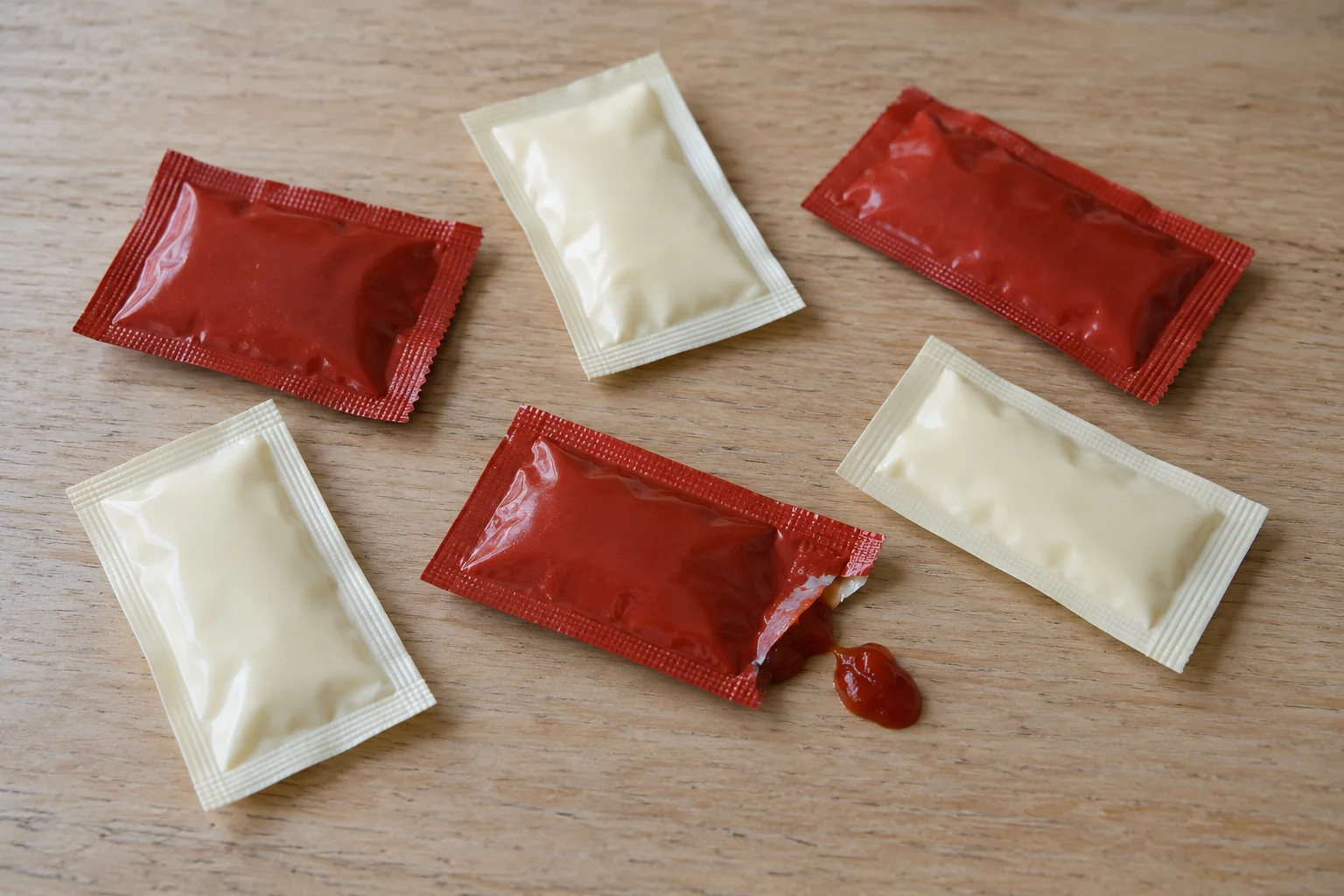
Illustrative ketchup and mayonnaise portion packets on a kitchen table.
For an unopened condiment packet, start with the specific product date, its storage instructions and the intact packaging. FDA describes Best if Used By as the date for best flavor and quality, not a safety cutoff, and advises checking food past that date for signs of spoilage. A packet with an unknown age or damaged seal cannot be assessed by borrowing another product’s shelf-life number.
- Count any stated shelf life from the manufacturer’s defined starting point, not from the day you received the packet.
- Keep the packet and its outer-carton code together when the individual pack has no readable date.
- Packaging helps protect the contents; the filling machine alone does not establish a storage life.
On this page
How long does the printed date actually cover?
The useful answer is tied to an identifiable product and batch. FDA’s quality-date guidance explains what Best if Used By means. Read that date alongside the product’s storage instructions: the date is a quality reference, not an inspection of an individual packet. If a loose packet has no readable date, its outer case or the supplier may hold the needed product and batch information.
| Product or record | What the source establishes | How to use it |
|---|---|---|
| Unopened ketchup packet with a readable date | The producer’s date and stated storage conditions | Use the identified product’s instructions; collecting a takeout order does not restart its storage life |
| Unopened mayonnaise packet | Its own label and storage instructions | Use that product’s date rather than another condiment’s date |
| Best if Used By wording | FDA describes it as a flavor/quality date | Keep quality dating separate from packet condition and storage history |
| Loose packet without a readable date | Age cannot be determined from the packet alone | Ask the restaurant or brand to identify the outer case and code |
A manufacture date, a batch code and a best-before date answer different questions. A batch code can identify production without itself being a consumer-readable expiry date. Photograph the code exactly as printed and ask the brand to explain it. Adding an assumed number of months to an undecoded code can produce a false date.
Unopened packet, opened packet or bottled condiment?
An unopened single-use packet retains its original seal; an opened packet has lost that enclosure. Bottles and jars add a different handling pattern because they can be opened repeatedly. Keep those situations separate when reading storage advice. A recommendation written for a refrigerated jar is not a shelf-life test for an unopened sachet.
| Situation | Practical next step | Reason |
|---|---|---|
| Unopened packet with identifiable date | Follow its label and keep the package intact | The stated life belongs to a defined product and storage instruction |
| Packet opened for a meal | Use it for that serving and discard the leftover packet as a practical single-use habit | An open edge no longer provides the original enclosure |
| Mayo stored in a jar after opening | Follow the manufacturer’s refrigeration instructions | Hellmann’s official FAQ tells users to refrigerate its real mayonnaise after opening |
| Leaking or visibly damaged food package | Discard it rather than repairing the seal | FDA advice on damaged packaged foods identifies leakage and package damage as warning signs |
Keep unopened packets away from conditions that contradict the manufacturer’s storage instructions. A glove compartment or other warm location should not be treated as equivalent to the storage condition behind a shelf-life specification. If the instructions or storage history are unavailable, use a fresh packet rather than assigning an invented safe-use interval.
How does a sachet protect the sauce?
A small packet needs a compatible film structure and a continuous seal. The film controls movement through the package wall; the seal closes the edges where the film is joined. An excellent barrier sheet cannot compensate for an open channel at an edge. For a packaging project, evaluate the filled pack rather than treating the film name as the finished-pack result.
| Packaging feature | Question to put in the specification | Evidence to collect |
|---|---|---|
| Film barrier | What oxygen, moisture and light protection does this recipe need? | Converter’s complete laminate data and relevant transmission results |
| Seal layer | Can it seal with this sauce and the agreed process? | Film data sheet and filled-pack seal evaluation |
| Seal-band clearance | Does the nozzle leave sauce where the jaws close? | Samples from each running lane and a record of filling conditions |
| Opening feature | Can the user open the packet without damaging the intended seal? | Finished samples showing notch, cut and seal positions |
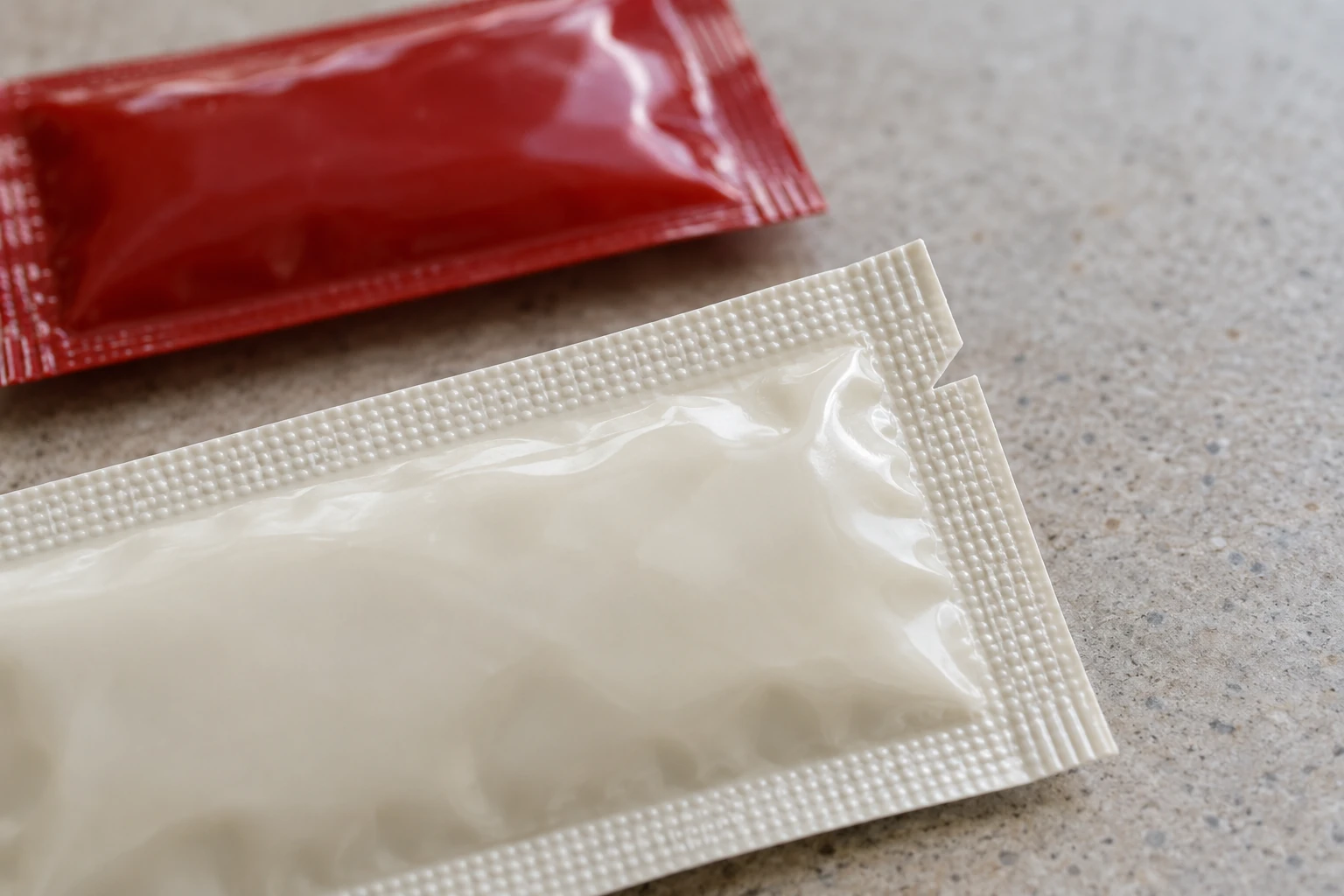
Illustrative close view of the textured seal band and tear notch on a plain condiment packet.
The sachet family film review calls for product properties and a film sample together. Oils, acidity, fragrance ingredients and filling temperature are reasons to ask the converter for compatibility information. Do not select a laminate merely because the outer surface resembles an existing ketchup packet.
Seal review should include where the product sits relative to the closing jaws and whether each lane produces the intended finished pack. Record any visible wet seal band, distorted seam or channel and agree the appropriate test method with the packaging team. A photographed good-looking packet helps locate an issue; it cannot prove barrier performance.
What do headspace, nitrogen and date coding change?
Headspace is the space around the contents inside the closed pack. It is a packaging variable, not a shelf-life number. Fill level and nozzle position affect how much empty space remains and whether sauce reaches the seal area. Any proposed gas treatment needs its own product rationale and measurement plan; the Y/SY listings do not establish a nitrogen result for a sauce packet.
| Variable | What to record | What the record does not prove |
|---|---|---|
| Fill and headspace | Target portion, finished dimensions and fill position | A storage-life claim |
| Gas treatment, if specified | Gas arrangement and the required measurement method | Sterilization or an automatic extension of shelf life |
| Batch code | The link between packet, production run and outer case | The date when the consumer collected the packet |
| Date print | Agreed wording, format, position and legibility | Quality of the contents if the seal or storage conditions have changed |
Decide where the code will appear before finalizing the artwork and cut positions. Keep the date readable after sealing and cutting, and record what the code means in the brand’s batch documentation. A coding requirement belongs in the configuration brief on the liquid and sauce application page.
If you make these packs
Start with the intended sauce, packet construction and storage claim, then choose the dosing and sealing route. LINEVO lists three-side seal sauce series LV-400Y / LV-680Y / LV-980Y and four-side seal series LV-500SY / LV-700SY / LV-980SY. The liquid and sauce guide carries the model tables and the product information needed to review them.
| Published route | Finished dimensions in the series listing | What needs your sample |
|---|---|---|
| Y three-side seal sauce series | 17–110 mm width and 50–180 mm length across sizes | Recipe behavior, seal clearance and appropriate model/lane arrangement |
| SY four-side seal sauce series | 50–125 mm width and 45–160 mm length | The actual packet and its film/seal requirements |
| Specific ketchup configuration | LV-SY ketchup listing names ketchup, tomato paste, chili sauce and viscous liquid | Fill requirement and the suitability of the quoted dosing parts |
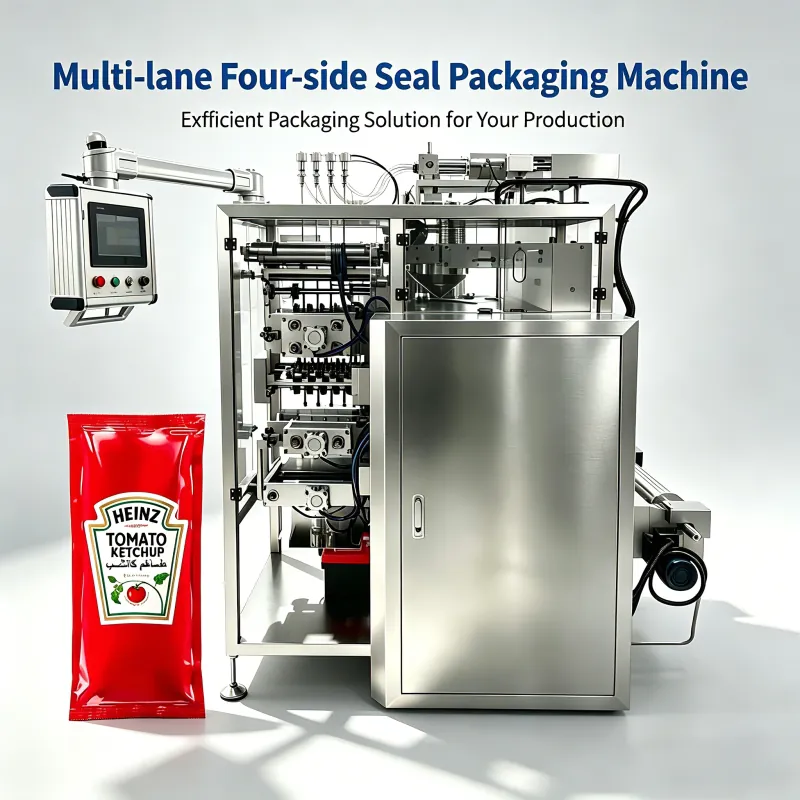
Catalog image of the four-side seal ketchup sachet configuration and its packet example.
The ketchup configuration with rotary piston pumps lists a different dosing reference. Use the sauce viscosity at filling temperature, particle content and cleaning requirements to compare scope. Do not transfer a fill range from one configuration to an unnamed pump arrangement.
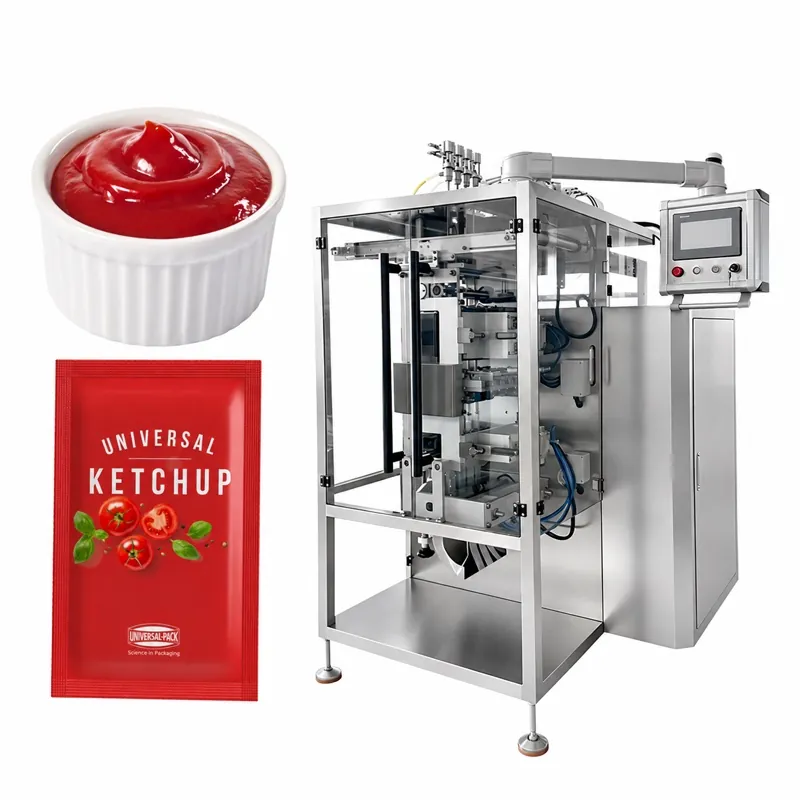
Catalog image of a multi-lane ketchup configuration with a piston-pump route and a condiment example.
Give the sample-testing team your intended packet and film with the sauce information. A machinery trial can examine filling and sealing under an agreed setup; establish the storage claim separately using the brand’s product and packaging validation. Prepare the equipment inputs through the project brief checklist.
When this guidance does not apply
These comparisons concern commercially packaged condiment portions. They do not assign a storage period to homemade sauces, a chilled product, a recalled batch or a product with an unknown formulation. Follow the actual label and the manufacturer’s current advice for those cases. A best-before quality explanation does not authorize use of a damaged packet.
Larger sauce formats also use different equipment. Purchased stand-up or spout pouches belong on the premade pouch route; preformed sauce cups belong on the cup filling and sealing route. The fact that the contents are ketchup does not make these formats interchangeable with a roll-film sachet.
Condiment packet FAQ
Can you eat expired ketchup packets?
Sometimes, if the packet is intact. FDA describes Best if Used By as a flavor and quality date rather than a safety deadline, and advises checking food past that date for spoilage, such as a noticeable change in color or consistency. Discard a leaking, torn or damaged packet regardless of its date; there is no universal grace period.
How long does Hellmann’s Real Mayonnaise last?
Until the Best If Used By date printed on the jar or bottle, for best flavor and quality, according to Hellmann’s official FAQ. The code reads as a three-letter month followed by two digits each for day and year, so AUG2124 means August 21, 2024. This decodes that brand’s jar or bottle date; it does not assign the same storage period or code format to a mayonnaise sachet.
How do I know if my ketchup packet is bad?
Leakage, tears or a damaged seal are reasons to discard the packet. A normal-looking exterior cannot verify storage history. Check the identified product’s date and instructions as well; do not taste a suspect packet to test it.
Do sauce packets need to be refrigerated?
An unopened shelf-stable packet and a sauce sold chilled have different handling requirements. Follow the actual sauce label. Once a single-use packet is open, use it for that serving and discard the leftover packet as a practical single-use habit; its original sealed-pack conditions no longer apply.
Does Hellmann’s Real Mayonnaise need to be refrigerated?
Yes, after opening: its official FAQ recommends refrigeration in the refrigerator door and advises against freezing because the product may separate. The FAQ concerns that mayonnaise product; it is not a tested storage interval for an opened portion sachet.
Why do some ketchup packets have Best Before or expiry dates?
The producer uses dates to communicate an intended quality or storage period. A production lot code can instead identify a batch. If only a code appears, ask the brand to interpret it rather than adding an assumed number of months; the label table above separates these cases.
Methods and sources
Checked 8 October 2026: FDA on quality dates, FDA on damaged packaged foods, and Hellmann’s official date-code and refrigeration FAQ. No universal ketchup- or mayonnaise-packet duration is inferred from bottled products or a different brand’s package.
Equipment facts are compiled from the linked LINEVO series and configuration pages. Related reading: sachet construction and definition explains the seal-style terminology; premade pouch types helps distinguish larger purchased pouches. These are separate packaging routes, not measured shelf-life comparisons.
We reply within 24 hours.
Discuss your packaging project