
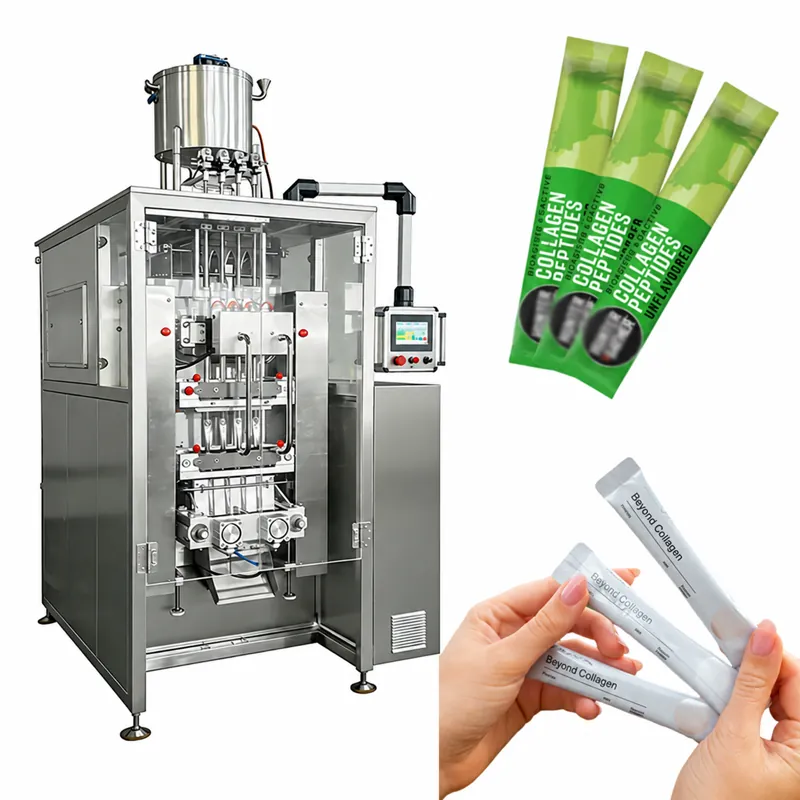
Catalog powder stick pack equipment with sample stick formats
Missing items in a stick pack machine price comparison can leave required costs outside your budget. Compare the dosing unit, lanes, format tooling, contact parts, options and downstream equipment under the same product and production conditions. Separate the machine from delivery, installation and operating costs, and mark missing items as unresolved. Use the tables below to prepare comparable proposals; actual prices are established in the project quotation.
| Input | Typical value or condition | Why it matters |
|---|---|---|
| Product and dose | Buyer product description and fill requirement | Determines the dosing arrangement to quote |
| Finished stick and film | Buyer sample, drawing and film specification | Defines format tooling and the film-handling scope |
| Output and lanes | Required good sticks per minute or shift | Connects lane selection to an accepted-output target |
| Contact parts and options | Buyer cleaning requirements and requested functions | Separates included equipment from project-specific options |
| Downstream handling | Buyer discharge and cartoning requirement | Defines whether the quote is a machine or a connected line |
| Site and start-up | Destination, utilities, layout and responsibility list | Defines delivery, installation and training boundaries |
On this page
What belongs in a stick pack machine price?
A useful price belongs to a defined equipment scope. Separate the stick pack machine from the units that feed it, handle finished sticks and make it ready to operate at your site. Ask the quotation to identify the product, formats, configuration and responsibilities covered by each amount.
| Cost boundary | Items to identify | Comparison question |
|---|---|---|
| Primary machine | Frame, film handling, forming and sealing, controls, dosing arrangement | Does each offer cover the same product and finished stick? |
| Production system | Product feeding, coding, discharge, counting, grouping and any cartoner | Which operations are included, separately quoted or supplied by the buyer? |
| Delivered and installed scope | Export packing, shipping terms, site work, installation and training arrangements | Where does each supplier’s responsibility begin and end? |
| Project checks and documentation | Sample testing where needed, acceptance record, manuals and change-parts list | What evidence and documents are included? |
Use the packaging project quotation checklist to record these boundaries. An equipment-only offer can still be worth comparing, but add the missing required work as separate budget lines. Leave an unpriced item unresolved rather than treating a blank cell as something included.
Keep the physical pack in view. This guide applies to narrow, back-sealed sticks made from roll film on stick pack machines. A carton of finished sticks adds another packaging operation; it does not redefine the primary machine as a complete cartoning line.
How does the product change the quoted dosing scope?
Start with what is being filled. Powder, granule and liquid requirements lead to different dosing arrangements in the published stick pack range. A quote for the same finished stick can therefore cover different equipment when the product changes. State the material behavior, target fill and acceptable variation before asking for a price.
| Product | Information to provide | Scope to name in the quotation |
|---|---|---|
| Fine powder | Flow, dust, tendency to bridge, bulk density if measured, target dose | Auger and screw tooling, feeding, agitation if proposed, dust-control arrangement |
| Sugar or other granules | Particle size distribution, flow, fragility, target dose | Project-specific granule dosing arrangement and format tooling |
| Liquid, sauce or gel | Viscosity at filling temperature, foaming, particles, target volume or weight | Pump, nozzle, product supply and any proposed heating or anti-drip arrangement |

Catalog powder stick pack equipment beside a drink and stick pack examples
The powder stick pack and sachet guide explains why screw tooling and dust control need product-specific review. The liquid and sauce guide records the liquid information needed to discuss pumps and nozzles. Do not carry the scope of one route into a quotation for another.
For a sugar stick packing machine price, describe the actual granules and finished stick rather than sending only the word “sugar.” The published granule series is a starting point for discussion; the dosing unit is confirmed for the project.
Why do lanes and pack formats belong in the same budget?
Lane count describes only part of the work a configuration must do. Finished stick width, reel width, length and the required good output belong in the same brief. The family page explains that each running lane has its own forming and dosing path, so lane and format choices also define tooling to prepare, clean and check.
- List every finished stick width and length, with a drawing or representative sample.
- State target good sticks per minute or per shift and the intended operating hours.
- Provide the film specification, reel dimensions and printed registration requirement.
- Ask which forming and dosing parts are included for the initial format and which are needed for other formats.
- Ask whether a proposed future format or lane change is supported by the offered configuration; do not budget it as a settings change without confirmation.
The LV-400BF powder configuration is a published equipment reference, while the stick pack family’s lane and film discussion gives the input checklist. Use those references to prepare a requirement, then let the quotation name the model and tooling that cover it.
Compare output on the same basis. Cuts per minute describe sealing and cutting cycles; multiplying by running lanes describes sticks formed before rejects and stops. For an investment decision, ask for good output at your product, fill, stick dimensions and film, with the test or acceptance conditions stated. Do not substitute a catalog cut rate for sustained accepted production.
Which materials and options need separate quote lines?
Treat product-contact materials, cleaning requirements and added functions as explicit scope decisions. The published powder application page lists individual configurations with different contact-zone and dust-control arrangements. That supports asking what the offered machine includes; it does not make every listed feature standard across the stick pack family.
| Requirement | Buyer input / question | Confirmation document to request |
|---|---|---|
| Contact parts and cleaning | Product data, cleaning / allergen procedure; which parts contact the product? | Quoted contact-parts material list and proposed cleaning arrangement |
| Dust extraction | Dust behavior, collection points and site connections | Quoted equipment list and supplier / buyer connection responsibilities |
| Nitrogen flushing | Required protection, gas supply and agreed measurement method | Quoted gas equipment and responsibility list; agreed acceptance record |
| Coding | Code content, position and film; which coding equipment is included? | Quotation option list and agreed print-check requirement |
| Printed-film registration | Registration marks, production sample film and tracking requirement | Quotation stating the printed-film requirement; agreed registration check |
| Feed and discharge | Feed description and layout; where is each handover? | Quoted equipment list and interface responsibility drawing |
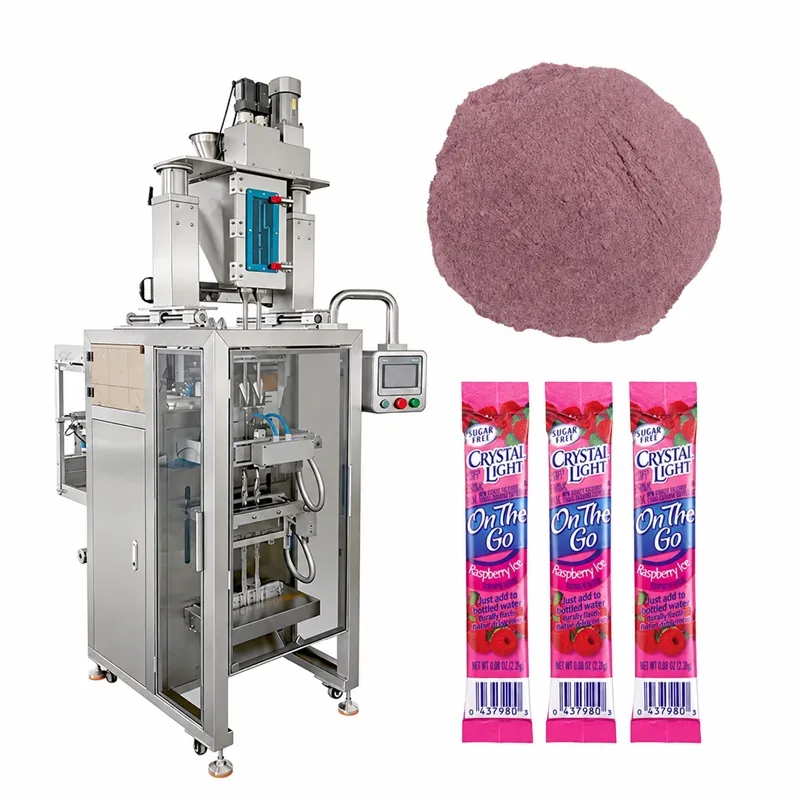
Catalog drink mix stick pack equipment with a powder and packet examples
The listed drink mix configuration with dust extraction provides one configuration reference. Ask for the dust-control scope of the offered machine instead of inferring it from a product photograph. For nitrogen, specify the requirement and how it would be checked.
Put a requested contact material or cleaning arrangement beside the relevant part or operation. A general phrase such as “food application” does not tell you which component is included or which cleaning procedure the offered equipment supports. Your own site requirements should be addressed in the proposal without turning them into an assumed specification.
Does the budget include counting and cartoning?
Define where the stick pack machine stops and the next operation begins. Loose sticks, counted groups and retail cartons create different handover requirements. If the project needs automatic cartoning, name the counting, grouping, transfer and carton-handling scope separately, together with responsibility for the interface.
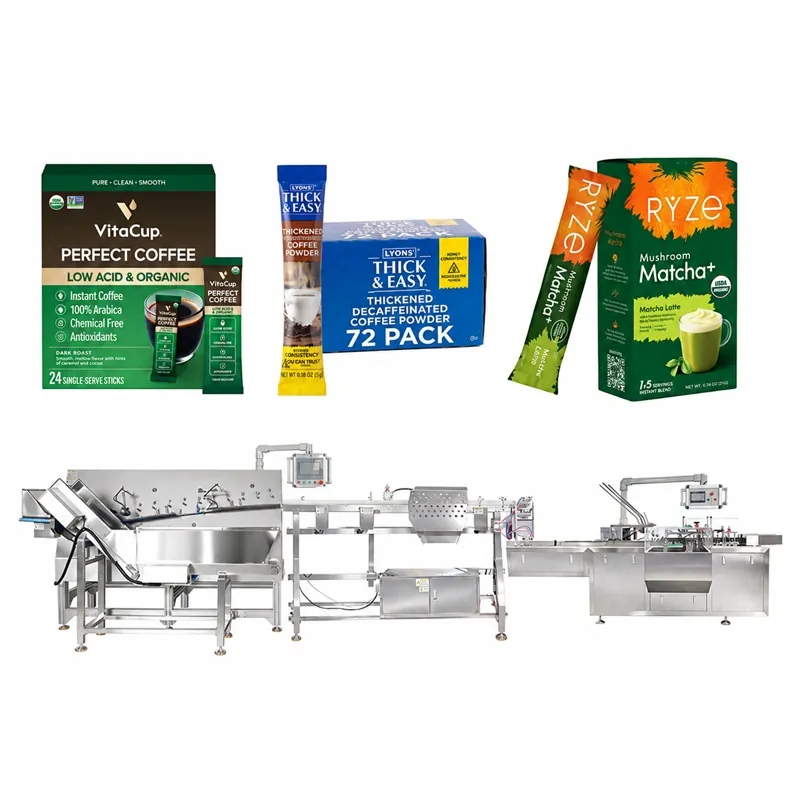
Catalog cartoning equipment shown beneath boxed stick pack examples
Use the cartoning machine guide to describe the carton and closing requirement. For a stick line, the downstream brief also needs the number of sticks per group, how they are presented, and what should happen to incomplete groups or rejected packs. These are requirements to agree, not a claim that every stick pack machine already performs them.
- Show the intended handover: loose discharge, conveyor, counted group or cartoner infeed.
- Identify who supplies the transfer equipment and who coordinates controls and stop signals.
- Name the included carton formats, inserts and closing method when a cartoner is required.
- Agree whether acceptance covers only the primary machine or the connected equipment running together.
A machine quote and a connected-line quote can both be valid offers. The comparison becomes useful when the operations they cover are visible, and the remaining buyer work has its own place in the budget. Keep the same handover drawing with both proposals so responsibility cannot disappear between documents.
How can you compare two quotations without hiding omissions?
Use a shared scope sheet and give every required item a status: included, separately priced, excluded or unresolved. Apply the same product, pack list, output basis and site boundary to each offer. Then compare totals only for a scope whose remaining differences you can identify and cost.
Record a brief scope description and status for each offer, together with its quotation clause or attached drawing. Split a combined line when its components have different inclusion statuses. Mark a requirement that does not apply as such, with the reason; keep an unpriced required item unresolved.
| Required item | Quote A scope / status | Quote B scope / status | Document reference / open difference |
|---|---|---|---|
| Product, fill and dosing arrangement | Enter scope and status | Enter scope and status | Quote clause / unresolved difference |
| Lanes and initial format tooling | Enter scope and status | Enter scope and status | Quote clause / unresolved difference |
| Additional formats and change parts | Enter scope and status | Enter scope and status | Quote clause / unresolved difference |
| Film and good-output acceptance basis | Enter scope and status | Enter scope and status | Quote clause / unresolved difference |
| Product-contact materials and cleaning | Enter scope and status | Enter scope and status | Quote clause / unresolved difference |
| Dust extraction, if required | Enter scope and status | Enter scope and status | Quote clause / unresolved difference |
| Nitrogen flushing, if required | Enter scope and status | Enter scope and status | Quote clause / unresolved difference |
| Coding / printed-film registration, as applicable | Enter scope and status | Enter scope and status | Quote clause / unresolved difference |
| Product-feed equipment | Enter scope and status | Enter scope and status | Quote clause / unresolved difference |
| Discharge / counting / cartoning equipment | Enter scope and status | Enter scope and status | Quote clause / unresolved difference |
| Transfer interfaces and responsibilities | Enter scope and status | Enter scope and status | Quote clause / unresolved difference |
| Packing, delivery terms and destination | Enter scope and status | Enter scope and status | Quote clause / unresolved difference |
| Buyer site work | Enter scope and status | Enter scope and status | Quote clause / unresolved difference |
| Installation and training arrangements | Enter scope and status | Enter scope and status | Quote clause / unresolved difference |
| Tests, records and documentation | Enter scope and status | Enter scope and status | Quote clause / unresolved difference |
For uncertain material behavior, sample-testing preparation explains how to agree the product, film, configuration and measurements. A short trial helps answer the agreed questions; keep its conditions with the result instead of treating it as evidence of long-term output.
A practical review can reveal that one offer includes a feeder while another expects buyer-supplied product feed, or that one includes only the first format. Ask for the missing scope in writing and record any buyer work separately before deciding which proposal fits the project.
What belongs in an equipment ownership-cost review?
Keep the purchase and delivered-installation budget separate from the costs of operating the equipment. Compare the same planning period, products and operating schedule. Use your own records and agreed project information for labor, utilities, consumables, cleaning and maintenance; leave unknown quantities open rather than inserting a generic savings percentage.
Write the common planning period, products, shifts and currency above your record before entering amounts. Keep one-time equipment and start-up amounts in their own subtotal. Record operating costs against the shared period; do not add amounts covering different periods or mix a measured production record with an assumed future saving.
| Cost category | Buyer amount / unknown | Period and basis | Source / date | Assumption note |
|---|---|---|---|---|
| Equipment acquisition — once | Enter quote amount / unknown | Same currency; quoted equipment scope | Quotation reference and date | Included options / unresolved items |
| Delivery and installation — once | Enter amount / unknown | Same destination and responsibility boundary | Quotation / buyer site estimate; date | Buyer work and separately priced services |
| Operators and cleaning — operating | Enter amount / unknown | Shared planning period and shift pattern | Staffing / cleaning records; date | Proposed staffing or cleaning changes |
| Utilities and consumables — operating | Enter amount / unknown | Shared period, equipment requirements and local rates | Site records / supplier requirements; date | Gas or coding scope where required |
| Maintenance and change parts — operating | Enter amount / unknown | Shared period, format mix and maintenance plan | Parts information / site records; date | Unconfirmed parts or future format needs |
| Stops and rejects — operating review | Enter measured record / unknown | Shared products and timed observation basis | Production or trial record; date | Separate observations from future assumptions |
The installation and training service outline helps define start-up responsibilities. Include site preparation and the operator-training arrangement stated in the agreement. Do not assume these are included in a machine-only offer or assign an installation fee before the proposal provides it.
Keep a note beside each entry saying whether it is a quotation amount, a site record or a planning assumption. If a quote changes, update the corresponding scope item rather than replacing the whole record with a headline total. Where operating costs are still unknown, compare the resolved equipment scope first and list the information needed to complete the ownership review.
When this does not apply
Use this framework for a defined multi-lane, roll-film stick pack project. A different pack route, unverified product behavior or a different cost boundary needs a separate assessment. Set these limits before using the comparison sheet to approve a budget.
- Premade pouches, bottles, sachets with another seal layout and cartons involve different equipment requirements. Confirm the actual finished pack first.
- A catalog configuration or photograph does not establish your fill tolerance, cleaning result or long-term accepted output.
- A proposed additional product, format or future expansion needs confirmation for the offered equipment; it is not assumed capacity.
- Transport, destination requirements and site work follow the agreed project terms. This guide supplies no duties, freight charges or delivery commitments.
- Prices, option availability, testing arrangements and support scope are settled through the project quotation and agreement. A general cost checklist does not settle them.
This guide supplies no market price range, production cost per stick, payback date or promised labor saving. Those estimates require a defined commercial scope and separate production and financial inputs. It sets no residual-oxygen value or shelf-life outcome.
Questions buyers ask before budgeting
What is a stick pack machine?
It forms, fills and seals narrow sticks from roll film. For budget purposes, ask which dosing unit, lanes, format tooling and feeding or discharge equipment the offered configuration includes. That equipment boundary is more useful than a generic machine label when comparing proposals.
What are stick packs used for?
The published range includes powders, granules and liquid products, with separate pump-dosed configurations for gels and sauces. State your actual product and fill, including dust, flow or viscosity as relevant. An application listing is a starting point for a quote discussion, not acceptance evidence for your product.
What is the difference between a sachet and a pack?
“Pack” is a broad word, so send a finished sample or drawing. Specify whether you need a narrow back-sealed stick or a flat sachet with another seal layout. Different forming and sealing requirements can change the machine and tooling being quoted; terminology alone does not settle the scope.
Which is the best packing machine?
For a purchase decision, shortlist equipment against the same product, formats, accepted-output requirement and site boundary. Ask the proposal to address unresolved material behavior and included operations. Choose from the documented scope and evidence; this guide does not rank machines or manufacturers.
What are the common problems with packing machines?
Risks to check include fill-weight variation, unstable feeding, powder or liquid reaching the seal area, and production stops. For purchase review, agree product-specific fill, seal and output checks using your production film, and keep the conditions with the results. The sample-testing service page explains how to prepare that review.
What are the disadvantages of automatic packing?
An ownership review needs to account for setup, cleaning, change parts, maintenance and operator tasks as well as purchase scope. Their effect depends on your products and operating schedule. Record those tasks and costs for the proposed arrangement rather than assuming automation removes them.
Method and sources
This equipment-budget framework uses LINEVO’s published stick pack family, powder and liquid application guides, configuration pages and project quotation and service descriptions, consulted on October 9, 2026. The tables organize the scope, responsibility and cost records a buyer can compare.
Listed configurations are equipment references. Product-specific capability, materials, options and acceptance conditions belong in the quotation and agreed checks. Ownership-cost entries come from the buyer’s records or explicitly stated planning assumptions.
What to send us
Send what you have and mark what is still undecided. We reply within 24 hours.
| Item | Why we need it | Example format |
|---|---|---|
| Product and target fill | Defines the dosing arrangement and the questions for application review | Product description, flow or viscosity information; fill in g or ml |
| All finished stick sizes and film | Defines the format tooling and film-handling requirement | Dimensioned drawing in mm, sample sticks and film data sheet |
| Good output and operating pattern | Frames lane selection and the output basis of the proposal | Good sticks per minute or shift, operating hours and format changes |
| Contact parts, cleaning and options | Separates the requested functions from the included equipment | Cleaning procedure; dust, gas, coding and material requirements |
| Product feed and downstream handling | Defines the equipment boundary and interfaces | Layout with loose discharge, counting, grouping or cartoning |
| Site, utilities and destination | Defines the electrical, delivery and start-up discussion | Country, power supply, available air, site layout and installation expectations |