
Start with the product and finished bag
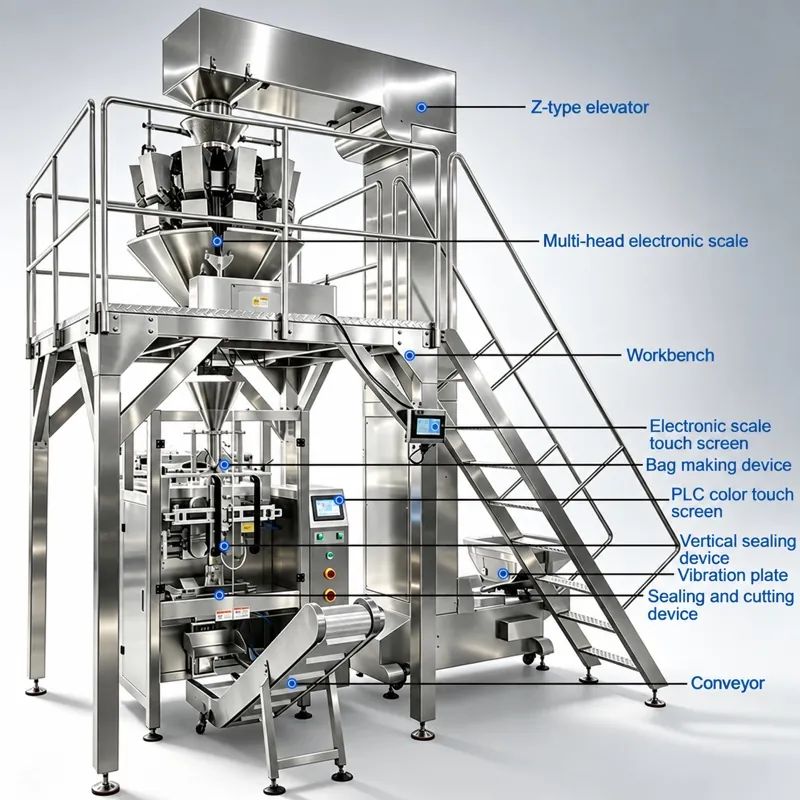
The equipment photograph above is an existing LINEVO catalog reference for the VFFS system with multihead weigher. It identifies the weighing, bag-forming and conveying stages; it does not show a trial of your snack or define the included project equipment.
| Selection input | What to establish |
|---|---|
| Product | Whole chips, puffed snacks, nuts or dried fruit; include fragile and sticky variants. |
| Portion | Every target weight and the acceptance tolerance. |
| Bag | Finished dimensions, seal layout and whether a zipper is required. |
| Material | Film structure, seal layer and a representative roll or supplier specification. |
| Output | Required good packs per minute under the agreed conditions. |
| Protection | Whether gas flushing, vacuum or another packaging approach is being considered. |
| Changeover | Product and bag-format changes, cleaning needs and schedule. |
| Site | Available height, access, utilities and downstream interface. |
This page focuses on loose snacks dosed into bags made from roll film. Use the VFFS family guide for the broader machine range. The process starts with product feed, then weighing, bag forming, filling and sealing; inspection and takeaway complete the agreed scope.
Takeaway: Choose the route from the actual product and bag before comparing machine names.
Separate roll-film bags from other snack formats
| Finished pack | Starting route | What changes |
|---|---|---|
| Loose chips or nuts in a roll-film bag | Vertical forming, filling and sealing | The forming set, film and dose must work together. |
| Ready-made zipper pouch | Premade pouch filling and sealing | Pouch opening, gripping and filling differ from making a bag from a roll. |
| An individual snack bar | Horizontal flow wrapping | The product is presented as an individual item through the wrapping infeed. |
A retail description such as “snack pouch” does not identify the machine. Compare the premade pouch route when the supplied empty pouch already has its shape or zipper. Use flow wrapping for individually presented bars and similar items.
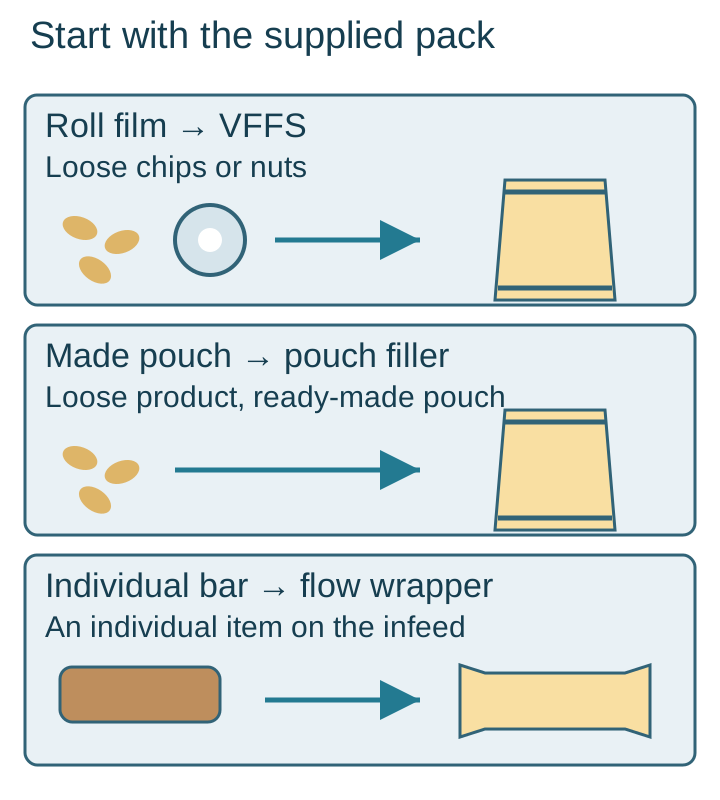
Common mistake: Choosing equipment from the package photograph without stating whether the empty pack arrives as roll film or as a made pouch.
Takeaway: Confirm how the empty package reaches the machine; similar-looking finished packs can require different equipment.
Review the whole product path for fragile snacks
Chips, puffed snacks and whole nuts do not behave identically during feeding and discharge. Describe piece size, how much fines or seasoning is present, whether the product bridges or sticks, and what counts as unacceptable damage. Do not use a generic accuracy figure to answer a breakage question.
The LINEVO catalog includes multihead-weigher configurations for these applications. For the general dosing choice, use the VFFS weighing overview. For the snack project, review the path from the upstream feed to the filled bag, including transfer points and the agreed discharge arrangement.
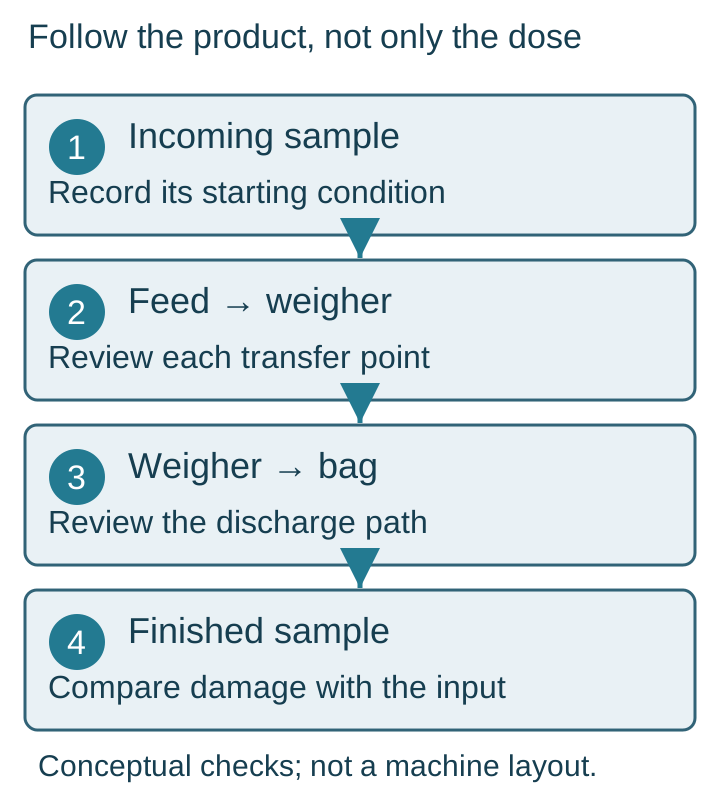
A practical trial brief states the condition of the incoming sample and the condition expected after packaging. Agree how samples are collected and how breakage is described before comparing results. Ask the team which checks can be included in sample testing; this page does not claim that a test has already been performed.
Takeaway: Evaluate the delivered product, not only the number of successful weighing cycles.
Snack bag materials and atmospheric protection
Laminated film is a common starting category for vertical snack bagging; OPP/CPP film also appears in snack flow-wrapping applications. These categories are not approvals for a LINEVO configuration. Film choice needs the finished product, storage and distribution conditions, seal requirements and the machine configuration. Ask the film supplier for the proposed structure and relevant barrier and sealing information. A material name alone does not establish that a roll will form, run and seal correctly.
| Question | Information to bring | Decision it supports |
|---|---|---|
| Will the film seal on the proposed setup? | Film structure, seal layer and sample roll | Review sealing conditions and contamination risks. |
| Is oxygen or moisture protection needed? | Product objective and intended storage/distribution conditions | Agree the pack-performance assessment with the appropriate specialists. |
| Is nitrogen flushing required? | Requested atmosphere and a proposed verification method | Define gas supply, flushing and finished-pack checks. |
| Can paper-based film run? | Actual laminate/coating and reel specification | Review the particular material; “paper-based” is not machine approval. |
| Would vacuum suit this product? | Product fragility and required pack appearance | Assess the product-specific alternative before specifying it. |
The catalog has a chip configuration listing nitrogen flushing and a separate dried-fruit vacuum configuration. These listings identify options for review. They do not establish a universal residual-oxygen level, a storage life or suitability for every snack.
When gas flushing is proposed, agree how the filled pack will be assessed alongside seal quality and film selection. Do not translate a gas-supply specification directly into a finished-pack result. A bag with a contaminated seal still needs investigation, even if gas was introduced during filling.
Common mistake: Treating nitrogen injection as evidence of a particular shelf life. A machine feature and a validated finished-product storage claim are different things.
Takeaway: Review film, sealing and atmosphere as one pack requirement; confirm the result under the agreed trial conditions.
Browse the snack and nut configurations
These eleven published LINEVO records group the available catalog references by product. Open a record to review its listed scope; an application name alone does not establish output, bag dimensions or suitability for your recipe.
Takeaway: Shortlist the product route, then supply samples and pack details to review the actual configuration.
Read a catalog value with its conditions
The following values belong only to the published VFFS system with multihead weigher, a nuts and dried-fruit reference configuration. They are not ratings for every chip or snack machine on this page.
| Published reference parameter | Catalog value | Conditions retained |
|---|---|---|
| Packing speed | 30–70 bags/min | Bag volume, target weight and material flow; verify with your product. |
| Bag length | 80–350 mm | Source bag-size range; proposed pack must match the forming set. |
| Bag width | 60–240 mm | Source range; tooling is reviewed for the proposed format. |
| Weighing accuracy | ±0.3–1.5 g | Product uniformity and blend ratio; not a universal filling guarantee. |
Other snack application records may list technical data on request. An application title does not justify copying the reference machine’s numbers into its specification. The quotation should identify the configuration, the conditions and the equipment included.
Takeaway: Keep each parameter attached to its named configuration and stated conditions.
What changes the quotation and line scope
A price comparison is useful only when the scope matches. Record the bagger, dosing unit, feed system, support structure, takeaway, gas equipment, coding, inspection, tooling, installation and support arrangements as included, optional or outside the quotation. Do not infer a complete line from the photograph of a bagger.
Product changes can affect contact surfaces, transfer arrangements, film settings and cleaning requirements. A stored recipe does not by itself demonstrate that a new product or bag format has been qualified. Put the complete product and format list into the brief, rather than adding the difficult variants after the quotation.
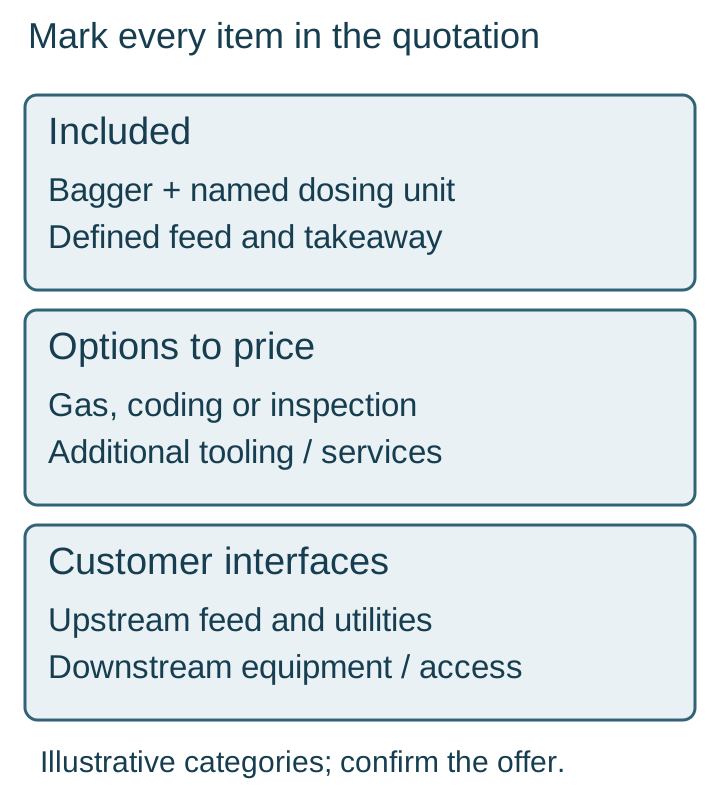
Use the project quotation checklist to organize the boundary. Installation support and spare parts address neighboring ownership questions; confirm their actual scope for your order.
Discuss the equipment boundary with LINEVO. Include the product list and a drawing or description of the existing upstream and downstream equipment.
Takeaway: Compare an agreed line scope and acceptance basis, not two unlabeled machine prices.
What to send us
| Item | Why we need it | Example format |
|---|---|---|
| Product and variants | Review flow, fragility and product changes | Named SKU list, photographs and representative sample description. |
| Portion and tolerance | Define what each pack must contain | Target weights with acceptable variation stated separately. |
| Finished bag | Identify forming and sealing requirements | Dimensioned drawing or physical sample; mark zipper or special seal. |
| Film information | Review the material that will run | Supplier data sheet and roll specification. |
| Required output | Define the operating target | Good packs per minute, planned operating hours and changeovers. |
| Pack protection | Describe the intended finished-product requirement | Requested gas or vacuum option and how the result will be checked. |
| Site and interfaces | Review physical and service connections | Room height, access drawing, utilities and connected equipment. |
Send the available information through the LINEVO project contact route. Mark unknown fields as unknown; a partial but accurate brief is more useful than guessed specifications. Agree any additional samples and test outputs with the team before sending materials.
Takeaway: Provide the actual product and pack information, and identify the decisions still open.
When this does not apply
This guide does not cover snack cooking, frying or extrusion, or a finished-product shelf-life validation. It does not specify a single configuration for every snack, and it does not claim a customer installation or completed trial.
Very sticky products, unusual film structures, fragile shapes or several mixed ingredients need a product-specific review. Where the chosen pack follows a different route, return to applications by product rather than stretching a roll-film recommendation to fit it.
Takeaway: Use the guide to prepare a bounded equipment discussion; resolve the remaining product-specific conditions in the project.
Frequently asked questions
How much does an automatic chips packing machine cost?
Request a project quotation for the purchase price. For your budget, keep recurring costs separate: packaging material, any gas supply, utilities, staffing and replacement parts. Ask which consumables have to be bought from the equipment supplier and which have an agreed local specification. This avoids mistaking the initial equipment payment for the operating budget; no cost or payback figure is estimated here.
What are the best food packaging machines for small businesses?
Start with available space, the operator’s tasks, actual product formats and required output. A smaller output target does not remove cleaning, bag-quality or product-handling requirements. Ask for a proposed scope matched to those inputs rather than a generic ranking.
Which sealing machine is best?
If you already fill the bags separately, the purchase may concern sealing alone rather than an integrated weighing and bagging line. Describe that existing process, how the filled bag is presented and whether product reaches the seal area. Send the actual bag material for a sealing assessment. This guide does not rank standalone sealers or confirm that LINEVO supplies one for your process.
What are the disadvantages of vacuum packing?
For a fragile snack, examine whether the proposed vacuum pack changes the shape or increases damage when the bag closes around the product. Compare representative finished samples with the incoming product, including after the intended handling. The dried-fruit vacuum listing is not evidence that the same approach suits chips. Leave vacuum out of the requirement until its effect on this product has been assessed.
What are the disadvantages of automatic packing?
The project adds setup, cleaning, changeover and equipment-support tasks, even where it automates portioning and bagging. Compare those responsibilities with your present process and staffing. Do not assume that automatic operation means no operator or no format adjustment.
What is the best potato chips machine for home use?
This page covers commercial packaging equipment for an existing snack product. It does not recommend a domestic chip cooker or provide food-production instructions. Distinguish making the chips from weighing and packaging them before requesting equipment.
Methods and sources
Updated October 2026. Product photographs and the explicitly attributed reference parameters come from LINEVO’s published catalog. The process diagrams are original explanations, not engineering layouts or images of a delivered project. No speed trial, breakage reduction, residual-oxygen measurement or customer result is claimed.
The six FAQ topics were selected from the US English snack-packaging and related packing/sealing search questions recorded on October 5, 2026. Vespa was queried and a weighing-machine article was read in full; it informed the review of feeding and dosing terminology, but its price, performance and compliance claims were not adopted. A separate archived snack-packaging article was read for the distinction between laminated vertical-bagging film and OPP/CPP flow-wrap film; it does not establish LINEVO compatibility. Company-specific statements are grounded in the linked LINEVO records. This guide was prepared with AI assistance and checked against those records; no first-hand trial is reported.
What to send us
Send what you have and mark what is still undecided. We reply within 24 hours.
| Item | Why we need it | Example format |
|---|---|---|
| Product and its behavior | Powder, granule, liquid, paste or solid pieces decide the dosing method and the parts that touch the product. | Free-flowing granules, with a photo of the product |
| Finished pack and fill | The pack style, its size and the fill per pack set the format and the dosing range. | Pillow bag, 100 × 150 mm, 50 g per bag |
| Target output | Output per minute or per shift decides the number of lanes and the model size. | 60 good packs per minute, one shift per day |
| Packaging material | Film or container type affects sealing, forming and the settings we confirm. | Laminated roll film, 250 mm wide, or the film datasheet |
| Site and destination | Power supply, compressed air and destination country decide the electrical and utility scope. | 380 V, 3-phase, 50 Hz, delivery to Germany |