
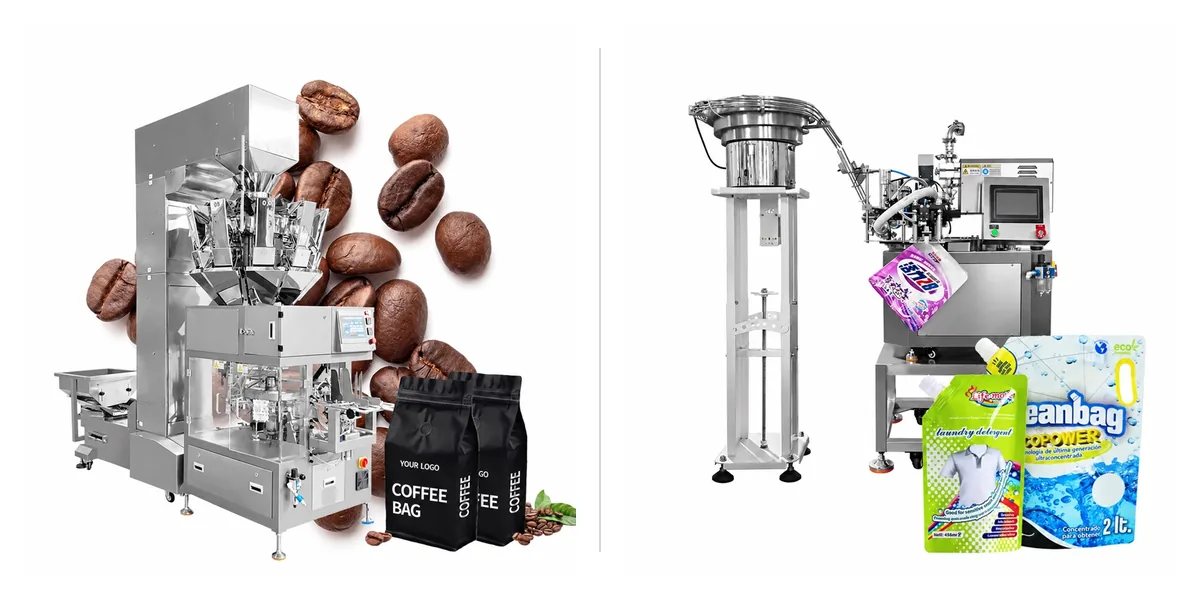
Two catalog premade pouch machines side by side: a pick-fill-seal machine with a multihead weigher and sealed stand-up pouches, and a spout pouch filler with a cap feeder and spout pouches.
LINEVO does not publish a price list for premade pouch machines. Each price comes in a quotation for a confirmed configuration, covering the model, filler, closure, change parts for each pouch size, options, checks, documents, delivery and support. To compare two offers, give both suppliers the same production pouch, product, target dose and closure. Then mark every line in the worksheets below as included, optional, separately quoted, excluded or unknown, and compare totals only once both offers cover the same complete requirement with confirmed amounts.
On this page
What sets a premade pouch machine price?
LINEVO prices a packaging machine in a quotation for the confirmed configuration; there is no fixed list to pick from. The quotation states the model and configuration, included and optional items, formats and change parts, utilities, checks before shipment, documents, delivery, support, price and the contracting entity. Any of those fields can differ between two suppliers, so each one needs its own line in your comparison.
For a pouch machine, the configuration starts with your pouch. On the premade pouch filling machines page, the proposal covers the machine model, the filling system, the grippers and change parts for each pouch size, and options such as zipper reclosing, coding or desiccant insertion. The quotation marks each of them as included, optional or still under review. Another supplier may use different words, but ask them for the same split.
The project brief checklist collects the inputs a quotation is built from. You can leave undecided items marked open at the first enquiry; they must be settled before the configuration is quoted.
Which pouch route is each offer quoting?
LINEVO’s premade pouch family has two routes. A pick-fill-seal machine, with the LV-210 as the reference model, picks each empty pouch from a magazine, opens it, fills it and heat-seals the top. A spout pouch filler, with the LV-160 as the reference model, typically holds the pouch by the spout, fills through it and closes it with a cap. Because the closing work differs, an offer for one route cannot be priced against an offer for the other as if both did the same job.
The catalog listings show where machine scope stops. The LV-210 weighing and filling configuration lists premade pouch retrieval, opening and sealing as included equipment. Its weighing and filling arrangement, zipper handling, feeding and product change parts are listed as requirements to review. A machine price on that route tells you nothing about the weigher until the offer names it.
The LV-160 laundry liquid spout pouch configuration lists automatic bag loading, lid feeding and lid screwing, with no separate filling step in its listed sequence. Ask the offer to state the filling equipment, spout diameter, cap type and whether capping is included. For viscous products, the premade pouch sauce configuration lists servo piston dosing with an anti-drip nozzle; quote that dosing as its own line.


Schematic of two premade pouch routes. In each, product supply and the filler feed the pouch machine; a checkweigher, metal detector or conveyor after the machine is added only if required. The pick-fill-seal route closes a stand-up pouch with a heat-sealed top; the spout pouch route closes a spout pouch with a screwed cap. Every box is a separate quotation line to mark included, optional, separate, excluded or unknown.
Equipment worksheet for Supplier A and Supplier B
Copy the table into your own sheet or print the page. For each row, enter the status from the offer and the clause or page where it appears. Use one of five statuses:
- Included: named in the offer and covered by its price
- Optional: offered as an option, with or without a separate amount
- Separately quoted: priced in another quotation or by another supplier
- Excluded: stated as outside the supply
- Unknown: not mentioned, so ask before comparing
| Item | Shared requirement | Supplier A: status and clause | Supplier B: status and clause | Question to close |
|---|---|---|---|---|
| Route and model | Pick-fill-seal or spout pouch route, with the model reference | Enter status and clause | Enter status and clause | Is the model confirmed for every pouch size on the shared basis? |
| Pouch feeding, opening and zipper | Magazine feeding and opening for the production pouch; zipper opening and reclosing if required | Enter status and clause | Enter status and clause | Is zipper handling in the machine price or listed for review? |
| Filler and product supply | Weigher, auger, pump or piston filler for the target dose, and the product feed to it | Enter status and clause | Enter status and clause | Who supplies the filler and the product feed, and who connects them? |
| Seal or cap closure | Heat-sealed top, or cap feeding and screwing for the stated spout and cap | Enter status and clause | Enter status and clause | Do both offers quote the same closure work? |
| Grippers and change parts | Grippers or holders and settings for each pouch size | Enter status and clause | Enter status and clause | Which sizes are covered by included parts, and which need extra parts? |
| Coding and requested options | Coding, desiccant insertion or air removal, as requested | Enter status and clause | Enter status and clause | Which requested options are priced, and which are only mentioned? |
| Failure handling and inspection | No-pouch and no-fill handling, rejection of suspect seals or weights; checkweigher or metal detector after the machine if required | Enter status and clause | Enter status and clause | Is each function listed as included or optional? |
| Connected equipment and interfaces | Conveyors, platforms, product feed and links to existing equipment | Enter status and clause | Enter status and clause | Where does each supplier’s supply stop, and who integrates the line? |
Project worksheet: testing, start-up and support
The offer also sets what happens between order and production. LINEVO’s ordering steps run from the quotation and project agreement through build, an agreed check before shipment, shipping, and installation and training as arranged. Compare these items with the same five statuses.
| Item | Shared requirement | Supplier A: status and clause | Supplier B: status and clause | Question to close |
|---|---|---|---|---|
| Sample test | Agreed product and pouch quantities, the configuration, and how fill, seal and output will be judged | Enter status and clause | Enter status and clause | What will the test record show, and are packed samples returned? |
| Check before shipment | Production pouches and criteria agreed in advance, and the record you receive | Enter status and clause | Enter status and clause | Which criteria, which pouches and which record? |
| Packing, shipping and destination | Export packing, packing list, shipping terms, destination charges and import documents | Enter status and clause | Enter status and clause | Where does the supplier’s delivery responsibility end? |
| Installation and commissioning | On-site or remote support, schedule and any separate costs | Enter status and clause | Enter status and clause | Who attends, for how long, and at what cost? |
| Operator training | Magazine loading, gripper and size changes, cleaning and routine maintenance | Enter status and clause | Enter status and clause | Which people, which topics and which language? |
| Buyer site work | Power at the machine position, compressed air, floor, access route and connections | Enter status and clause | Enter status and clause | Which utilities and preparation does the buyer provide? |
| Manuals and named documents | Manuals, drawings, and any declaration or document your market requires | Enter status and clause | Enter status and clause | Is each document named in the quotation? |
| Recommended spare parts | Suction cups, sealing parts and size change parts for this configuration | Enter status and clause | Enter status and clause | Is a recommended spare parts list attached, and is any kit priced? |
| Support after start-up | Contact route, remote or on-site help, and languages | Enter status and clause | Enter status and clause | Which support is in the agreement, and which is charged separately? |
Sample testing preparation explains how to agree samples, measurements and the record before any material is shipped. Confirm quantities and shipping instructions with the supplier before you send pouches or product. The installation and training outline lists the site information to prepare, and notes that remote or on-site support, documentation, schedule and any separate costs are agreed for each project.
For spares, the spare and change parts page names suction cups and sealing parts as premade pouch wear parts, and grippers as the change part for each pouch width. Ask for the recommended list with the quotation and decide what to keep on site. Project and equipment support shows how these steps connect from enquiry to start-up.
Close the gaps before comparing totals
Resolve each row that differs between the two offers in this order:
- Point to the clause in each offer that covers the item, or record that neither mentions it.
- Ask who supplies, integrates and tests it. A filler bought from a third party still has to be connected to the pouch machine and checked with it.
- Decide where the item belongs: in the machine offer, in a separate quotation, or in your own scope.
- Ask the supplier for the missing amount and leave the cell open until it arrives, instead of estimating it from the other offer.
- Compare totals only when both offers cover the same complete requirement: the same quantities, functions and responsibilities, each with a confirmed amount. Add the options and separately quoted items you need from each supplier, plus the costs on your own side, and count each cost once even if one supplier includes it and the other prices it separately. While a needed row is still unknown, draw no conclusion from the totals.
If the open rows include product supply, conveyors or checks after the machine, the purchase is becoming a line project. Packaging line design and system planning covers how to define those connections as one scope.
When this worksheet does not apply
- Bags formed from roll film need different equipment and tooling. Compare vertical form fill seal machines for those.
- Narrow sticks made from roll film have their own scope sheet in the stick pack machine cost guide.
- If you fill pouches by hand today, manual pouch filling: when to automate helps you record the current process first. LINEVO supplies automatic machines and does not supply manual or tabletop pouch fillers.
- Cost per pouch, pouch material prices, payback and labor savings need your production and financial records. This worksheet covers equipment and project scope only.
This page gives no price figures, ranges or discounts. None of the catalog listings it cites establishes your fill tolerance, seal result or accepted output; those are settled in the quotation and the checks you agree.
Questions buyers ask about pouch machine prices
How much does a pouch packing machine cost?
LINEVO prices each machine in a quotation for the confirmed configuration, so this page has no list price to give. The amount depends on the route, filler, closure, pouch sizes, options and project services in the offer. Send the shared basis from this page to receive a figure you can compare.
Is a pouch sealing machine price comparable with a premade pouch machine price?
Usually not. A sealing machine closes pouches that are already filled. A premade pouch machine picks, opens, fills and seals each pouch, often with a filler mounted above it. A closure-only quote and a complete pick-fill-seal quote cover different work, so compare each against an offer for the same duty.
Does a doypack machine price include the filler?
Not necessarily. Doypack is the common name for a stand-up pouch with a bottom gusset. The filler is chosen for the product: a weigher, auger, pump or piston filler. The LV-210 listing names its weighing and filling arrangement as a requirement to review. Check that each offer names the filler and its range for your dose.
Is there a price for a small pouch packing machine?
A smaller automatic machine is quoted the same way as a larger one: against your pouch, product, dose, closure and accepted output, with no published price. LINEVO supplies automatic premade pouch machines and does not supply manual or tabletop pouch fillers. If your volumes are low, record your current hand-filling output and labor first; that record shows whether an automatic machine is the next step.
What should a liquid pouch packing machine quote cover?
It should name the liquid filler and the closure. On LINEVO’s premade pouch family page, sauces and beverages are filled by a pump, and the sauce configuration lists servo piston dosing with an anti-drip nozzle. Larger spout pouches of laundry liquid, detergent and beer are filled on the LV-160 spout route, which lists cap feeding and cap screwing. The fill level has to stay clear of the seal, and seal quality through a liquid-filled pouch is checked on a trial, so ask whether that trial is part of the offer.
Is there a pouch packing machine price list?
Not from LINEVO. You can start the order online by sending the project brief by email or WhatsApp, but price, delivery, installation, training and acceptance criteria are confirmed in the quotation and agreement for your configuration. Any base-model figure you see elsewhere still has to be checked against the filler, change parts and project rows in the worksheets on this page.
Method and sources
This worksheet uses LINEVO’s published premade pouch family page, the LV-210, LV-160 and sauce configuration pages, the project brief checklist and the sample testing, installation and spare parts pages, consulted on October 11, 2026. Catalog listings are equipment references; the scope of a given project is set by its quotation and agreement.
What to send us
Send what you have and mark what is still undecided. We reply within 24 hours.
| Item | Why we need it | Example format |
|---|---|---|
| Production pouches and drawing | Decides the grippers, opening method and change parts | Pouches from your supplier in each size, width × length in mm; quantity and shipping agreed before sending |
| Product and target dose | Selects the filler and its range | Product photo or data sheet; fill in g or ml per pouch |
| Closure | Sets the sealing, zipper or cap handling | Heat-sealed top, zipper, or spout diameter and cap type |
| Accepted output and changeovers | Used to review the configuration; filling stations are confirmed per product and dose | Good pouches per minute or shift; size changes per week |
| Open worksheet rows | Shows which items still need a status, clause or amount | Row name, Supplier A and B status, offer reference |
| Site and destination | Defines the utility, delivery and start-up scope | Country, voltage, phase and frequency, compressed air, layout |