
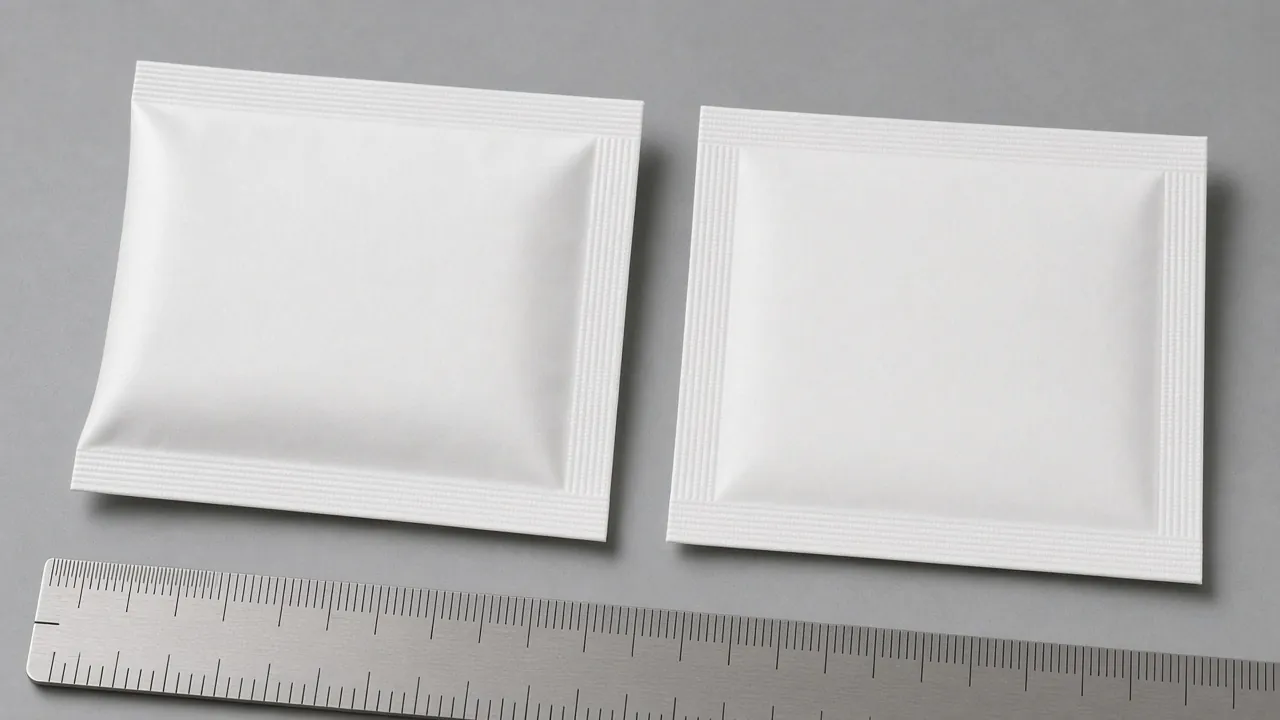
Two unprinted flat sachets on a bench beside a metal ruler, one with a folded edge and one sealed on every edge.
Choose a sachet packing machine from your product and finished sachet, not from lanes or speed. The product decides the dosing system, and the finished width and seal style decide the series and model. LINEVO lists six multi-lane sachet series, each in three model sizes at 2–4, 3–10 and 4–16 lanes and 20–40 cuts per minute (series listing, reread October 2026). These series tables do not specify a product-specific accepted output or fill accuracy. Confirm both in a sample test; request the price and included equipment in the quotation. The worksheet at the end records each decision, the evidence behind it and who closes it.
| Input | Where it comes from | What it decides |
|---|---|---|
| Product | Your description: powder, granule, liquid or paste; dust, bridging, particles or foam | Dosing system and series branch |
| Dose | Your target fill per sachet by weight or volume, and the tolerance you accept | Pump or auger size, and the fill check in the trial |
| Finished sachet | Width and length in mm, or a drawing or sample sachet | Three-side or four-side seal series, and model width |
| Features | Tear notch, coding position, print registration | Tooling and coding scope |
| Film | Film data sheet: laminate structure and sealing layer | Sealing conditions; whether the film needs a trial |
| Accepted output | Good sachets per agreed window, average and peak | Lane count and model size |
| Site | Cleaning method, hazardous-area rules for alcohol products, utilities, downstream handling | Cleaning scope, electrical scope and line boundary |
On this page
Is a multi-lane sachet machine the right family for your pack?
Use this guide when the pack is a flat single-portion sachet, formed from roll film and sealed on three or four sides. Settle the pack format before you compare any machine, because a different pack means a different machine family.
- Narrow back-sealed stick: a separate family. If you are still choosing between the two, read stick pack vs sachet first.
- Premade pouch (stand-up, zipper or spouted): it arrives already formed and runs on premade pouch machines.
- Tea in an inner bag and outer envelope: a separate process within the sachet family, not a flat three- or four-side sachet.
- Single-lane or benchtop sachet machine: not listed in the LINEVO sachet family. Apart from the tea machines, every listed configuration is multi-lane.
For the definition of a sachet and the seal-style boundary with sticks and pouches, read what a sachet is.
Step 1 — Which product facts decide the dosing system?
The product decides the dosing system, and the dosing system decides which series you compare. On the LINEVO configurations, liquids and pastes are dosed by piston or lobe pump, powders by servo auger, and granules by volumetric dosing. Write the product facts below before you look at lane counts.
| Product | What you write down | Listed dosing and series |
|---|---|---|
| Fine, dry powder | Flow, dust, bridging, bulk density if measured, dose and tolerance | Servo auger; three-side F or four-side SF series |
| Sauce, paste or viscous liquid | Viscosity at the filling temperature, particles, foaming, dose and tolerance | Piston or lobe pump; three-side Y or four-side SY series |
| Granule | Granule size, bulk density, whether pieces break, dose and tolerance | Volumetric dosing; three-side K or four-side SK series |
| Thin, free-flowing liquid | Viscosity, foaming, dose and tolerance | Listed for the back-seal stick series instead; the sachet series is confirmed with your own product |
Describe a fine powder precisely even when it seems simple. Fill-Package’s powder sachet guide describes changes in bulk density between batches, airborne particles during filling and bridging in the hopper. Those are the behaviors a trial has to watch, and they are why "milk powder" alone is not enough of a description.
For liquids, foam, drips or splashes can contaminate the seal area and interfere with sealing. Several LINEVO liquid configurations list an independent piston pump per lane, suck-back nozzles against dripping, and anti-foaming nozzles for foaming products. That is a configuration listing, so ask whether your quoted machine includes it.
For alcohol-based products such as hand sanitizer, send your site's hazardous-area rules. One configuration is listed with anti-explosion safety features, but the catalog does not state their scope.
The powder stick pack and sachet guide and the liquid and sauce guide list the product data each branch needs first.
Step 2 — What finished sachet size and seal style do you need?
Give the finished sachet width and length, not the flat film. The width and the seal style together pick the series and the model, and a size outside the listed range needs a separate review.
| Product branch | Three-side seal | Four-side seal |
|---|---|---|
| Powder (F / SF) | 25–110 × 50–150 mm | 50–125 × 45–160 mm |
| Sauce and paste (Y / SY) | 17–110 × 50–180 mm | 50–125 × 45–160 mm |
| Granule (K / SK) | 25–110 × 50–150 mm | 50–125 × 45–160 mm |
The three-side widths are the range of the largest model; the two smaller models stop at 75 mm and 100 mm. For powders, a sachet from 25 mm to under 50 mm wide is listed only on the three-side F series, and one over 110 mm up to 125 mm only on the four-side SF series. In between, compare the two by seal style and machine size. Widths outside 25–125 mm are not listed for powder.
Ruida’s sachet machine buying notes ask buyers to specify the finished width, length and seal style. Omag’s four-side seal overview describes that format as heat-sealed on all four sides.

The backs of two unprinted sachets, with seal bands along the edges.
Record the features with the size:
- Tear notch, perforation and the opening the user needs
- Coding position for batch or date codes
- Print registration and the eye-mark position, if the cut follows a printed mark
- Product headspace inside the finished sachet
- Every sachet size the line must run
Hanging holes, display windows and shaped sachets are not described in the LINEVO catalog, so list them as open questions. The catalog also does not describe changing between sachet sizes. Sachet width is tied to the film width and lane layout, so ask which forming parts each size change needs.
Step 3 — Which film will the trial use?
Choose the film with the product, not after the machine. Sealing conditions depend on the film's sealing layer and on how your product behaves against it, especially alcohol, oils and fragrances.
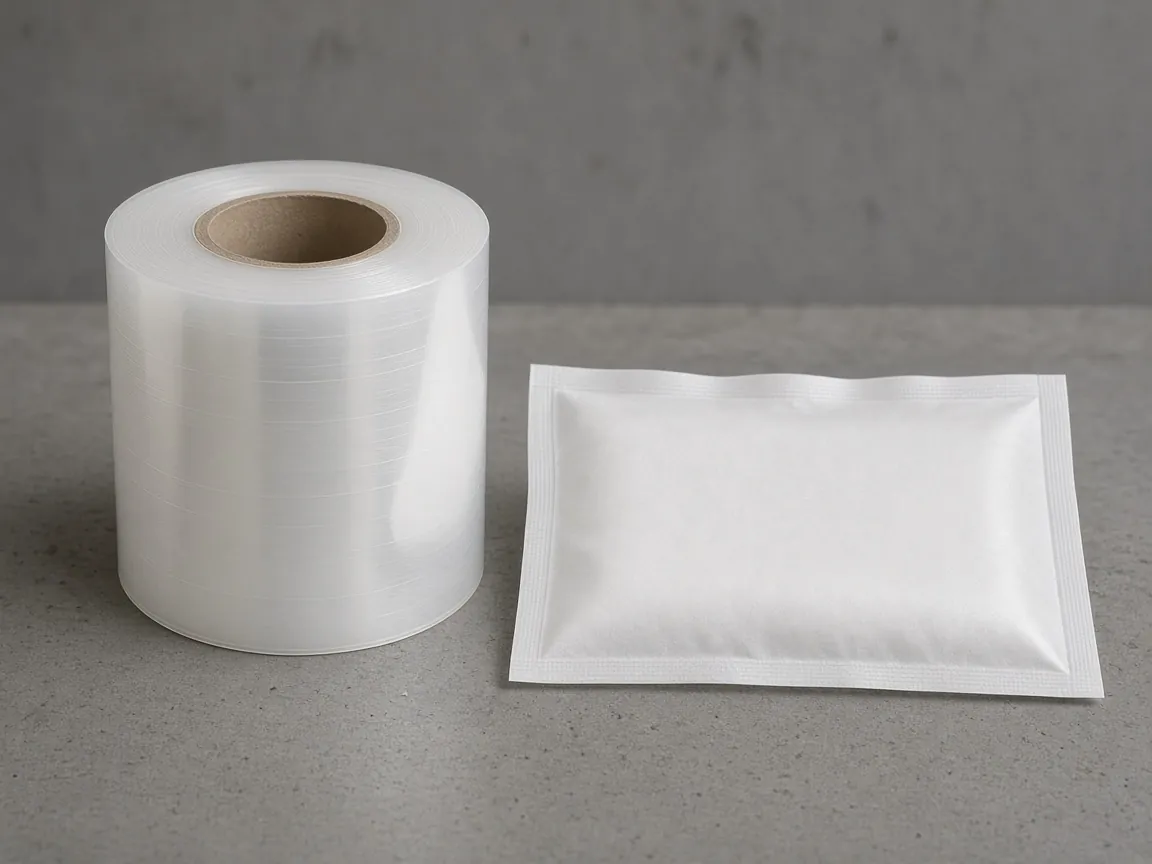
A clear unprinted film roll next to a blank flat sachet on a bench.
The LINEVO granule configuration lists OPP/CPP, PT/PE, KOP/CPP, aluminum foil, paper/PE and other laminates, and a liquid personal care configuration lists multi-layer high-barrier laminates. Recyclable single-material, compostable and other paper-based films are not described. If you plan to use one, its sealing is tested with your product rather than assumed.
Send the film data sheet with the product data so dosing, product clearance from the seal and sealing conditions are reviewed as one configuration. A film listed on one configuration does not carry over to every sachet machine.
Step 4 — How many lanes, and how will you count accepted output?
Lane count follows the sachet width and the film width the machine accepts; output follows the lane count and the cut rate. State the good sachets you need, and the window you will count them in, before you compare offers.
A cut is one knife cycle across the film. All six LINEVO sachet series are listed at 20–40 cuts per minute, so sachets formed per minute are at most the cut rate multiplied by the running lanes. The real figure depends on the product, the fill and the sachet length, and it is confirmed in a sample test.
Count good sachets as the sachets formed in an agreed window minus the rejects counted in that same window. Count formed sachets from the actual cycles in the window, which already reflect any stops, so do not deduct stopped time a second time. Ruida’s buying notes also advise stating both your average and peak required rates.
| Item | Listed value | Condition |
|---|---|---|
| Lanes per model size | 2–4, 3–10, 4–16 | Series listing; lane count chosen per project |
| Cut rate | 20–40 cuts per minute | Series listing for all six series; one cut is one knife cycle |
| Sachets per minute | Depends on lanes, sachet size, product and film; quoted for your case | |
| Fill accuracy | Depends on product, dose and dosing method; established in a trial | |
| Change parts per size | Not described in the catalog; ask per listed size | |
| Utilities and footprint | Listed for only some configurations; give your site limits | |
| Price | Not published; see the cost guide for quote scope |
Price is a separate decision. Once the configuration fits, compare offers on the same scope with the sachet packing machine cost worksheet.
Step 5 — What does the site have to confirm?
Put your plant's limits beside the offer before you treat a configuration as installable. These are inputs from your site, and the quotation has to answer each one.
- Cleaning: your cleaning method and frequency for product-contact parts. Some configurations, such as one mustard sachet configuration, are described as ready for cleaning in place with quick-release sanitary fittings. That is a listing for those configurations, so ask which parts are cleaned in place and which are removed.
- Contact parts: stainless steel contact parts are listed in SUS304 or SUS316, and SUS316 is an option on the LV-450X. State your requirement.
- Hazardous area: for alcohol-based products, your site rules, so the electrical design can be confirmed against them.
- Utilities and space: power, compressed air and floor space, because these are listed for only some configurations.
- Downstream: how sachets leave the machine and whether counting and cartoning are part of the project.
Step 6 — What should the sample test prove?
A sample test confirms how your product and film behave on the proposed configuration. Agree before the test what it must establish and how each result is judged, so the test answers your open rows instead of producing a general demonstration.
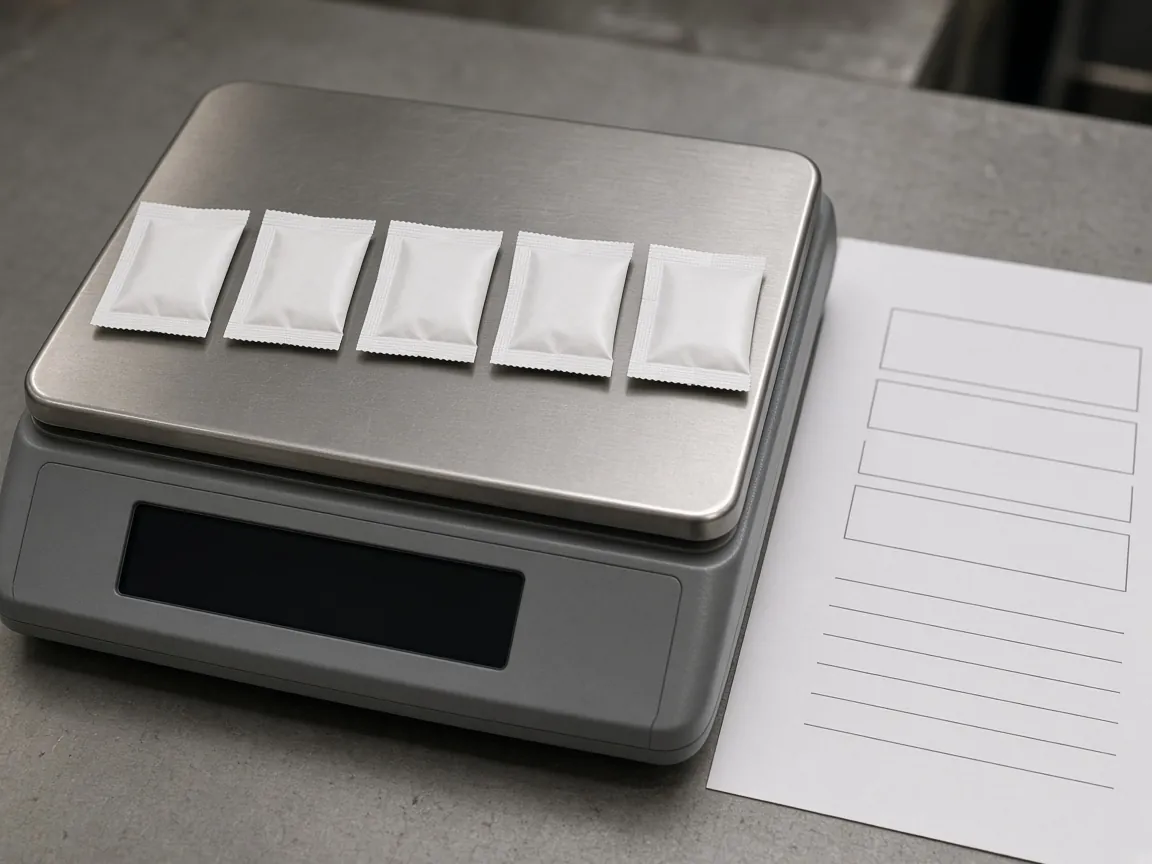
Five unprinted flat sachets on a scale tray beside a blank sheet.
- Fill: how many sachets are sampled from each lane, the individual net fill after accounting for packaging tare, and the agreed target and tolerance.
- Seal: whether sachets are checked visually, by hand, or by a leak or drop check you specify.
- Output: whether the figure is sachets formed or good sachets over a timed run, with stops and rejects recorded.
- Materials: product from a normal batch and film in the production specification, printed if registration matters.
A useful test record names the product, packaging material, machine configuration, settings and observations. A short test does not by itself establish long-term output, the result with another batch or film, or the performance of units that were not in the test. See sample-testing preparation for what to agree before shipping, and agree quantities and the address before any sample is sent.
The sachet selection worksheet
Copy both tables into your own sheet. Each row is one decision from the steps above. Fill "Evidence available" only with a document or record you hold, name an owner for every open question, and leave a cell blank until it is answered. A blank cell is unresolved.
| Decision | Input required | Evidence available | Unresolved question | Owner |
|---|---|---|---|---|
| Pack family | Flat three- or four-side sachet from roll film confirmed | |||
| Dosing system | Product form and behavior, dose and tolerance | |||
| Series and seal style | Finished width, length and seal style | |||
| Features and sizes | Tear notch, coding position, registration, every size run | |||
| Film | Film data sheet with sealing layer | |||
| Lanes and output | Good sachets per named window, average and peak | |||
| Site | Cleaning, contact parts, hazardous area, utilities, downstream |
| Decision | Sample check | Accepted-pack definition |
|---|---|---|
| Dosing system | Individual net fills checked per lane, with packaging tare accounted for, against the agreed target and tolerance | |
| Series and seal style | Finished sachets measured against the drawing | |
| Features and sizes | Notch, code and print position checked on finished sachets | |
| Film | Seals checked by the agreed method with your product | |
| Lanes and output | Formed and rejected sachets counted in the same timed window |
Write the accepted-pack definition yourself, in measurable terms: the dose tolerance, the seal check it must pass, and the dimensions and features it must have. The supplier's test is then judged against your definition, not against a catalog figure.
When this guide does not apply
- Back-seal stick packs, premade pouches and inner-and-outer tea bags: different machines.
- Single-lane or benchtop sachet machines: not listed in the LINEVO sachet family.
- Budgets, quote comparison and price: use the cost worksheet.
- Faults on a machine already running: use the sachet troubleshooting log.
- A product or film that is not yet representative: settle the recipe and film before closing the worksheet.
What to send, and what happens next
Send your product description, dose and tolerance, finished sachet size and seal style, film data sheet, the good sachets you need per window, and your site limits. Mark anything undecided as open. The team uses that record to suggest a series, model and lane count and to say whether a sample test is needed before quoting. We reply within 24 hours.
[Send your sachet selection worksheet](/go/whatsapp?source=%2Fresources%2Fsachet-packing-machine-buying-guide&locale=en&intent=quote&campaign=guide)
Method and sources
Series ranges, lane bands and cut rates come from the LINEVO sachet machine overview and the linked powder and liquid series tables, checked October 14, 2026. These are catalog ranges; configuration figures apply only to the named configuration. Sample-testing preparation explains what to agree before a trial.
The linked Fill-Package, Ruida and Omag pages support the powder-handling, buyer-input and seal-format explanations. Their machine ratings and commercial terms do not describe LINEVO equipment. Images on this page illustrate pack and inspection concepts; they are not records of a LINEVO sample test.
What to send us
Send what you have and mark what is still undecided. We reply within 24 hours.
| Item | Why we need it | Example format |
|---|---|---|
| Product | Selects the dosing system and series branch | Powder, granule, liquid or paste; dust, bridging, particles or foam if known |
| Dose and tolerance | Sets the pump or auger and the fill check | 10 ml or 5 g, with your tolerance, or "not decided" |
| Finished sachet and seal style | Selects the three- or four-side series and model width | Three-side seal, 50 × 80 mm, or a drawing or sample sachet |
| Film | Decides sealing conditions with your product | Film data sheet: laminate structure and sealing layer |
| Accepted output | Decides lane count and model size | Good sachets per shift, average and peak |
| Site limits | Sets cleaning, electrical and line-boundary scope | Cleaning method, hazardous-area rules, power, compressed air, floor space, downstream handling |