
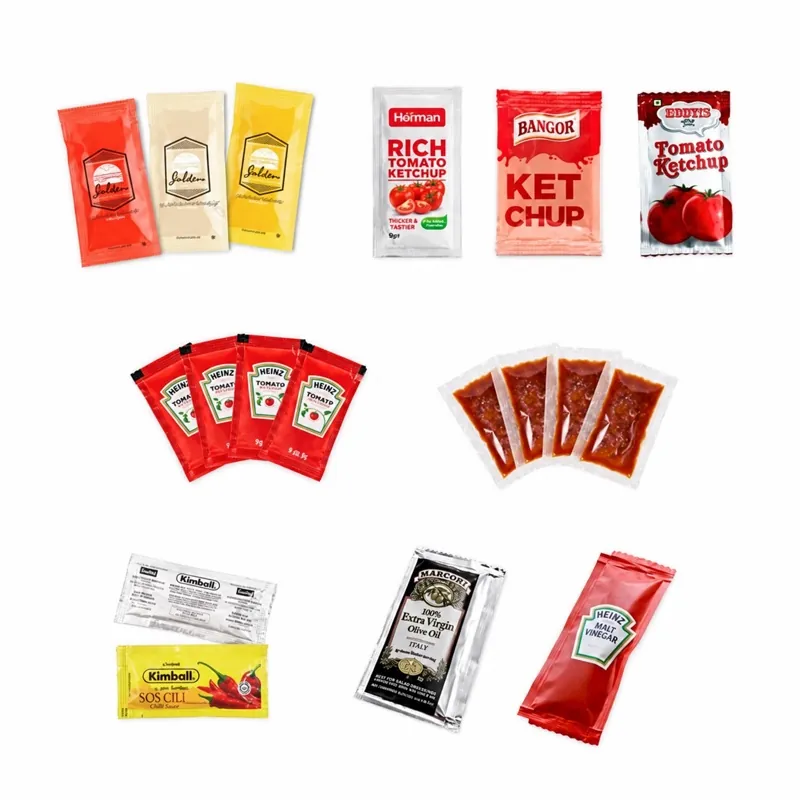
Catalog photograph showing small ketchup, mustard and other condiment sachets in several shapes.
A sachet packages a portion; the name does not prescribe a fill weight, a seal style or a material. Identify the product, count the sealed edges and measure the finished pack before choosing equipment. The tables below connect familiar packets with the seal styles and dimensions already listed in the LINEVO catalog.
- Three-side and four-side seals make flat sachets; back seals are common on narrow sticks.
- A finished-pack width is different from the film reel width.
- Roll-film forming and filling is a different route from filling purchased premade pouches.
On this page
What does sachet mean in packaging?
In this article, sachet means the flexible packet around a measured portion, rather than the contents themselves. A condiment packet, a drink-powder portion and a cosmetic sample can all be sachets. The Merriam-Webster definition distinguishes the small packet meaning from a bag of scented material.
A sachet is often opened once to dispense its contents. The drawing still needs to specify the tear feature, opening position and usable fill space. A rectangular outline alone does not tell you whether the pack is made from folded film, two film faces or a narrow formed tube. Those details change the forming and sealing parts on a sachet packing machine.
In US foodservice, packet is a familiar word for these small condiment packs. Pouch is a broader term for flexible packaging, including larger retail formats. Use the finished sample and its dimensions to communicate with a film supplier or machine builder; relying on the everyday name can hide a different manufacturing route.
Three-side seal, four-side seal or back seal?
Three-side seal sachets have a fold along one edge and sealed edges on the other three sides. Four-side seal sachets have a sealed perimeter on all four sides. Back-sealed packs have a longitudinal seam on the back and seals across the ends; a long, narrow example is commonly called a stick pack.
| Seal construction | What you can identify on the pack | Listed finished width | Corresponding LINEVO series |
|---|---|---|---|
| Back seal: powders | Long seam plus two end seals | 20–105 mm across series sizes | LV-400BF / LV-680BF / LV-980BF |
| Back seal: granules | Narrow pour-out stick | 20–105 mm across series sizes | LV-400BK / LV-680BK / LV-980BK |
| Back seal: free-flowing liquids | Narrow liquid stick | 20–105 mm across series sizes | LV-400BY / LV-680BY / LV-980BY |
| Three-side seal: powders | Folded edge plus three sealed edges | 25–110 mm across series sizes | LV-400F / LV-680F / LV-980F |
| Three-side seal: granules | Flat granule sachet | 25–110 mm across series sizes | LV-400K / LV-680K / LV-980K |
| Three-side seal: sauces and pastes | Flat sauce sachet | 17–110 mm across series sizes | LV-400Y / LV-680Y / LV-980Y |
| Four-side seal: powders | Four sealed perimeter edges | 50–125 mm listed series range | LV-500SF / LV-700SF / LV-980SF |
| Four-side seal: granules | Four sealed perimeter edges | 50–125 mm listed series range | LV-500SK / LV-700SK / LV-980SK |
| Four-side seal: sauces and pastes | Four sealed perimeter edges | 50–125 mm listed series range | LV-500SY / LV-700SY / LV-980SY |
These are combined series ranges, not a claim that each model covers every width shown. For example, the back-seal series lists width limits of 20–65, 20–85 and 20–105 mm by model size. Use the model tables on the powder application page or liquid and sauce application page to check the smaller models and pack length. Width and lane count are selected together.
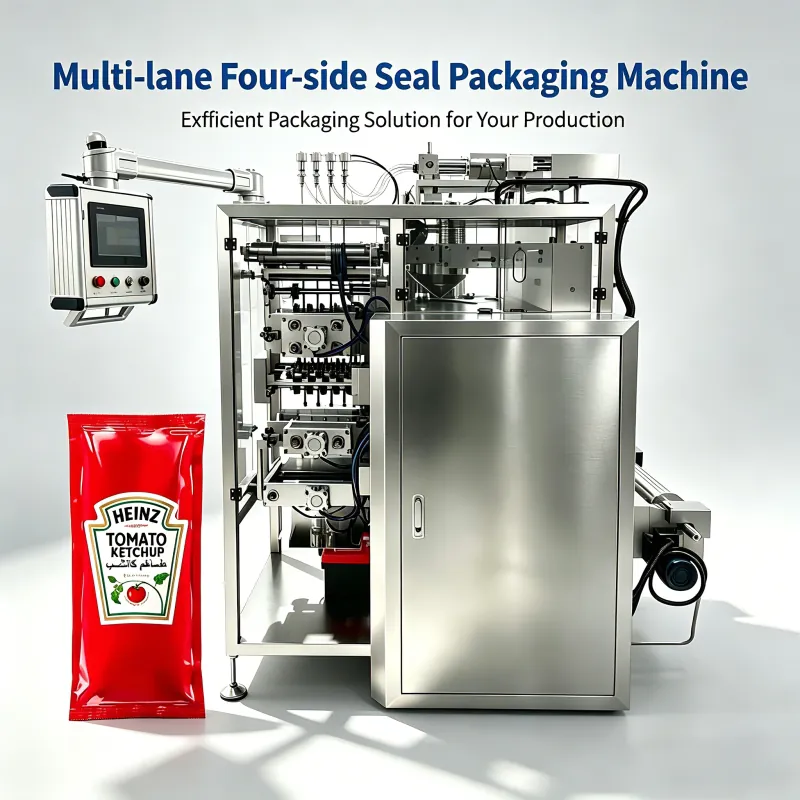
Catalog image of a four-side seal liquid sachet machine with a ketchup packet example.
Sachet, stick pack and premade pouch: where is the boundary?
A stick pack describes a long, narrow portion pack, usually with a back seal in the LINEVO listings. A sachet commonly describes a flatter packet, including three-side and four-side sealed forms. Premade identifies how the empty pouch arrives at the filler: already made by a converter, rather than formed around the product from roll film.
| Format | Starting packaging material | Typical use here | Next page |
|---|---|---|---|
| Flat sachet | Roll film formed, filled and sealed | Condiments, samples, powders | Sachet family |
| Narrow stick pack | Roll film formed into narrow packs | Pour-out powder or liquid portions | Stick pack family |
| Premade pouch | Purchased finished empty pouch | Larger pouches, zipper or spout routes | Premade pouch formats |
These categories describe different attributes, so words can overlap in a packaging brief. A small flat pack might be supplied premade; that does not make its filling process identical to a roll-film sachet machine. Record whether the supplier sends reels or empty pouches. For purchased pouches, the premade pouch machine family addresses opening, holding, filling and closing.
Which products fit the listed series?
The dosing system follows the product: powders are metered by an auger, granule configurations use volumetric dosing, and liquid or sauce configurations use pumps. Product behavior then determines which listed configuration is worth reviewing. Powder density, granule size, liquid viscosity and particles in a sauce affect filling and how cleanly the seal area stays clear.
| Product group | Catalog route | What to describe |
|---|---|---|
| Fine powders such as coffee, creamer or drink mixes | BF back seal; F three-side; SF four-side | Bulk density, dust, target grams and fill tolerance |
| Free-flowing granules such as sugar or salt | BK back seal; K three-side; SK four-side | Granule size, flow and target dose |
| Ketchup, tomato paste and viscous sauces | Y three-side; SY four-side | Viscosity at filling temperature, particles and target ml |
| Shampoo, lotion or other personal-care liquids | Specific listed liquid/cosmetic configurations | Product compatibility, cleaning and pump/nozzle needs |
For a concrete powder example, the milk creamer stick configuration is a route reference. For condiments, the four-side seal ketchup configuration lists ketchup, tomato paste, chili sauce and viscous liquids. A listed application is a starting point for evaluation, not evidence that your recipe has been trialed.
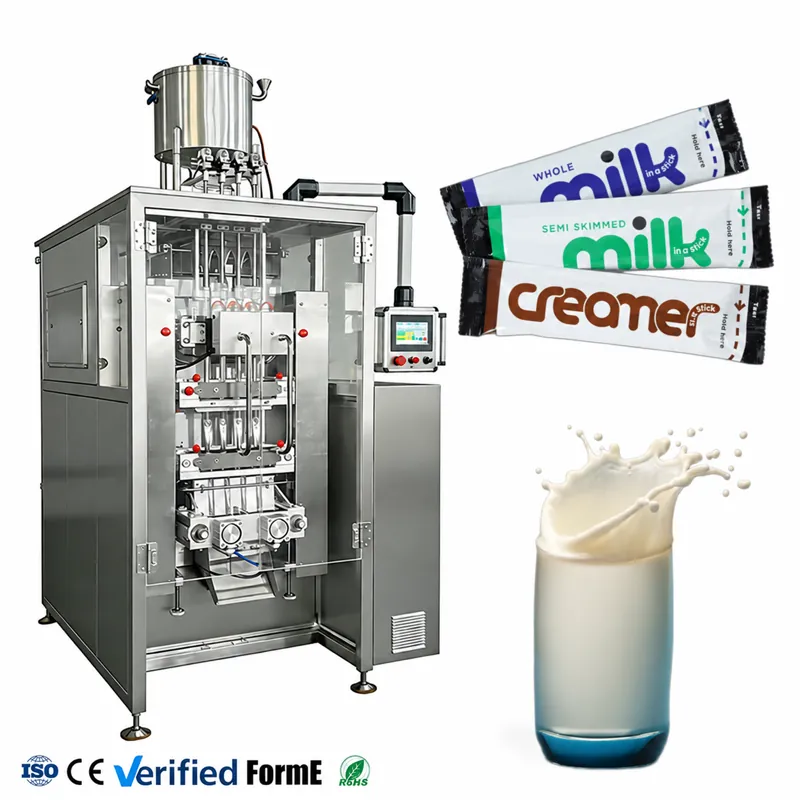
Catalog image of a multi-lane powder stick machine with a milk creamer pack example.
How are sachets made, filled and sealed?
A roll-film sachet machine brings together web handling, pack forming, dosing, sealing and cutting. In a multi-lane layout, several packs are made side by side from the film web. The material feed and the dosing unit must be synchronized so the intended portion lands inside the pack without occupying the seal band.
| Stage | What happens | What to check on a finished sample |
|---|---|---|
| Film unwind and registration | The reel feeds toward the forming parts; printed marks locate the artwork | Print position, reel specification and cut position |
| Forming and initial seals | Film is arranged for the specified seal style | Fold or back seam and empty fill space |
| Dosing | The auger, volumetric unit or pump releases the portion | Dose and clearance above the product |
| Closing and cutting | The remaining seal closes the pack and the web is separated | Seal continuity, tear feature and final dimensions |
| Coding and discharge | The specified coder marks the packs before handling or grouping | Legible code and correct batch relationship |
The multi-lane ketchup pump configuration illustrates a liquid dosing route. The sample-testing service explains how actual product, film and finished-pack expectations are reviewed. A film-only demonstration cannot establish dosing performance on your material.
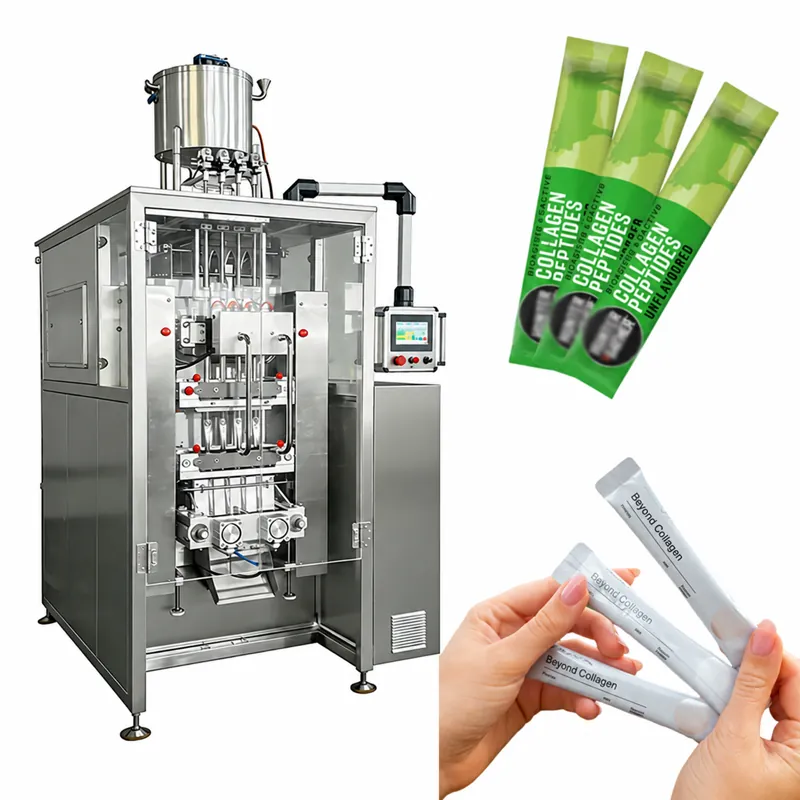
Catalog image of a back-seal powder stick machine with narrow finished-pack examples.
What is sachet film made from?
Sachet film can combine layers with different jobs: an outer surface for printing and handling, any needed barrier layer, and an inner layer that seals and contacts the product. The exact structure must come from the film data sheet. A metallic appearance alone does not identify aluminum foil, a metallized layer or the performance of the complete laminate.
| Catalog-listed material example | What the listing tells you | What still needs the supplier data sheet |
|---|---|---|
| OPP/CPP | A laminated structure listed for a granule configuration | Layer thicknesses and sealing conditions |
| PT/PE or paper/PE | Other structures in that same configuration listing | Material definitions, contact suitability and barrier values |
| KOP/CPP or aluminum foil | Additional listed packaging-material options | Full laminate construction, oxygen/moisture transmission and seal layer |
These material examples come from the Packing Material field of the four-lane solid-beverage granule configuration. They are not a universal approved-film list for all sauce or powder machines. A personal-care configuration separately lists multi-layer high-barrier laminates; product compatibility and the sealing layer still need review.
Ask the converter to identify the complete layer sequence and supply the sealing window, reel width, print repeat and registration-mark position. Packaging performance follows the finished laminate and seal, rather than the name of a single polymer. Make recyclability claims only with the material supplier and the relevant collection system; a small flexible packet is not automatically recyclable.
When this definition does not select the machine
The sachet name covers more than this roll-film packaging route. A scented fabric bag, a cooking spice sachet and a permeable infusion tea bag have different requirements. The LINEVO catalog includes tea-bag configurations with their own inner-and-outer bag process; the width table above is not a tea-bag specification.
- A large retail bag of nuts or snacks belongs to a different size and feeding review, often within vertical form fill seal.
- A purchased spout or zipper pouch starts from a completed empty pouch, so use the premade-pouch route.
- Manual or benchtop filling is outside LINEVO supply; automatic small-sachet equipment and individual stations can be reviewed.
- Shelf life, good output, film compatibility and size-change scope must be assessed for the actual product and configuration.
Sachet FAQ
What does 1 sachet mean?
It means one packet, not a fixed weight or volume. Read the net contents on the product label; in a machinery brief, give both the portion size and finished packet dimensions.
What is a sachet in pharmacy?
Collins defines the pharmaceutical sense as a sealed packet containing a liquid or powder product. That terminology does not establish that a food-packaging configuration meets pharmaceutical requirements; a medicinal product needs its own process and compliance review.
What are the drawbacks or limitations of sachet packaging?
Usable fill space, opening space and readable print area are limited by the small format. Check a filled sample for opening and code legibility; recyclability depends on the complete material and local collection route.
What types of sachet filling machines exist for different product types?
Use the product-series table above: the listed routes use auger dosing for powders, volumetric dosing for free-flowing granules and pumps for liquids or sauces. Choose the dosing route before reviewing seal-style tooling.
How to choose the right sachet packing machine for a given product?
First identify whether packaging arrives as film reels or purchased empty bags. For roll-film portions, match the product-series table to the seal-style width table above; then check the exact model’s pack length and lane arrangement with a filled sample and film data sheet.
Are sachets used only for food and cosmetics, or also for other industries?
No. The LINEVO catalog also lists hand-sanitizer applications. Alcohol-based liquids require a separate safety and material-compatibility review; a listed sachet format alone does not establish hazardous-area suitability.
Methods and sources
Definition and terminology were checked against the Merriam-Webster dictionary. Series, film examples and product routes were compiled from the published sachet and stick pack catalogs and linked application/configuration pages on 8 October 2026. Widths are catalog ranges, not our measurements or a speed comparison. The pharmaceutical terminology follows Collins’ sachet entry, under “sachet in the Pharmaceutical Industry.”
Related reading: premade pouch types explains purchased-pouch features and filling routes; what is flow wrapping explains horizontal pillow packs for individual products.
We reply within 24 hours.
Discuss your packaging project