
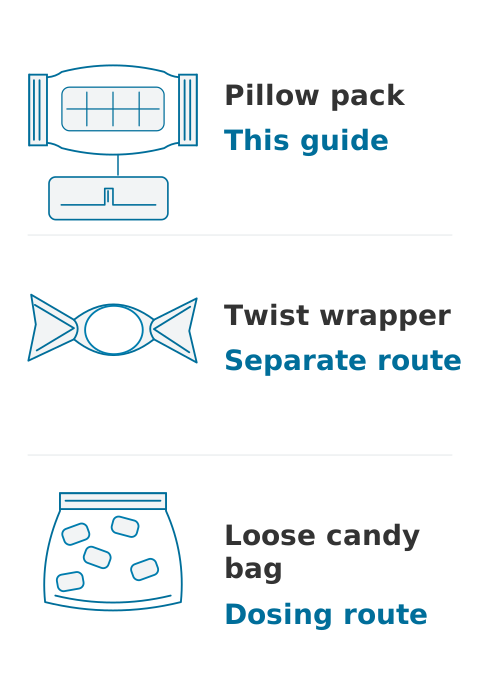
- Pillow pack: this guide
- Twist wrapper: a separate route
- Loose candy bag: a dosing route
A pack-format mismatch wastes a candy equipment inquiry. Choose horizontal flow wrapping for pillow packs around candies, lollipops and bars that can be fed in the required orientation. This guide connects published application references to feeding, film and sample checks. Twist wrapping and loose-candy dosing need separate routes.
| Input | Typical value or condition | Why it matters |
|---|---|---|
| Finished pack | Your sample or drawing | Separates pillow packs, twist wraps and loose-filled bags |
| Product size | Smallest and largest L × W × H, in mm | Defines the product envelope, including a lollipop stick |
| Product presentation | Orientation, spacing and an infeed video | Shows what the feeder needs to deliver |
| Film | Supplier specification and representative material | Starts the seal-method and tooling discussion |
| Output | Your required good packs per minute | Keeps a demand figure separate from a catalog speed |
| Product condition | Your observations at the wrapping point | Identifies soft, sticky, fragile or heat-sensitive variants |
On this page
Which candy packaging route matches the finished pack?
Choose flow wrapping when the brief calls for a product or defined group enclosed in a sealed pillow pack. A twist-ended sweet wrapper and a bag filled with loose candies represent different tasks. Keep that distinction in the specification before discussing a machine name or a target speed.
| Pack you want | Starting route | Input that separates it |
|---|---|---|
| Candy or bar in an individually sealed pillow pack | Horizontal flow wrapping | Product shape, orientation and roll-film specification |
| Sweet with twisted film ends | Twist-wrapping assessment outside this guide | An actual twist-wrapped sample |
| Loose sweets in a bag made from roll film | Dosing and vertical bag forming | Portion and bag specification |
| Loose sweets in a purchased pouch | Premade pouch filling | Pouch opening, dose and closure |
Use the flow wrapping family for the wider horizontal equipment range. For loose candy portions, begin instead with vertical form fill seal equipment or premade pouch filling equipment, according to whether the bag is formed on the machine or supplied ready-made.
Which published configuration should you use as a starting point?
Start with the application closest to your product, then check its presentation and material requirements. The six references below are published catalog configurations, rather than a ranked list. Use the requirement column to record what still needs to be resolved for your product.
| Published reference | Why to open it | What your project still needs |
|---|---|---|
| Disc-feeding candy wrapper | The listing identifies a rotary disc-feeding configuration | Candy shape, orientation and feeder assessment |
| High-speed candy packaging configuration | A named candy application in the LV-250B/D listings | Product-specific feeding, film and output scope |
| Full-servo lollipop wrapper | A reference for products with a stick | Full product envelope, stick direction and tooling; figures on request |
| Chocolate bar wrapper | A bar-wrapping application reference | Bar condition, film and feeding; figures on request |
| Nutty chocolate flow wrapper | A separate chocolate application listing | Surface and dimensional variation; product-specific setup |
| Chocolate energy bar wrapper | A starting reference for energy-bar projects | Actual bar composition, shape and handling; figures on request |
For a granola bar packaging machine inquiry, use the energy-bar reference to describe the task, then supply the actual bar and pack. A granola bar, a coated protein bar and a solid chocolate bar need representative inputs of their own. Mark which variants are in scope and which one is hardest to handle.
Review ratings on the individual product pages with their stated catalog and quotation conditions. For the bar, energy-bar and lollipop references, technical data is on request. Leave those entries open in your comparison and request the applicable figures in the proposal.
How should small candies, bars and lollipops enter the wrapper?
Record how the product reaches the wrapping point before choosing the infeed. Small loose candies, bars already aligned on a conveyor and products with a projecting stick give the feeder different jobs. Show the intended orientation, spacing and handoff, including the difficult moments when the incoming flow changes.
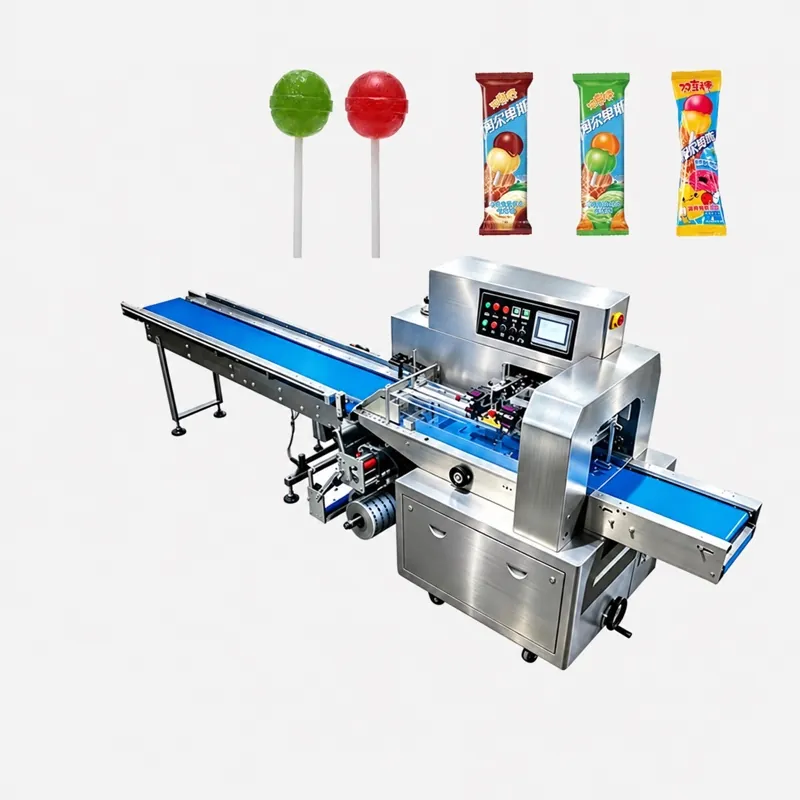
Published lollipop catalog reference with a horizontal wrapper, infeed conveyor, unwrapped lollipops and wrapped product examples.
| Product presentation | Show in the brief | Decision to resolve |
|---|---|---|
| Small candies arriving loose | Shapes, surface condition and the current supply method | Whether the proposed feeder can orient and separate these pieces |
| Bars arriving in rows | A video of row spacing and the transfer to wrapping | Where alignment and spacing will be established |
| Hand-loaded products | The current loading arrangement and required output | Whether hand loading is the intended project scope |
| Lollipops with projecting sticks | Stick direction and total dimensions, not only the candy head | The support, orientation and sealing clearance to review |
The disc feeder is a listed feature of one candy reference, not a general solution for every sweet. Likewise, full servo describes the published lollipop reference; it does not answer how your sticks are presented. Photograph the product in the proposed travel direction and include any support card or tray in the drawing.
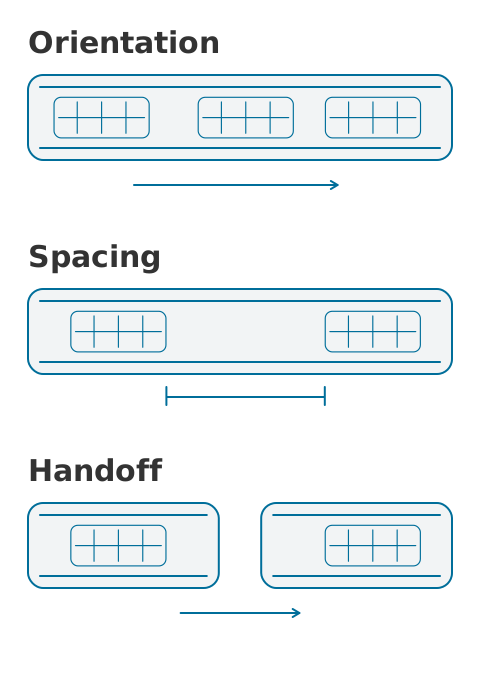
- Orientation
- Spacing
- Handoff
Film the upstream discharge as well as the proposed wrapper position. A close-up of a bar alone cannot show whether products arrive regularly or in groups. Identify who is responsible for the transfer between the two machines, and keep that responsibility in the proposed equipment scope.
When should you ask about cold-seal film for chocolate?
Raise cold-seal film as a requirement when heat exposure is a concern for your chocolate or coating. It is a material and machine compatibility question, not an automatic feature of a chocolate bar wrapper. Ask the film supplier and equipment team to review the chosen material together before accepting a seal setup.
Supply the film structure, thickness, reel width, seal specification and printed repeat information if applicable; include representative material when a sample evaluation is agreed. Match the specification to the material you will actually buy, with the film supplier identified in the brief.
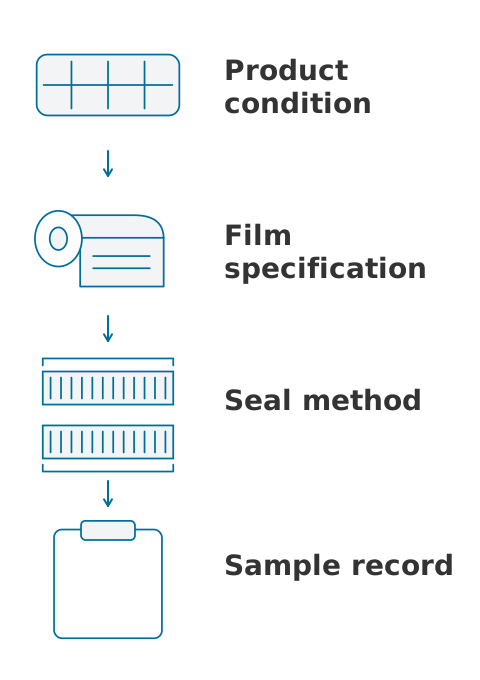
- Product condition
- Film specification
- Seal method
- Sample record
Keep the product condition specific: describe whether your concern is a soft center, a coated surface, marking during handling or something observed at the seal. Ask what settings and tooling will be proposed for that combination. If a product temperature limit matters, obtain it from the relevant product and material evidence.
Which dimensions belong in the product and pack drawings?
Provide the product envelope and the finished-pack dimensions separately. The product drawing describes what moves through the machine; the pack drawing describes what the film must enclose and where its seals belong. Include all variants and any stick, tray or support that travels with the product.
Record the smallest and largest length, width and height in millimeters, with the travel direction marked. For a lollipop, the total stick-and-head envelope matters as well as the head shape. For a bar with nuts or a coating, show the variation you actually observe rather than supplying only a nominal rectangle.
Then show the desired pack with the end seals, longitudinal seal, print position and opening requirement. If the packaging design is still open, label it as a proposed layout. Do not derive a film width from product width alone: the forming and seal allowances belong in the film and tooling review.
The explanation of the flow-wrapping process describes the relationship between film forming and sealing. Use it to label your drawing, while keeping final tooling and material dimensions in the project proposal. Product and pack dimensions with similar names are not substitutes for one another.
How do you compare output without borrowing a catalog maximum?
State the good packs you require, then identify the conditions under which that output is needed. A catalog speed describes a listing; your requirement includes the product supply, film, acceptable pack and downstream handoff. Compare proposals using the same product and acceptance basis before comparing their headline speeds.
| Record | What to distinguish | Why it changes the comparison |
|---|---|---|
| Required good output | Your demand, with units and product variant | An output target is not a claim about a machine |
| Incoming product supply | Normal flow and observed interruptions | The proposed feeder needs an agreed handoff |
| Acceptable finished pack | Seal, appearance and product condition criteria | Counting all discharged packs can hide rejects |
| Format changes | Products and pack sizes in the planned schedule | A single-format proposal may miss the actual task |
| Downstream process | Loose wrapped packs, grouped packs or cartoning | The wrapper is only one part of the required output |
If wrapped bars will enter cartons, add the grouping and loading requirement to the brief. The cartoning family covers that separate process. Agree the transfer responsibility and the evidence needed for the combined scope; wrapping and cartoning names alone do not establish a matched line.
Ask each proposal to state which variant, film and infeed arrangement its output refers to, and which supplied equipment is included. Keep changeover, stops and rejected packs in the evaluation discussion rather than silently substituting a continuous machine rating for a shift-level requirement.
What should a sample evaluation establish?
Agree what needs to be resolved before arranging a sample evaluation. Useful questions concern feeding, pack appearance, product condition, sealing and the proposed output basis. Choose representative variants and define what record would let you decide whether to continue with the configuration.
| Question | Record to request | Decision it supports |
|---|---|---|
| Does the product enter consistently? | Video of orientation, spacing and transfer | Whether the infeed scope needs attention |
| Does the pack match the drawing? | Pack photographs and measured dimensions | Whether forming and cut length suit the layout |
| Are the seals acceptable? | Agreed seal checks with the named material | Whether the proposed seal setup needs further work |
| Is the product condition acceptable? | Before-and-after observations of the selected variants | Whether handling or material choices need review |
| What does the output record cover? | Conditions, test window, counted good packs and rejects | Whether the evidence answers your output requirement |
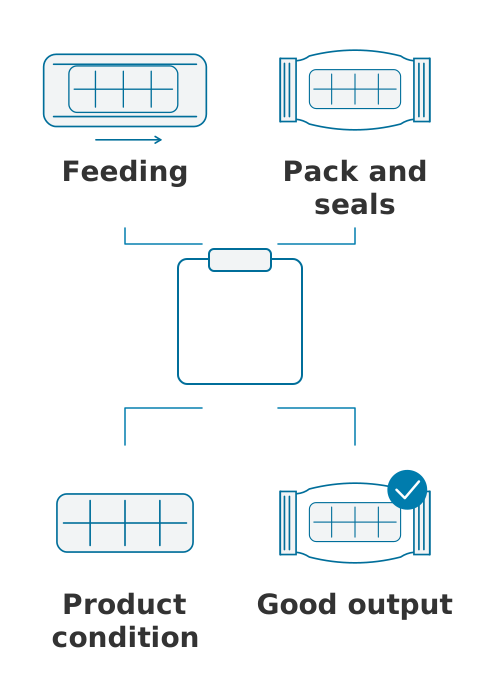
- Feeding
- Pack and seals
- Product condition
- Good output
Follow the sample testing preparation guide to discuss product and packaging samples, handling conditions, quantity and shipping instructions before dispatch. Decide whether a written record, photographs, run video or returned packs would answer your questions. Returned samples and their handling are arrangements to agree.
For an energy-bar project, identify the variants that matter to the decision rather than treating one easy sample as the entire range. If your film specification or final pack design is still open, record that limitation with the evaluation brief so the resulting discussion remains tied to the material actually used.
When this does not apply
This guide applies to a horizontal pillow-pack selection brief. It does not select a twist wrapper, a candy-making machine, a loose-candy dosing system or a hobby wrapping appliance. If your product cannot be presented in the intended orientation, resolve that handling requirement before treating a wrapper reference as suitable.
- Cold-seal compatibility, temperature control, inspection and other additions remain configuration questions; application names do not confirm them.
- Catalog ranges are not your demonstrated output. Technical data on request remains open until the proposal supplies it.
- A successful packaging discussion does not establish a shelf-life claim. Product protection requirements need their own material and product evidence.
- This page supplies no price, delivery date, destination-specific electrical scope or fixed changeover time. Put those requirements into the quotation discussion.
The project brief checklist collects the remaining site, utility and destination details. Mark unknown decisions explicitly: an incomplete input is more useful than an assumed specification that later becomes part of the wrong proposal.
Questions before a confectionery wrapping inquiry
What is the price of a flow wrapping machine?
This guide gives no fixed price. Request a quotation identifying the wrapper, infeed, tooling and integration scope. Check whether format parts for your other products are included or separately quoted; otherwise two amounts may describe different purchases.
How do you maintain a flow wrapper?
Request the proposed machine's maintenance and cleaning instructions during the quotation review. Ask which tasks concern product-contact areas and which parts are consumables, and who will perform them. The catalog application name does not establish an interval or a cleaning procedure for sticky candy residue.
What type of knife does a flow wrapper use and how do you maintain it?
Ask for the cutting assembly and consumable part identification for the proposed configuration. Have the equipment team explain the applicable maintenance instructions and safe access procedure. Do not choose a replacement blade or a service method from a confectionery application name alone.
What is a flow wrapper forming box?
It folds the film into a tube around the product. The selection question is whether each product cross-section can use the proposed forming set. Request a list matching your planned bar and lollipop sizes to the required tooling, rather than assuming one set covers every variant.
What is the difference between a flow wrapper and shrink wrap?
Flow wrapping closes the pack with seals; a shrink process uses suitable film and heat to change its fit. For a proposal, ask whether any shrink stage is included. The word horizontal alone does not identify the final finish; compare it with your approved pack sample.
Is there an order form for flow wrapping machines?
The linked project brief is a preparation checklist, not a checkout form or a confirmed order. Use the attributed inquiry link to discuss the configuration and quotation scope. Mark unresolved decisions in the brief, and resolve the commercial terms separately before treating the proposal as an order.
Method and sources
This selection guide was compiled from publicly available catalog material and LINEVO's published family, product, process and sample-preparation pages, reviewed on October 8, 2026. The matrix records application references; the feeding and evaluation tables organize buyer inputs. External equipment documentation informed the film-selection context. These are public-source organization and editorial guidance, not findings from a LINEVO trial.
FAQ demand comes from US English search-question and autocomplete records collected on October 5, 2026. The flow-wrapping price question is a recorded search question; the maintenance, knife, forming-box, shrink-wrap and order-form questions are editorial adaptations of recorded autocomplete queries. The figures are either labeled illustrations of the review task or an existing catalog equipment reference.
What to send us
Send what you have and mark what is still undecided. We reply within 24 hours.
| Item | Why we need it | Example format |
|---|---|---|
| Product and all variants | Identifies candy shape, bar condition and the full product envelope | Photos, smallest and largest L × W × H in mm; include the stick or tray |
| Finished-pack layout | Separates the route and locates the intended seals | Sample or drawing with items per pack and dimensions in mm |
| Infeed presentation | Shows orientation, spacing and transfer responsibility | Video of the current hand loading or upstream discharge |
| Film specification | Starts the seal-method and tooling review | Supplier data sheet with structure, thickness, reel width and print repeat |
| Required good output | Defines the task and downstream scope to compare | Good packs per minute by variant; downstream grouping or cartoning requirement |
| Site and open requirements | Completes the quotation brief and identifies unresolved decisions | Layout, destination, utilities and a list of undecided options |