
On this page
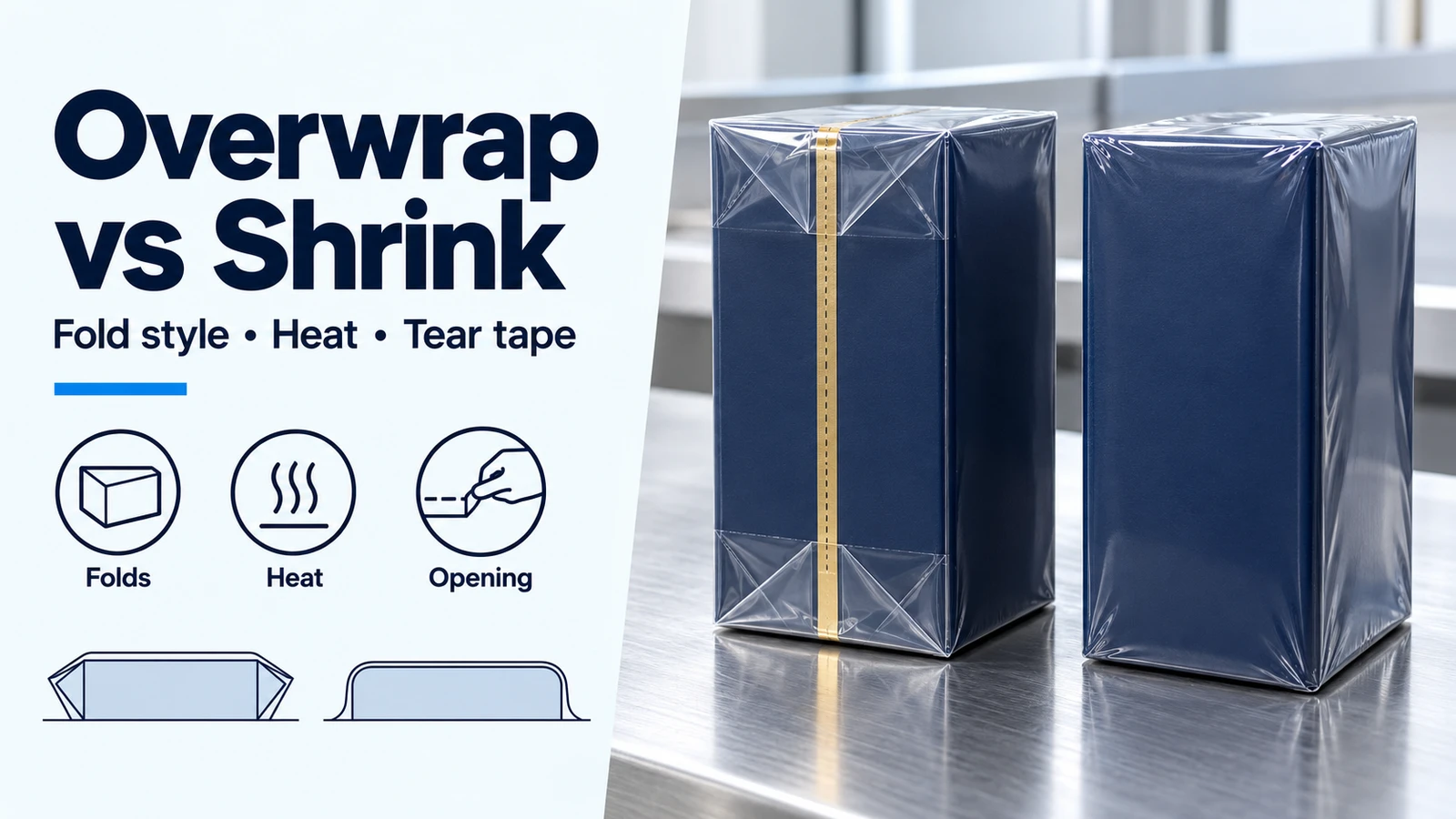
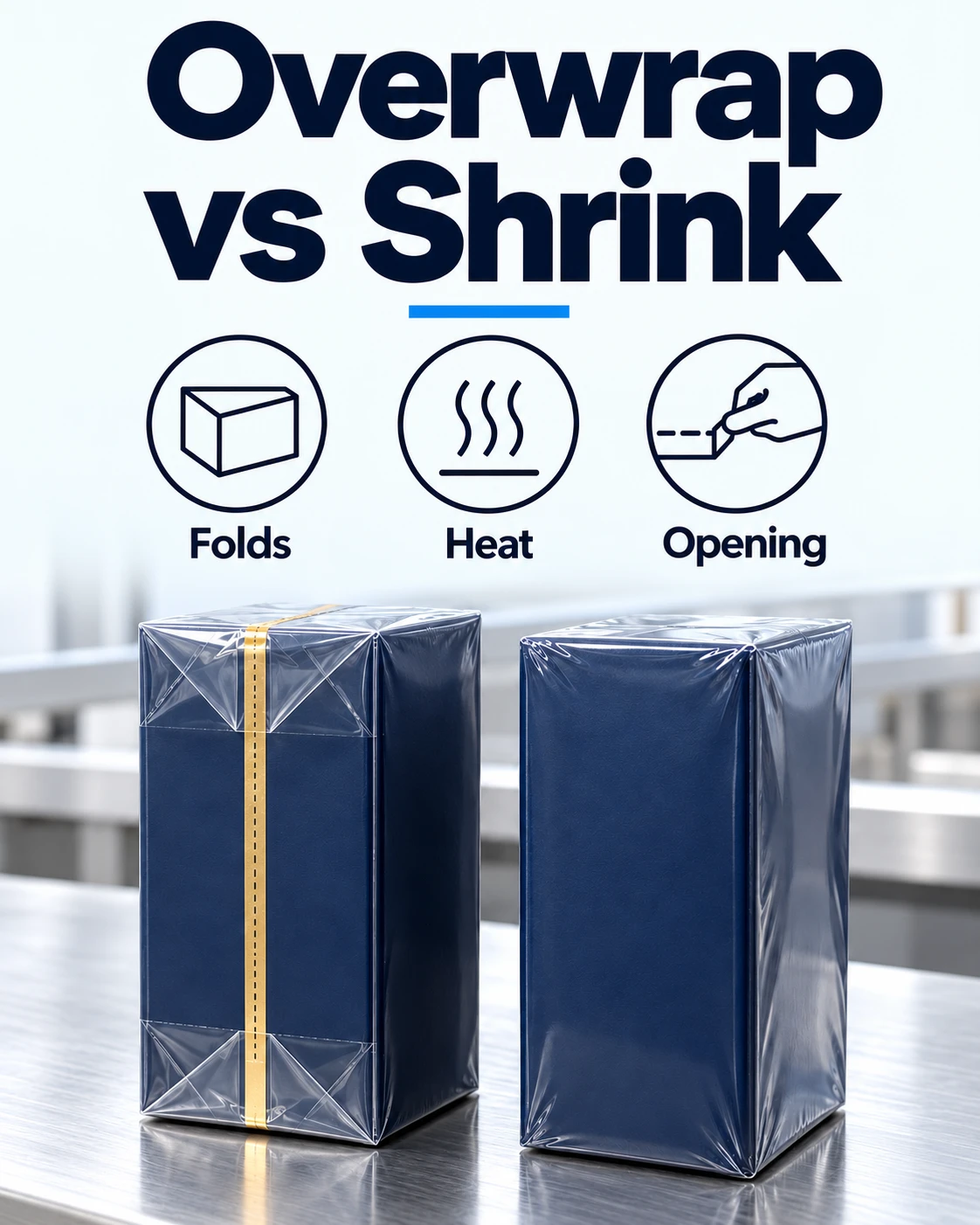
Choosing the wrong wrap can leave loose folds or a heat-marked carton. Compare folded-film overwrapping for crisp rectangular boxes with shrink wrapping for a conforming finish.
The useful distinction between types of overwrapping machines is how they close and tighten the film. A folded-film overwrapper makes an envelope around a rigid box and heat-seals the overlaps. A shrink wrapper seals a film enclosure, then heat shrinks it against the pack. For cellophane vs shrink wrap, choose the required finish first, then confirm the film grade, box geometry and heat exposure. Both routes can use heat; the material name alone cannot settle the choice.
| Input | Typical value or condition | Why it matters |
|---|---|---|
| Box dimensions | Production L × W × H, in mm, with variation | Defines format fit and fold geometry |
| Film | Supplier grade, coating and thickness in micrometres | Identifies sealability and shrink behavior |
| Finish | Approved folded-end or conforming sample | Makes appearance acceptance specific |
| Heat exposure | Filled-pack and decoration limits from the product owner | Sets what the trial must check |
| Opening strip | Tape width, position, color and opening requirement | Separates easy opening from authentication |
| Production mix | Required accepted packs and format changes per shift | Makes output and changeover comparisons meaningful |
Compare the closure and finish on the same box
Start with folded-film overwrapping when a rectangular carton needs flat faces and deliberate envelope folds. Start with shrink wrapping when a conforming outer film meets the presentation brief, including packs whose contours do not suit a fixed folded envelope. A shrink sleeve used as a bottle label is a different packaging task.
| Route | Closure and heat | Box and finish fit | Opening requirement | Dominant Failure Mode & Prevention |
|---|---|---|---|---|
| Folded-film overwrapping | Film overlaps and folded ends are heat-sealed; no shrink tunnel is needed for this folding process. | Rigid, square rectangular cartons; visible envelope folds are part of the finish. | Optional tear tape with an accessible starting tab; review its position against the artwork. | Loose end folds or marked corners: check carton stiffness, dimensional variation, format parts and film/seal settings together. |
| Shrink wrapping | Film is sealed around the pack, then heated to contract around it. | A conforming finish; confirm seam location and the appearance of corners on a sample. | Specify how the consumer starts opening; an opening strip is not implied by the process name. | Uneven shrink, protruding corner film or pack distortion: review film grade, air escape and the tunnel setup on the filled pack. |
For folded-box configurations, use the cellophane overwrapping machines page to review available applications and the format information needed for quotation. The comparison here selects a process; it does not establish a universal speed or energy winner. Application pages show overwrapped boxes within complete lines: tea box overwrapping, perfume and cosmetic boxes, pharmaceutical cartons and boxed shisha pouches.
Separate film material, fold style and tear tape
Cellophane is a cellulose film. BOPP is biaxially oriented polypropylene. A machine called a cellophane overwrapper may use either where the exact heat-sealable grade is suitable. Shrink film must have the shrink behavior required by the proposed process; do not order an ordinary overwrap grade as a substitute on the strength of clarity or polymer name.
The film supplier's Cellophane range includes lacquered grades that heat-seal on both sides. Request the actual grade data sheet rather than assuming every clear cellulose film has that sealing surface. When considering what to use instead of cellophane, evaluate heat-sealable BOPP for folded wrapping, or a suitable shrink film if you also accept a different finishing process. Recheck opening behavior and any required barrier properties after a material change.
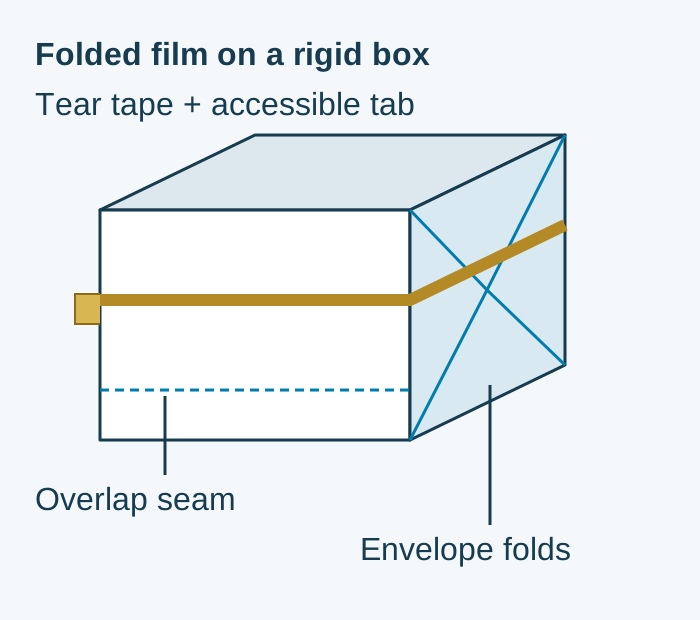
A gold tear strip is an easy-opening feature. Its color alone does not authenticate the pack. If your brief calls for tamper evidence or anti-counterfeit control, specify the visible evidence of opening and any controlled marking or verification system separately. Review tape continuity, tab access and the opening path on samples instead of treating a gold line as a security guarantee.
Use box geometry before discussing film savings
A rectangular cross-section gives a useful starting perimeter, but it cannot size the complete overwrap blank. For a band running around box width W and height H, with overlap allowance s, the developed band path is C = 2 × (W + H) + s. The actual film web direction, end-fold allowance and cutting arrangement still need confirmation.
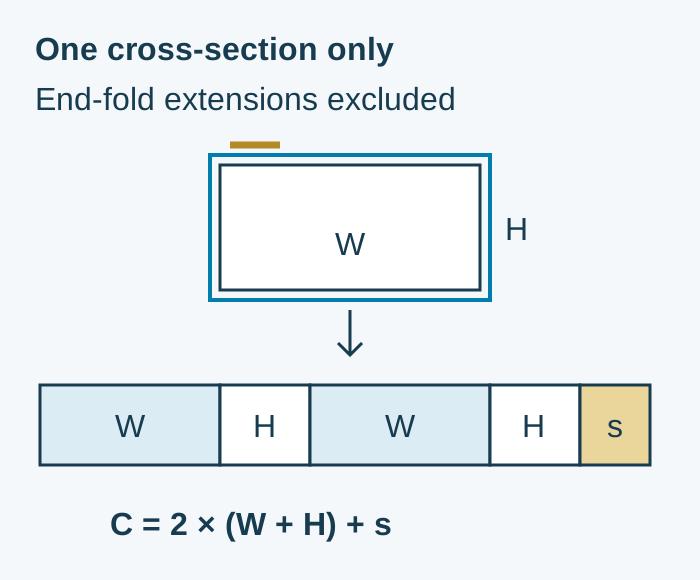
Worked example with assumed inputs: W = 60 mm, H = 30 mm and s = 15 mm give C = 2 × (60 + 30) + 15 = 195 mm. These values illustrate geometry, not a recommended sealing allowance. A supplier must confirm the full blank and film orientation for the actual box.
Compare material use using the confirmed blank area, thickness, density and rejects for each route. A smaller nominal film thickness does not prove lower consumption per accepted pack if startup waste or rejected wraps increases.
Reject a route when the actual pack exceeds its limits
Use measured project limits to make the shortlist. For each dimension d, a proposed format only fits when the production range stays inside its confirmed tooling window: d_min,tool ≤ d_min,pack and d_max,pack ≤ d_max,tool. If either comparison fails, request another format arrangement rather than assuming adjustment will cover it.
For heat-sensitive contents or decorated cartons, compare measured pack exposure with the product owner's allowable exposure under the same time and temperature conditions. If the trial exceeds that limit, reject those settings or reconsider the process. A tunnel display is not the temperature reached by the contents. Folded overwrap still needs heat at its sealing contacts, so it also needs a filled-pack check.
For repeated size changes, time the whole transition: last accepted pack of the old format to the first accepted pack of the next format, including film and tape threading and setup rejects. Manual, semi-automatic and automatic handling describe the work allocation; they do not change the distinction between folded closure and shrink closure.
Ask the film supplier for shrink data at stated test temperatures. ASTM D2732-14(2025) measures unrestrained linear thermal shrinkage of plastic film and sheeting up to 0.76 mm thick. Its public scope helps identify comparable film data; it does not set carton acceptance limits or qualify the completed pack.
Compare total cost per accepted pack over one period
Put both proposals on the same production period and accepted-pack requirement. Include equipment cost allocated to that period, film and tape, operator time, setup losses, measured electricity and maintenance. Record startup and running rejects separately so a low film price does not conceal lost cartons or extra labor.
Accepted packs = attempted packs − rejected packs. Cost per accepted pack = total costs for the period ÷ accepted packs in that period. In a hypothetical shift with 20,000 attempted wraps and 600 rejects, the denominator is 19,400 accepted packs. Do not divide costs by 20,000 and omit the rejected material.
Changeover time belongs in the same ledger. For example, three assumed changes taking 20 minutes each remove 60 minutes from that shift. Record the resulting accepted output rather than deducting the same downtime again from an already measured total. Meter tunnel warm-up and running consumption or folded-wrapper consumption over that same shift; installed power alone is insufficient for a cost comparison.
Check the upstream cartoning machine as part of the wrapping brief. A carton that leaves the cartoner open, bowed or inconsistent in size changes the downstream trial. Agree transfer orientation, accumulation and reject handling across the interface, then include those items in the equipment scope.
Send the box, film and opening requirements together
Prepare the following inputs for a folded-overwrap configuration discussion. If the film or tape is undecided, say so and include the finish you want. The sample-testing service explains how to agree the materials and checks before shipping samples.
- Dimensioned box drawing with L × W × H in mm, production variation, carton stiffness and the filled-box weight.
- Film supplier and grade, BOPP or cellulose, coating/sealable sides and thickness in micrometres; include the data sheet and available reel details.
- Tear-tape width, color, intended position and accessible tab; state easy-opening, tamper-evidence and authentication requirements separately.
- Approved finish sample or photographs, artwork areas that must remain clear, and any product or decoration heat-exposure limit.
- Required accepted output, shift length, sizes changed per shift and the upstream cartoning interface.
Send your box dimensions, film data sheet and tear-tape brief through WhatsApp. LINEVO uses the box-and-film information to review a configuration and discuss whether a sample test is needed.
Method and sources
Updated October 2026. Process definitions were checked against the approved box-overwrapping catalog and public film-supplier guidance on 20 October 2026. The calculations are explicitly hypothetical geometry and production-accounting examples. Final film, tooling and pack acceptance require the actual filled carton and agreed project conditions.
Material source: Futamura, Cellophane Films, public range description, checked 20 October 2026. Shrink-process source: Clysar, Understanding Shrink Film, and Shrink Tunnel Temperature (2020), checked 20 October 2026. Their guidance supports the material/process distinction and the need to match film and tunnel conditions; no generic operating temperature is prescribed here.
Standard source: ASTM D2732-14(2025), public scope and significance summary, checked 20 October 2026. The full paid standard was not used. This article concerns secondary wrapping of retail boxes; it does not specify sterile-barrier packaging or establish shelf life.
Discuss your application with LINEVO.
Discuss your box and film requirements