
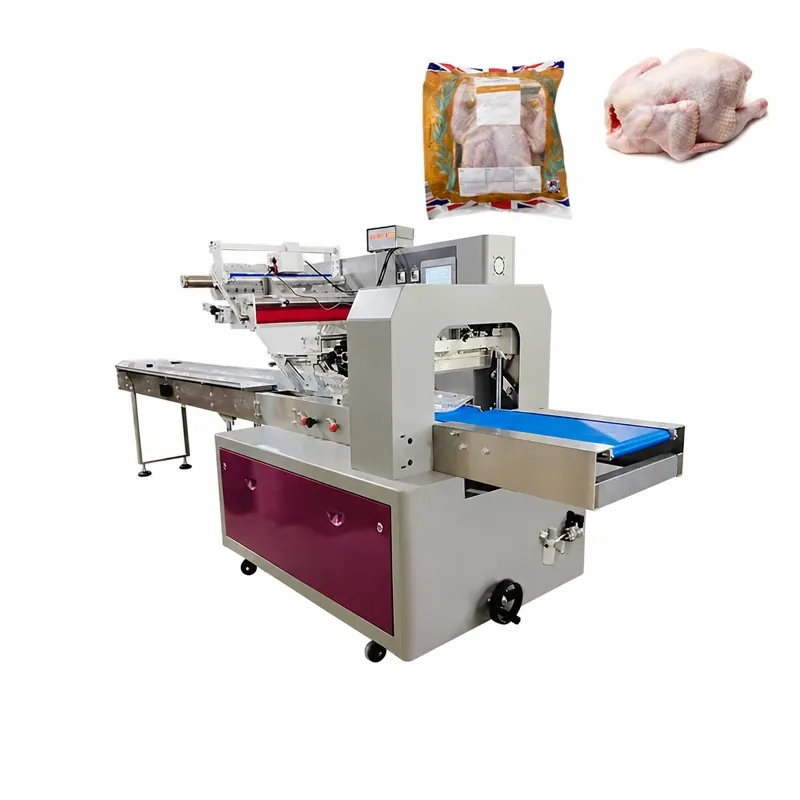
LV-250B/D horizontal flow wrapper with an infeed conveyor and discharge belt
Flow wrapping is a horizontal packaging process that forms roll film into a tube around individual products, fixed groups or trays. The machine joins the film edges with a lengthwise seal, then seals and cuts the tube between products. The finished package is a pillow pack with one back seal and two end seals.
On this page
Flow wrapping in short
| Input | Typical value or condition | Why it matters |
|---|---|---|
| Infeed | Product orientation and spacing | Unstable feeding can put the product in the seal area. |
| Film forming | Product and finished-pack dimensions | A mismatched forming box can give the wrong pack shape. |
| Fin seal | Film specification and seal method | Unsuitable film or tooling can leave the long seal open. |
| End seal and cut | Pack length and product gap | A misplaced cut can damage the pack or product. |
Use this guide to understand the process and decide whether your product should enter the flow wrapping family. It explains the conventional fin-seal layout; the comparison below helps separate it from vertical bagging and shrink wrapping.
How does a flow wrapper work, step by step?
A flow wrapper turns a flat reel of film into sealed packs in one continuous pass. Each stage controls one part of the pack, so the table shows what happens at each stage, what it decides about the pack, and what you need to confirm for your own product.
| Stage | What happens | What it decides | What to confirm for your product |
|---|---|---|---|
| 1. Infeed | Products are placed on a conveyor with pushers, by hand or from an automatic feeder, and carried into the film at a fixed pitch. | Whether every product reaches the film in the right position, which is the first thing to check when packs come out wrong | Product size range, orientation, whether it is fragile or sticky, and how products leave your line |
| 2. Film forming | Film unwinds from one reel. On printed film a sensor reads the registration mark so the print lands in the same place on every pack. The forming box folds the film into a tube around the product. | Pack width and height, and where the print sits | The film reel and the forming box needed for each product size |
| 3. Fin seal | Fin seal wheels press the two film edges together under the product and seal them lengthwise. | The long seal on the underside of the pack | Heat-seal or cold-seal film, and the seal settings on your film |
| 4. End seal and cut | Rotary end-seal jaws close across the film tube in the gap between two products, seal it and cut it, so each stroke completes a pack. | Pack length, set by the cut length, and the end seal pattern | Finished pack length, end seal pattern and any easy-open feature |
| Discharge | A conveyor carries the finished packs away. Coding and gas flushing are listed as options on some configurations. | What happens to the packs next | Code position and content, any gas flushing target, and the next machine, such as a cartoner |
How this looks on the LV-250B/D
The LV-250B/D horizontal pillow flow wrapper source record describes touch-screen setup, conveyor feeding, bag forming, back sealing, cutting and discharge. Use that sequence to identify the parts of the machine; request the operating range for your pack separately.
What drives the motions
The infeed and drive arrangement differ between configurations. Compare the wrapper types and feeding arrangements once you know whether your product arrives singly, in a group or on a tray.
The finished pillow pack
The result is usually called a pillow pack or pillow bag: one seal along the back and a sealed end on each side of the product. A vertical form fill seal machine makes a pillow bag with the same three seals, but forms it vertically and fills it from the top. In the standard flow wrapper layout the film comes from above and the fin seal sits underneath; some layouts feed the film from below, so the product rests on it from the start.
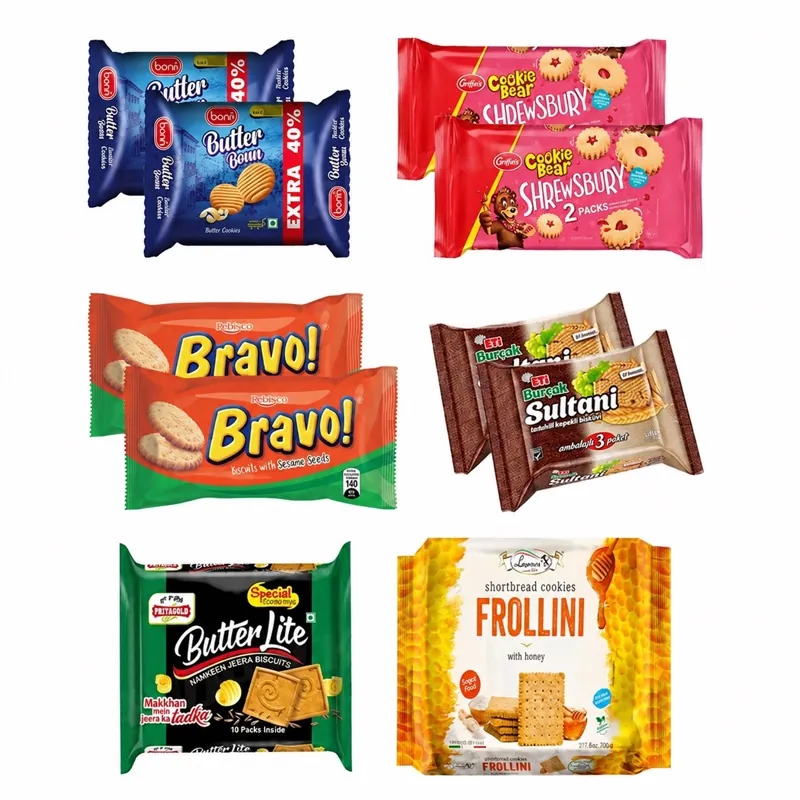
Catalog photographs of individually film-packed biscuit and wafer products
What does the film have to do on a flow wrapper?
The film has three jobs on a flow wrapper. It must seal by the method the machine uses, it must be wide enough to wrap the product with room for the fin seal, and printed film must carry a registration mark the sensor can read. The LINEVO catalog does not name film materials for its wrappers, so the film is reviewed for each project rather than picked from a list.
Seal by heat or by pressure
Heat-seal film is closed by heated fin seal wheels and end-seal jaws. Cold-seal film carries a pressure-sensitive coating on the seal area and is closed by pressure, which keeps heat away from chocolate and other heat-sensitive products. Cold seal needs suitable seal tooling, so decide which film you will use before the configuration is fixed.
A width that matches the pack
Film width follows the pack cross-section plus room for the fin seal. Send the product width and height, the finished-pack dimensions and the film reel specification together; confirm the forming box and usable film width for that combination.
Print that stays in register
On printed film, the sensor reads the printed mark so the film is cut and sealed in the right place on every pack. Send a sample of the printed reel with its mark.
What to ask your film supplier for
- The film structure and sealing layer, or the cold-seal coating
- The thickness
- The reel dimensions
- Whether the film is printed, and where the registration mark sits
Seal temperature, pressure and speed are then set on that film rather than copied from another product. If the product needs gas flushing, define the target and how it will be checked, because it is an option on some configurations, not a standard part of every wrapper. Choosing the film structure itself is a matter between you and your film supplier and is not covered on this page.
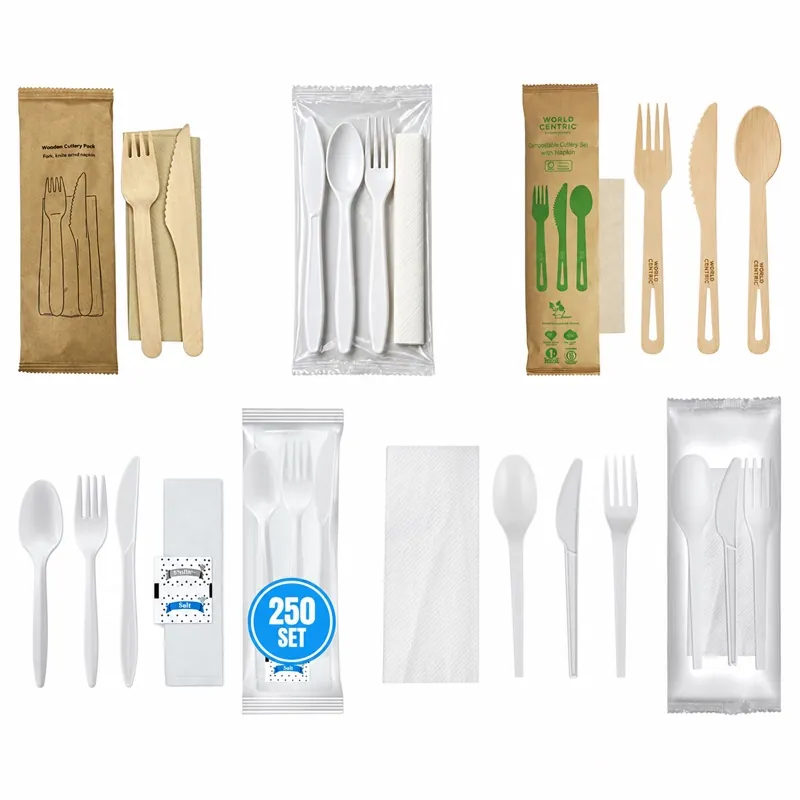
Catalog photographs of cutlery sets and individual utensils in film packs
Which products suit a flow wrapper?
A flow wrapper suits products that arrive as one unit per pack, or as a fixed group or kit, and can be fed lying down at a steady pitch. Some answers below point to a different machine family; others only point to a configuration detail to confirm with a sample.
| Question | If yes | If no |
|---|---|---|
| Is each pack one item, or a fixed group you can place by hand or by feeder? | A flow wrapper is a candidate. LINEVO configurations cover bars, biscuits and wafers, candy and lollipops, bread, mooncakes, instant noodles, ice lollies, honey spoons, fruit and vegetables, frozen dumplings on trays, sponges, toothbrushes, slippers, sanitary napkins and cutlery kits. | Loose product that has to be weighed or dosed, such as snacks, granules or powder, belongs on a vertical form fill seal machine with a weigher, auger or cups. |
| Can the product lie flat and be pushed along a conveyor without tipping or sticking? | A standard infeed with pushers can work. | Soft, loose or irregular items may need film fed from below, or a tray. Confirm it with a sample of your product. |
| Have you recorded every product and pack size? | Compare the smallest and largest dimensions with the proposed configuration. | Measure the product, any tray and the finished pack before choosing the forming box. |
| Is the product heat-sensitive, like chocolate? | Consider cold-seal film, and confirm the seal method and tooling with samples of your product and film. | Heat-seal film is the usual starting point. |
| Do you want a sealed film pack around each item, rather than a tight folded film on a rigid box? | Flow wrapping. | A tight folded film on a carton or box is cellophane overwrapping. |
| Is the product sold in a film pack, rather than a stand-up pouch with a zipper or spout? | Flow wrapping, or VFFS for loose product. | Finished pouches are opened, filled and sealed on a premade pouch machine. |
| Do you want the film sealed around the product, rather than shrunk tight around it with heat? | Flow wrapping. | A shrunk-on finish, around one item or a bundle, is shrink wrapping, which is not among the LINEVO machine families. |
Send product dimensions and feeding details, film specifications, finished-pack size and target good output for a configuration review.
Flow wrap, shrink wrap and VFFS: what is the difference?
Flow wrapping forms film around a horizontally fed unit; VFFS forms a bag vertically and doses product into it. Shrink wrapping adds heat to shrink suitable film around the pack. This is a comparison of published process descriptions, not our own test. LINEVO supplies the flow wrapping and VFFS routes described here.
| Method | How the product meets the film | How the pack is closed or fitted | Typical pack | In the LINEVO range |
|---|---|---|---|---|
| Flow wrap (HFFS) | The product lies flat on an infeed conveyor, and a film tube is formed around it | A fin seal along the back and a seal at each end; the film is sealed, not shrunk | A pillow pack around one item, a fixed group, a kit or a tray | See the flow wrapping family |
| Shrink wrap | Film is placed around an item or group | Suitable film is shrunk around the pack using heat | A close-fitting wrap around an item or group | Not listed as a separate LINEVO machine family |
| Vertical form fill seal (VFFS) | Loose product is weighed or dosed and falls into the bag from above | The film tube is sealed along its length, filled from above, then sealed and cut across | Pillow, gusseted, quad-seal and vacuum bags of snacks, coffee, grains, frozen food and powders | See the VFFS family |
Where to start: if each product is already a unit and you want it individually sealed in film, start with flow wrapping. If the product is loose and sold by weight, start with VFFS. If you need film that shrinks tight with heat around an item, a bundle of packs, a carton, a group of cans or a pallet load, you are looking at shrink wrapping, which is not among the current LINEVO machine families. A tight folded film on a rigid box, like the film on a perfume or tea box, is overwrapping rather than any of the three.
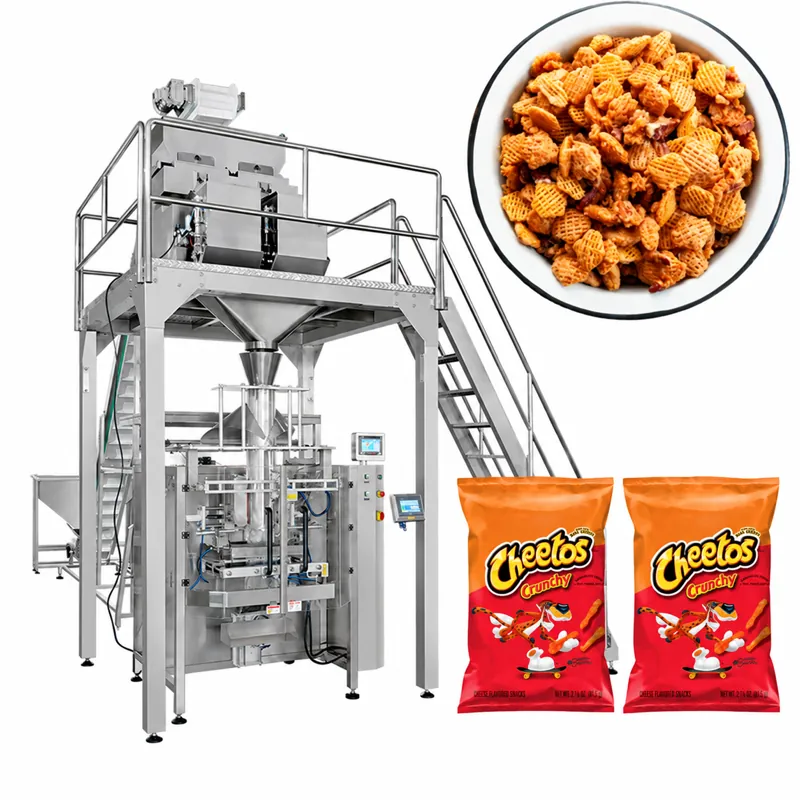
Vertical form fill seal machine with a multihead weigher above it, shown with loose snacks and finished bags in the source catalog
When this does not apply
This guide explains a conventional fin-seal wrapper, not every horizontal packaging layout. Film can enter from above or below; seal layout and tooling vary. Manufacturer documentation also shows horizontal wrappers integrated with shrink tunnels, so “horizontal” alone does not rule out a shrink process.
Catalog speeds and dimensions are not accepted output for your product. Keep output, pack size, film, feeding and any optional gas flushing together in the project specification. Film choice and product protection requirements belong with your film supplier; this page does not prescribe a film grade or shelf life.
A change in pack width or height may require another forming box or infeed adjustment. List every intended size for sample testing preparation.
Prepare a wrapper review
The closing What to send us table turns product, film, pack and output requirements into a review brief. Mark open decisions and agree sample quantities and shipping before dispatch.
Use the project brief checklist to assemble the details. The team can discuss a configuration proposal or sample-test plan from those inputs.
Questions buyers ask
What is the price of a flow wrap machine?
Compare prices only for the same product size, film, feeding scope and target good output. Separate the wrapper, automatic infeed, format tooling and optional coding or gas flushing. A lower machine-only figure is not a lower installed price when those required items are quoted separately.
What are common problems with wrapping machines?
Products caught in end seals point to spacing or timing problems: check orientation and the infeed pitch. Open seals point to film or seal-setting mismatch: review the sealing layer and temperature, pressure and time. Misplaced print or cuts require checking the registration mark and sensor setup.
What are the different types of flow wrap machines?
Types include film-fed-from-above and film-fed-from-below layouts, heat-seal and cold-seal wrappers, and machines with manual or automatic infeed. Servo drive is another configuration distinction. These categories overlap: select the film path, sealing method and feeding arrangement together on the flow wrapping family page.
What are pillow pouches?
Pillow pouches are flexible packs with one lengthwise back seal and two end seals. Flow wrappers form them around horizontally fed items; VFFS machines form them vertically and fill them from above. The three-seal shape alone does not identify which process made the pouch.
What is the difference between flow wrap and shrink wrap?
Flow wrapping seals a film tube around an item or group to make a closed pack. Shrink wrapping uses heat to tighten suitable film around the product. A flow wrapper’s heated sealing jaws close the seals; they do not by themselves perform a shrink stage.
What is a flow wrapper?
A flow wrapper is a horizontal machine that feeds products into roll film, forms a tube around them, seals the long film edges, and seals and cuts between items. Its infeed accepts individual items, prepared groups or trays; grouping several components is a separate feeding task.
Methods and sources
Reviewed 8 October 2026. This guide uses the published LINEVO flow wrapping process, the LV-250B/D source-backed product record and the VFFS process. These are manufacturer descriptions, not our trial results. Photographs are authorized catalog equipment and packaging examples, not trial results.
External manufacturer sealing documentation and a January 2025 horizontal shrink-wrapper data sheet were checked on 8 October 2026 for the seal functions and shrink-tunnel boundary. Source URLs and document locations are retained in the editorial evidence record. No external machine ratings are applied to LINEVO.
We reply within 24 hours.
Discuss your flow wrapping project