
On this page
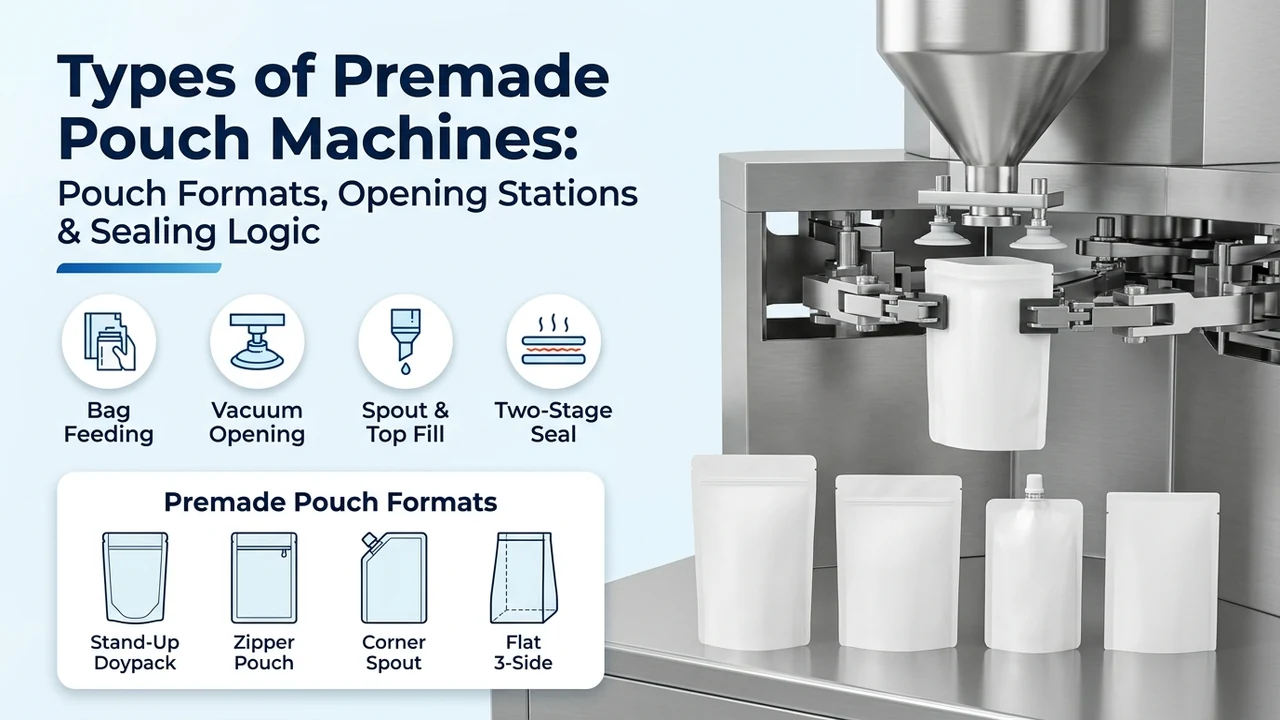
Ordering a premade pouch machine before locking your converted pouch geometry, closure hardware and SKU width span causes chronic missed bag openings, crushed zipper tracks and unsealed side-gusset leaks. Match your stand-up doypack, zipper, gusseted, flat-bottom or spouted pouch format to the exact pick-fill-seal turret or spout-rail filling architecture, gripper pitch and Factory Acceptance Testing (FAT) protocol before fixing your quotation scope.
Premade pouch machines use different arrangements for open-top, zipper and spouted pouches. Compare pouch handling, dosing, closing and changeover requirements with your product and finished pack before choosing a rotary, inline or through-spout configuration.
| Engineering input | Standard baseline or buyer source | Why it governs machine architecture & station tooling |
|---|---|---|
| Primary closure & filling entry path | Open top mouth (heat-sealed after fill) vs. pre-welded top/center spout neck (8–22 mm inner bore) with screw cap | Separates top-seal pick-fill-seal turrets (LV-210 and premade pouch shisha machine baselines) from spout-rail liquid fillers with servo/magnetic capping (LV-160 baseline) |
| Bottom & side gusset geometry | Flat 3-side-seal (0 gussets), W-fold stand-up doypack bottom gusset (30–100 mm), fold-over side gusset, or 5-panel flat-bottom box / quad-seal pouch | Dictates whether flat-panel vacuum cups suffice or bottom-gusset inflation nozzles, mechanical gusset-tucking fingers and dual-stage sealing bars are mandatory |
| Reclosable zipper profile | None vs. press-to-close (PTC) single/double profile track (1.2–2.5 mm rib thickness set 25–40 mm below pouch top) or Velcro/pocket zipper | Requires a dedicated mechanical zipper-spreading claw at Station 3 plus recessed relief grooves (1.5–3.0 mm) on gripper jaws and heat-seal bars to prevent track crushing |
| Pouch width & length envelope | Buyer CAD drawing across all SKUs (90–210 × 110–330 mm on LV-210 baseline; 80–240 mm, 180–300 mm or 270–400 mm across standard vs. wide-format OEM turrets) | Sets turret pitch circle diameter, gripper clamp spacing, magazine cassette width, and whether motorized PLC width adjustment is required |
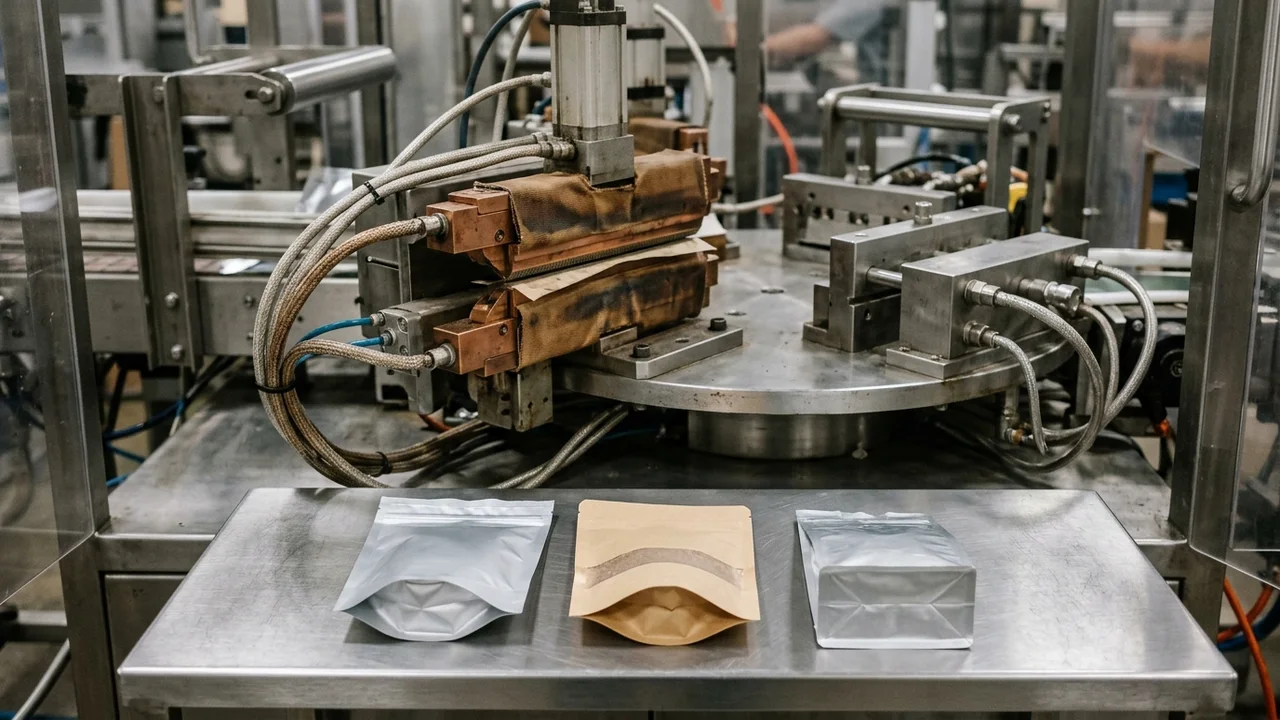
| Laminate structure & sealant gauge | Multi-layer film composition (PET/AL/LLDPE, PET/VMPET/PE, Kraft/AL/CPP, or retort PET/AL/OPA/RCPP; 80–200 µm, FDA 21 CFR 177.1520 olefin sealant) | Controls conductive heat-transfer dwell time, single-stage vs. two-stage heat sealing (Station 6 + Station 7), and water-chilled cooling bar clamping |
| Product rheology & target fill dose | Free-flowing granules, dusty powders, viscous/particulate sauces (CIP SUS304/316), cohesive pastes (100–500 g on our premade pouch shisha machine), or high-volume liquids (2 kg–5 L on LV-160) | Selects the synchronized multihead weigher, servo auger with dust extraction hood, servo piston with anti-drip shut-off nozzle, or magnetic/mass-flow liquid pump |
| Accepted line speed & lane kinematics | Net good pouches/min (Q_net): 10–25 bpm (inline/spout), 20–60 bpm (8-station simplex 1-up rotary), or 60–100+ bpm (duplex 2-up twin-gripper rotary) | Determines simplex vs. duplex turret selection, single vs. twin dosing discharge nozzles, and compressed air supply (400–600 vs. 1,000 NL/min at 0.5–0.65 MPa) |
| Seal & closure validation standard | ASTM F88 peel strength (25.4 mm or 15 mm strip at 200–300 mm/min), ASTM F1921 hot tack, ASTM F1140 whole-pouch burst/creep, and ASTM D3198 cap torque | Establishes objective Factory Acceptance Testing (FAT) pass/fail limits across 2-to-4-layer gusset transitions, zipper ends, and threaded spout caps |
How do stand-up pouch types, doypacks, flat-bottom bags and spout pouches change machine stations?
In industrial packaging engineering, stand-up pouch and doypack describe the exact same baseline container: a flexible laminate bag constructed with a W-fold oval bottom gusset that expands into a self-standing base when filled, sealed along two vertical side seams and left open across the top mouth for filling. While converter catalogs group flat 3-side-seal pouches, stand-up doypacks, press-to-close zipper bags, side-gusseted pouches, 5-panel flat-bottom (box) bags, and spouted pouches under one retail display category, an automatic premade pouch machine interacts with them as distinct mechanical loads. Every fold, gusset step, zipper rib, or welded plastic fitment alters how the machine's grippers clamp the edges, how vacuum and compressed air separate the panels, and how thermal jaws compress the top seal.
Across our premade pouch filling machines family and international OEM turret specifications (including PACRAFT/Toyo Jidoki pouch classification standards, Viking Masek rotary pouch fillers, and Rezpack RZ8 series turrets), pouch formats divide into top-mouth pick-fill-seal formats and through-spout rail-guided formats. Within the top-mouth group, transition thickness at the top seal line—ranging from 2 film layers on a plain doypack to 4 film layers on a side-gusset or flat-bottom box pouch, plus 2.4–5.0 mm of thermoplastic zipper profile at the side seams—dictates station hardware. Auditing each pouch structure by its dominant failure mode and root cause—such as zipper misalignment, powder contamination or liquid seal contamination in the top jaw zone, polymer extrusion at 2-to-4-layer gusset steps, and micro-channel leakage—allows packaging engineers to specify the mechanical station hardware that prevents field defects before ordering.
| Pouch format & structure | Top-seal layer count & closure geometry | Required gripping, opening & sealing stations | Our baseline route & status | Dominant field failure mode & mechanical prevention |
|---|---|---|---|---|
| Plain stand-up pouch (Doypack, W-fold bottom gusset) | 2 flat laminate layers (2 × t_film) across the full top mouth; W-fold bottom gusset (30–100 mm depth) expands into a round/oval base | Flat-pad side grippers; dual upper vacuum suction cups + timed over-pressure air blast (0.5–0.65 MPa) or bottom-gusset opener; 1st + 2nd heat-seal jaws + cooling bar | Pick-fill-seal route: LV-210 weighing and filling, beverage pouch configuration, and stand-up milk configuration (90–210 × 110–330 mm, 20–70 bpm baseline) | Failure mode: Incomplete W-gusset expansion causing product bridging in the upper throat and contaminated top seals. Prevention: Synchronize a timed air-blast jet (150–300 ms) or mechanical bottom-gusset spreading fingers at Station 3 before the dosing chute opens. |
| Press-to-close (PTC) zipper stand-up pouch or flat zipper bag | 2 flat film layers at the top seal edge above a male/female extruded PE/PP zipper track (1.2–2.5 mm rib thickness per side) welded 25–40 mm below the mouth | Recessed gripper jaws with zipper-clearance notch; servo/cam mechanical zipper-spreading claw at Station 3 prior to vacuum pull; optional pre-seal zipper reclosing rollers | Pick-fill-seal route: LV-210 zipper gummy configuration, zipper fruit configuration, and desiccant pouch configuration | Failure mode: Vacuum cups pull only the outer film while the inner zipper stays locked ('no-open' skip), or flat gripper jaws crush the thick zipper ends causing corner leaks under ASTM F1140 burst testing. Prevention: Use a dedicated mechanical zipper-opening blade/claw and machine 1.5–3.0 mm relief cutouts into gripper pads. |
| Single-layer-top fold-over side-gusset pouch | Side gussets fold outward/flat near the top mouth so the center seal sees 2 layers while outer folded edges transition from 2 to 4 layers | High-clamp side grippers; vacuum + air-jet mouth opening verified on actual converter fold creases; dual-stage heat seal + silicone compensation pad | Pick-fill-seal route: listed on the CIP-ready premade pouch sauce configuration (dimensions & speed confirmed via sample trial) | Failure mode: Capillary micro-channel leaks at the 2-to-4-layer fold-over step where rigid metal jaws bridge over the thinner 2-layer center. Prevention: Specify two-stage heat sealing (Station 6 pre-heat + Station 7 seal/cool) with compliant silicone rubber backer pads (60–70 Shore A) to equalize nip pressure. |
| Flat-bottom (box / 5-panel) pouch & double-layer-top quad-seal bag | True flat rectangular base with 4 vertical corner seals and full M-fold side gussets (4 film layers across both side gussets at the top seal line; 2 layers in center) | Heavy-duty high-clamp grippers; positive mechanical gusset-tucking/spreading fingers inside the mouth prior to sealing; dual-stage high-force heat seal + chilled cooling bar | Custom project configuration; requires physical pouch sample review via sample testing before proposing any machine route | Failure mode: Side-gusset panels Accordion-buckle or pop outward during top sealing, creating unsealed 4-layer corners or wrinkled box shoulders. Prevention: Require mechanical gusset-folding tucker blades immediately upstream of the first heat-seal station and validate whole-bag creep hold under ASTM F1140. |
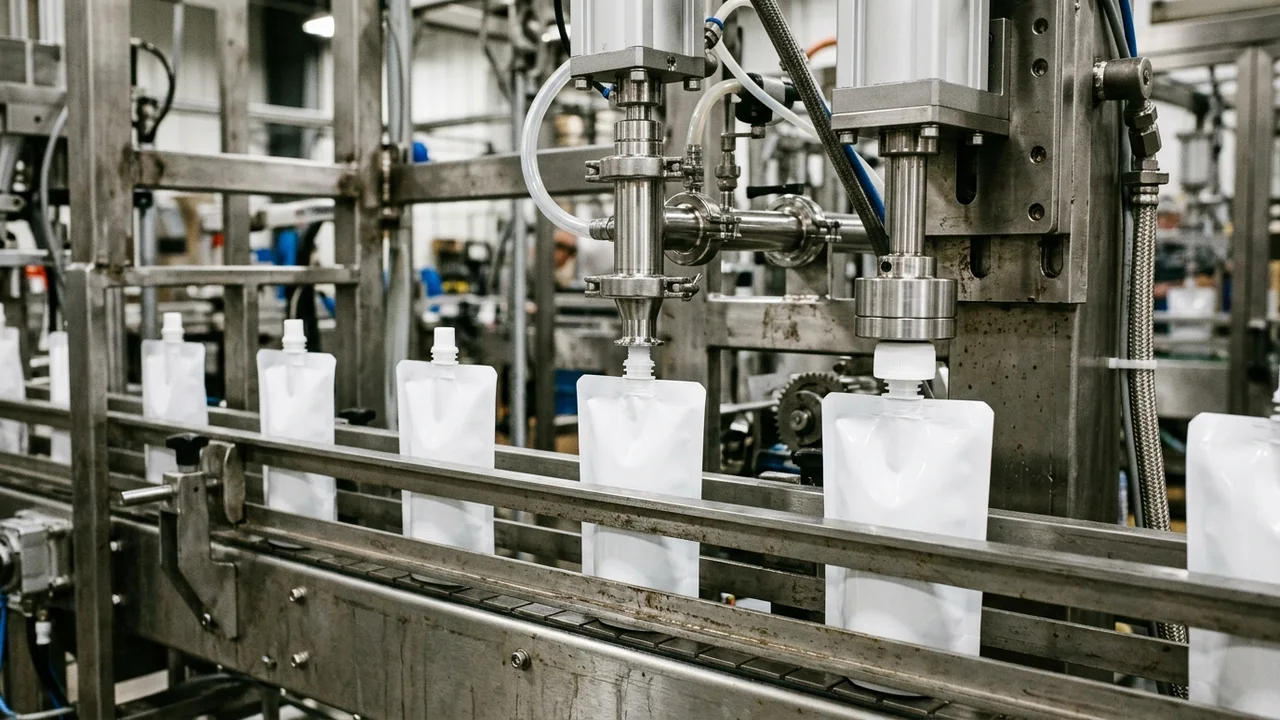
| Top-center pre-welded spout pouch (250 mL–5 L liquid format) | Pouch perimeter is 100% pre-sealed by the converter; product enters through a rigid injection-molded HDPE or PP top spout neck (8–22 mm ID) closed by a threaded tamper-evident cap | Slotted stainless-steel spout-neck carrier rail (holds rigid spout flange, not flexible film); diving or sealed through-spout liquid nozzle; vibratory cap sorter + servo/magnetic torque capper | Through-spout filler route: LV-160 2 kg–5 L laundry liquid spout filler and LV-160 beer nozzle bag filler (10–15 bags/min catalog baseline) | Failure mode: Liquid splash or foam wets spout threads during dosing, causing cap cross-threading, cocked tamper bands or transit leakage. Prevention: Use a positive shut-off anti-drip nozzle matched to spout bore ID and verify application/removal torque (0.8–1.8 N·m) under ASTM D3198. |
| Angled corner-spout stand-up pouch (30°–45° pour fitment) | Spout is pre-welded into one upper corner (30°–45°) while the adjacent top edge remains open for top-mouth filling (or spout is filled on an inclined rail) | Asymmetric cutaway gripper jaws on a pick-fill-seal turret (clearing the corner spout boss) with top-mouth filling + offset top heat seal, OR dedicated inclined corner-spout capper | Listed under spout/doypack options on the premade pouch sauce configuration; exact top-fill vs. through-spout route confirmed from your pouch drawing | Failure mode: Standard symmetrical gripper jaws or straight top-seal bars strike the rigid plastic spout flange, cracking the weld boat or jamming the turret. Prevention: Submit dimensioned spout-boat CAD drawings so stepped sealing bars and notched grippers maintain a >=3–5 mm thermal clearance buffer from the spout weld. |
| Flat 3-side-seal / 4-side-seal pillow or retort pouch (no bottom gusset) | 2 flat layers across top mouth (2 × t_film); zero bottom gusset; lies flat after discharge (including aluminum-foil retort or cohesive paste pouches) | Standard flat grippers (rotary or horizontal inline); vacuum suction cup opening without bottom-gusset air jet; vacuum/steam deaeration or gas flush + two-stage flat seal | Pick-fill-seal rotary (LV-210 baseline) or horizontal inline premade pouch shisha machine (100–500 g, 10–20 bags/min baseline) | Failure mode: Cohesive paste, oil or condiment strings across the narrow flat mouth during nozzle retraction, blistering the top heat seal. Prevention: Pair servo diving nozzles with suck-back/anti-drip shut-off valves and validate seal peel strength under ASTM F88. |
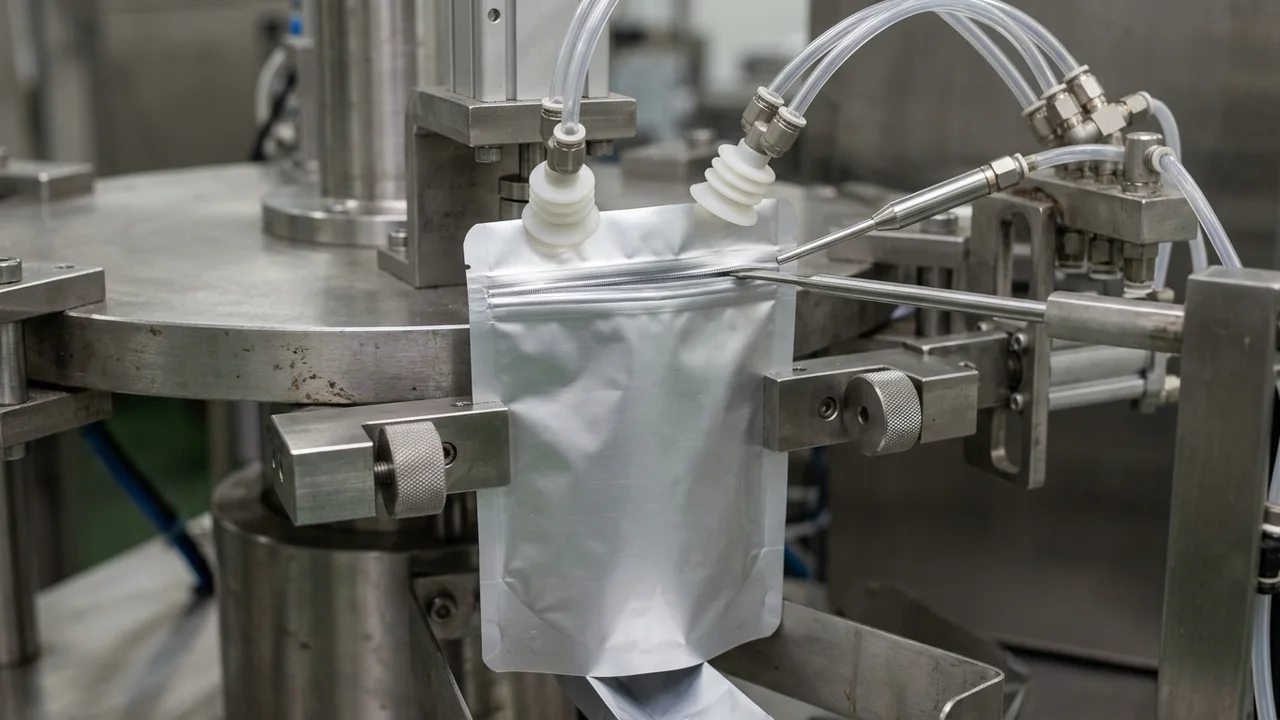
Rule-of-Thumb 1 (Press-to-Close Zipper & Multi-Layer Side-Gusset Threshold): If your converted pouch laminate exceeds 110 microns total thickness, incorporates a press-to-close zipper rib (1.2–2.5 mm profile thickness), or transitions from 2 film layers to 4 film layers across side gussets, specify an 8-station or 10-station pick-fill-seal turret equipped with a mechanical zipper-spreading claw at Station 3, recessed zipper-relief gripper pads, and two-stage heat sealing (Station 6 pre-heat + Station 7 final seal and water-chilled cooling bar). Single-stage sealing jaws cannot drive sufficient conductive heat into 4-layer gusset steps at 30–60 bags/min without overheating and scorching the 2-layer center panel or failing ASTM F1921 hot-tack and ASTM F1140 burst tests.
What are the main types of premade pouch machines—and how do rotary, duplex, inline and spout fillers differ?
Once your pouch format fixes the opening and closing method, the second engineering decision is the machine transport architecture. Search results and supplier catalogs often mix rotary 6-station, 8-station and 10-station turrets, duplex (twin-gripper) turrets, horizontal inline indexing machines, and spout-rail cappers without explaining the kinematic boundaries that separate them. Unlike vertical form fill seal (VFFS) machines or sachet packing machines that unwind and form rollstock film around a forming tube, every premade pouch machine must index discrete, pre-converted bags through a synchronized station loop.
| Machine type & architecture | Station sequence & indexing kinematics | Standard baseline speed, width & utility envelope | Best-fit pouch formats & product applications | Dominant field failure mode & mechanical prevention |
|---|---|---|---|---|
| Industry 8-station simplex (1-up) rotary pick-fill-seal turret (8S-235 / RZ8-240E / TT-8D-N examples) | Cam- or servo-indexed circular turret carrying 8 pairs of width-adjustable side grippers (1 pouch per station): (1) Magazine feed, (2) Date code, (3) Zipper + vacuum/air open, (4) Fill + vibrate, (5) Settling / gas flush / desiccant / dust hood, (6) 1st seal, (7) 2nd seal + cooling bar, (8) Discharge | 20–60 bags/min industry comparison; width 80–240 mm (RZ8-240E); 3.0–3.5 kW; 400–600 NL/min (14–21 CFM) dry air at 0.5–0.65 MPa; 900–1,500 kg | Stand-up doypacks, press-to-close zipper pouches, flat 3-side-seal bags, and desiccant pouches for coffee beans, gummies, dried fruit, snacks, powders, juice, milk drinks and sauces | Failure mode: Vacuum suction loss or static cling in the horizontal/inclined bag magazine causing double-picked or dropped pouches at Station 1. Prevention: Combine an inclined motorized belt magazine with side air-knife separation jets and Station 3 'no-pouch / no-open / no-fill' optical/vacuum interlocks. |
| Wide-format 8-station simplex rotary turret (RZ8-300E / RZ8-400E / 8S-285 / TT-8C2 class) | Enlarged pitch-circle rotary turret with reinforced cam indexers and heavy-clamp spring/cam grippers engineered for wide pouches and high fill masses (1.5–5.0 kg) | 15–50 bags/min on 180–300 mm width (RZ8-300E, 1,800 kg) or 15–30 bags/min on 270–400 mm width (RZ8-400E, 2,500 kg); length up to 450–600 mm; 3.6–5.5 kW; >=400–700 NL/min air | Club-store bulk pet food, protein powder, frozen food, agricultural granules, and institutional sauce stand-up or zipper pouches (1.5–5.0 kg dose) | Failure mode: Dynamic impact of a 2–5 kg product drop pulls the pouch downward inside the gripper jaws, producing a sagged, crooked top heat seal. Prevention: Install a synchronized under-pouch bottom support pedestal under Stations 4–7 and specify serrated high-friction carbide/silicone gripper inserts. |
| 10-station simplex rotary pick-fill-seal turret (ZP-10R200 / multi-component class) | 10-station circular turret adding two extra dwell positions between bag opening (Station 3) and first heat sealing (Station 8) | 20–75 bags/min; pouch width 80–240 mm; length 120–380 mm; 4.0–5.5 kW; 500–750 NL/min air at 0.6 MPa | Multi-component ready meals (solid weigher drop at Station 4 + liquid sauce piston fill at Station 5 + desiccant/oxygen absorber or dual-stage N2 gas flush at Station 6–7) | Failure mode: Liquid sauce splashes onto the upper inner sealant layer when dosed immediately after solid chunks, causing steam blowouts at the sealing jaws. Prevention: Separate solid fill (Station 4) from diving-nozzle liquid dosing (Station 5) and add an inner-mouth wipe/aspirator (Station 6). |
| Duplex (2-up / twin-gripper) rotary pick-fill-seal turret (TT-9CW / 8SU-240 / SG320D class) | Each rotary turret station carries two parallel pairs of grippers (2 pouches indexed per cycle), fed by a dual-lane magazine and twin-discharge filler | 60–100+ bags/min combined output (30–50 cycles/min × 2 lanes); pouch width restricted to 75–180 mm (up to 240 mm on large-pitch frames); 4.5–7.0 kW; ~1,000 NL/min (~35 CFM) compressed air | High-volume single-serve or retail stand-up and zipper pouches (50–500 g gummies, nuts, pet treats, capsules, liquid detergents) with long single-SKU runs | Failure mode: Uneven seal bar clamping force or fill-weight drift between the inner-radius and outer-radius pouch lanes. Prevention: Specify independent pneumatic/hydro-pneumatic pressure compensation cylinders for each lane's sealing jaw pair and twin independent servo dosing heads. |
| 6-station compact rotary or mini linear indexing pick-fill-seal (4SC-235 / TRC-300 class) | Compact 4-to-6-station frame that merges coding/opening and uses a single combined heat-seal station without a separate water-chilled cooling station | 6–25 bags/min; pouch width 90–235 mm; 1.5–2.5 kW; 350–500 NL/min air | Short-run contract packagers or pilot lines running thin (<100 µm) non-zipper 3-side-seal or simple doypack pouches at low speeds | Failure mode: Top-seal distortion and ASTM F1921 hot-tack separation on thick foil/kraft or zipper pouches because the pouch is released before the molten sealant crystallizes. Prevention: Restrict 1-seal frames to thin laminates at <=20 bpm, or step up to an 8-station turret with dedicated 2nd seal + cooling bar. |
| Horizontal inline intermittent-motion pouch machine (premade pouch shisha machine / linear track class) | Linear horizontal indexing conveyor or walking-beam carrier transporting pouches in a straight line past accessible overhead dosing and sealing modules (4799 × 779 × 1450 mm on our premade pouch shisha machine) | 10–20 bags/min on our premade pouch shisha machine (100–500 g weighing range, 2.4 kW, 450 kg); high-speed multi-lane horizontal inline systems reach 40–100 bpm with extended linear stations | Cohesive, sticky shisha tobacco paste, wet wipes, medical device pouches, or recipes requiring bulky overhead extruders/depositors that do not fit around a circular turret | Failure mode: Linear chain stretch or carrier pitch accumulation drift over the 4.8 m track shifts the pouch mouth off-center beneath the filling nozzle and sealing jaws. Prevention: Use servo-indexed linear transport with optical registration sensors at the filling and heat-sealing stations. |
| Spout-rail through-spout pouch filler & screw capper (LV-160 rotary/inline spout class) | Pouches slide by their rigid spout neck along a slotted stainless-steel rail: (1) Auto bag loading, (2) Through-spout pumped/piston dosing, (3) Vibratory cap feeding & placement, (4) Magnetic/servo cap screwing, (5) Discharge | 10–15 bags/min per head on LV-160 (3.0 kW, 220V/380V 50 Hz, 1400 × 900 × 1050 mm, 100 kg); multi-head rotary spout fillers scale to 30–60+ bpm | Top-center or angled spouted pouches (250 mL to 2 kg–5 L named on LV-160) for laundry liquid, detergent, dish soap, beer, juice concentrate, cooking oil and purees | Failure mode: Spout neck flange jams in the carrier slot or screw cap strips threads due to misaligned spout-boat welding from the pouch converter. Prevention: Enforce converter spout-flange dimensional tolerances (±0.15 mm neck slot clearance) and verify servo/magnetic clutch slip torque on production caps. |
Rule-of-Thumb 2 (Pouch Width Span & Gripper Turret Frame Threshold): If your target pouch width W_pouch spans > 120 mm between your smallest and largest SKUs or exceeds 210–240 mm (with fill mass M_fill > 1.5 kg), prioritize a wide-format simplex rotary frame (180–300 mm or 270–400 mm class) with motorized PLC gripper-width adjustment and a synchronized under-pouch support pedestal rather than forcing extreme SKU spans onto a standard 90–210 mm turret, because excessive gripper arm overhang induces pouch drop skew and crooked top seals.
Rule-of-Thumb 3 (Simplex 1-Up vs. Duplex 2-Up Rotary Output Threshold): If your required net accepted output Q_net exceeds 50–55 pouches/min on narrow pouches (W_pouch ≤ 180 mm) with free-flowing granules or low-viscosity liquids, select a duplex (2-up twin-gripper) rotary turret (60–100 pouches/min) only when SKU changeovers occur <= 1 time per shift; if your plant changes pouch widths 2–4 times per shift, two independent simplex 8-station turrets often deliver higher weekly net output because duplex frames double gripper adjustment points (16–20 gripper pairs vs. 8), require twin-discharge dosing nozzles, and consume ~1,000 NL/min (~35 CFM) of compressed air.
Rule-of-Thumb 4 (Top-Mouth Pick-Fill-Seal vs. Through-Spout Rail Threshold): If the pouch utilizes a pre-welded top-center spout or carries 1.5–5.0 L of liquid detergent, beverage or oil, route the project to a spout-rail through-spout filler and screw capper (LV-160 baseline) rather than a top-seal pick-fill-seal turret, because hanging the bag by its rigid HDPE/PP spout neck eliminates liquid sloshing across open heat-seal zones and enables closed-loop cap torque control under ASTM D3198.
How do you calculate usable pouch volume, seal-clearance headspace, and simplex vs. duplex net output?
A premade pouch machine's published pouch-dimension range (such as 90–210 mm width and 110–330 mm length on the LV-210 premade pouch weighing and filling machine) defines the mechanical envelope of the magazine guides and side grippers—not how many grams of your product will fit inside a given pouch without contaminating the top heat seal. Because dosing fillers measure mass or liquid volume while a flexible pouch constrains geometric volume, engineers must verify both headspace clearance below the top seal/zipper zone and effective net accepted throughput (Q_net) before locking the turret and filler specification.
Equation 1 — Usable stand-up pouch volume, seal clearance & maximum fill weight
When a flat converted stand-up pouch of outer width W_pouch (mm), outer length L_pouch (mm), and unfolded bottom gusset depth D_gusset (mm) is inflated at Station 3, the upper portion of the bag is consumed by the top heat seal and zipper profile (H_seal_zone, typically 30–45 mm on zipper pouches or 12–20 mm on plain doypacks) plus a mandatory product-free headspace buffer (H_clear, typically 25–40 mm for dry solids or 40–60 mm for splashing liquids) so falling product never bridges the sealing jaws. The usable geometric fill volume V_usable (cm³ or mL) and maximum safe fill mass M_max (g) for a product of loose bulk density ρ_bulk (g/cm³) follow:
V_usable (cm³) = k_geom × (W_pouch - 2 b_side) / (10) × (L_pouch - H_seal_zone - H_clear) / (10) × (D_gusset) / (10)
M_max (g) = V_usable × ρ_bulk
Worked Example (Checking a 160 × 240 mm Zipper Stand-Up Pouch for 250 g Whole-Bean Coffee on LV-210): Assume a converted zipper doypack with W_pouch = 160 mm (within the LV-210 90–210 mm baseline), L_pouch = 240 mm (within 110–330 mm), bottom gusset D_gusset = 80 mm, side seal width b_side = 8 mm (net inner width = 144 mm), top seal + zipper band H_seal_zone = 38 mm, required jaw-clearance headspace H_clear = 32 mm (net fill height = 170 mm), oval doypack cross-section factor k_geom = 0.52, and roasted coffee bean bulk density ρ_bulk = 0.38 g/cm³: V_usable = 0.52 × 14.4 cm × 17.0 cm × 8.0 cm = 1,018.4 cm³, yielding a maximum clean-seal fill mass of M_max = 1,018.4 × 0.38 = 387.0 g—confirming that a 250 g target dose occupies 64.6% of usable volume and leaves >32 mm of clean headspace below the zipper track without requiring vibration settling.
Equation 2 — Simplex (1-Up) vs. Duplex (2-Up) net accepted output & turret cycle speed
Catalog speed ranges (such as 20–70 bags/min on LV-210, 10–20 bags/min on our premade pouch shisha machine, and 10–15 bags/min on LV-160) represent dry mechanical indexing baselines. Actual shift output Q_net (accepted pouches/min) depends on the physical turret cycle rate N_cpm (cycles/min, governed by product dump/settle time and heat-seal dwell time for your laminate gauge), pouches indexed per cycle N_up (1 for simplex, 2 for duplex), overall equipment effectiveness OEE_line (magazine reloading, film/zipper lot variance, routine jaw wiping), the 'no-open / no-fill' skip rate R_no_open, and checkweigher/seal reject rate R_reject:
Q_net = N_cpm × N_up × OEE_line × (1 - R_no_open - R_reject)
N_up_min = ⌈ (Q_target) / (N_cpm × OEE_line × (1 - R_no_open - R_reject)) ⌉
Worked Example (Sizing for 55 Accepted Pouches/min of 150 g Zipper Gummy Pouches): Assume a 140 × 200 mm PET/VMPET/LLDPE (130 µm) zipper pouch where multihead weigher dump settling plus conductive seal dwell fixes the turret index rate at N_cpm = 38 cycles/min, with OEE_line = 0.85, R_no_open = 0.012 (1.2%), and R_reject = 0.005 (0.5%): a single simplex (N_up = 1) turret delivers Q_net,simplex = 38 × 1 × 0.85 × (1 - 0.017) = 31.75 accepted pouches/min, whereas achieving Q_target = 55 pouches/min requires N_up_min = ⌈ 55 / 31.75 ⌉ = 2 lanes (Q_net,duplex = 63.5 accepted pouches/min via either one duplex 2-up rotary turret or two parallel LV-210 simplex turrets).
How do our 10 premade pouch configurations map to your pouch and product?
Within our premade pouch filling machines family, ten equipment configurations cover four mechanical sub-routes: standard rotary/indexed pick-fill-seal (LV-210 reference series), CIP-ready viscous sauce pick-fill-seal, horizontal shisha paste premade pouch filling, and through-spout liquid filling with screw capping (LV-160 reference series). Baseline figures represent standard engineering ratings; product-specific dosing hardware, zipper reclosing modules, and format change parts are verified against your physical pouch samples during project engineering.
| Configuration & model baseline | Target pouch styles & closure route | Standard baseline parameters | Product & dosing application scope | Dominant field failure mode & FAT verification focus |
|---|---|---|---|---|
| LV-210 Premade Pouch Weighing & Filling | Stand-up doypacks, press-to-close zipper pouches, and flat 3-side-seal bags (top-mouth pick-fill-seal) | Width 90–210 mm; length 110–330 mm; speed 20–70 bags/min; 3.5 kW; 220 V, 50/60 Hz; 2150 × 1350 × 1300 mm; 900 kg | Roasted coffee beans, nuts, snacks, granules and dry free-flowing solids paired with overhead weighing | Failure mode: Whole beans or granules bounce into the open zipper track during high-speed drop. FAT check: Verify funnel timing, bottom vibration settling, and zipper-track blow-off before Station 6 sealing. |
| LV-210 Zipper Bag Gummy Candy Configuration & Zipper Stand-Up Fruit Configuration | Reclosable zipper stand-up pouches (lists automatic bag retrieval and automatic opening including the zipper) | Width 90–210 mm; length 110–330 mm; speed 20–70 bags/min; 3.5 kW; 220 V, 50/60 Hz; 900 kg | Sugar-coated or oiled gummy candies, dried fruit, trail mix, and confectionery pieces | Failure mode: Sticky sugar or oil buildup on the filling chute and zipper-opening claw causes bridging or missed zipper separation. FAT check: Test embossed/dimpled contact chutes and verify ASTM F88 top-seal peel integrity. |
| LV-210 Food Bag with Pre-Filled Desiccant Configuration | Moisture-barrier stand-up and zipper pouches requiring synchronized desiccant sachet insertion | Width 90–210 mm; length 110–330 mm; speed 20–70 bags/min; 3.5 kW; 220 V, 50/60 Hz; 900 kg | Dehydrated foods, freeze-dried snacks, crispy baked goods, and moisture-sensitive nutraceuticals | Failure mode: Desiccant packet lodges in the upper seal zone or misses insertion without halting top sealing. FAT check: Verify optical desiccant-drop confirmation interlock and headspace clearance above the product bed. |
| LV-210 Pre-Filled Bag Juice Beverage Configuration & Stand-Up Milk Configuration | Top-filled liquid stand-up pouches sealed across the top mouth after liquid dosing | Width 90–210 mm; length 110–330 mm; speed 20–70 bags/min; 3.5 kW; 220 V, 50/60 Hz; 900 kg | Fruit juice, NFC juice, jelly, milk-style beverages, herbal drinks, and functional liquids | Failure mode: Centrifugal liquid wave sloshes onto the inner PE sealant zone during turret indexing, causing seal-through contamination and ASTM F1140 burst failure. FAT check: Validate turret acceleration ramps, diving-nozzle depth, and seal-through-liquid jaw pressure. |
| High-Speed Premade Pouch Sauce Configuration | Doypack (stand-up), gusseted, or spout pouches (top-fill or corner-spout architecture confirmed per sample) | Dimensions and speed confirmed on sample; SUS304/316 stainless steel; integrated Clean-in-Place (CIP) protocol; Siemens PLC/HMI | Ketchup, mayonnaise, chili sauce, hot-pot seasoning paste, and viscous sauces containing particulates | Failure mode: Particulate trapping or oil/fat film smear in the top seal area, plus long allergen/flavor washdown changeovers. FAT check: Test servo piston anti-drip shut-off nozzle cut-off and CIP manifold flushing cycle. |
| Premade Pouch Shisha Tobacco Configuration | Ready-made flat or stand-up barrier pouches handled on a horizontal layout (4799 × 779 × 1450 mm) | Weighing range 100–500 g; speed 10–20 bags/min; max film/pouch width ref 350 mm; 2.4 kW; 220 V, 50/60 Hz; 450 kg | Molasses-soaked shisha tobacco, Arab and Turkish shisha tobacco paste, and high-viscosity cohesive pastes | Failure mode: Molasses/glycerin stringing fouls the pouch mouth edge during horizontal transfer. FAT check: Confirm paste dosing cut-off gate and seal-bar compression across syrup-wetted FDA 21 CFR 177.1520 polyolefin sealants. |
| LV-160 2 kg–5 L Laundry Liquid Spout Pouch Filler & LV-160 Beer Nozzle Bag Filler | Pre-welded spout pouches held by the spout neck (automatic bag loading, through-spout filling, cap feeding, and cap screwing) | Speed 10–15 bags/min; 2 kg and 5 L for the laundry-liquid configuration; 3.0 kW; 220V/380V 50 Hz; 1400 × 900 × 1050 mm; 100 kg | Laundry detergent, liquid soap, dishwashing liquid, disinfectant, beer, tea drinks, and cooking oil | Failure mode: Surfactant foam overflow or inconsistent cap removal torque during bulk transit. FAT check: Verify submerged/anti-foam dosing profile and measure cap torque consistency under ASTM D3198. |
How do 5-year TCO hidden costs and the rollstock VFFS crossover equation govern machine selection?
Comparing two premade pouch machines—or deciding between a premade pouch machine and a roll-film vertical form fill seal (VFFS) machine—by machine invoice price alone hides the three largest operating cost drivers over a 5-year (1,250-shift) horizon: multi-SKU gripper changeover downtime, converted pouch scrap from missed openings and gusset-step leakers, and the unit-cost gap between pre-converted bags and rollstock laminate. Once you narrow down your machine architecture here, use our premade pouch machine cost and quote-comparison guide to audit supplier proposals line by line, or review when to automate manual pouch filling if you currently fill bags by hand.
Equation 3 — 5-Year multi-SKU changeover & pouch-scrap hidden cost delta (C_hidden_5yr)
Every time an 8-station rotary turret switches from a narrow pouch (e.g., 110 mm) to a wide pouch (e.g., 200 mm), all 8 pairs of gripper arms (16 jaw pads), the bag magazine guides, and the zipper-opening shoe must move symmetrically. Manual hand-wrench adjustment across 8 stations takes T_change_manual ≈ 25–35 min plus 20–40 setup pouches, whereas motorized PLC recipe-driven gripper width adjustment completes the span shift in T_change_PLC ≈ 3–5 min. Across N_shifts_5yr total shifts (250 days/yr × 1 shift × 5 yrs = 1,250 shifts), with N_changeovers width changeovers per shift, line downtime value C_downtime_hr, shift pouch volume Q_shift, empty pouch cost C_pouch, and filled-pack scrap cost C_filled_pack, the 5-year hidden operating cost delta is:
C_hidden_5yr = N_shifts_5yr × [ (T_change_manual - T_change_PLC) / (60) × N_changeovers × C_downtime_hr + Q_shift × (Δ R_pouch_waste × C_pouch + Δ R_leaker × C_filled_pack) ]
Worked Example (8-Station Rotary Running 2 Pouch Width Changeovers/Shift): Assume N_shifts_5yr = 1,250 shifts, N_changeovers = 2 per shift, manual adjustment T_change_manual = 30 min vs. motorized PLC width adjustment T_change_PLC = 5 min (0.833 hr/shift saved), Q_shift = 15,000 pouches/shift, a mechanical zipper claw reducing torn/unopened bag waste by Δ R_pouch_waste = 1.5% (225 pouches/shift), and two-stage water-chilled sealing reducing gusset-step leakers by Δ R_leaker = 0.8% (120 filled packs/shift): over 5 years (1,250 shifts), motorized PLC width adjustment, a servo zipper opener, and a water-chilled second sealing bar save 1,041.7 hours of changeover downtime, 281,250 empty converted pouches, and 150,000 filled-pack leakers.
Equation 4 — Premade pouch vs. rollstock VFFS unit-cost crossover volume (N_crossover)
Buyers often hear that roll-film VFFS packaging costs less per pack than premade pouches without seeing the boundary conditions. Because a pouch converter slits, prints, laminates, die-cuts, and pre-seals stand-up pouches off-line, a pre-converted zipper doypack carries a higher unit material price (C_premade_unit) than equivalent flat rollstock film (C_rollstock_unit, typically 50% to 60% lower per pack in raw film mass). However, forming a stand-up zipper bag inline from rollstock requires a higher-complexity doy-style VFFS machine with an inline transverse/longitudinal zipper applicator (Δ CapEx_VFFS_doypack) plus longer forming-tube/collar changeovers (Δ C_changeover_5yr). The cumulative volume N_crossover (total packs) required for rollstock savings to pay back the VFFS forming hardware and changeover penalty is:
N_crossover = (Δ CapEx_VFFS_doypack + Δ C_changeover_5yr) / (C_premade_unit - C_rollstock_unit)
Format Crossover Rule (Premade Zipper Doypack vs. Doy-Style VFFS): When you divide the incremental capital and 5-year forming-collar changeover hours of an inline doy-quad VFFS + zipper-applicator system by the converter-to-rollstock unit material delta on a 150 × 220 mm zipper doypack, the breakeven crossover lands around 1.5 to 2.0 million pouches per format. For multi-SKU brands running < 1.5–2.0 million pouches per format or requiring shaped die-cuts, corner spouts, and 5-minute gripper width changeovers, a premade pouch machine yields lower total project cost and faster market launch; for single-SKU commodity runs exceeding 3–5 million packs/year in a plain pillow or gusseted bag, compare our VFFS machines or horizontal flow wrapping guide.
| Cost or line-integration layer | Hidden operating loss if underspecified | Engineering specification & upstream/downstream handoff | Verification method (FAT / standard) |
|---|---|---|---|
| 1. Multi-SKU gripper & magazine changeovers | 25–35 min manual wrench adjustment across 8 stations (16 gripper jaws) per width change, plus crooked-bag startup waste | Specify motorized PLC servo/leadscrew gripper width adjustment (3–5 min recipe recall) and quick-lock magazine side guides when running >=3 pouch widths | Time a full min-to-max width changeover (90 mm to 210 mm on LV-210) during Factory Acceptance Testing (FAT) |
| 2. Compressed air & vacuum generation | Venturi vacuum generators starve below 0.5 MPa (75 psi), causing intermittent bag-opening drops (1–4% missed cycles) and 400–1,000 NL/min air draw | Size plant dry compressed air (ISO 8573-1 clean dry air at 0.55–0.65 MPa) or specify a rotary-vane mechanical vacuum pump to cut compressed-air kW consumption by 40–60% | Log main manifold pressure droop at peak cycle speed (N_cpm) with all vacuum cups and air-blast jets firing |
| 3. Wear spares & converter batch variance | Worn silicone vacuum cups (3–6 month life) or carbonized PTFE seal-bar cloth cause sudden shift stoppages; curled converter pouches jam the magazine | Order a 12-month spare and change parts kit (bellows suction cups, cartridge heaters, PTFE tape, silicone backer strips) and freeze converter pouch COF/curl tolerances | Run 300–500 production-supplier pouches per SKU during pre-quote sample testing |
| 4. Upstream dosing & product feed synchronization | Buying a base pouch turret without synchronized bucket elevator, working platform, or anti-drip/dust-hood dosing interlocks causes seal-zone contamination | Match solids to a multihead weigher + Z-bucket elevator, dusty powders to a servo auger + dust collector, and sauces/pastes to a SUS304/316 servo piston or our premade pouch shisha paste filler | Verify closed-loop 'Bag Open OK -> Release Dose' handshake signal and ASTM F88 peel strength on filled pouches |
| 5. Downstream checkweighing, metal detection & cartoning | Manual pack-off bottlenecks a 40–70 bpm rotary turret and lets underweight or micro-leaking pouches reach retail cartons | Integrate a take-away conveyor, dynamic checkweigher + metal detector, rotary accumulation table, and—for retail multipacks or brick-style center-spout pouches—an automatic cartoning machine | Validate end-to-end reject diversion and ASTM F1140 burst/creep integrity before secondary case/carton loading |
How do you validate seal integrity during FAT—and what should you send for an engineering review?
Because converted premade pouches combine pre-sealed side seams and bottom gussets made by your film converter with a final top heat seal (or threaded cap closure) made on your packaging line, Factory Acceptance Testing (FAT) must evaluate the entire package perimeter under recognized international standards rather than relying on visual inspection alone:
- Seal Peel Strength (ASTM F88 / F88M): Cut 25.4 mm (1.0 in.) or 15 mm wide strips across both the 2-layer center top seal and the 2-to-4-layer side-gusset or zipper-end transitions, and pull them at 200–300 mm/min (Techniques A, B, or C) to verify uniform fusion without delamination or scorching of the FDA 21 CFR 177.1520 polyolefin inner sealant.
- Hot-Tack Resistance (ASTM F1921 / F1921M): Verify that the freshly melted top seal resists spring-back opening forces from rigid side gussets, trapped headspace gas, or heavy product loads (1–5 kg) between Station 6 (first seal) and Station 7 (second seal + water-chilled cooling bar).
- Whole-Pouch Internal Pressurization Burst & Creep (ASTM F1140 / F1140M & ASTM F2054): Inflate finished pouches to burst (Method A) or hold them at a specified creep pressure (Methods B/C) to expose micro-channel leaks at the exact point where the horizontal top seal crosses the vertical side-gusset fold or crushed zipper end.
- Process Window Validation (ISO 11607-1 / 11607-2): For medical, pharmaceutical, or high-barrier retort pouches, qualify the lower and upper operating limits of jaw temperature (°C), nip pressure (MPa), and dwell time (ms).
- Threaded Spout Cap Torque (ASTM D3198): On LV-160 through-spout configurations, measure application and removal torque across production caps after liquid dosing to confirm tamper-band engagement and leak-free transit.
Send your pouch drawings or physical production-supplier samples, closure specification, product details, target fill weight/volume, and required shift output through WhatsApp or the project brief checklist. Our engineering team maps your pouch geometry against the premade pouch filling machines range, flags whether a pre-quote sample trial is required (mandatory for flat-bottom box pouches, thick quad-seal gussets, or unlisted spout geometries), and returns an itemized configuration scope that you can audit with the premade pouch machine cost worksheet.
Frequently asked questions about stand-up pouch types and premade pouch machines
What is the difference between a doypack and a stand-up pouch on a packaging machine?
There is no mechanical difference: 'doypack' is the original trade term for a flexible stand-up pouch with a W-fold bottom gusset that expands into a self-supporting base. What changes the machine is not the name, but whether the pouch arrives pre-converted in stacks for a pick-fill-seal machine (LV-210 baseline) or is formed inline from rollstock film on a doy-style VFFS or HFFS machine.
How does a flat-bottom (box) pouch differ from a standard stand-up doypack for machine handling?
A standard doypack has two flat side seams and a W-fold bottom gusset (2 film layers across the top seal). A flat-bottom (5-panel box) or quad-seal pouch has four vertical corner seals and full M-fold side gussets, creating a 2-to-4-layer thickness step at the top seal line. It requires mechanical gusset-tucking fingers, higher gripper clamp force, and two-stage heat sealing + cooling verified via a physical sample test.
Can one premade pouch machine run both zipper stand-up pouches and spout pouches?
Only if the spout is an angled corner spout where the pouch still fills and heat-seals through an open top mouth using notched gripper jaws. Pre-welded top-center spout pouches have a completely sealed perimeter and must hang by their rigid spout neck on a through-spout filler and screw capper (LV-160 baseline), which is a mechanically separate machine from a top-seal pick-fill-seal turret (LV-210 baseline).
When should you choose a premade pouch machine over a vertical form fill seal (VFFS) machine?
Choose a premade pouch machine when your pack requires converter-applied features—such as press-to-close zippers, corner or top spouts, shaped contours, or multi-panel box gussets—or when you run multiple pouch widths across < 1.5–2.0 million packs per SKU where 5–20 minute gripper adjustments beat changing VFFS forming collars. Compare small roll-film flat packs in our sachet construction guide.
Why does a premade pouch machine need two heat-sealing stations plus a cooling bar?
Multi-layer barrier laminates (PET/AL/LLDPE or Kraft/VMPET/CPP, 110–180 µm) and 4-layer gusset transitions require more thermal dwell time than a single indexing cycle provides. Dividing heat input across Station 6 (first seal) and Station 7 (second seal) melts the inner FDA 21 CFR 177.1520 polyolefin layer without scorching the outer print film, while the water-chilled cooling bar sets ASTM F1921 hot-tack strength before discharge.
Sources & scope boundaries
Equipment routes, station sequences, and baseline ratings for the LV-210 (90–210 × 110–330 mm, 20–70 bags/min, 3.5 kW, 900 kg), LV-160 (10–15 bags/min for 2 kg–5 L spout pouches, 3.0 kW, 100 kg), our premade pouch shisha machine (100–500 g, 10–20 bags/min, 4799 × 779 × 1450 mm, 2.4 kW, 450 kg), and our SUS304/316 CIP-ready sauce configuration reflect our machine specifications. Industry architectural comparisons reference published OEM specifications from PACRAFT (Toyo Jidoki TT-8D-N simplex and TT-9CW duplex series and pouch classification guide), Viking Masek (4SC-235, 8S-235, 8S-285, 8SU-240), Rezpack (RZ8-240E, RZ8-300E, RZ8-400E), and DolcePack (REVO, COMBI Sprint). Validation protocols reference ASTM F88 / F88M, ASTM F1921 / F1921M, ASTM F1140 / F1140M, ASTM F2054, ASTM D3198, ISO 11607-1 / 11607-2, ISO 8573-1, and FDA 21 CFR 177.1520. All worked equations use stated illustrative engineering inputs; final machine configuration, cycle speed, and dosing accuracy are verified on your production pouches and product during Factory Acceptance Testing (FAT) or sample trials.
Discuss your application with LINEVO.
Discuss your pouch format & machine route