
Hand filling or a premade pouch machine: in short
Hand filling with a scale and a heat sealer works while the people on the line can keep pace and every pouch is weighed and sealed the same way. It reaches its limit when the output you need, the fill consistency or the seal quality start to depend on who is working that shift. An automatic premade pouch machine opens, fills and seals every pouch in the same timed sequence; on the LINEVO LV-210 the source catalog lists 20–70 bags per minute for pouches 90–210 mm wide and 110–330 mm long, a catalog range without product-specific trial conditions. If your pouch falls outside that range or is a style the catalog does not list, its fit is not confirmed yet and is reviewed from a pouch sample.
- The current LINEVO premade pouch catalog lists no manual, semi-automatic or benchtop pouch fillers. This page explains the boundary; it does not recommend a manual machine.
- There is no single pouches-per-day threshold. The move is decided by your pouch, your product and the good output you need.
- The pouch you fill by hand today is the sample an automatic machine is set up around, so settle the pouch supplier and specification first.
- A sample test with your own pouches and product shows how they open and seal on the machine before you commit.
What does a manual pouch filling setup look like?
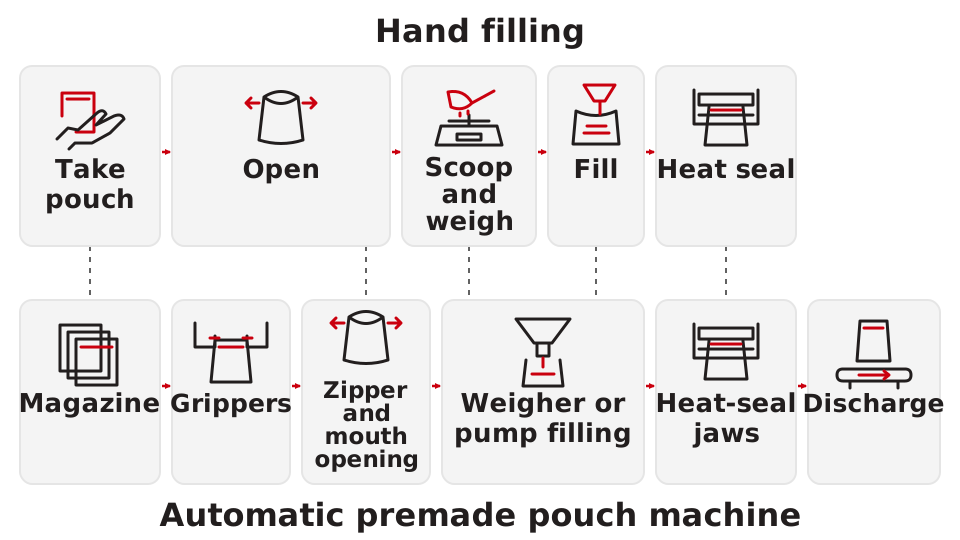
A manual setup splits the job into steps that one or more people do in turn: take a pouch, open it, dose the product, fill, close the zipper if there is one, and seal the top. An automatic premade pouch machine picks, opens, fills and heat-seals at fixed stations; closing the zipper again before the seal is confirmed per configuration. The table puts the two side by side, so you can see which of your current steps the machine takes over and which details it needs from you.
On this page, semi-automatic means any setup in which a person still places or removes every pouch, even if a filler doses the product or a band sealer closes the pouch.
| Step | Manual or semi-automatic way | Automatic premade pouch machine |
|---|---|---|
| Pouch supply | An operator takes each empty pouch from the box | Empty pouches stand in a magazine and one is picked at a time; grippers hold it from pick-up to discharge |
| Opening | Opened by hand, including the zipper | On zipper pouches the zipper is opened first, then the pouch mouth is opened by suction and air |
| Dosing and filling | Scooped or poured and checked on a scale, or dosed by a filler the operator triggers | A multihead weigher, auger or pump above the filling station, sometimes split across two filling stations |
| Sealing | A heat sealer: an impulse sealer heats its element only while current flows and holds the pouch under pressure, and a band sealer carries the pouch on moving belts over heating elements | Heated jaws seal the pouch top at a fixed station |
| Extras | Desiccant dropped in by hand, code stamped or printed separately | Coding at the gripping station, desiccant insertion, settling or air removal before sealing, each as an option |
| Spout pouches | Filled through the spout and capped by hand | A spout pouch filler such as the LV-160 lists automatic pouch loading, cap feeding and cap screwing |
When is it time to move to a premade pouch machine?
It is time to look at an automatic machine when the problems in your hand process come from people and pace rather than from the pouch or the product, and when the pouch itself has stopped changing. The table lists the signs, what each one tells you, and what to check before you automate.
| Sign | What it tells you | Check before you automate |
|---|---|---|
| Output | The pouches you need per shift no longer fit the people and hours you have, so output rises only by adding people | State the good pouches per minute or per shift you need; the listed ranges are 20–70 bags per minute on the LV-210 and 10–15 on the LV-160 spout filler, without product-specific trial conditions |
| Fill consistency | Fill weights vary with the operator, and you give product away to stay above the label weight | Your target fill, the tolerance you need and how the product behaves, which together decide the dosing unit |
| Seal quality | Wrinkled, weak or leaking seals depend on who is at the sealer | Seal quality on your pouch in a sample test; with liquids, that the fill level stays clear of the seal |
| A settled pouch | You run the same pouch styles and sizes week after week | Each size falls inside the listed range (LV-210: width 90–210 mm, length 110–330 mm), and every size you run is listed so the grippers for each width are quoted |
| Line links | You want filled pouches to go straight to a checkweigher, metal detector or conveyor | How product reaches the machine and where finished pouches go next |
Signs that it is still too early
- The pouch design is still changing, or you only have pouches from a supplier you will not use in production. Pouches from different suppliers, or different batches, can open differently.
- Your pouch is outside the LV-210 listed size range, or it is a flat-bottom (box) pouch, which the LINEVO premade pouch listings do not name. That does not settle the question either way: the fit is not confirmed yet and is reviewed from a pouch sample.
- Almost every batch uses a different pouch size. Each width needs its grippers and settings, so frequent changes cost time on an automatic machine.
- You cannot yet describe how the product behaves, for example whether it is sticky, dusty or a liquid with particles. Plan to send a sample first.
We do not give a pouches-per-day threshold. It would depend on your pouch, product, shifts and the good output you need, and the listed machine speeds are ranges without trial conditions, so a single number would mislead more than it helps.
How to prepare the move from hand filling
Fix the pouch supplier, record your hand process as a baseline, check the fill in your own pouch, list every size and check the room. All of this can start while you still fill by hand.
- Fix the pouch: choose the supplier you will use in production and keep its pouch specification in writing. Decide on the zipper or spout now; stand-up pouch types and the premade pouch machine each one needs shows how each type changes the machine.
- Record your hand process: the target fill and how you weigh it, the sealer and its settings, how many good pouches each person fills per hour, and how many you reject. This is your baseline for comparing offers.
- Check the fill in your pouch: fill a pouch with your product at the target weight and see how much room is left below the seal area.
- List every size: all the pouch sizes you run, and how often you change between them.
- Check the room: the space, power supply and how product will reach the machine. The table gives the listed footprint of the two routes.
| Listed value | LV-210 pick-fill-seal | LV-160 spout pouch filler |
|---|---|---|
| Dimensions (mm) | 2150 × 1350 × 1300 | 1400 × 900 × 1050 |
| Power | 3.5 kW | 3 kW |
| Supply | 220 V, 50/60 Hz | 220 V or 380 V, 50 Hz |
| Listed speed | 20–70 bags per minute | 10–15 bags per minute |
These are catalog values. Machine dimensions do not include the full line layout and access space, and for plants in the United States the voltage, phase and frequency at the machine position are confirmed against your supply in the quotation.
What to send for a review of your pouch project
Send the product with its target fill, the daily output, pouch samples for every size, and a description of your current hand process. Anything you have not decided can be marked open.
- Product and target fill: granules, gummies, powder, liquid or a sauce with particles, whether it is sticky or dusty, and the target fill weight or volume with the tolerance you need
- Daily output: the good pouches you need per day or per shift, and how many shifts you run
- Pouch type and samples: pouches from your production supplier for every size, with the width, length, specification and any zipper or spout
- Your current hand process: the steps, the scale and sealer you use, and your current output and rejects
The team reviews whether an automatic route fits your pouch and output, and whether a sample test is needed, and comes back with a configuration proposal or a sample-test plan to discuss. If the answer is that hand filling still fits, that is part of the review.
Questions small brands ask about pouch filling
Does LINEVO sell a manual or semi-automatic pouch filling machine?
Not in the current catalog: its nine premade pouch configurations are automatic pick-fill-seal machines and spout pouch fillers. The short answer explains how this page uses them.
Can an automatic machine fill the pouches I already fill by hand?
Often, when the pouch fits a configuration's listed range and opens consistently; a sample test with your production pouches confirms it. The signs that it is still too early cover the exceptions.
What changes for the operator after the move?
The work moves from filling to running the machine. Training covers loading the magazine, changing grippers and settings between pouch sizes, cleaning and routine maintenance, and suction cups and sealing jaws are parts that wear in normal use.
How this page was put together
This page is compiled from published sources, not from our own trials, and contains no customer cases. Machine stations, listed ranges, power and dimensions come from the LINEVO premade pouch family page and the source catalog records for the LV-210 and LV-160 configurations (catalog revision of September 2026); every figure is a catalog listing without product-specific trial conditions. The description of impulse and band sealers is based on the Wikipedia entry “Heat sealer”, read on 7 October 2026. Prices, payback periods and labour savings are not covered.
Last updated: 7 October 2026.