
On this page
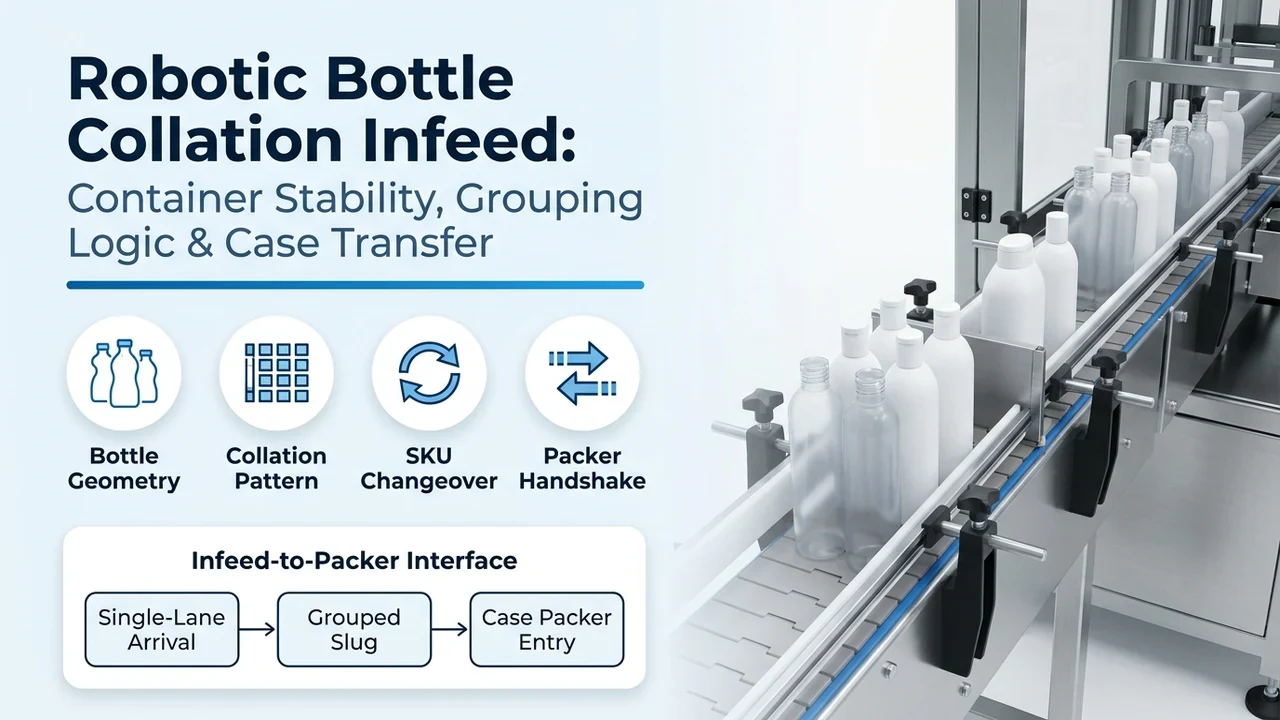
Sidel’s Cermex RoboSELEX announcement concerns the collating infeed between container conveying and case loading. Use the published module specifications to review bottle handling, collation patterns and changeovers. Our engineers coordinate upstream filling, pouching, labeling and retail cartoning with the selected downstream equipment, including transfer layouts and control signals.
Cermex RoboSELEX groups containers for a downstream case packer. Keep the collating module, case-loading equipment and upstream primary packaging as separate line functions in the process map. Our team selects the filling, pouching, labeling and cartoning configuration and reviews its discharge, buffering and controls with your chosen system supplier.
| Engineering parameter | Sidel Cermex RoboSELEX baseline (2-Delta Robotic Comb Infeed) | Sister Sidel Collators (CareSelect iTRAK / ProSelex / Vision / Racetrack) & Upstream Primary Scope |
|---|---|---|
| Equipment boundary & packaging function | Upstream robotic bottle-collating infeed module for case packers (spaces, pitches, orients at the source, and groups containers into batches; does not erect, load, or seal corrugated cases) | Sidel CareSelect / ProSelex / Racetrack feed downstream Cermex WB/SW/SB case packers; we supply upstream bottle labeling, liquid/paste filling, premade/spouted pouch packing, and secondary folding-carton cartoning |
| Rated gross throughput & batch matrix | 80 to 320 bottles/min (products/min); case collation matrices from 3 × 1 (3 units) up to 8 × 6 (48 units), depending on container footprint and pitch | Cermex ProSelex: 80–300 bpm (batches up to 15 kg); Cermex CareSelect (iTRAK): up to 400 ppm; Sidel Industrial Vision Delta: 120 ppm (< 40 ms vision latency); Racetrack pocket collator (soft packs/pouches): up to 500 ppm |
| Kinematics & End-of-Arm Tooling (EoAT) | 2 overhead-hung Delta robots (TPM top-frame design leaving full ground access for hygiene and leakage cleaning) driving 2 quick-release vacuum comb gripping heads with 3D-printed gripping tooling and shaped comb buckets | ProSelex: 4 servo drives moving shaped comb buckets (with regenerative braking recovery); CareSelect: independent magnetic movers on Rockwell iTRAK linear synchronous rails (reducing bottle friction contact time >= 20x vs. endless timing screws) |
| Accumulation behavior & puck-elimination boundary | Continuous-motion, accumulation-free infeed using upstream conveyor speed differential for product spacing/pitching; enables potential removal of transport pucks on conveyable, non-accumulable shaped FHPC bottles | Requires container base stability sufficient for single-file belt travel when isolated; extreme unstable vials/flacons still require pucks, whereas flexible stand-up pouches (LV-210 / LV-160) use vision-guided vacuum delta heads or isolated racetrack pockets |
| Format & collation changeover clock (SMED check) | Same bottle, different collation pattern: 1 min; Different bottle format: 2 min 30 s on Sidel product page vs. 'about 2 minutes' in the March 10, 2026 Interpack press release (ergonomic parking for 2 vacuum comb swaps + manual/optional motorized guide adjustment) | Cermex ProSelex: 1 min (collation) / 2 min 30 s (bottle format); Cermex CareSelect (iTRAK): < 1 min fully automatic tool-less HMI changeover with zero mechanical change parts |
| Vision inspection & batch verification | Integrated 2D vision system with AI-powered photo analysis for batch completeness and orientation verification prior to case-packer transfer | Sidel Industrial Vision System extracts (x, y, theta) coordinates on the fly in < 40 ms per object (two sides), verifying cap presence, label/date code position, and flexible pouch geometric distortion |
| Safety, control & transit validation standards | ISO 10218-1 / ISO 10218-2 industrial robot perimeter guarding & dual-channel safety monitored stop; OMAC PackML (ISA-TR88.00.02) state model; ASTM D4169 / ISTA 3A transit case testing | High-speed overhead Delta robots (> 4g acceleration) operate inside interlocked guarding (ISO 10218-1), distinct from ISO/TS 15066 power-and-force-limited cobot palletizers (FANUC CRX-30iA) |
How does Sidel Cermex RoboSELEX compare with mechanical continuous-motion collators, intermittent starwheel/pusher grouping, and vision-guided pouch/bottle buffering?
A product collating infeed system is the electromechanical interface module positioned between single-file upstream primary container transport (coming off a liquid filler, capper, bottle labeling machine, or premade pouch machine) and the loading station of a secondary case packer or shrink-wrapper. Its sole mechanical task is to meter, space (pitch), orient, and assemble individual primary containers into a multi-row, multi-column batch slug (such as a 3 × 2, 4 × 3, or 8 × 6 array) synchronized with the downstream packer's flight bars or loading head. Crucially, a collating infeed module is not a complete case packer (which erects corrugated RSC or wrap-around blanks, inserts the collated batch, and glues or tapes the flaps) and is distinct from a primary horizontal cartoning machine (which loads pouches, sachets, or bottles into 250–400 gsm retail paperboard folding cartons).
Across Food, Home Care, Personal Care (FHPC), and flexible-packaging lines, project engineers select from four secondary collation architectures depending on container rigidity, center-of-gravity stability (H / W_base), line speed (Q_products/min), and daily SKU changeover frequency: (1) vision-guided and Delta robotic comb/pick-and-place collation (Sidel Cermex RoboSELEX 2-Delta vacuum comb at 80–320 bpm and vision-guided delta pick-and-place cells at 60–120 picks/min per robot), (2) mechanical and linear-motor continuous-motion collation (Sidel Cermex CareSelect iTRAK at up to 400 ppm, Cermex ProSelex 4-servo comb at 80–300 bpm, and endless timing screws), (3) intermittent starwheel, lane-diverter, and pneumatic right-angle pusher grouping (40–150 ppm), and (4) isolated pocket/bucket racetrack buffering for non-accumulable flexible pouches and sachets (Sidel Racetrack Collators at up to 500 ppm and our LV-180 synchronized cartoner bucket infeeds). All published speeds below represent Standard Engineering Baselines under Reference Conditions; actual plant output and container stability must be verified on filled production samples during Factory Acceptance Testing (FAT).
| Collation architecture & reference platforms | Rated speed baseline & batch matrix range | Grouping kinematics & container handling mechanism | Changeover clock & SKU agility | Dominant field failure mode & mechanical prevention |
|---|---|---|---|---|
| 1. Vision-Guided & Delta Robotic Comb / Pick-and-Place Collation (Sidel Cermex RoboSELEX 2-Delta Vacuum Comb; Sidel Industrial Vision Delta Cell) | RoboSELEX: 80–320 bottles/min (3×1 to 8×6 case patterns); Vision-guided Delta pick-and-place cell: 60–120 picks/min per manipulator (scaling to 180–360 ppm with multi-pick vacuum/mechanical EoAT) | Accumulation-free continuous motion: upstream conveyor speed differential spaces containers; 2 overhead Delta robots drive 3D-printed vacuum comb heads (RoboSELEX) or vision-guided (< 40 ms x, y, theta) vacuum/gripper EoAT to orient and group at the source without accumulation tables | 1 min (same bottle, different collation); 2 min to 2 min 30 s (different bottle format via tool-less quick-release swap of 2 vacuum comb heads at ergonomic park position) | Failure mode: Vacuum seal loss or container slip during > 4g delta robot acceleration when handling textured matte labels, condensation-wet bottles, or wrinkled flexible stand-up pouches, causing mid-swing drop faults and ISO 10218-1 safety trips. Prevention: Pair 3D-printed form-fitting comb buckets with dual-durometer 30–40 Shore A silicone bellows cups, size Venturi vacuum flow Q_vac >= 1.5–3.0 NL/s per cup, and verify wet/labeled bottles during FAT. |
| 2. Mechanical / Linear-Motor Continuous-Motion Collation (Sidel Cermex CareSelect iTRAK; Cermex ProSelex 4-Servo Comb; Endless Timing Screws) | Cermex CareSelect (Rockwell iTRAK): up to 400 products/min; Cermex ProSelex (4-servo comb): 80–300 bottles/min (3×1 to 8×6, batch mass up to 15 kg); Dual endless timing screws: 100–350 bpm | CareSelect transports each bottle individually on independent magnetic linear-motor movers (cutting friction contact time >= 20x vs. screws); ProSelex uses 4 servo axes to drive shaped comb buckets; timing screws pitch rigid containers via machined helical pockets | CareSelect (iTRAK): < 1 min fully automatic HMI changeover (zero change parts); ProSelex: 1 min (collation) / 2 min 30 s (bottle format); Timing screws: 20–40 min heavy Delrin screw + guide swaps | Failure mode: Endless timing-screw thread wedging, wet pressure-sensitive label scuffing, and bottle wall paneling when lightweight PET/HDPE bottles (< 18–25 g) enter fixed screw helices under upstream line pressure. Prevention: Replace rigid timing screws with independent iTRAK movers (CareSelect) or accumulation-free servo/robotic combs (ProSelex / RoboSELEX), and limit upstream conveyor line pressure below 15 N. |
| 3. Intermittent Starwheel, Swinging Gate Diverter & Pneumatic Right-Angle Pusher Grouping (Standard Drop / Side-Load Case Packer Infeeds) | 40–150 products/min (single-lane pneumatic pusher); 120–240 ppm (multi-lane oscillating lane diverter + dead-plate accumulation table) | Containers accumulate under contact backpressure against a pneumatic stop gate across parallel guide-rail lanes; once row count N_cols is reached, a pneumatic/servo cross-pusher sweeps the row 90° onto a dead plate | 15–45 min manual changeover across 8–20 threaded guide-rail handwheels, lane dividers, and pusher plates (requires trial-and-error width tweaking after restart) | Failure mode: Shingling (oval/flat bottles twisting sideways and wedging between fixed lane rails), trigger-sprayer neck tangling, and domino tip-overs during 90° pneumatic pusher impact on containers with H / W_base > 2.8. Prevention: Restrict dead-plate pusher infeeds to rigid cylindrical cans, jars, or low-aspect-ratio bottles (H / W_base <= 2.5), and fit encoders + digital counters on all guide-rail spindles. |
| 4. Isolated Pocket / Bucket Racetrack & Cartoner Buffering for Soft Packaging (Sidel Racetrack Collators; our LV-180 Bucket Infeed) | Sidel Racetrack Collator: up to 500 products/min. For our cartoner infeed, define the pack dimensions, count, orientation and required good output so our engineers can select the transfer arrangement. | Non-accumulable flexible packages (stand-up doypacks from LV-210, spouted pouches from LV-160, flow-wrapped bars, or multi-lane sachets/sticks from LV-400Y–980Y) are placed individually into isolated servo-indexed pockets and swept by a retractable transfer shuttle pusher into the case or folding carton | 5–15 min servo pitch/pocket recipe recall + adjustable bucket width guides or quick-release pusher fingers | Failure mode: Bulging bottom gussets on filled stand-up pouches (doypacks) or entrained headspace air in pillow bags jamming inside narrow transfer buckets during shuttle extraction. Prevention: Install top-compression conditioning/settling belts upstream of pocket loading and size pocket width with +4 to +6 mm clearance over maximum filled pouch bulge thickness. |
What did Sidel announce on March 10, 2026 for Cermex RoboSELEX, and how do you audit the 1-minute vs. 2-minute-30-second changeover clock?
On March 10, 2026, Sidel announced that Cermex RoboSELEX would make its global exhibition premiere with live booth demonstrations at Interpack 2026 (May 7–13, 2026, Hall 13, Booth B47, Düsseldorf, Germany), building on the earlier Cermex ProSelex platform introduced at Interpack 2023 (announced April 18, 2023) and reported by Packaging Europe on September 11, 2026. In its official release and machine repository specification, Sidel defines Cermex RoboSELEX as an accumulation-free robotic collating infeed system for Food, Home Care, and Personal Care (FHPC) lines—explicitly highlighting edible oils, sauces and dressings, and household/personal-care shaped containers.
When translating Sidel's published announcement and product datasheet into an engineering Request for Quotation (RFQ) or line-integration brief, procurement and project engineers must audit five concrete technical boundaries:
- 1. Infeed Module vs. Complete Case Packer Boundary: Although secondary trade coverage (Packaging Europe, September 11, 2026) headlined the story 'Sidel targets flexibility and speed with new case packer', Sidel's primary engineering documentation specifies that Cermex RoboSELEX is a product collating infeed system designed for case packers (80 to 320 bottles/min, batch matrices from 3 × 1 to 8 × 6). It replaces upstream accumulation tables, lane dividers, and intermediary orientation turntables, but must be paired with a downstream case packer (such as a Cermex WB wrap-around packer, SW, or SB RSC packer) to erect corrugated blanks, load the grouped batch, and glue or tape the shipping case.
- 2. Two-Delta-Robot Vacuum Comb vs. Four-Servo Mechanical Comb (RoboSELEX vs. ProSelex): Whereas the 2023 Cermex ProSelex uses 4 servo drives on a floor-mounted frame to articulate shaped comb buckets at 80–300 bottles/min (for batch weights up to 15 kg), the 2026 Cermex RoboSELEX suspends 2 Delta robots from the top of the frame (TPM-standard overhead design, leaving full ground access for washdown and product-leakage cleaning) to drive 2 vacuum comb gripping heads with 3D-printed gripping tooling at up to 320 bottles/min.
- 3. The 2-Minute vs. 2-Minute-30-Second Bottle-Format Changeover Discrepancy: Both Sidel's product page and its March 10, 2026 press release state 1 minute for switching to a different collation pattern of the same bottle. However, for switching to a different bottle format, the March 10, 2026 press release cites about 2 minutes, whereas the official Cermex RoboSELEX machine specification page lists 2 minutes 30 seconds (2 min 30 s). During a bottle-format changeover, the two Delta robots park at an ergonomic operator height so the 2 vacuum comb gripping heads can be swapped via tool-less quick-release latches (stored in an optional internal tooling drawer), accompanied by simple manual or optional motorized adjustments of the upstream conveyor guides.
- 4. 'Conveyable, Non-Accumulable' Puck Removal Physics: Sidel states that Cermex RoboSELEX performs batch orientation at the source (eliminating intermediary rotating tables) and 'offers the possibility to eliminate the puck's usage when dealing with conveyable non-accumulable shaped bottles'. In packaging-line physics, a conveyable, non-accumulable bottle can stand upright and travel along a single-file conveyor belt when isolated (spaced apart by upstream belt speed variation), but tips, wedges, or shingles if allowed to touch and accumulate under line backpressure. Containers with bases so narrow or rounded that they cannot stand upright even on a smooth moving belt still require pucks until captured by the collator.
- 5. Integrated 2D Vision & AI Photo Batch Control: Cermex RoboSELEX incorporates a 2D vision system with AI-powered photo analysis for batch verification, complementing Sidel's standalone Industrial Vision System (which extracts container (x, y, θ) coordinates in < 40 milliseconds per object across two sides at 120 products/min).
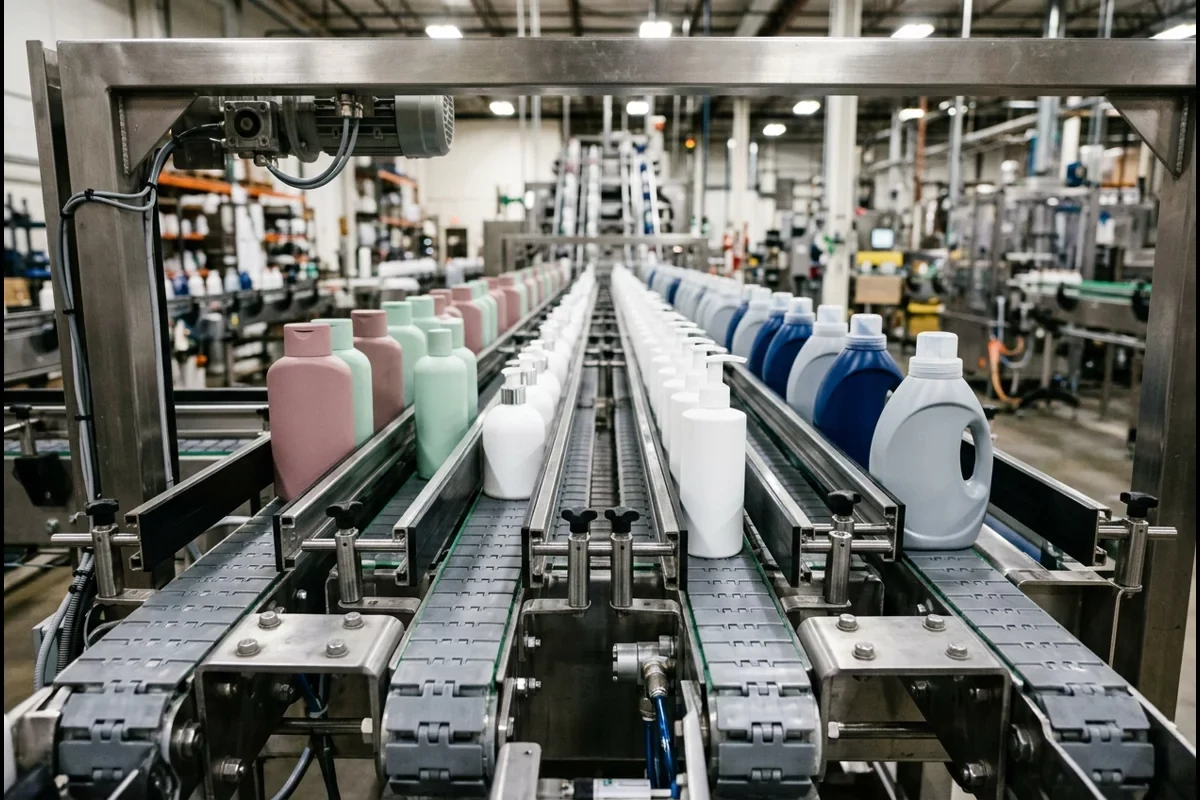
| Sidel Cermex collating model & launch baseline | Published speed, batch matrix & payload rating | Published changeover clock & mechanical scope | Dominant specification risk & RFQ prevention |
|---|---|---|---|
| Cermex RoboSELEX (Announced March 10, 2026 for Interpack May 7–13, 2026) | 80–320 bottles/min; case patterns from 3×1 (3 units) to 8×6 (48 units); 2 overhead Delta robots + 2 vacuum comb heads with 3D-printed tooling + 2D AI vision batch check | Same bottle / new collation: 1 min; New bottle format: 2 min 30 s (product page) vs. ~2 min (press release); manual or optional motorized upstream guide rails | Risk: Treating 320 bpm and puck elimination as guaranteed across every bottle geometry and assuming manual guide-rail resets finish inside the 2 min 30 s robot comb swap. Prevention: Specify optional motorized upstream guides in the RFQ, define the SMED clock from last good case A to first accepted case B, and test filled sample bottles for puck-free conveyor stability. |
| Cermex ProSelex (Launched April 18, 2023 at Interpack 2023) | 80–300 bottles/min; case patterns from 3×1 to 8×6; batch payload up to 15 kg; 4 servo drives articulating shaped comb buckets; OMAC / PackML compliant with regenerative braking | Same bottle / new collation: 1 min; New bottle format: 2 min 30 s (combination of simple manual and motorized adjustments) | Risk: Exceeding the 15 kg total batch mass limit on large 8×6 edible-oil or detergent collations or omitting dynamic inertia derating on heavy glass/HDPE containers. Prevention: Calculate gross batch mass (M_batch = N_rows N_cols m_bottle <= 15 kg) and request the servo speed-vs-payload derating curve. |
| Cermex CareSelect (Rockwell Automation iTRAK Linear Motor Infeed) | Up to 400 products/min; independent magnetic linear-motor movers handling each bottle individually (reduces friction contact time >= 20x vs. endless timing screws); dynamic 90° orientation | Under 1 minute (< 1 min) fully automatic changeover from the HMI with zero mechanical adjustments, zero tools, and zero change parts | Risk: Specifying a change-part comb system when a high-mix personal-care or spirits line runs >= 8–12 short SKU runs per day requiring sub-minute zero-part changeovers. Prevention: Benchmark iTRAK mover pitch limits against 3D-printed comb tooling cost across your full 5-year SKU portfolio. |
| Sidel Industrial Vision System & Racetrack Collators (Flexible & Soft Packaging) | Industrial Vision: 120 products/min per robot cell (< 40 ms 2-sided coordinate capture); Racetrack Collators: up to 500 products/min in servo-indexed isolated pockets with shuttle pusher | Vision: offline/online recipe training from HMI; Racetrack: quick size changeover across single/dual-axis pocket chains for RSC or wrap-around packers | Risk: Attempting to collate flexible stand-up pouches (doypacks), spouted pouches, or flow-wrapped bags on a rigid-bottle comb or screw infeed where soft gussets deform. Prevention: Route flexible pouches (LV-210 / LV-160) into isolated servo pocket racetracks, vision-guided vacuum delta cells, or horizontal cartoner bucket conveyors. |
Which four application decisions guide collation selection?
Define catch-up capacity, container stability, gripping and format changeovers using the actual product and production schedule.
Catch-up capacity: use the upstream good output, stop pattern and buffer capacity to agree the downstream rate. Calculate robot cycles from items handled per pick and the measured application cycle; select any surge margin with the integrator.
Container stability: trial filled, closed and labeled containers on the proposed transfer. Include narrow bases, off-center closures and changing fill levels. Geometry helps identify risks, but the actual handling trial decides the guides and accumulation method.
Gripping: test the filled product, label finish, condensation and pouch wrinkles with the selected tooling. The integrator selects vacuum, cup material, support and motion from the actual load and risk assessment.
Changeovers: define the clock from the last accepted pack of one format to the first accepted pack of the next. Include tooling, guides, recipes and restart checks, then record the time for your format sequence.
How do you calculate required Delta robot count (N_robots), case throughput (Q_cases/min), and changeover OEE loss?
Headline collator ratings (up to 320 bottles/min on Cermex RoboSELEX or up to 120 picks/min on a vision-guided delta robot) cannot be plugged directly into a line balance without calculating items captured per robot cycle (n_items/pick), upstream catch-up surge factor (k_surge), and shipping-case pack count (N_pack = N_rows · N_cols · N_layers).
1. Quantitative Robotic Cell Pick-Rate Capacity & Manipulator Count Formula (N_robots)
Calculate a first-pass robot count from product rate, the selected planning margin, items per pick and sustained application cycle rate. The integrator then checks motion, load and transfer timing.
N_robots = ⌈ (Q_products/min · k_surge) / (n_items/pick · R_cycles/min) ⌉, ; Q_cases/min = (Q_products/min) / (N_rows · N_cols · N_layers)
Cell sizing example: 240 products/min × 1.20 surge planning factor = 288 products/min. At one item/pick and 90 cycles/min, ceil(288 ÷ 90) = 4 robots; at two items/pick and 75 cycles/min, ceil(288 ÷ 150) = 2. A 12-unit case at the nominal 240 products/min requires 20 cases/min. Validate the selected tooling and handling sequence with the system integrator.
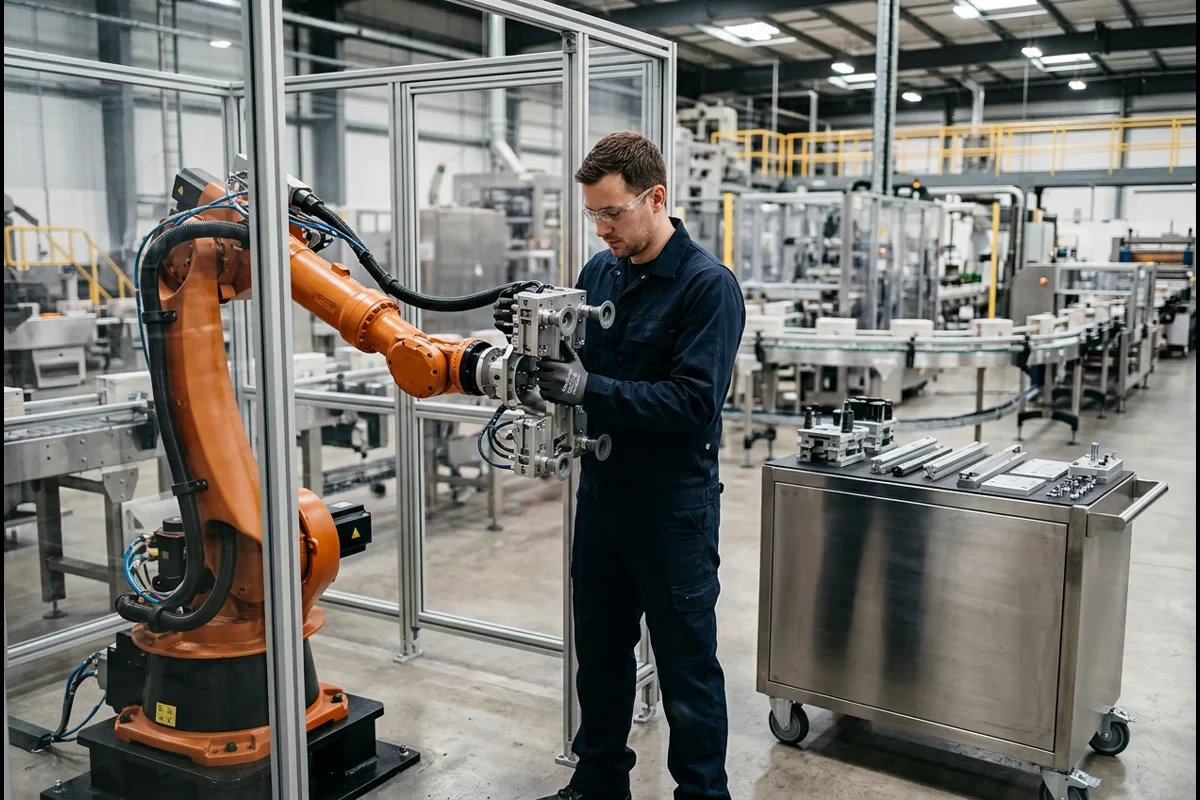
2. Secondary Line Starvation, Bottle-Jam & Changeover OEE Availability Loss Formula (Δ OEE_avail)
When an end-of-line collator stops for manual guide-rail changeover (t_chg,mech) or wedges a lightweight shaped bottle inside a timing screw or lane divider (N_jam,day · t_clear), the upstream buffer fills within 30–90 seconds and forces the primary filler, capper, and labeler into an OMAC PackML Held / Suspended state. Daily downtime saved (T_loss,day) and net line OEE availability gain (Δ OEE_avail across scheduled shift time T_sched,day) are governed by:
T_loss,day = N_chg,day · (t_chg,mech - t_chg,robo) + (N_jam,mech · t_clear,mech - N_jam,robo · t_clear,robo), ; Δ OEE_avail = (T_loss,day) / (T_sched,day) × 100%
Availability calculation: four daily format changes reduced from 30 to 2.5 minutes recover 110 minutes/day. A further 34 minutes/day reduction in jam clearing recovers 144 minutes/day total. Across 960 scheduled minutes this represents 15 percentage points of availability, or 600 production hours over 250 operating days.
How do manual case-packing labor, mechanical guide scuffing/jam downtime, and robotic collation compare in a 5-year operating ledger?
Compare equipment scope, direct staffing, changeover and jam hours, container scuffing scrap, format tooling, and wear parts across the same two-shift production schedule (4,000 hr/yr, 212M total containers over 5 years).
TCO_5yr = C_capex + 5 × (C_labor,yr + C_downtime,yr + C_scrap+parts,yr + C_maint,yr)
| Operating & TCO component | Scenario A: Manual collation & hand case packing (4 operators/shift × 2 shifts) | Scenario B: Legacy mechanical timing-screw & manual guide-rail collating infeed | Scenario C: Accumulation-free robotic comb / vision delta collating infeed (RoboSELEX class) | Dominant TCO risk & engineering mitigation |
|---|---|---|---|---|
| Initial collating infeed & integration scope (C_capex, excluding downstream case erector/sealer) | Stainless pack-off rotary accumulation tables, roller lanes & ergonomic hand-pack stations | Multi-lane slat divider, dual Delrin timing screws, pneumatic 90° pusher & initial 4-SKU machined screw sets | 2-Delta robotic comb or vision-guided delta cell, differential-speed belts, 2D vision & 4 sets of 3D-printed EoAT combs | Missing scope: obtain separate quotations for the collating module, downstream case packer, and line integration. |
| 5-year direct end-of-line operator & changeover labor (2 shifts, 4,000 hr/yr) | 8.0 FTE hand-packers across 2 shifts (160,000 operator-hours over 5 yr to sustain 200 ppm at ~25 ppm per person) | 1.5 FTE line tender + mechanic assistance during four 30-min manual rail/screw changeovers per day (30,000 labor-hours over 5 yr) | 0.75 FTE shared end-of-line tender (15,000 labor-hours over 5 yr; 1–2.5 min tool-less quick-release comb swap by single operator) | Labor baseline: record current staffing, ergonomic tasks, and sustained output before estimating labor hours saved. |
| 5-year changeover & jam downtime hours (valued at your plant's hourly line rate) | 1,000 hr over 5 yr (200 hr/yr micro-stops when hand-packers fall behind 200 ppm primary line surge) | 3,250 hr over 5 yr (650 hr/yr lost to four 30-min changeovers/day + 36 min/day bottle-wedge and shingling jams) | 250 hr over 5 yr (50 hr/yr across four 2.5-min changeovers/day + minimal 2 min/day stops — recovers 600 hr/yr vs. Scenario B) | Changeover verification: time guide adjustment, tooling exchange, and restart to first good case for each format. |
| 5-year container/label scuffing scrap & new SKU tooling additions (2 new SKUs/yr = 10 SKUs over 5 yr) | ~0.25% dropped/dented packs & mis-oriented cases during manual fatigue (~530,000 affected containers over 5 yr); zero format tooling | ~1.1% wet-label/bottle scuffing in timing screws (~2.33M scuffed containers) + 10 new machined Delrin screw & guide sets over 5 yr | < 0.12% non-contact/low-friction scrap (< 254,000 containers) + 10 new 3D-printed vacuum comb heads over 5 yr | Tooling & scrap: obtain supplier unit prices and lead times for every new container format and measure label scuffing during FAT. |
| 5-year preventive maintenance, vacuum cups/belts & servo spares | Conveyor wear strips and roller bearings only | Pneumatic cylinders, pusher guides, timing-screw drive chains, and UHMW wear strips across 20,000 running hours | Delta robot ball-joint/carbon-rod kits, vacuum generator cartridges, silicone suction cups, and vision LED lighting | Maintenance budget: obtain the OEM wear-part schedule and price the recommended 2-year and 5-year spare kits. |
| 5-Year operating balance & payback takeaway (5-year operating balance) | Lowest initial equipment outlay, but 160,000 manual labor-hours and 1,000 hr of surge micro-stops dominate 5-year operating cost | Loses 3,250 production hours (650 hr/yr) to manual screw/rail changeovers and bottle jams plus 10 machined screw sets | Recovers 3,000 production hours over 5 years vs. mechanical screws, cuts staffing to 0.75 FTE, and replaces machined screws with 3D-printed combs | Multiply labor hours, recovered line hours, scrap counts, and tooling sets by your plant rates and supplier quotes to compute exact payback. |
How do ISO 10218-1, OMAC PackML (ISA-TR88.00.02), and ASTM D4169 govern primary-to-secondary line integration and FAT verification?
An accumulation-free robotic collator (Sidel Cermex RoboSELEX) or linear-motor infeed (Cermex CareSelect) cannot operate as an isolated island. Because it eliminates large contact-accumulation tables between the primary line and the case packer, its conveyor speed control, upstream bottle labeling machine or premade pouch filler, and downstream case packer or horizontal cartoner must be synchronized under a single Interface Control Document (ICD) governed by international safety, control, and transit-testing standards.
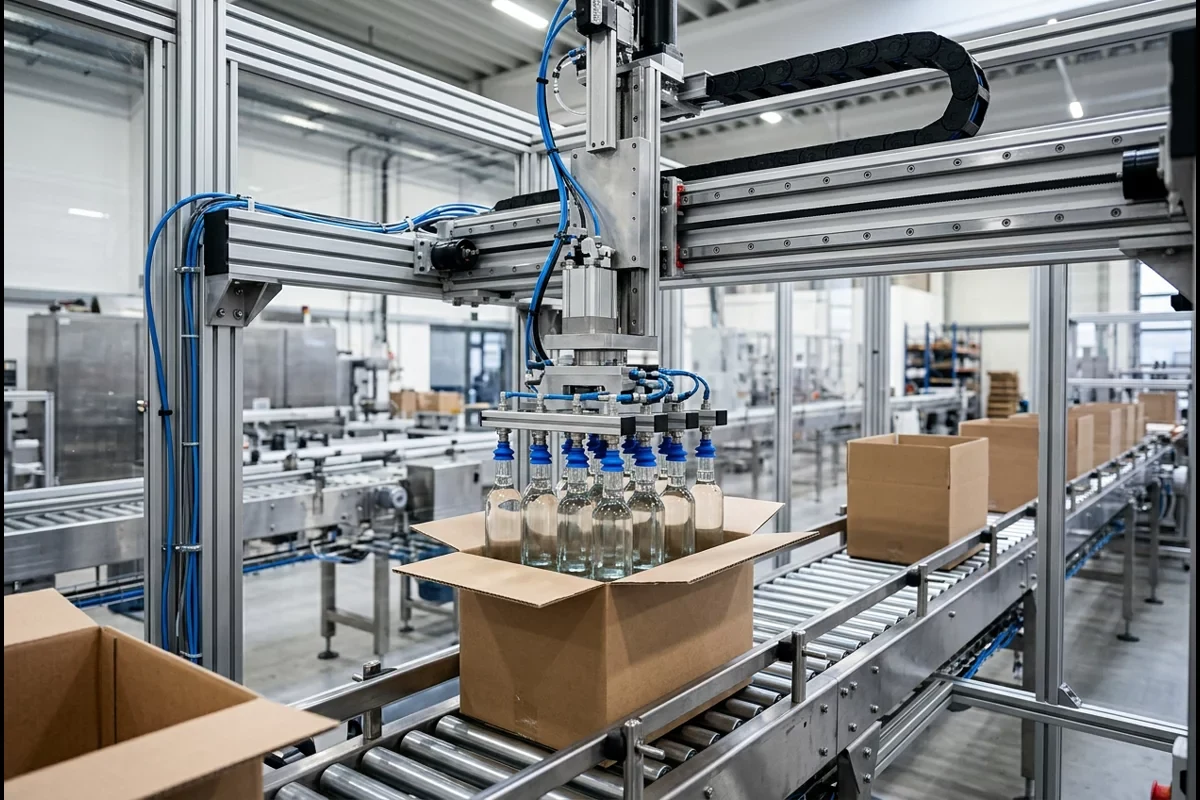
Use the site installation and operator-training checklist, the bottle labeling machine buying guide, and our sample-testing preparation protocol to verify all four primary-to-secondary line boundaries during Factory Acceptance Testing (FAT):
| Integration boundary or compliance gate | Governing standard & control architecture | Project-specific FAT checks | Dominant integration failure mode & engineering prevention |
|---|---|---|---|
| 1. Upstream Primary Container Decoration & Filling Discharge (Bottle Labeler / Pouch Filler → Collator Infeed Belt) | Upstream flat/oval personal-care bottle labeler, edible-oil multi-side labeler, shrink-sleeve tunnel, or LV-210 / LV-160 pouch filler discharging onto differential-speed pitch conveyor | Agree transfer height and gap, container support, surface condition and label-settling requirements with the equipment suppliers. | Labels can move or scuff during transfer: trial filled and labeled containers, including wet or chilled conditions, and select drying or additional travel where needed. |
| 2. Multi-Vendor Machine State & Speed Synchronization (OMAC PackML ISA-TR88.00.02 Handshake) | Agree the communication protocol, machine states, stop/restart behavior and speed coordination between suppliers. | Smooth S-curve conveyor deceleration (< 0.15g) during downstream case-packer Suspended / Held transitions; automatic pitch re-indexing on restart with zero tipped bottles and zero partial-case shipments | Abrupt stops can tip containers: evaluate the deceleration and restart sequence on filled production samples. |
| 3. Industrial Robot Cell Safety & Ergonomic SMED Access (ISO 10218-1 / ISO 10218-2 vs. ISO/TS 15066) | System risk assessment, guarding, access and safety controls selected by the robot-system integrator for the installed application. | Verify the approved safe-access and tooling-change procedure, stopping behavior and restart controls before measuring changeover time. | Unsafe access during tooling changes: use the integrator’s validated safeguarding and isolation procedure for the task. |
| 4. Downstream Case Loading & Distribution Transit Integrity Gate (ASTM D4169 / ISTA 3A) | Select distribution tests for the actual filled case and shipping route. | Agree closure, damage and handling criteria with the quality team and packaging supplier. | Scuffing or container damage in transit: evaluate the packed case before changing dividers, pucks or case dimensions. |
When your packaging project includes upstream primary filling, pouching, container labeling, or retail folding-carton cartoning—such as an automatic shampoo & personal-care flat bottle labeler, cosmetic & lotion bottle labeler, square edible-oil bottle labeler, multi-side edible-oil bottling & labeling line, high-precision sauce bottle labeling line, high-speed shrink-sleeve labeling line, premade or spouted pouch filler (LV-210 weighing/filling, LV-160 2kg–5L laundry liquid spout filler, or CIP sauce pouch filler), or a downstream horizontal folding-carton cartoning machine (LV-180, chocolate bar cartoner, or LV-GS150 bottle & blister cartoner)—send your container drawings, target line speed, and layout via our project brief checklist. Our engineers review the primary and cartoning equipment, transfer layout and control signals with your selected system supplier.
Frequently asked questions about Sidel Cermex RoboSELEX, bottle/pouch collation, and line integration
Is Sidel Cermex RoboSELEX a complete case packer or an upstream collating infeed system?
Cermex RoboSELEX is an upstream robotic bottle-collating infeed system, not a complete case packer. Announced by Sidel on March 10, 2026 for its Interpack 2026 premiere (May 7–13, 2026, Düsseldorf), it sits between upstream single-file bottle conveying and a downstream case packer (Cermex WB wrap-around, SW, or SB RSC packer). It uses 2 overhead Delta robots driving 2 vacuum comb gripping heads with 3D-printed tooling to space, orient, and group shaped containers at 80 to 320 bottles/min across 3 × 1 to 8 × 6 case patterns, while case erecting, batch loading into the corrugated case, and flap sealing are performed by the downstream case packer.
Why do Sidel's RoboSELEX documents list both 2 minutes and 2 minutes 30 seconds for bottle-format changeover?
Both Sidel's March 10, 2026 Interpack press release and its official Cermex RoboSELEX machine specification page state 1 minute when switching to a different collation pattern of the same bottle. For switching to a different bottle format, the press release states about 2 minutes, whereas the official product specification page states 2 minutes 30 seconds (2 min 30 s). Ask Sidel to reconcile these figures for the proposed bottle formats and specify what the changeover measurement includes. Record the agreed target in the RFQ and FAT protocol, including any optional motorized upstream conveyor guides and manual guide-rail adjustments.
How does Cermex RoboSELEX differ from Cermex ProSelex and Cermex CareSelect (iTRAK)?
Cermex RoboSELEX (80–320 bottles/min, 3 × 1 to 8 × 6 batches) uses 2 overhead-hung Delta robots driving 2 quick-release vacuum comb heads with 3D-printed tooling and 2D AI vision batch control in an accumulation-free continuous flow. Cermex ProSelex (launched April 2023, 80–300 bottles/min, batch mass up to 15 kg) uses 4 servo drives on a floor-mounted frame to articulate shaped comb buckets (1 min collation / 2 min 30 s format changeover). Cermex CareSelect (up to 400 products/min) uses Rockwell Automation iTRAK linear synchronous motor independent movers to transport each bottle individually—cutting friction contact time by >= 20× compared to endless timing screws and achieving fully automatic tool-less HMI changeovers in < 1 minute with zero change parts.
What does 'puck removal on conveyable, non-accumulable shaped bottles' mean in practice?
A conveyable, non-accumulable bottle is an asymmetrical, conical, tapered, or trigger-sprayer container (typically with a height-to-base-width aspect ratio H / W_base > 2.8) that can stand upright on a moving conveyor belt when isolated in single file, but wedges, shingles, or domino-tips if bottles touch under contact accumulation backpressure. Because Cermex RoboSELEX pitches bottles via upstream conveyor speed variation without an accumulation table and orients batches at the source, it can eliminate plastic transport pucks (puck removal) on containers that are dynamically stable when spaced apart—whereas unstable vials or flacons that cannot stand on a moving belt even when isolated still require pucks.
How do you size robotic pick-and-place or comb collators for flexible stand-up pouches (doypacks) and sachets?
Use the integrator’s validated pick cycle and selected tooling with the actual pouches. Calculate items per pick, required good output and a project-specific catch-up margin, then trial gripping, transfer and the downstream case or carton loading sequence.
What is the difference between a bottle/pouch collator, a horizontal cartoner, and a case packer?
A collator (Cermex RoboSELEX, CareSelect, or Racetrack) spaces, orients, and groups loose primary containers into a multi-row pattern (3 × 1 to 8 × 6). A horizontal or vertical cartoning machine (LV-180 / LV-GS150) erects flat printed paperboard folding cartons (250–400 gsm), inserts primary pouches, blister cards, or bottles, and closes tuck or hot-melt glue flaps to create a retail unit. A case packer erects corrugated shipping cases (RSC or wrap-around blanks), loads either collated primary bottles or collated retail folding cartons, and seals the outer master shipper for palletizing (FANUC CRX-30iA palletizer guide).
Discuss your application with LINEVO.
Discuss your primary & cartoning scope