
On this page
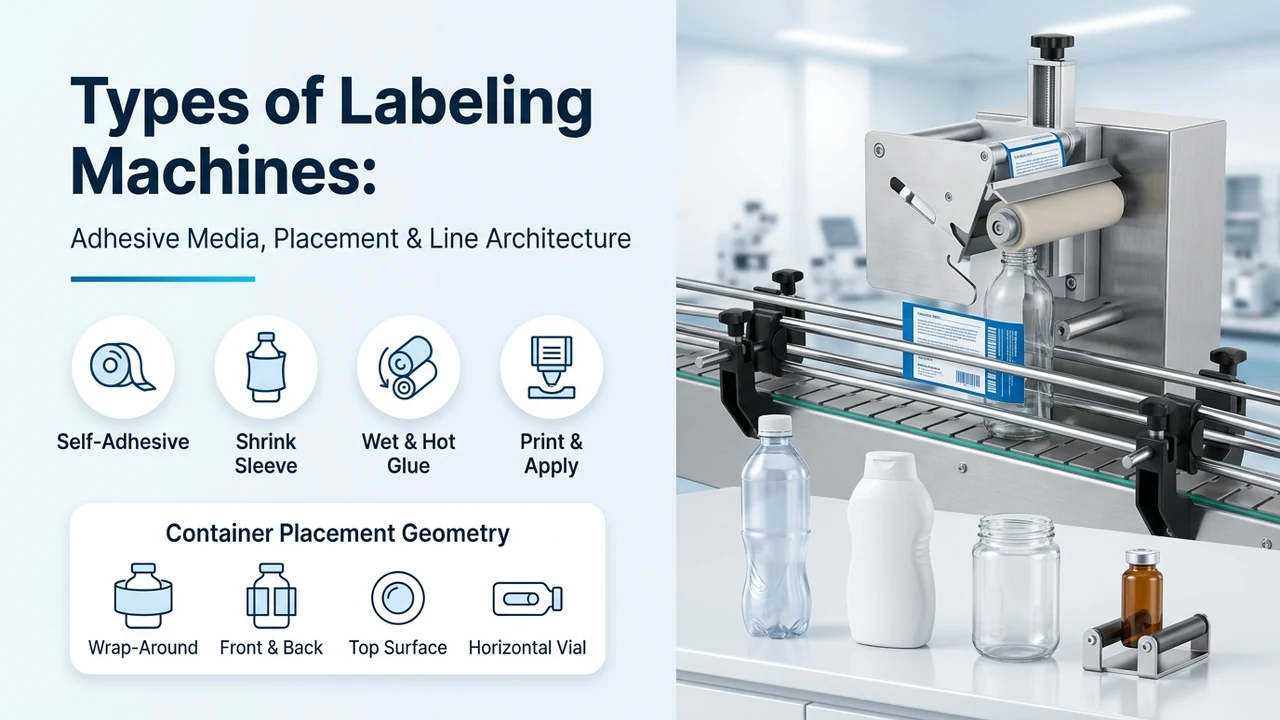
Workbench comparison of three unprinted label media formats: a roll of die-cut pressure-sensitive labels on release liner, a stack of flat cut-paper labels beside a stainless-steel glue roller, and a roll and upright cylinder of clear lay-flat shrink-sleeve film
Treating wrap-around, pressure-sensitive, rotary and tamp-blow as competing machine categories leads to the wrong equipment comparison and rework. Separate label stock, applicator transfer, placement position, container posture and transport path before reviewing any configuration.
Supplier catalogs routinely put 'self-adhesive labeler', 'wrap-around labeler', 'tamp-blow applicator', 'horizontal vial labeler' and 'rotary labeler' in the same navigation menu. Treating those terms as mutually exclusive machine types causes specification errors, because a single production labeler occupies one position on all five axes at the same time.
This reference separates the five classification axes used across industrial labeling specifications, maps each term to the 21 automatic configurations listed in the LINEVO labeling machine family, and marks which mechanical details are published in our catalog versus confirmed from your physical container and label samples. Once you know which configuration group fits your pack, use the labeling machine buying guide to prepare your sample brief or the labeling machine quote comparison guide to audit supplier offers.
Why 'types of labeling machines' mixes five separate specifications
When two equipment descriptions use different names, they are often describing different parts of the same machine. A 'pressure-sensitive labeler' names the label web and adhesive; a 'wipe-on applicator' names how the dispensing head transfers that label; a 'front-and-back labeler' names where the patches sit on the bottle; an 'upright inline labeler' names how the conveyor carries the bottle past the head.
| Input | Typical value or condition | Why it matters |
|---|---|---|
| 1. Label stock & bonding medium | Pressure-sensitive (self-adhesive) liner web, pre-cut wet-glue paper stack, roll-fed hot-melt film/paper, tubular heat-shrink sleeve, or print-and-apply label stock | Sets the unwind, glue tank, print engine or heat tunnel required on the line. |
| 2. Dispensing head transfer | Wipe-on (merge), tamp-blow / tamp-on, or air-blow (non-contact) | Applies to pressure-sensitive and print-and-apply heads; chosen from surface recess, pack rigidity and line indexing. |
| 3. Label placement geometry | Full or partial wrap-around, front-and-back, multi-side, top-surface, top-and-bottom, or L/U-shaped tamper-evident strip | Determines the number of heads, wrap belts, overhead hold-down belts and multi-stage pressure rollers. |
| 4. Container posture & path | Vertical (upright) vs horizontal (trunnion roller / V-block cradle); inline linear conveyor vs rotary starwheel turret | Driven by container base stability (aspect ratio) and whether multi-panel angular orientation is required at high speed. |
| 5. Automation & line scope | Manual / benchtop dispenser, semi-automatic foot-pedal station, standalone automatic conveyor machine, or integrated filling-capping-labeling line | LINEVO supplies standalone automatic machines and integrated lines only; manual and benchtop units are outside our catalog. |
Cross-axis comparison matrix: term, axis, label stock, container condition and LINEVO scope
Use the matrix below to translate common supplier and search terms into concrete engineering requirements. Where the published LINEVO catalog lists a container or sleeve configuration, the table links directly to a representative page; where the catalog leaves the adhesive head or transport architecture open until sample review, the status column states that explicitly.
| Term | Classification axis | Label form | Container & placement condition | Published LINEVO example | Method status & source |
|---|---|---|---|---|---|
| Pressure-sensitive (self-adhesive) labeler | Axis 1: Label stock & bonding | Die-cut paper or film labels pre-coated with adhesive on a release liner | Wrap-around, front-and-back, top-surface or corner seal on rigid bottles, jars, vials, cans or cartons | Candidate across bottle, jar, vial and box routes, such as the flat shampoo bottle labeler | Adhesive method confirmed on request with label samples (PMMI ProSource; LINEVO T11 catalog) |
| Wet-glue (cold-glue) labeler | Axis 1: Label stock & bonding | Pre-cut unsupported paper or foil blanks stacked in a magazine; liquid water-based glue applied by roller and pallets | Rigid glass bottles, jars or metal cans where low paper-label cost outweighs glue cleanup | Candidate for rigid glass beverage routes such as the beer bottle labeler | Adhesive method confirmed on request; catalog does not pre-assign cold glue vs self-adhesive (VKPAK; Yundu; LINEVO T11 catalog) |
| Hot-melt (roll-fed wrap) labeler | Axis 1: Label stock & bonding | Continuous unsupported film or paper web cut on the machine; molten hot-melt adhesive applied to leading and trailing edges | Full 360-degree wrap on cylindrical PET beverage bottles, food cans or tins | Candidate for cylindrical beverage and can routes such as carbonated drink filling and labeling | Adhesive method confirmed on request with container and film spec (PMMI ProSource; Yundu; LINEVO T11 catalog) |
| Shrink-sleeve applicator | Axis 1: Label stock & bonding | Continuous lay-flat tubular film (PVC, PETG, OPS) opened on a mandrel, cut to length, dropped over the container and heat-shrunk | Contoured bottles, full-body 360-degree graphics or neck/cap tamper-evident bands; requires steam or hot-air shrink tunnel | Beverage bottle shrink-sleeve machine and industrial shrink-sleeve line | Confirmed in catalog: servo sleeve feeding/cutting plus steam or hot-air tunnel listed (Accutek; LINEVO T11 catalog) |
| Print-and-apply labeler | Axis 1: Label stock + inline printing | Pressure-sensitive labels fed through a thermal-transfer or direct-thermal print engine immediately before dispensing | Cartons, cases, trays or primary packs needing real-time variable bar codes, lot dates or serialized data | Candidate for carton and line routes such as the industrial box labeling line | Coding/vision interfaces listed on pharma and line routes; print-and-apply engine confirmed on request (Weber Packaging; LINEVO T11 catalog) |
| Wipe-on (merge) applicator | Axis 2: Dispensing head transfer | Pre-coated pressure-sensitive web peeled at a sharp peel edge as the product passes continuously | Moving flat panels, cartons or cylindrical bodies where conveyor speed and web dispense speed are synchronized | Candidate on continuous-conveyor routes such as the top-surface food box labeler | Head transfer mechanism confirmed on request from sample geometry (Weber Packaging; LINEVO T11 catalog) |
| Tamp-blow / tamp-on applicator | Axis 2: Dispensing head transfer | Peeled pressure-sensitive label held on a vacuum pad, extended by an actuator stroke and transferred by air blast or contact | Recessed panels, uneven container heights or indexed/stationary packs where a fixed peel plate cannot reach | Candidate for recessed jar or carton surfaces reviewed under labeling machines | Head transfer mechanism confirmed on request from container drawing and sample (Weber Packaging) |
| Air-blow (non-contact) applicator | Axis 2: Dispensing head transfer | Peeled pressure-sensitive label held on a fixed vacuum grid and blown across a short air gap by a compressed-air jet | Thin-walled, fragile or compressible packages passing within a consistent standoff distance of the grid | Candidate for delicate cartons or thin-walled containers reviewed under labeling machines | Head transfer mechanism confirmed on request (Weber Packaging) |
| Wrap-around labeler | Axis 3: Placement geometry | Single label band (self-adhesive, roll-fed or cut paper) spun around 360 degrees or a partial arc of a cylinder | Round glass, plastic or metal bottles, cans, jars and vials rotated by a wrap belt or roller station | Wine bottle labeler, sauce bottle and jar labeler, pet food can labeler | Confirmed in catalog by container group; adhesive method and output confirmed on request (Machpack; LINEVO T11 catalog) |
| Front-and-back / multi-side labeler | Axis 3: Placement geometry | One, two or more discrete panels applied to flat, oval or square side walls | Flat cosmetic/shampoo bottles, square edible oil bottles or hexagonal honey jars stabilized by overhead belts and multi-stage pressure rollers | Flat cosmetic bottle labeler, square edible oil bottle labeler, multi-side edible oil line | Confirmed in catalog: multi-stage pressure rollers and servo synchronous conveyors listed (Machpack; LINEVO T11 catalog) |
| Vertical upright vs horizontal roller labeler | Axis 4: Container posture | Usually pressure-sensitive wrap-around web | Upright conveyor for stable flat-bottom bottles/jars; horizontal trunnion rollers or V-block stabilization for narrow ampoules, 5–50 ml droppers and tubes that tip easily | CBD & essential oil bottle labeler (5–50 ml), small vial applicator, ampoule labeler | Partially confirmed in catalog: V-block stabilization and dual pressure rollers listed; upright vs horizontal infeed confirmed from vial dimensions (Paxiom; CECLE; Weber Packaging; LINEVO T11 catalog) |
| Inline (linear) vs rotary turret labeler | Axis 4: Container transport path | Pressure-sensitive, wet-glue or hot-melt heads mounted along a straight conveyor or around a circular starwheel turret | Inline conveyors suit multi-SKU format changes across bottles, jars and boxes; rotary turrets index bottles on cam/servo plates for high-speed angular registration | Standalone automatic machines and turnkey bottling lines in labeling machines and bottle labeling machines | Inline vs rotary architecture confirmed on request based on container set and required line speed (VKPAK; Yundu; LINEVO T11 catalog) |
Axis 1: Label stock and bonding method (how the label sticks or shrinks)
The first engineering split is the label material itself. Changing from a self-adhesive roll to cut paper or tubular shrink film is not a change-part adjustment on an existing head—it changes the core machine mechanism.
Pressure-sensitive (self-adhesive) systems
Pressure-sensitive applicators unwind a roll of die-cut paper or film labels that are pre-coated with active adhesive on a siliconized release liner. As the web is pulled sharply around a peel plate (dispensing beak), the stiffer label separates from the backing liner and is transferred onto the passing container, while a rewind mandrel collects the spent liner. Because no liquid glue tank or heat tunnel is involved, pressure-sensitive heads handle front-and-back panels, wrap-around bands, top-surface patches and tamper seals with clean changeovers, at the trade-off of higher consumable cost per thousand labels and liner waste.
Wet-glue (cold-glue) and hot-melt roll-fed systems
Wet-glue machines pick pre-cut paper or foil blanks from a magazine using glue-coated pallets that transfer water-based adhesive from a glue roller before pressing the blank onto a rigid glass bottle, jar or metal can. Hot-melt roll-fed machines feed a continuous, linerless film or paper web, cut each label to length on a vacuum drum, and apply stripes or dots of molten hot-melt adhesive to the leading and trailing edges as the label wraps 360 degrees around a cylindrical PET bottle or can. Both glue routes reduce label stock cost on high-volume runs, but add adhesive temperature/viscosity management and wash-down steps.
Shrink-sleeve and print-and-apply systems
Shrink-sleeve machines carry no adhesive on the applicator: a servo-driven feed unit pulls lay-flat tubular film over a forming mandrel to open the cylinder, cuts individual sleeves to length, drops each sleeve over the bottle, and conveys the bottle through a steam or hot-air shrink tunnel so the film contracts tightly around contoured curves or neck caps. In the LINEVO catalog, the beverage bottle shrink-sleeve machine and the high-speed shrink-sleeve line explicitly list servo-driven sleeve feeding and cutting plus steam or hot-air tunnel integration. Print-and-apply systems pair a thermal-transfer or direct-thermal print engine with a pressure-sensitive dispensing pad so variable bar codes, lot dates or shipping data are printed onto each label immediately before application.
Axis 2: Applicator dispensing mechanics (wipe-on, tamp-blow and air-blow)
When buyers search for 'types of label applicators', they are usually looking at the dispensing head inside a pressure-sensitive or print-and-apply system. Once the peel plate separates a self-adhesive label from its liner, the head uses one of three physical methods to place that label onto the package:
- Wipe-on (direct merge): The leading edge of the label projects just past the peel tip into the path of the moving container. As the container contacts the label, a wipe roller, brush or resilient pad smooths the label down while the web dispense speed matches the linear conveyor speed (often tracked by an encoder). Wipe-on heads are the standard workhorse for continuous-motion flat panels, carton tops and wrap-around infeed stations.
- Tamp-blow and mechanical tamp-on: The peeled label is held flat against a perforated pad by vacuum while a pneumatic or servo actuator extends the pad toward the target surface. On a tamp-blow head, the pad stops just shy of the surface and a short pulse of compressed air blows the label across the final gap; on a pure tamp-on head, the pad presses the label directly onto the surface. Tamp strokes reach into recessed bottle panels, sunken jar lids or stationary indexed packs that cannot pass flush against a fixed peel edge.
- Air-blow (non-contact blow-on): The peeled label is staged on a stationary vacuum grid ('air box') above or beside the conveyor. When a product sensor triggers, a high-velocity air jet blasts the label across a short, fixed standoff gap onto the passing package without any mechanical arm or roller touching the pack. Air-blow heads suit thin-walled, fragile or easily deformed packages moving at high speed, provided the package-to-grid distance stays tight.
In the LINEVO catalog, published configurations describe the container stabilization and rolling hardware rather than pre-assigning wipe-on, tamp-blow or air-blow heads. Which transfer head is fitted depends on whether your label sits on a flush wall, inside a recessed panel, or on a compressible carton.
Axis 3: Label placement geometry and container shape
Most factory buyers organize labeling machines by the container shape and where the label lands on the package. That is also how the 21 configurations on the LINEVO labeling machines page are grouped, because container geometry dictates the wiping, rolling and hold-down tooling after the label leaves the peel plate.
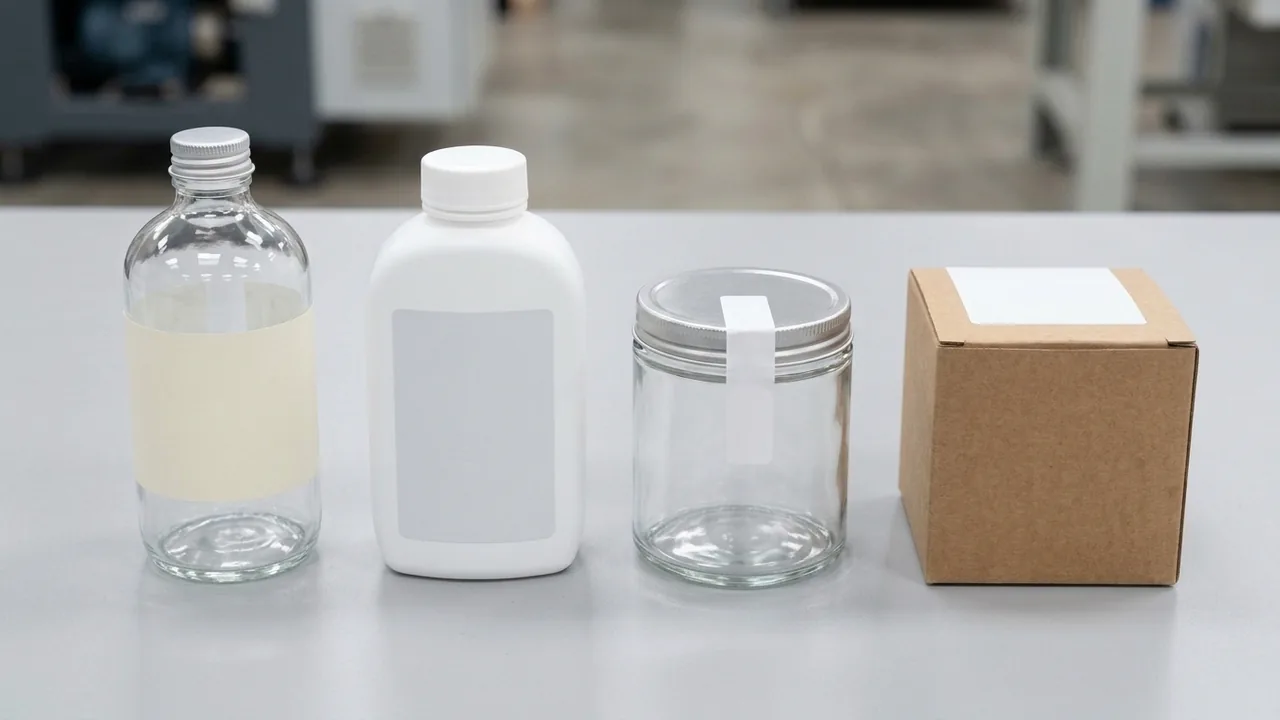
Four unbranded containers on a workshop bench showing distinct label placement geometries: a round glass bottle with a wrap-around band, a flat oval HDPE bottle with a front panel patch, a glass jar with a lid-to-shoulder tamper strip, and a kraft carton with a top-surface label
- Wrap-around and partial-wrap on round containers: Cylindrical glass, plastic and metal containers rotate against a wrap belt or three-point roller assembly as the label feeds tangentially, pressing a full 360-degree band or partial arc without wrinkles. Published LINEVO configurations include the wine bottle labeling machine, high-speed beer bottle labeler, sauce bottle and jar labeler and pet food can and tin labeler.
- Front-and-back and multi-side on flat, oval or square containers: Non-round containers cannot simply spin against a wrap belt. They require an aligning chain or timing screw plus an overhead top hold-down belt to lock the bottle's orientation while opposing heads and multi-stage pressure rollers wipe labels onto the front, back or adjacent flat panels. Published configurations include the flat shampoo and personal care bottle labeler, flat cosmetic lotion bottle labeler, square edible oil bottle labeler and multi-side edible oil bottling line, as well as hexagonal and octagonal jar configurations under the honey jar labeling machine.
- Top-surface, top-and-bottom and corner tamper-evident placement: Flat cartons, food boxes, trays and lidded jars carry an overhead applicator head above the conveyor; when a label must fold over a box edge or bridge a jar lid to the jar shoulder as a tamper seal, a secondary wipe-down roller or corner-wrap brush folds the trailing tab down. In the LINEVO catalog, the top-surface label applicator for food boxes and the industrial box labeling line cover flat food cartons, with side, top-and-side or top-and-bottom requirements reviewed against your box samples.
Axis 4: Container posture and transport path (vertical vs horizontal, inline vs rotary)
Even when two containers both take a self-adhesive wrap-around label, their height-to-diameter ratio and required line speed can force two completely different mechanical frames: vertical vs horizontal posture, and inline vs rotary transport.
Vertical (upright) vs horizontal (trunnion roller / V-block) posture
Standard beverage bottles, food jars and canisters have a wide, flat base that stands upright on a flat-top conveyor without tipping when it enters the wrap belt. By contrast, small pharmaceutical ampoules (with tapered necks and sealed glass tips), slender tubes, lip-balm sticks and narrow 5–50 ml dropper or peptide vials have a small footprint and high center of gravity; on an unstabilized upright belt they wobble, tip over or skew at the wrap point. Industrial labelers solve this in two ways: either laying the cylinder horizontally onto revolving trunnion rollers fed by a side chute, or cradling upright/angled vials inside synchronized V-block guides and dual pressure rollers. In the LINEVO range, the CBD and essential oil bottle labeler (5–50 ml), e-liquid bottle labeler, small pharmaceutical vial applicator, ampoule labeling machine and pharmaceutical ampoule and vial line are dedicated small-diameter configurations that list servo-driven synchronous conveyors, V-block stabilization and dual pressure rollers.
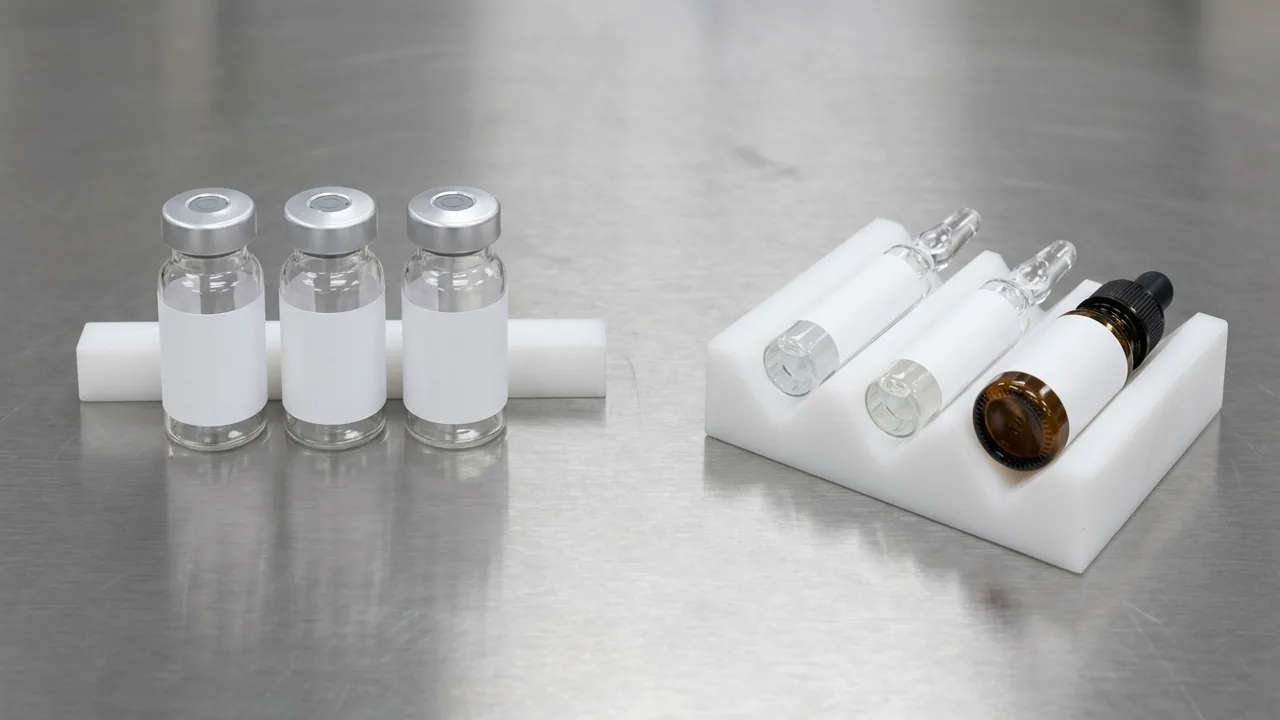
Close-up workshop photograph on a brushed stainless-steel surface showing three clear flat-bottom glass serum vials standing upright between white Delrin guide rails on the left, beside a white Delrin V-groove cradle holding two glass ampoules and an amber dropper bottle horizontally on the right
Inline (linear) conveyor vs rotary turret transport
An inline (linear) labeler conveys containers in a straight line using spacing belts or a timing screw to separate packs before they pass the applicator head. Inline frames adapt across round, flat, oval and square bottles with limited change parts, making them the standard choice for multi-SKU lines. A rotary labeler transfers containers through an infeed starwheel onto a circular revolving turret where individual bottle plates and overhead centering bells clamp each container and rotate it via cam tracks or servo motors past one or more labeling stations (pressure-sensitive, cold-glue or hot-melt). Rotary turrets maintain positive control of the container for high-speed beverage, beer and wine lines or when labels must register to an embossed glass lug or bottle seam.
Axis 5: Automation level and LINEVO's supply boundary
Search results for labeling machine types also group equipment by how much operator labor is involved per container:
- Manual and hand-cranked dispensers: Benchtop cradles where an operator places a bottle on rollers and pulls a lever or turns a handle to wipe on a label. Used for laboratory batches or early market trials.
- Semi-automatic benchtop applicators: Motorized roller or tamp stations where an operator loads each container by hand and presses a foot switch to trigger a single labeling cycle.
- Automatic standalone conveyor machines: Self-contained conveyor-fed stations with automatic container spacing, sensor triggering, PLC/HMI controls and powered web handling that can either be fed from a rotary unscramble table or bolted into an existing line.
- Integrated filling, capping and labeling lines: Turnkey multi-machine lines where liquid or paste filling, cap placement/torquing, labeling, coding and accumulation are synchronized under coordinated line controls.
All 21 published configurations in the LINEVO labeling machine family belong to the third and fourth categories: standalone automatic machines (15 configurations) and integrated turnkey filling-and-labeling lines (6 configurations, covering carbonated soft drinks, sauces, honey jars, edible oil, pharmaceutical vials/ampoules and shrink-sleeved beverages). LINEVO does not manufacture or supply manual or semi-automatic benchtop label dispensers.
Where catalog type names stop and sample review begins
Because labeling performance depends on how your specific container wall, label face stock, adhesive and line speed interact, keep five catalog boundaries in view when reading any page on this site:
- Adhesive method is confirmed per project: Except for the two shrink-sleeve configurations (which explicitly specify lay-flat sleeve feeding, cutting and a steam or hot-air shrink tunnel), the LINEVO catalog does not pre-assign pressure-sensitive vs wet-glue vs hot-melt heads on bottle, jar, can or box listings.
- Dispensing head transfer is fixed from samples: Whether a self-adhesive station uses a wipe-on roller, a tamp-blow pad or a non-contact air-blow grid is selected after reviewing your container geometry and any recessed panel depth.
- No model numbers or speed ratings are published: Every T11 configuration carries technical data on request (`brandModel: null`). Output in containers per minute, label web width/length limits, roll core/outer diameter and placement tolerance in millimeters are confirmed in the written proposal for your samples.
- Multi-shape lines require explicit review: Running both round wrap-around bottles and flat front-and-back bottles on one machine requires confirming whether the frame includes both a wrap station and an overhead hold-down / dual-head station with change parts.
- Downstream peripherals are scoped separately: Date coders, vision inspection cameras, reject actuators and shrink tunnels are only included when itemized in the quotation—see the labeling machine cost and quote comparison guide for the line-by-line scope checklist.
Questions buyers ask about types of labeling machines
What are the 4 main types of labeling machines by label material?
When grouped by label stock and bonding method, the four primary industrial categories are pressure-sensitive (self-adhesive) labelers that peel pre-glued labels from a release liner, wet-glue (cold-glue) labelers that apply liquid water-based adhesive to pre-cut paper blanks, hot-melt roll-fed labelers that wrap continuous film or paper around cylindrical containers with molten edge glue, and heat-shrink sleeve applicators that drop cut tubular film over the container before passing it through a steam or hot-air shrink tunnel. A fifth variant, print-and-apply, adds an inline thermal-transfer or direct-thermal print engine ahead of a pressure-sensitive dispensing pad.
What is the difference between wipe-on, tamp-blow and air-blow label applicators?
All three are dispensing head mechanisms used on pressure-sensitive and print-and-apply labelers. A wipe-on head merges the label edge directly onto a moving package as a roller or brush wipes it flat, requiring conveyor speed and web dispense speed to match. A tamp-blow head holds the peeled label on a vacuum pad, extends a stroke arm close to a stationary or recessed surface, and transfers the label with a pulse of air. An air-blow head holds the label on a fixed vacuum grid and fires a compressed-air jet across a short gap without any mechanical part touching the package.
When do I need a horizontal labeling machine instead of a vertical wrap-around labeler?
Use a vertical (upright) wrap-around labeler when your cylindrical bottles, jars or vials have a wide, flat base that stays stable on a flat conveyor belt as it enters the wrap station. Use a horizontal trunnion-roller labeler—or an upright/angled system with synchronized V-block cradles—when running narrow, tall or top-heavy cylinders such as sealed-tip glass ampoules, small 5–50 ml dropper bottles, test tubes or cosmetic tubes that would tip over or skew on a standard upright conveyor.
Can one labeling machine apply both wrap-around labels on round bottles and front-and-back labels on flat bottles?
Only if the machine is explicitly configured with the stations and hold-down hardware for both geometries. A round bottle needs a wrap belt or roller assembly to spin the cylinder, whereas a flat or square bottle needs an overhead hold-down belt, orientation alignment and opposing side heads with multi-stage pressure rollers. Always send samples of every container shape before assuming a single configuration covers your full SKU list.
Which types of labeling machines does LINEVO supply?
LINEVO supplies 21 published automatic labeling configurations across nine container and sleeve groups: round bottles, flat and oval bottles, square bottles, small 5–50 ml dropper/vial bottles, glass jars, pharmaceutical vials and ampoules, heat-shrink sleeves, metal cans/tins, and top-surface food boxes, available as standalone automatic stations or integrated filling-and-labeling lines. LINEVO does not supply manual or benchtop label dispensers.
How this page was put together
This page is compiled from published industry references and the LINEVO equipment catalog, not from product-specific trial records. Classification axes and applicator head mechanics are grounded in the PMMI ProSource Directory for Pressure-Sensitive Label Applicators, Weber Packaging Solutions technical guides on label applicators and print-and-apply systems (checked 17 October 2026), Paxiom Group documentation on horizontal roller tube labelers, Accutek Packaging Equipment documentation on shrink-sleeve applicators, Machpack and CECLE technical notes on placement geometry and small-vial stability, and VKPAK and Yundu classification overviews. LINEVO configuration groups and scope boundaries come from the T11 labeling family in the LINEVO catalog (revision of September 2026).
Last updated: 17 October 2026. Workbench photographs show unbranded container, fixture and label-stock examples created to illustrate classification axes; they are not sample-test records.
We reply within 24 hours.
Send container and label details