
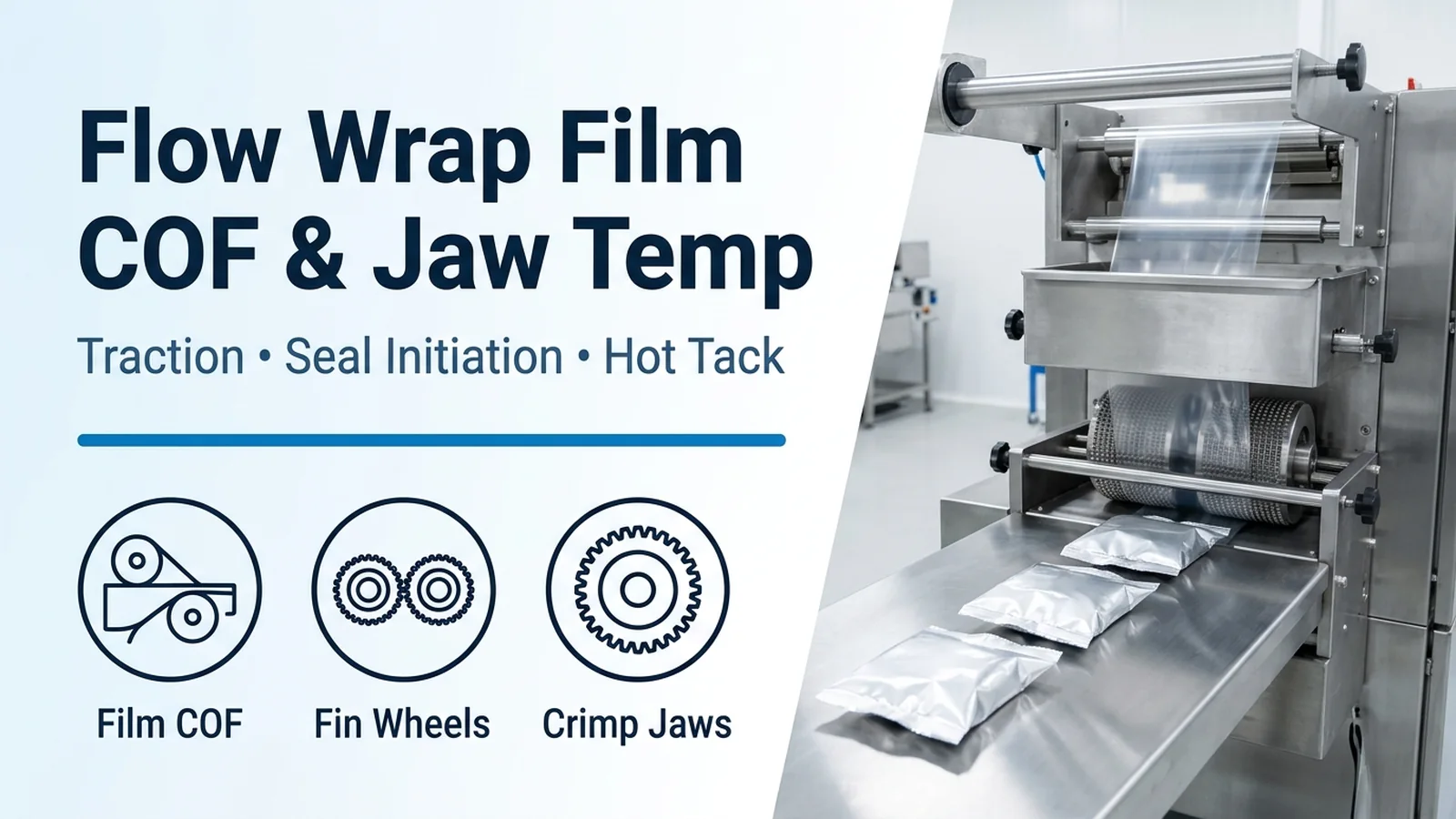
On a horizontal flow wrapper, flow wrap film must clear two mechanical and thermal bottlenecks in sequence before producing accepted flow wrap bags: (1) Forming-shoulder glide and fin-wheel traction, governed by static and dynamic Coefficient of Friction (COF) under ASTM D1894 and ISO 8295, and (2) Longitudinal and transverse seal formation, governed by the window between the inner sealant layer's Seal Initiation Temperature (SIT) and the outer or core layer's distortion temperature, plus hot tack strength under ASTM F1921. Across our horizontal flow wrapping machines, matching these datasheet parameters to the forming box, fin-wheel pairs, and rotary or box-motion crimper jaws prevents tracking drift, fin-seal burn-through, and end-seal transition leaks.
- Audit film-to-metal drag over the forming plough (ASTM D1894 / ISO 8295) alongside published film-to-film ASTM D1894 COF by measured surface (0.22–0.25 Acrylic/Acrylic on Bicor™ AB, 0.25 dynamic NT/NT on coextruded Taghleef TSS, 0.4 sealant-to-sealant on metallized Torayfan® PAX, and 0.6 sealant-to-sealant on low-SIT Torayfan® PWS3).
- Check the polymer trade-off between lowering SIT (85 °C on Torayfan® PWS3 vs 105 °C on Torayfan® PAX) and rising inner sealant COF (0.6 on PWS3 vs 0.4 on PAX).
- Separate unheated Pair 1 fin-wheel traction setup (forward wheel tilt and gripper grooves) from heated Pairs 2–3 sealing temperatures.
- Evaluate ASTM F1921 hot tack (peel-tested within 150 ms of seal formation) across end-seal thickness transitions created by the fin seal, lap seal, or gussets, or specify pattern cold-seal film for heat-sensitive confectionery.
On this page
Why flow wrap film fails at two separate machine interfaces: forming-box drag (COF) vs. jaw heat transfer (SIT)
A horizontal form-fill-seal (HFFS) wrapper subjects flat rollstock to coupled frictional and thermal forces. As detailed in RDM Test Equipment Ltd.'s packaging testing documentation, flat film must first unfold and slide over a metal former (ASTM D1894 / ISO 8295 static and dynamic COF). Simultaneously, as Greener Corporation documents for horizontal flow-wrapper fin-wheel assemblies, most wrappers use two or three pairs of longitudinal fin wheels: the first pair (typically unheated) acts as the primary traction nip drawing the film tube forward through the wrapper, while the second and third pairs (heated) weld the longitudinal fin seal and guide the tube toward the transverse crimper head. For the upstream 5-stage machine sequence and unfolded flat web-width sizing formula (W_web = 2(W_prod + H_prod) + 2W_fin + C_forming, where W_fin is typically 12–15 mm and C_forming is 10–18 mm), see our guide on what flow wrapping is and how a flow wrapper works.
Why does a rollstock change that improves end-seal bonding suddenly cause bag-length shrinkage or forming-box jams? Comparing Technical Data Sheets from Toray Films Europe SAS illustrates the trade-off between lowering Seal Initiation Temperature (SIT) and rising sealant-to-sealant friction: standard metallized heat-sealable BOPP Torayfan® PAX and PAX-O (12, 15, 20, and 30 µm) specifies an SIT (> 2 N/25 mm) of 105 °C and a sealant-to-sealant dynamic ASTM D1894 COF (Kd) of 0.4. Switching to low-SIT metallized BOPP Torayfan® PWS3 (15 µm and 17.5 µm) lowers the SIT (> 2 N/25 mm) by 20 °C down to 85 °C and provides 3 N/25 mm hot tack at 121 °C, while sealant-to-sealant ASTM D1894 COF rises from 0.4 to 0.6.
As polymer engineering analysis from PAXXUS (Doug Dodrill and Henk Blom, PhD) notes, inner-sealant COF also governs product control inside the tube: if the inner sealant COF is too low, products can slide backward into the end-seal zone when the leading crimper jaw compresses the film tube; if the inner COF is too high, the web resists folding and bunches up during the three-dimensional to two-dimensional collapse at the crimper jaws, creating wrinkles and channel leakers.
Reading flow wrap film datasheets: COF, SIT, seal range, and hot tack across 7 reference BOPP and OPP grades
Before ordering slit production reels or scheduling a factory trial, compare the film converter's Technical Data Sheet (TDS) across five specific rows: thickness (µm or gauge), ASTM D1894 / ISO 8295 static and dynamic COF (noting whether measured as Acrylic/Acrylic, on the treated outer print surface, on untreated/untreated NT/NT surfaces, or sealant-to-sealant), minimum Seal Initiation Temperature (SIT) or heat-seal range, thermal shrinkage (ASTM D1204 or 130–140 °C oven test), and hot tack (ASTM F1921).
The benchmark matrix below compiles published manufacturer specifications across seven commercial BOPP and coated OPP flow-wrap webs from Taghleef Industries, Toray Films Europe SAS, Toray Plastics (America), Inc., Multi-Plastics / Bicor™, and TOPPAN Packaging.
| Film grade & structure (manufacturer) | Published thickness range | ASTM D1894 COF & test surface | SIT / heat-seal temperature window | Published seal strength & test condition | Thermal shrinkage, barrier & flow-wrapper role |
|---|---|---|---|---|---|
| Taghleef TSS — 2-side coextruded heat-sealable BOPP (Taghleef Industries) | 15, 18, 20, 25, 30, 35, 40, 48 µm | 0.25 dynamic COF (NT/NT) | 105–140 °C heat-seal range (35 °C window, NT/NT) | 170 g/cm (15–20 µm), 230 g/cm (25–30 µm), 300 g/cm (35–48 µm) at 130 °C, 0.5 s | 6.0% MD / 3.0% TD shrinkage (130 °C, 5 min); 38 mN/m treatment (ASTM D2578); WVTR 9.0 to 3.1 g/m²/d (38 °C, 90% RH, ASTM F1249); single-web or laminated HFFS/VFFS pillow bags. |
| Torayfan® PAX / PAX-O — metallized heat-sealable BOPP (Toray Films Europe SAS) | 12, 15, 20, 30 µm (yield 92.1, 73, 55.2, 36.5 m²/kg) | 0.4 dynamic COF (Kd, sealant-to-sealant) | 105 °C SIT (> 2 N/25 mm, Internal Method) | 3 N/25 mm (12 µm, 15 µm), 4.2 N/25 mm (20 µm), 4.6 N/25 mm (30 µm) at 121 °C | 6.3–6.9% MD / 3.5–4.7% TD shrinkage (140 °C, 15 min); OTR 50 cc/m²/day (23 °C, 0% RH, ASTM F1927); MVTR 0.4 g/m²/day (38 °C, 90% RH, ASTM F1249); snack, bakery, and confectionery barrier flow wrap. |
| Torayfan® PWS3 — metallized low-SIT heat-sealable BOPP (Toray Films Europe SAS) | 15 µm (73 m²/kg), 17.5 µm (62.6 m²/kg) | 0.6 COF (sealant-to-sealant) | 85 °C SIT (> 2 N/25 mm, Internal Method) | 3.5 N/25 mm (15 µm) and 4 N/25 mm (17.5 µm) at 121 °C; Hot Tack at 121 °C = 3 N/25 mm | OTR 50 cc/m²/day (23 °C, 0% RH, ASTM D3985); MVTR 0.15 g/m²/day (38 °C, 90% RH, ASTM F1249); high-speed rotary HFFS requiring a 20 °C lower SIT and verified 3 N/25 mm hot tack. |
| Torayfan® BMS — 1-side treated, 1-side heat-sealable matte BOPP (Toray Films Europe SAS) | 15 µm (73 m²/kg), 20 µm (54.5 m²/kg) | 0.4 COF (sealant-to-sealant) | 105 °C SIT (> 2 N/25 mm, Internal Method) | 3 N/25 mm at 121 °C (Internal Method) | Matte exterior with ASTM D2457 Gloss (20°, Matt side) = 6 and ASTM D1003 Haze = 57%; outer print/lap-seal web with stable slip system. |
| Bicor™ AB — 2-side acrylic-coated sealable OPP (Multi-Plastics / Bicor) | 80, 100, 132 gauge (20, 25, 33 µm) | 0.25 (20 µm), 0.24 (25 µm), 0.22 (33 µm) (Acrylic/Acrylic) | Minimum crimp seal temp: 185 °F (85 °C) for 20 µm & 33 µm; 205 °F (96 °C) for 25 µm | 540 g/in (20 µm), 560 g/in (25 µm), 600 g/in (33 µm) at 260 °F (126 °C), 20 psi, 0.75 s (ASTM D882) | Dimensional stability -4.5% MD, -4.0% / -3.5% TD at 275 °F (135 °C), 7 min (ASTM D1204); lap-sealable to acrylic and PVdC coatings; explicitly not recommended as VFFS sealant web due to poor hot tack. |
| Bicor™ ASB-X — 1-side acrylic / 1-side sealable PVdC-coated OPP (Multi-Plastics / Bicor) | 110, 150, 170, 210 gauge (27.5, 37.5, 42.5, 52.5 µm) | 0.24 across all 4 thicknesses (Acrylic/Acrylic) | Minimum crimp seal temp: 190 °F (87.8 °C; printed on PDF with a parenthetical conversion typo as 190°F(32°C)) | 650, 600, 650, 700 g/in at 260 °F (126 °C), 20 psi, 0.75 s | Excellent hot tack and seal strength; WVTR 0.53, 0.23, 0.21, 0.17 g/100 in²/24 hr (ASTM F1249); OTR 4.5 cm³/100 in²/24 hr (ASTM D3985); lap-sealable to itself for HFFS and VFFS. |
| Torayfan® TC01 + PC1 — pattern cold-seal BOPP laminate (Toray Plastics America & TOPPAN Packaging) | TC01: 45, 50, 60, 70 ga (68,200 to 44,000 in²/lb); PC1: 45, 50 ga (68,200 & 61,200 in²/lb) | 0.36 static (μs), 0.31 dynamic (μd) on non-migratory treated side (TC01 & PC1) | Ambient temperature (water-based cohesive coating bonds under pressure alone; zero jaw heat) | Pressure-only cohesive bond across patterned fin and end-seal margins | TC01 shrinkage 8% MD / 5% TD (284 °F / 140 °C, 15 min, ASTM D1204) & MVTR 0.70–0.45 g/100 in²/day; PC1 metallized barrier MVTR 0.009 g/100 in²/day (100 °F, 90% RH, ASTM F1249); 41 dyne/cm wetting tension (ASTM D2578); runs 30%–50% faster than low-temp heat-seal film and up to 2× traditional heat seal. |
Fin-wheel traction vs. slippage: why turning up fin-seal heat causes bag-length shrinkage and burn-through
When a high-COF film drags over the metal forming plough or slips between the longitudinal fin wheels, bags emerge shorter than the cut-length setpoint and eye-mark registration drifts. As Greener Corporation documents in its flow-wrapper fin-wheel optimization guidance, operators frequently respond by cranking up fin-wheel clamping pressure or fin-seal heater temperature—a temporary band-aid that accelerates mechanical wear and worsens film tracking.
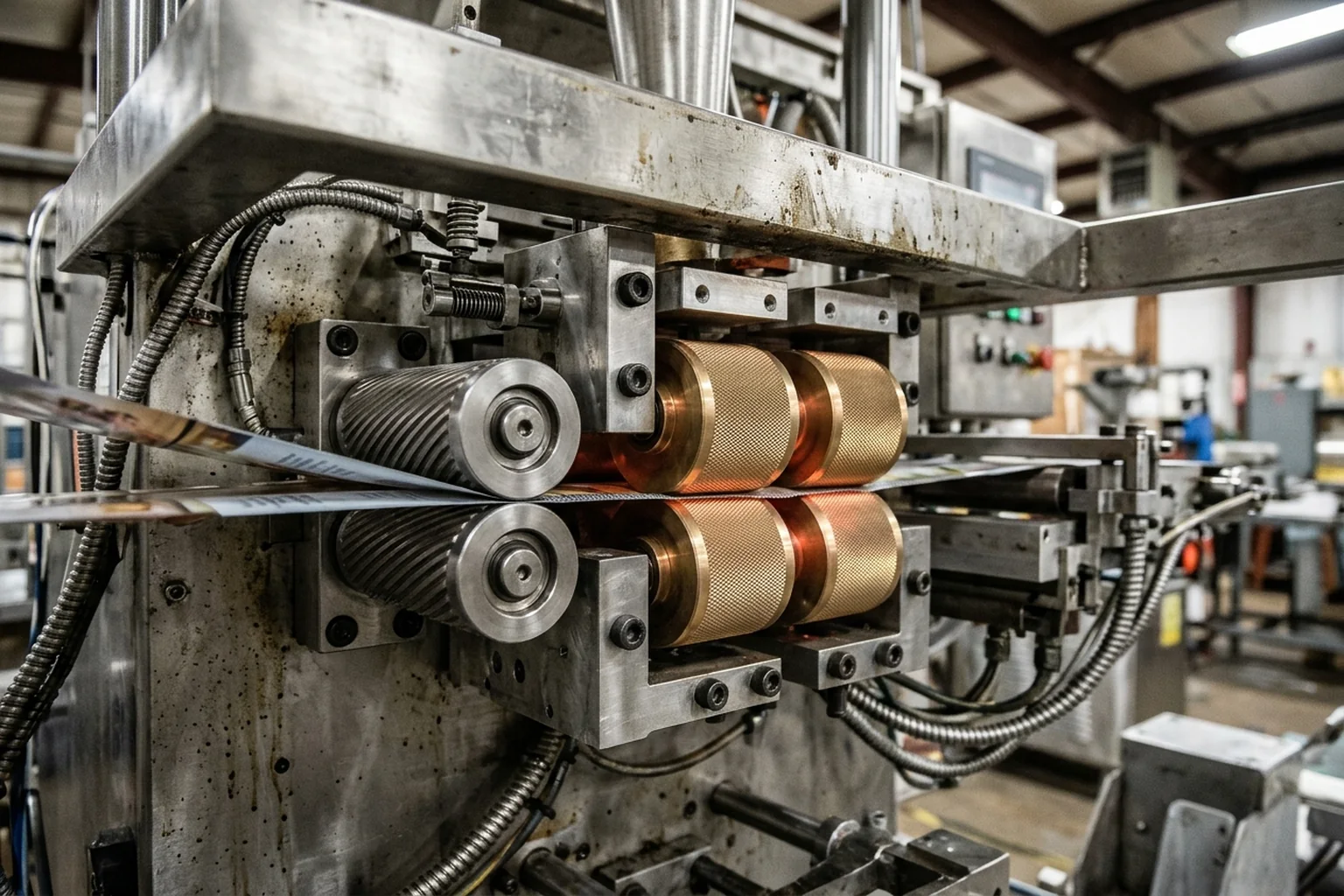
Increasing clamping pressure and thermal load overloads the fin-wheel shaft bearings, while excess heat on the fin wheels softens the flexible web, causing worse slippage, seal distortion, and complete melt-through of the fin seal. Because the first pair of fin wheels (typically unheated) provides the forward pulling tension and the second and third pairs seal the fin and guide the tube, solving web slippage requires separating mechanical traction on Pair 1 from heat transfer on Pairs 2 and 3.
| Diagnostic & setup step | Inspection & adjustment procedure | Failure mode prevented |
|---|---|---|
| 1. Inspect and clean matched fin-wheel pairs (every 6 months) | Wire-brush built-up polymer, ink, and adhesive residue from knurl teeth; inspect tooth crests for crushing wear and check the top edge of each wheel for wear caused by rubbing the top cover plate. Always replace worn fin wheels as a matched pair, never individually. | Eliminates uneven nip contact, localized web slipping, and cover-plate friction that sharpens top wheel edges and cuts packages. |
| 2. Rock-test fin-wheel shaft bearings for axial play | Grip each fin wheel and rock it back and forth on its shaft. Excessive clamping pressure and heat adjustments accelerate bearing wear; replace any bearing that exhibits play. | Prevents shaft deflection that opens the nip gap and forces operators to apply even more destructive spring pressure. |
| 3. Run an operating-temperature doubled-film pull-out test | Bring the fin wheels to normal operating temperature, place a doubled strip of packaging film between each stopped pair, and pull by hand to verify firm, uniform gripping resistance from side to side across the knurl face. | Detects thermal expansion misalignment or worn wheel profiles before running product at speed. |
| 4. Set forward fin-wheel tilt, Pair 1 gripper grooves & Dura-Therm wheels | Set a slight forward tilt (infeed end of the fin wheel slightly higher than the discharge end) to give the wheels extra bite and pull the web downward tightly around the product without rubbing the top cover plate. Fit gripper grooves on the first leading unheated pair for extra pulling tension, and specify high-conductivity Dura-Therm fin wheels on heated pairs when running paper laminates or thick barrier webs. | Restores positive web traction and downward film tension without overheating or melting the longitudinal fin seam. |
Crimp jaw temperature cycles, ASTM F1921 hot tack, and sealing across end-seal thickness transitions
As Greener Corporation defines for horizontal flow wrappers and vertical baggers, a packaging material's seal range is the temperature difference between the inner sealant layer's Seal Initiation Temperature (SIT) and the outer or core structural layer's distortion temperature. Heat must conduct from the crimper jaw faces through the outer and core layers to bring the inner sealant above its SIT during the brief jaw contact window (t_dwell). Using the worked 2-up rotary crimper baseline from our horizontal flow wrapping engineering guide—where t_dwell = (θ_contact / 360°) × (60 / (PPM / N_up)) yields 44.4 ms of jaw contact and 28.80 m/min web speed at 180 packs/min (N_up = 2 jaw pairs at 90 rpm, θ_contact = 24°, L_bag = 160 mm, D_rot = 102 mm)—increasing line speed directly compresses dwell time and narrows the effective seal range.
During steady production, jaw temperatures dip slightly as heat transfers into the moving film web and recover as heater cartridges energize, cycling within a few degrees. When the line stops, heat stops transferring into the film and jaw temperatures spike; when the wrapper restarts, jaw temperatures drop significantly before the heater cartridges recover. If an operator sets jaw temperature near the top of a film's seal window (for example, approaching the 130–140 °C upper limit of Taghleef TSS, where thermal shrinkage reaches 6.0% MD / 3.0% TD at 130 °C, or 140 °C on Torayfan® PAX, where shrinkage reaches 6.3–6.9% MD), a line-stop temperature spike distorts the core layer, while the subsequent restart temperature plunge drops the inner sealant below its 105 °C SIT and produces unsealed leakers. Greener Corporation reports that sealing jaws machined from high-conductivity Dura-Therm alloy reduce temperature cycle fluctuations by 80% or more, preserving the effective seal window on narrow-window recyclable mono-materials.
End-seal integrity is further challenged by thickness transitions across the transverse seal. As Greener Corporation documents, transitions on the end seal between varying thicknesses of film created by the fin seal, lap seal, gussets, and wrinkles make it more difficult to maintain the operating window necessary for quality seals:
- Too little jaw pressure at thickness transitions: Leaves gaps, or leakers, at the transition zones created by the fin seal, lap seal, gussets, and wrinkles.
- Excess mechanical jaw pressure: Easily crushes or splits the end seal across varying thicknesses of film.
- Overheating and poor hot tack ("moons"): Overheating distorts the seal and causes poor hot tack, where the film springs back open at transition zones or "moons" before the seal can set.
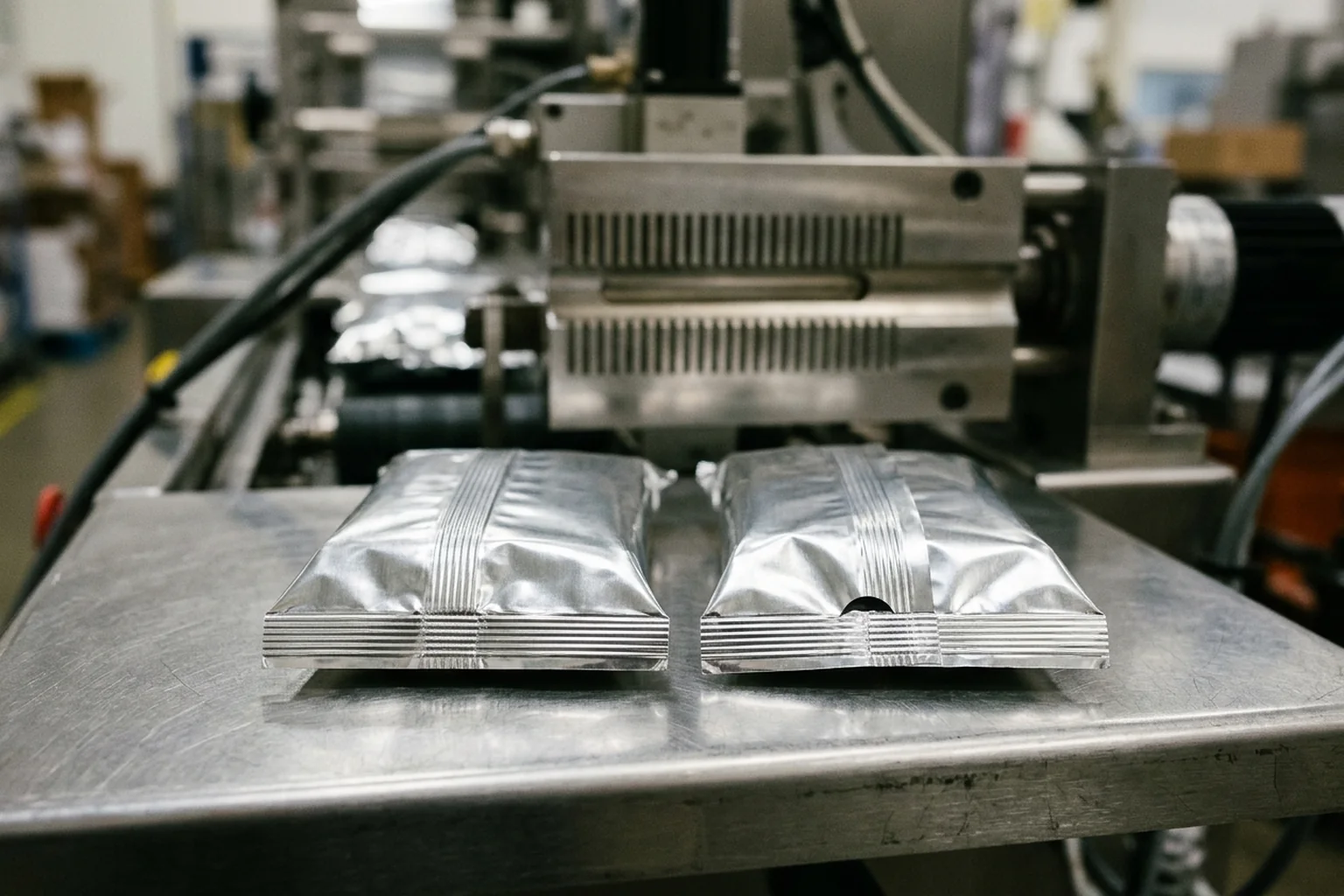
Why do bags pass room-temperature peel checks yet still spring open into half-moon voids at the wrapper discharge? As RDM Test Equipment Ltd. and Intertek Testlopedia explain, laboratory heat seals formed under controlled Temperature + Pressure + Time (ASTM F2029) must be evaluated under two separate standards: ASTM F88 / F88M measures Ultimate Seal Strength after cooling, whereas ASTM F1921 / F1921M Method B measures Hot Tack Strength by peel-testing the seal within 150 ms of seal formation (using 15 mm, 25 mm, or 1.00 in wide by 30–35 cm / 12–14 in long strips) to record threshold sealing temperature, maximum peak hot-tack force, and hot-tack temperature range. A coating chemistry with strong cooled crimp strength—such as two-side acrylic-coated Bicor™ AB (540–600 g/in at 260 °F / 126 °C, 20 psi, 0.75 s)—can still exhibit poor hot tack, which is why Multi-Plastics / Bicor explicitly notes Bicor™ AB is not recommended as the sealant web on VFFS machines and offers PVdC-coated Bicor™ ASB-X (600–700 g/in) or low-SIT Torayfan® PWS3 (3 N/25 mm hot tack at 121 °C) when high hot tack is required.
| Test standard or tooling feature | Measured parameter or mechanical function | Flow-wrapping qualification & setup rule |
|---|---|---|
| ASTM F2029 + ASTM F1921 Method B (Intertek & RDM Test Equipment) | Forms controlled lab seals (Temperature + Pressure + Time) and peel-tests hot-tack force within 150 ms of seal formation across 15 mm, 25 mm, or 1.00 in strips (30–35 cm length). | Identifies the hot-tack temperature window so crimper jaws operate where the molten sealant resists spring-back at the fin-to-end-seal transition. |
| ASTM F88 / F88M + ASTM F2096 / ASTM F3039 (RDM & PAXXUS) | Measures cooled ultimate seal peel strength (ASTM F88), non-porous dye penetration (ASTM F3039 vs ASTM F1929 for porous webs), visual channel inspection (ASTM F1886), and regulated 100–850 mbar water-bath bubble leak testing (ASTM F2096 / DIN 55508-1). | Confirms that polymer caulkability and serration shearing action have completely filled the back-seal/end-seal T-junction void after cooling. |
| Matched serration shearing & Fin Seal Relief (Greener Corporation) | As film stretches across the serrations, a shearing action pushes the inner sealant layer into transition gaps; a precision Fin Seal Relief machined into the serration pattern accommodates the extra layers of film from the fin seal. | Specify Fin Seal Relief when fin-seal size and web tracking are consistent; check hidden jaw wear with a static carbon-paper impression. |
| Easy Seal™ FLEX inserts & FRED profile (Greener Corporation) | Easy Seal™ FLEX inserts conform to extra film layers at transition zones between varying thicknesses of film (for heat-seal or cold-seal applications), while Fracture Elimination Design (FRED) leading-edge serration profiles eliminate excess pressure that can damage or cut through the film. | Eliminates fin-seam crushing and splitting when running thin metallized BOPP or multi-layer barrier laminates. |
When a thick barrier laminate or paper structure requires more thermal conduction time than a rotary crimper can supply without overheating the outer web, evaluate a following-jaw architecture using our box motion vs. rotary end seal comparison.
Heat-seal vs. cold-seal flow wrap film: cohesive pattern coatings, release-web COF, and speed boundaries
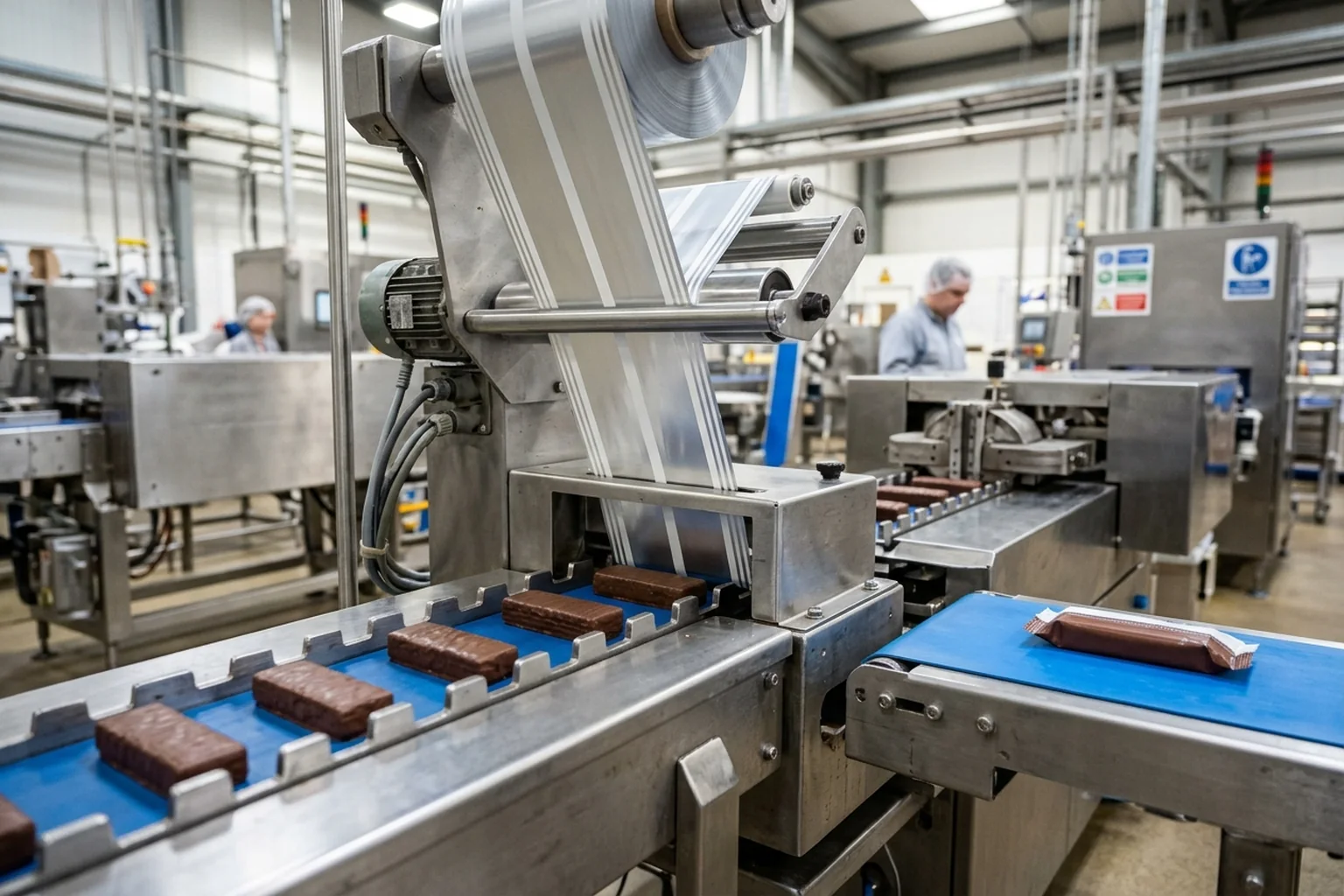
When packaging heat-sensitive products—such as moulded chocolate bars, enrobed candy bars, granola and nutritional protein bars, baked goods, or frozen ice cream novelties covered in our candy and chocolate flow-wrapping guide—radiant and conductive heat from heated fin wheels and crimper jaws (85 °C SIT on Torayfan® PWS3 or 105–140 °C heat-seal range on Taghleef TSS) can bloom chocolate or melt coatings—especially during line stops. Cold-seal flow wrap film solves both thermal product damage and high-speed dwell lag by replacing thermal polymer melting with a water-based cohesive coating pattern-printed strictly onto the inner fin-seal and end-seal margins.
As TOPPAN Packaging documents in its cold-seal engineering guide, cold-seal cohesive coatings bond only to themselves under mechanical roller and jaw pressure alone, requiring zero heat. Because the wrapper no longer waits for heat to conduct through the outer print web and barrier core, TOPPAN Packaging reports that cold-seal flow wrapping increases line speeds by 30%–50% compared to low-temperature heat-seal films and doubles (2×) the line speeds of traditional heat-seal processes, while eliminating heat streaking, tightening eye-mark registration control, and extending cutting-knife and sealing-jaw life.
| Selection dimension | Heat-seal flow wrap film (coextruded / coated BOPP) | Pattern cold-seal flow wrap film (cohesive laminate) |
|---|---|---|
| Bonding mechanism & jaw temperature | Thermal conduction melts inner copolymer/coating above SIT (85 °C on Torayfan® PWS3 and Bicor™ AB 20/33 µm; 87.8 °C / 190 °F on Bicor™ ASB-X; 105 °C on Torayfan® PAX/BMS and Taghleef TSS up to 140 °C). | Water-based cohesive coating bonds to itself under fin-wheel and crimper pressure alone at ambient temperature (zero jaw heat, TOPPAN Packaging). |
| Reference laminate & surface COF | Single-web or laminated Taghleef TSS (0.25 NT/NT dynamic COF), Bicor™ AB (0.22–0.25 Acrylic/Acrylic COF), Bicor™ ASB-X (0.24 Acrylic/Acrylic COF), Torayfan® PAX (0.4 sealant-to-sealant COF), or Torayfan® PWS3 (0.6 sealant-to-sealant COF). | Outer print/release web Torayfan® TC01 (45–70 ga, non-migratory treated-side ASTM D1894 μs = 0.36, μd = 0.31) laminated to metallized cold-seal reception web Torayfan® PC1 (45–50 ga, μs = 0.36, μd = 0.31, MVTR = 0.009 g/100 in²/day) in O.L./Ink/TC01/Pattern Cold Seal or FCR/ink/ADH/PC1/Patterned Cold Seal structures. |
| Line speed & thermal dwell boundary | Speed is bounded by heat conduction across the web during jaw dwell (e.g., 44.4 ms at 180 packs/min on a 2-up rotary baseline). | Delivers a 30%–50% speed increase over low-temperature heat-seal films and up to 2× traditional heat-seal line speeds (TOPPAN Packaging). |
| Wrapper tooling & conversion requirements | Heated Pairs 2–3 fin wheels and cartridge-heated rotary or box-motion crimper jaws with temperature controllers. | Turn off fin-wheel and crimper heaters; verify uniform mechanical nip pressure across the fin-seal thickness transition using cold-seal crimper jaws or compliant Easy Seal™ FLEX inserts (TOPPAN Packaging & Greener Corporation). |
Matching film structure, COF, and slit reel width to LINEVO flow-wrapping configurations
European and North American film mills slit master BOPP rolls up to 340–2450 mm wide on 152.8 mm (6 in) internal-diameter paper cores (Toray Films Europe SAS for Torayfan® PAX, PWS3, and BMS), while standard converted flow-wrapper reels are supplied on 76 mm (3 in) cores with a 305 mm outside diameter (4,250 m roll length at 15 µm down to 1,350 m at 48 µm on Taghleef TSS, or 337 mm OD on 152 mm cores). Before mounting a reel on a horizontal flow wrapper, follow Taghleef Industries' storage and handling baseline: store BOPP reels at 20 °C to 30 °C, condition reels in the packaging pressroom for at least 24 hours prior to running so thermal and slip equilibrium is reached, and use heat-sealable BOPP within 6 months of production.
Across LINEVO's 30 horizontal flow-wrapping configurations (family T05), our lineup includes both catalog-listed configurations with published working ranges and application-specific configurations (such as the full-servo lollipop wrapper and multi-component line configurations) whose pack size, film width, and speed ranges are confirmed on request in the project quotation. Use the three catalog-listed reference configurations below to match your slit reel width, speed tier, and sealing mode:
| LINEVO configuration & catalog path | Published film width & bag size range | Published speed, power & frame specs | Film COF, SIT & jaw tooling match |
|---|---|---|---|
| LV-250B/D — Horizontal Pillow Flow Wrapping Machine (/products/ds-250bd) | Maximum film width: 250 mm; Bag width: 30–110 mm (bag length and product height confirmed per project quotation) | 40–230 bags/min listed packing speed; 220 V, 50/60 Hz supply; 3770 × 670 × 1450 mm frame | Matches slit reels ≤ 250 mm on 76 mm cores across coextruded BOPP (Taghleef TSS, 0.25 NT/NT COF, 105–140 °C seal range), metallized BOPP (Torayfan® PAX 105 °C SIT or PWS3 85 °C SIT), or pattern cold-seal webs. |
| LV-250B/D — High-Speed Candy Packaging Machine (/products/high-speed-candy-packaging-machine-in-a-chinese-factory) | Film width: Max. 350 mm; Bag width: 30–110 mm; Bag length: 45–190 / 90–330 mm; Product height: Max. 40/70 mm | 40–230 Bags/Min packing speed; 220 V, 50/60 Hz; 420 kg net weight; 3920 × 670 × 1320 mm frame | Wide-web (≤ 350 mm) configuration for taller or wider packs (up to 40/70 mm height); supports low-COF outer or single-web BOPP/OPP structures such as Bicor™ AB (0.22–0.25 Acrylic/Acrylic COF), Taghleef TSS (0.25 NT/NT dynamic COF), or Torayfan® TC01 (0.31 treated-side dynamic COF). |
| High-Speed Candy & Confectionery Horizontal Flow Wrapper (/products/high-speed-candy-confectionery-horizontal-flow-wrapper) | Film width: 50–120 mm; Package size: L 10–50 mm, W 10–30 mm, H 4–25 mm | 800–1200 bags/min packaging speed; 1,200 pcs/min rotary disc-feeding turntable; 3-Axis Servo Drive Control System; 4.5 kW power; 1400 kg weight; 2400 × 1340 × 1760 mm frame | Short seal dwell time at 800–1,200 bags/min requires low-SIT high-hot-tack film (such as 85 °C SIT Torayfan® PWS3 or 190 °F / 87.8 °C PVdC-coated Bicor™ ASB-X) or pressure-only cold-seal film with stable surface COF (0.24 Acrylic/Acrylic COF on Bicor™ ASB-X or 0.31 treated-side dynamic COF on Torayfan® TC01/PC1). |
When validating a candidate film on our LV-250B/D horizontal pillow flow wrapper, our wide-web LV-250B/D high-speed candy packaging machine, or our 800–1,200 bags/min disc-fed candy flow wrapper during sample testing, evaluate performance by good output rather than gross cycle rate: as defined in our end-seal trial worksheet, Good output (packs/min) = accepted packs ÷ elapsed run time (min) (for example, 1,200 formed packs minus 60 rejects over 20 elapsed minutes equals 57 accepted packs/min). Combine visual inspection (ASTM F1886) with ASTM F3039 dye leak testing or 100–850 mbar regulated bubble leak testing (ASTM F2096) across both steady-state packs and restart packs captured immediately after a line stop. For shisha tobacco pouches from a horizontal roll-film packer, compare configurations on our hookah and shisha packaging page.
Frequently asked questions on flow wrap film COF, SIT, and jaw temperature
What dynamic COF range works best for horizontal flow wrap film?
Published manufacturer datasheets for commercial horizontal flow-wrap BOPP and coated OPP films specify ASTM D1894 COF values by coating and sealant family: acrylic-coated Bicor™ AB (20–33 µm) specifies 0.22–0.25 (Acrylic/Acrylic), acrylic/PVdC-coated Bicor™ ASB-X (27.5–52.5 µm) specifies 0.24 (Acrylic/Acrylic), coextruded Taghleef TSS (15–48 µm) specifies 0.25 dynamic (NT/NT), two-side treated Torayfan® TC01 and metallized Torayfan® PC1 specify 0.31 dynamic (0.36 static) on the non-migratory treated side, and metallized Torayfan® PAX and matte Torayfan® BMS specify 0.4 (sealant-to-sealant). When a low-SIT sealant layer raises inner sealant-to-sealant COF to 0.6—as on Torayfan® PWS3 (85 °C SIT)—verify forming-box clearance and Pair 1 unheated fin-wheel traction during sample trials.
Why does increasing fin-wheel temperature make film slippage worse on a flow wrapper?
On a horizontal flow wrapper, the first leading pair of fin wheels is typically unheated and provides the mechanical traction that pulls the film tube through the forming box, while the second and third pairs are heated to seal the longitudinal fin seam. As Greener Corporation documents, raising fin-wheel temperature or clamping pressure to fight slippage overloads the shaft bearings and softens the flexible packaging web, which causes worse slippage, seal distortion, and fin-seal melt-through. Restore traction mechanically by checking bearings for axial play, setting a slight forward fin-wheel tilt (infeed end slightly higher than discharge end), or installing gripper grooves on the first leading fin-wheel pair.
What causes half-moon voids ("moons") where the center fin seal meets the end seal?
Half-moon voids ("moons") at the folded fin-to-end-seal thickness transition occur when the transverse crimper jaws overheat the film and degrade its hot tack (ASTM F1921, peel-tested within 150 ms of seal formation), allowing the molten seal to spring back open at the transition zone before the polymer cools and sets. Prevent transition leaks and "moons" by keeping jaw temperatures within the film's hot-tack window (using high-conductivity Dura-Therm jaws to cut thermal cycle fluctuations by 80% or more), specifying a machined Fin Seal Relief or compliant Easy Seal™ FLEX insert in the crimper serrations, and selecting a sealant layer with verified hot tack (3 N/25 mm at 121 °C on Torayfan® PWS3 or PVdC-coated Bicor™ ASB-X).
How much faster can cold-seal flow wrap film run compared to heat-seal film?
According to converter data from TOPPAN Packaging, water-based cohesive cold-seal flow wrap film bonds under mechanical roller and crimper pressure alone with zero heat, delivering a 30%–50% line-speed increase compared to low-temperature heat-seal films and up to double (2×) the line speed of traditional heat-seal processes. Cold-seal structures (such as outer release web Torayfan® TC01 laminated to metallized barrier reception web Torayfan® PC1 with 0.009 g/100 in²/day MVTR) eliminate thermal product damage on chocolate bars, enrobed confectionery, protein bars, and ice lollies.
What to send us
Send what you have and mark what is still undecided. Discuss your application with LINEVO.
| Item | Why we need it | Example format |
|---|---|---|
| Film laminate structure and total thickness (µm) | Determines thermal conduction lag through the outer/core webs and mechanical stiffness in the forming box. | Converter TDS showing layer composition (e.g., 20 µm Torayfan® BMS / ink / adh / 20 µm metallized Torayfan® PAX, or FCR/ink/ADH/PC1/Patterned Cold Seal), total thickness in µm, and slit reel width on a 76 mm or 152.8 mm core. |
| Dynamic Coefficient of Friction (ASTM D1894 / ISO 8295) | Sizes forming-plough glide resistance and Pair 1 unheated fin-wheel traction requirements. | Published ASTM D1894 / ISO 8295 COF values and measured surfaces (e.g., film-to-metal former COF, 0.25 NT/NT dynamic COF on Taghleef TSS, 0.22–0.25 Acrylic/Acrylic COF on Bicor™ AB, or 0.4–0.6 sealant-to-sealant COF on Torayfan® PAX and PWS3). |
| Inner sealing layer, SIT (°C) or cold-seal pattern drawing | Matches fin-wheel and rotary or box-motion crimper temperature window and serration relief to the sealant. | Seal Initiation Temperature (e.g., 85 °C on low-SIT Torayfan® PWS3 vs 105 °C on Torayfan® PAX), 105–140 °C seal range on Taghleef TSS, ASTM F1921 hot tack, or cohesive cold-seal pattern die-line. |
| Target line speed (good bags/min) and product dimensions | Calculates available crimper dwell time (ms) and selects the right LINEVO wrapper frame and infeed. | Product L × W × H in mm, heat sensitivity, and target accepted packs/min (e.g., 40–230 bags/min on LV-250B/D or 800–1,200 bags/min on the disc-fed candy flow wrapper). |