
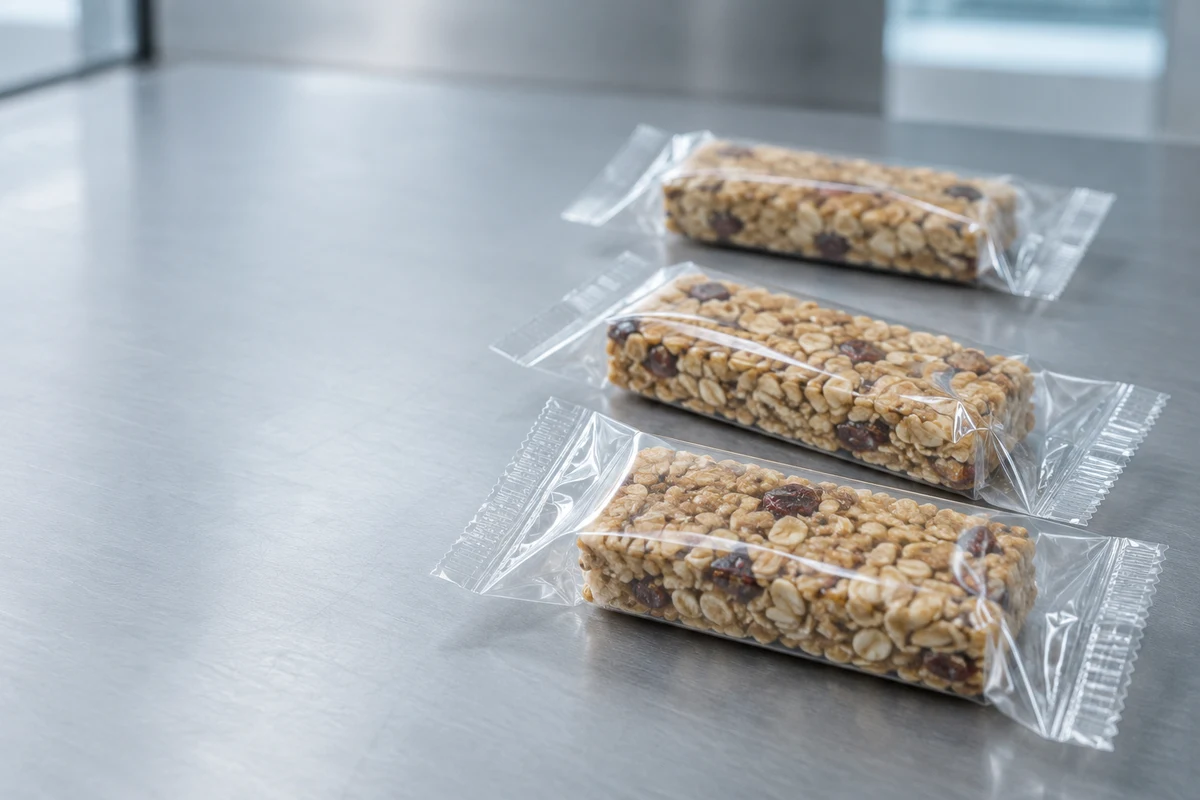
Three oat bars in clear pillow packs with crimped seals across both short ends, arranged on a gray packing bench.
This is a selection comparison based on published manufacturer process descriptions, not LINEVO trial results. LINEVO supplies flow wrappers; the inspected public records do not establish a LINEVO box-motion configuration.
If you are comparing box motion and rotary end seal options after choosing horizontal flow wrapping, use this guide to identify what the end jaws must achieve. End seals close across the film tube between products; the longitudinal fin seal joins the film edges along the pack. The flow forming and sealing stages explain the wider process.
| Input | Typical value or condition | Why it matters |
|---|---|---|
| Jaw motion | Rotating contact or a following contact phase | Identifies the motion to examine on the proposed configuration. |
| Film specification | Supplier datasheet and representative film | Defines the structure, sealing layer and conditions to review. |
| Product envelope | Smallest and largest items or trays; orientation and spacing | Establishes the clearance and product-free seal region needed. |
| Seal acceptance | Required end seal and agreed check method | Makes an acceptable pack a defined result. |
| Infeed record | Video of how products arrive at the wrapper | Shows whether spacing and orientation are repeatable. |
| Target good output | Buyer target in accepted packs per minute or shift | Sets the production requirement to evaluate alongside seals. |
On this page
What do the end-seal jaws actually do?
Rotary end sealing uses continuously rotating jaws that bring sealing faces into contact with the film tube, then carry them away. The described cycle seals and cuts between successive products. The products continue along the wrapper's transport path; a rotating end jaw does not mean the product rotates with it.
A box motion flow wrapper uses a different end-jaw cycle: the jaws close at the gap between products, travel with the moving film while closed, then open and return for the next cycle. Published descriptions call this a rectangular path. The useful distinction is the following phase: the sealing faces stay with the same moving seal region during contact.
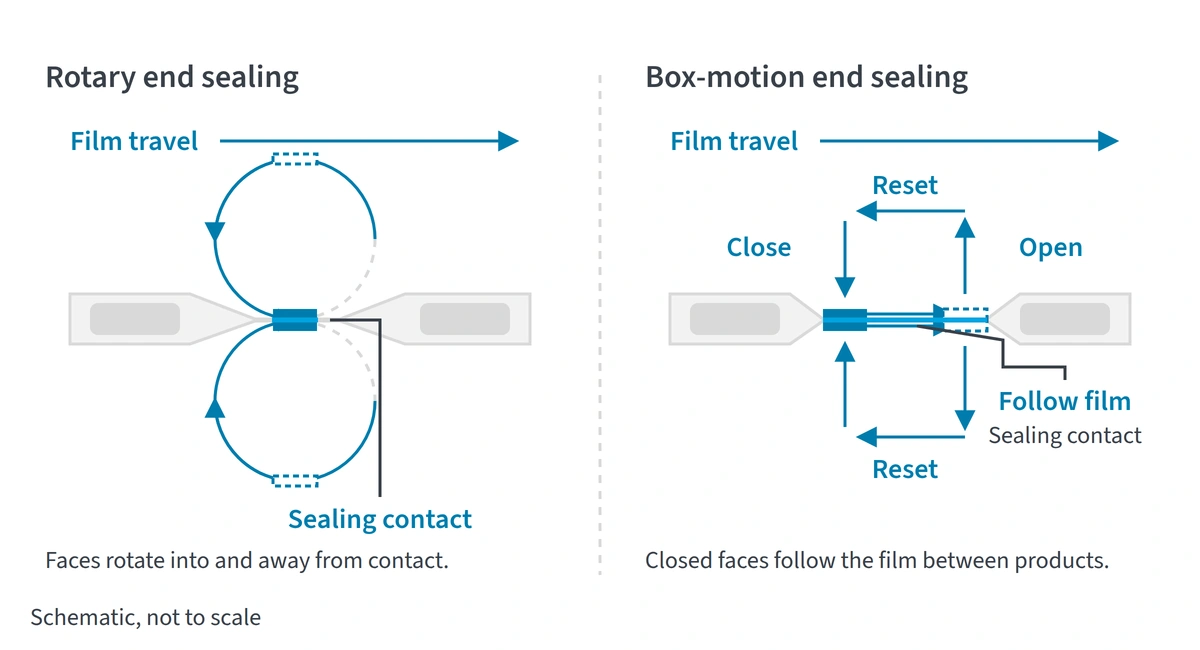

Opposing rotary sealing faces turn into the film gap; box-motion faces close, follow the right-moving film, open and reset between product silhouettes.
The motion comparison belongs alongside the other flow-wrapper configuration choices. Film fed from above or below describes the film path. Servo or inverter describes the drive arrangement. Manual loading, conveyor feeding and disc feeding describe product presentation. Ask for the proposed end-jaw motion separately from each of these choices.
Why does contact time matter to the film?
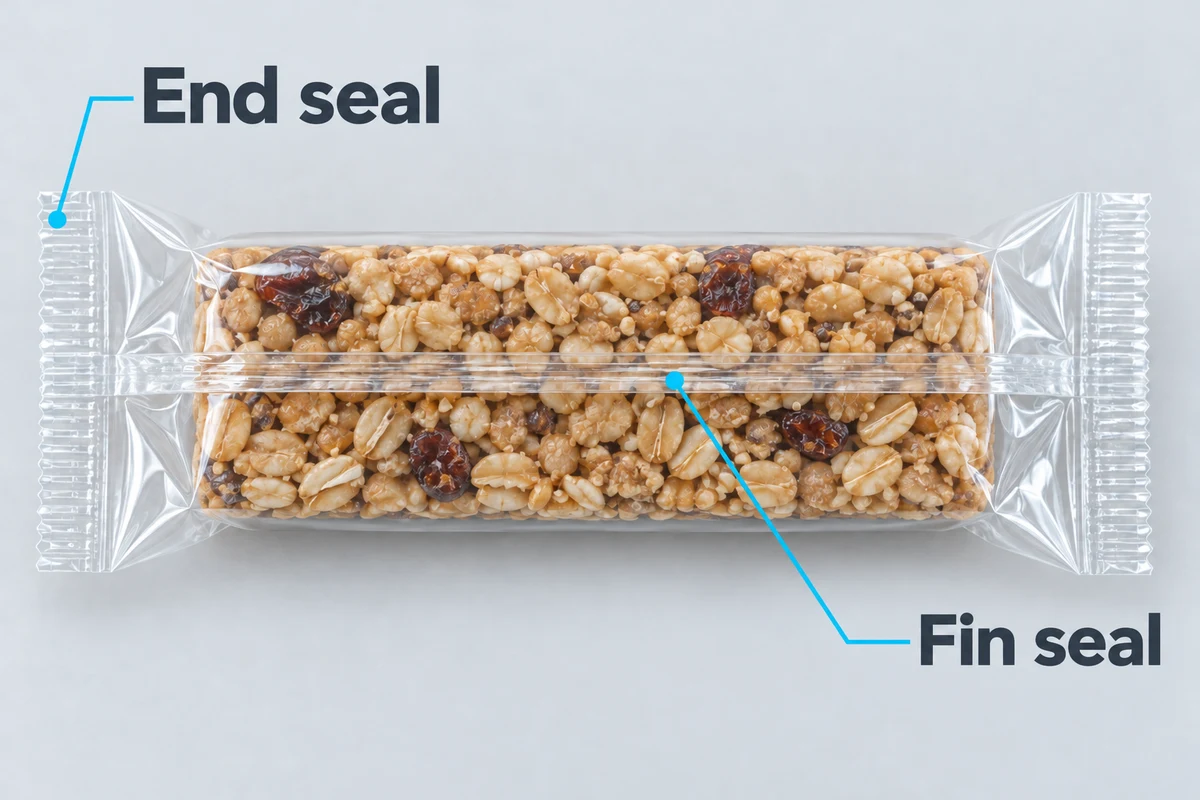
Underside of an illustrated clear pillow pack, with End seal pointing to the left transverse seal and Fin seal pointing to the seam along the pack.
Dwell is the time the sealing faces remain in contact with the film. Following the film while closed can provide a longer contact phase than a simple continuously rotating jaw pass. In heat sealing, that phase gives heat and pressure time to act on the sealing layers.
The practical question is whether the proposed jaws can give your film suitable contact at the required output. Review the laminate structure, thickness, sealing layer and the film supplier's sealing guidance together. Thicker or multilayer film warrants checking the heat-transfer requirement. Temperature, pressure and contact duration belong in the same configuration review.
| Factor | Rotary end sealing | Box-motion end sealing |
|---|---|---|
| Jaw motion | Sealing faces rotate through and away from contact. | Sealing faces close, follow the film, open and reset. |
| Contact phase | Contact during the rotating pass; actual duration to be confirmed. | Following contact can extend dwell; actual duration to be confirmed. |
| Film evidence needed | Film specification and accepted seals at the proposed settings and output. | The same evidence, including whether extra contact is needed by this film. |
| Product presentation | Clearance, orientation and a product-free end-seal gap to be confirmed. | The same checks across the following-jaw cycle; envelope to be confirmed. |
| Usable output | Good packs over an agreed run, with stops and rejects recorded; to be confirmed. | The same measurement and acceptance conditions; to be confirmed. |
Agree the seal and output checks for sample evaluation before using the result to approve a configuration.
When is each route worth investigating?
Investigate rotary end sealing when the proposed configuration can meet the film's sealing conditions and production requirement. Investigate box motion when the film needs more contact, or when a large or irregular product makes the following-jaw clearance worth examining.
| Buyer condition | Route to investigate | Evidence required | What invalidates the initial choice |
|---|---|---|---|
| Film and product appear suitable for a rotary proposal | Evaluate that rotary configuration against the required duty. | Accepted end seals, suitable product clearance and target good output on your film. | The configuration cannot meet those checks under the agreed conditions. |
| Film review indicates a need for more sealing contact | Investigate a following box-motion contact phase. | Film supplier guidance and a proposed contact/settings combination, followed by seal checks. | Extra contact fails to deliver accepted seals or the required usable output. |
| Tall, large or irregular product | Check the following-jaw envelope alongside infeed and film layout. | Dimensioned product range, orientation, spacing and clearance through the cycle. | Product cannot be presented consistently or occupies the intended seal region. |
| Unstable spacing or orientation at the wrapper | Review feeding before selecting either jaw route. | Infeed video and repeatable presentation of the representative product range. | A proposal changes jaw motion but leaves the presentation problem unresolved. |
A fragile product still needs a suitable feeding arrangement. For sweets and bars, the candy and chocolate feeding review helps identify orientation, grouping and film inputs. Use the LV-250B/D catalog reference to see a published LINEVO horizontal wrapper record; its forming, back-sealing, cutting and discharge sequence does not establish either end-jaw classification.
Send product dimensions, the film specification, your end-seal requirement and an infeed video through WhatsApp for a flow-wrapping configuration discussion. Include target good output if known. We can discuss the proposed configuration and the questions a sample evaluation would need to settle. We reply within 24 hours.
What should a comparable trial record?
Compare configurations using the same representative product, film and acceptance conditions. Record the configuration and its settings with each result, then distinguish packs formed from good packs over the agreed timed run.
| Record | What to identify | Why it matters |
|---|---|---|
| Configuration | Proposed machine, end-jaw motion, tooling and feeding scope. | Keeps the result attached to the arrangement actually evaluated. |
| Product and finished pack | Representative batch, size range, tray if used, orientation, spacing and pack geometry. | Prevents a result for one presentation being applied to a different one. |
| Film identity | Supplier specification, structure, sealing layer, thickness and production film sample. | Makes the material in the trial identifiable. |
| Sealing conditions | Contact duration or motion setting, temperature and pressure as recorded by the supplier. | Explains the conditions associated with the seal result; values remain to be confirmed. |
| Seal acceptance | Agreed visual, hand or specified leak/drop checks, and what counts as acceptable. | Keeps both proposals subject to the same pass criteria. |
| Good output, stops and rejects | Timed run, accepted packs, rejected packs and stoppage observations under those conditions. | Separates useful production from the number of packs formed. |
LINEVO's sample-testing preparation asks buyers to agree samples, shipping, the available configuration and measurements before a run. Use the packaging project brief checklist to record equipment scope, acceptance criteria and the written record, photographs or video you need. Access to both jaw arrangements for a trial must be discussed separately.
When does this comparison not settle the decision?
This comparison explains generic end-jaw motion and its heat-sealing contact opportunity. A different sealing method, a modified trajectory or an application-specific pack requirement needs evidence for that exact configuration.
- Cold-seal and other sealing methods need their own material and tooling review; do not apply the heat-transfer explanation as a compatibility approval.
- Modified rotary or following-jaw designs need their actual motion and contact information. The generic categories cannot supply a dwell range or product-clearance envelope.
- Longer dwell alone does not establish seal integrity. Modified-atmosphere, hermetic or sterile-pack requirements need separate configuration and acceptance evidence; longer contact proves no shelf-life extension.
- Fragile products require a review of feeding, support and positioning. Following jaws seal the film between products; their motion is not a product-handling guarantee.
- No category-wide cost, footprint, maintenance or speed advantage is established here. Compare the scoped proposals rather than borrowing manufacturer marketing claims.
- The inspected LINEVO catalog does not verify box-motion availability, tooling or a comparative trial. A generic mechanism description cannot establish a LINEVO supply commitment.
Questions about film and line integration
Can box motion machines handle thicker or sustainable films?
A sustainability label supplies no sealing specification. Send the actual film's structure, thickness, sealing layer and supplier guidance; use these to assess whether extra contact is needed and check the proposed pairing with representative samples.
Can these machines be integrated into a complete packaging line?
An end-jaw label cannot establish line compatibility. Identify how products arrive, their spacing and orientation, and where finished packs go next; include those interfaces in the equipment scope using the packaging project brief checklist. Any proposed connection and its output conditions need to be stated for that configuration.
What to send us
Product dimensions, the film specification, your end-seal requirement and an infeed video make the configuration discussion concrete. Add target good output if known, and mark undecided items as open.
| Item | Why we need it | Example format |
|---|---|---|
| Product dimensions and finished pack | Review the size range, orientation, clearance and intended seal region. | Dimensioned photos or PDF of smallest/largest items or trays, with a pack drawing or sample. |
| Film specification | Review the structure and sealing layer against the proposed sealing conditions. | Supplier datasheet listing structure, thickness and sealing guidance; representative roll-film sample when agreed. |
| End-seal requirement | Define the seal the configuration must make and how you will judge it. | Annotated finished-pack photo and your required acceptance check, or mark the method as undecided. |
| Infeed video | Review product arrival, orientation, spacing and transfer to the wrapper. | Short video of the current product flow, with grouping and manual handling visible. |
| Target good output | State the production duty to evaluate alongside seal acceptance. | Your required accepted packs per minute or shift, operating pattern and expected format changes. |
Send these inputs through WhatsApp to discuss your flow-wrapping requirements. We use the brief to discuss a proposed configuration, identify missing information and decide whether sample evaluation is needed. Samples and test conditions are agreed before shipping. We reply within 24 hours.
Method and sources
Reviewed 10 October 2026. The motion explanation uses archived original manufacturer process descriptions: a May 2024 rotary-versus-box-motion comparison and August 2026 descriptions of sealing contact and following-jaw motion. These technical sources share one publisher and are descriptive manufacturer material, rather than independent comparative tests. Exact source URLs, versions and passages are retained in the editorial evidence record.
LINEVO scope and enquiry practice come from the published flow-wrapper family, the LV-250B/D record, the project brief checklist and sample-testing page. The selection and trial tables are review prompts built from those descriptions; they contain no completed LINEVO trial, comparative performance result or proof of box-motion supply. Project-specific settings and output remain to be confirmed.
We reply within 24 hours.
Discuss your flow-wrapping requirements