
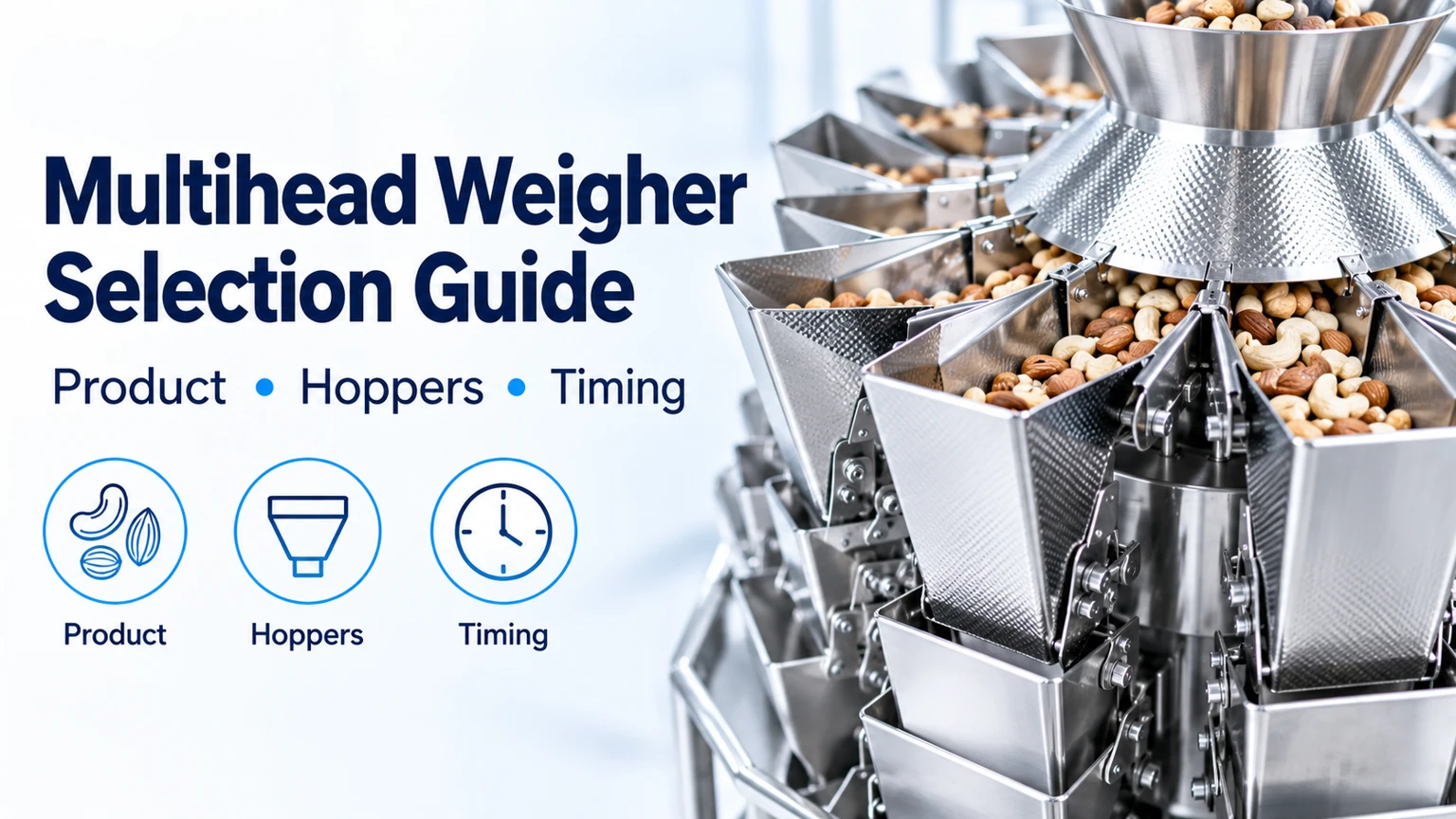
A multihead weigher combines portions from several independently weighed hoppers to make a target dose. For a VFFS line, select the product-contact and transfer arrangement before choosing between 10 and 14 heads. More available heads provide more possible combinations, but the complete portion still has to leave the hoppers, pass through the chute and clear the sealing area. Compare both proposals using the same product, bag weight, tolerance, film and good-bag output requirement. The selection tables below identify what to measure and what to put in the quotation.
| Input | Typical value or condition | Why it matters |
|---|---|---|
| Piece size and mass | Buyer samples: usual pieces, largest pieces and fines. | Defines feeding, hopper loading and transfer-clearance questions. |
| Dose and tolerance | Target grams per bag and your acceptance criteria. | Defines the combination task and how results will be judged. |
| Oil, tack and fragility | Actual product at its packing temperature and condition. | Changes surface, feeding, drop and cleaning requirements. |
| Good output | Accepted bags per minute or shift; observation period stated. | Keeps standalone weighing cycles separate from saleable bags. |
| Bag, film and transfer | Finished bag drawing, film and available filling window. | Connects dose release to forming-tube and seal clearance. |
| Cleaning and site | Cleaning method, change frequency, headroom and utilities. | Defines access, platform, contact-parts and installation scope. |
On this page
How does a multihead weigher work?
The controller chooses a group of measured portions whose combined mass meets the target. Product feeds across distribution channels into holding hoppers, then into weigh hoppers. Each weigh hopper measures its own portion. The controller evaluates available combinations, releases the selected hoppers into a collection chute and refills those hoppers for a later selection. Hoppers that were not selected can retain their portions for another cycle.
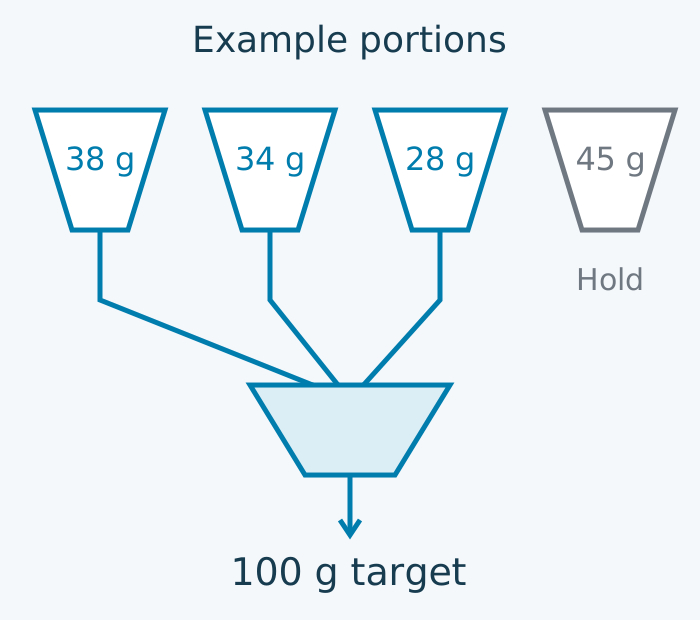
Worked example with assumed inputs: for a 100 g target, portions of 38 g, 34 g and 28 g give 38 + 34 + 28 = 100 g; an available 45 g portion need not be released in that selection. This explains the combination principle. Actual combinations depend on the measured portions, controller settings and acceptance limits; an exact sum is not available on every cycle.
Combination weighing controls total mass. A target total for mixed nuts does not by itself establish the proportion of each ingredient. If the pack needs a controlled recipe ratio or a guaranteed piece count, make that a separate requirement and request evidence for that mode.
Should you choose 10 heads or 14 heads?
Shortlist the head count that meets your dose, accepted output and handling criteria on representative product. A 14-head arrangement offers more potential combinations than a 10-head arrangement when the hoppers are available, but neither count supplies a universal speed or accuracy. Starved, sticky or slow-emptying heads reduce the choices the controller can actually use.
| Decision factor | 10-head candidate | 14-head candidate | Dominant Failure Mode & Prevention |
|---|---|---|---|
| Combination availability | Candidate when the available portions meet the agreed fill and output criteria. | Evaluate when additional available portions may help with variable piece masses or dose changes. | Unavailable heads reduce useful combinations; check feed balance and emptying before adding heads. |
| Line output | Record complete portions delivered and accepted bags over the same timed run. | Use the same run conditions; confirm that the bagger and transfer can accept the extra releases. | A faster scale can still wait for a slow bagger; verify the complete line bottleneck. |
| Product and hopper volume | Confirm the required volume per portion and the actual hopper geometry. | Confirm these separately; head count does not define hopper size. | Bulky or long pieces can bridge; assess the largest pieces and full transfer path. |
| Cleaning and ownership | Count removable contact parts and time the agreed cleaning/changeover method. | Compare the additional parts, access and maintenance scope over the same schedule. | Residue or difficult access extends stops; verify removal, cleaning and reassembly with the proposed design. |
Selection rule: if measured portion-delivery time exceeds the bagger's available filling window, resolve feeding, discharge or transfer before approving that combination. If a 10-head candidate meets all agreed criteria and a 14-head candidate adds no useful output or loss reduction, compare their cleaning and ownership costs before paying for extra heads. There is no defensible universal bags-per-minute crossover without the product and bag conditions.
What changes for fragile, oily or sticky products?
Choose surfaces and the feed path from how the actual product moves and releases. Dry, free-flowing pieces and tacky gummies can behave very differently on the same hopper. Include warm product, coating variation and fines in the sample brief when those occur in production.
- Fragile chips or puffed snacks: inspect damage after the feeder, hopper discharge and final drop separately. Review feed intensity, drop height and transfer geometry against your acceptable damage limit.
- Oily nuts or coffee beans: observe residue build-up and delayed release during a representative run. A clean start alone does not establish behavior later in the shift.
- Sticky dates or gummies: compare product retention on the proposed contact finish and check the feeder, hopper corners and chute. The catalog lists textured and optional coated arrangements for review; confirm the actual finish, contact suitability and cleaning instructions in the offer.
- If product cannot advance or empty consistently, a surface change may be insufficient. Request a different handling assessment rather than assuming more vibration or more heads will solve it.
Use the sample-testing preparation page to agree representative material, handling conditions and the observations needed. A surface described as non-stick is a selection item to verify, not a promise that all products will release without residue.
How should the weigher synchronize with a VFFS machine?
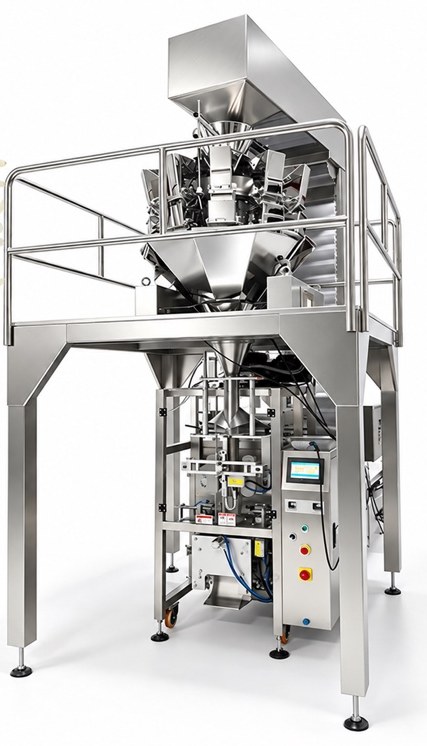
Agree when the bagger can receive product, when the weigher may release it and how both units handle a stop. A complete system includes the feeder, support platform, collection chute and bagger as well as the scale. The VFFS family overview explains the forming and sealing stations that the dose must reach at the correct point in the cycle.
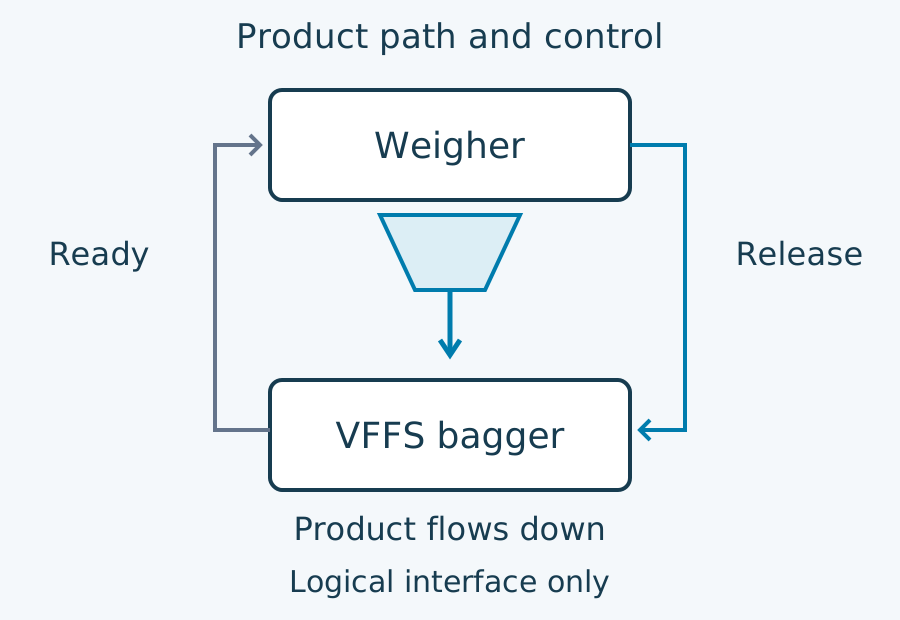
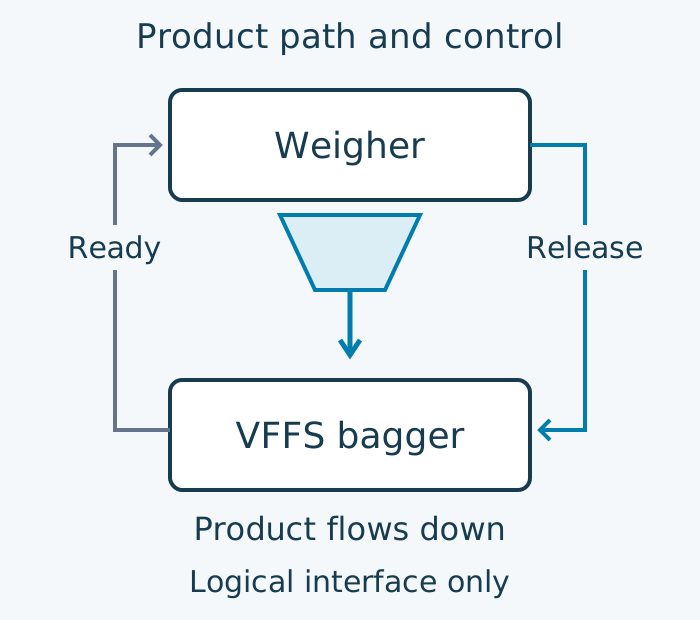
Ask the integrator to document the bagger-ready condition, permission to discharge, confirmation or handling of a missed dose, and what happens to a portion already in transit during a stop. Agree restart checks so a retained portion cannot become an unintended double fill. These are interface requirements; the actual protocol and sequence depend on the supplied controls.
For one bag per cycle, cycle time in seconds = 60 ÷ nominal bags per minute. Worked example with assumed inputs: 60 bags/min gives 60 ÷ 60 = 1.0 s per cycle. The available filling window is only part of that cycle because forming, product clearance and sealing also take time. Ask whether the bagger is intermittent or continuous-motion VFFS: the film either pauses or keeps moving during the cross-seal. Measure release-to-arrival time and its variation; do not use the full 1.0 s as a discharge setting.
For a shared observation period, good output = bags produced × accepted fraction ÷ elapsed minutes. Assumed example: 1,000 bags produced × 0.98 accepted ÷ 20 min = 49 good bags/min. Include stops in that elapsed period if comparing shift productivity. Ask downstream inspection and cartoning suppliers to use the same accepted-output basis and define buffering and stop handoffs.
Where should you look when weights or bag quality drift?
Locate the symptom before changing settings. Record the product batch, dose, bag, run time, affected head and recent cleaning or format changes. Use the machine's approved procedures for intervention; the table below identifies evidence to collect for support.
| Symptom | Location to review | Evidence and prevention question |
|---|---|---|
| Bagger waits for portions | Upstream supply, distribution and hopper refill. | Record whether heads are empty, waiting to weigh or retaining product. Confirm feed balance and the required delivery rate. |
| Late product or pieces in the seal | Discharge gates, chute, forming tube and release interface. | Compare release and arrival records with the filling window. Check residue and the largest pieces; agree clearance and stop handling. |
| Weight shifts after a product or cleaning change | Contact parts, retained product and weighing setup. | Record the before/after condition and fill measurements. Ask for the applicable zero/check procedure and inspect for residue using the manual. |
| More broken pieces in finished bags | Feed channels and successive drops. | Compare samples at successive transfer points. Review the handling path against the agreed damage criterion. |
| Correct total weight, wrong blend | Product preparation and ingredient-specific dosing requirement. | Verify whether the quoted system controls total mass only or individual ingredient proportions; inspect the feed mix. |
For parts or recurring faults, include machine identification, photographs and the relevant contact-part information from the spare-parts preparation guide. A general symptom list cannot identify a replacement part or justify an unsupported calibration change.
Which LINEVO catalog configurations should you compare?
Start with the product and package route below, then confirm the actual scale, finish, transfer and bagger scope. These are existing catalog configurations, not ten newly rated weigher models. Exact numerical specifications are on request unless the linked record explicitly publishes a value and its conditions.
- VFFS system with multihead weighing: starting point for the complete nuts and dried-fruit bagging arrangement.
- Quad-seal coffee bean configuration: compare the bag format and product-contact finish.
- Coffee bean VFFS configuration: review oil and release behavior for the intended roast.
- Dates configuration: review the textured or coated contact arrangement and retention.
- Gummy configuration: define tack, temperature and cleaning conditions.
- Pet food VFFS configuration: confirm the 10-/14-head integration choice, pellet size and dust handling. The pet food packaging machines guide compares bag and pouch routes for kibble and treats.
- Puffed snack configuration: review low-density volume and breakage through the transfer.
- Whole and mixed nut configuration: distinguish total fill mass from any ingredient-ratio requirement.
- Frozen vegetable configuration: define product temperature, condensation and clumping conditions.
- Pet food pouch configuration: first confirm whether finished premade pouches or bags made from roll film are required.
What determines price and operating cost?
Compare quotation scope before comparing multihead weigher price. Head count, hopper volume, contact finish, feeder, platform and access, transfer chute, bagger interface, cleaning design and inspection equipment all need named inclusion or exclusion. A standalone scale price cannot represent an installed packing line.
Use one period and the same accepted production requirement for ownership comparisons. Track product giveaway in accepted packs, product and film discarded in rejects, cleaning/changeover labor, stopped production, energy and maintenance. Keep rejected product separate from accepted-pack giveaway so the same material is not counted twice.
Worked example with assumed inputs for one shift: 12,000 bags produced at a 2% reject fraction give 12,000 × 0.02 = 240 rejected packs and 11,760 accepted bags. If the accepted bags average 1.5 g above target, giveaway is 11,760 × 1.5 ÷ 1,000 = 17.64 kg of extra product. Two cleaning stops of 20 min each consume 2 × 20 = 40 min. Use your actual accepted and produced counts, rejection losses and cleaning records in the comparison.
Same-period ownership cost = allocated equipment cost + product losses + discarded packaging + cleaning and operating labor + energy + maintenance. Apply your actual unit costs. Add stopped-capacity cost only when it represents a real unrecovered loss and does not duplicate labor or production costs already counted. A higher head count earns its extra cost only if the agreed trial and production assumptions support a useful reduction in those losses or extra accepted output.
What should the sample trial and source review establish?
Agree the target fill, measurement method, allowed variation, accepted output, product damage and cleaning requirements before comparing configurations. Ask for the product condition, hopper count and volume, contact finish, feed arrangement, bag, film and observation period to stay with the results. Use the sample-testing service to agree the observations and record format before shipping material.
OIML R 61-1:2017, section 2 addresses metrological and technical requirements for automatic gravimetric filling instruments that produce predetermined fills from one or more loads. It provides a relevant instrument category for the measurement discussion. It does not establish that a particular LINEVO configuration has approval, or supply a universal acceptance tolerance for your product and destination.
Method and sources, reviewed 20 October 2026: combination-weighing and difficult-product handling explanations were checked against primary manufacturer technical material; the selection discussion also considers the guide What to look for when choosing a multihead weigher for your production line, covering materials, cleaning and process interfaces. Equipment identities and contact-finish options were checked against the original authorized catalog archive and the linked public LINEVO records. These establish configuration questions, not interchangeable performance ratings. All worked numbers are explicitly assumed inputs. The OIML reference is used only within its stated scope.
Send particle dimensions or representative photos, target grams and tolerance, oil/tack/fragility, required good output, bag and film details, cleaning conditions and the current line interface. Use WhatsApp to discuss the configuration; the team can review the inputs and agree whether sample testing is needed.
What to send us
Send what you have and mark what is still undecided. Discuss your application with LINEVO.
| Item | Why we need it | Example format |
|---|---|---|
| Product, particles and condition | Defines feeding, retention, volume and damage questions. | Piece dimensions/photos, bulk density if known, oil/tack, packing temperature and fragile variants. |
| Bag weight and acceptance criteria | Defines the combination task and how fill results are judged. | Target grams, your tolerance, ingredient-ratio or piece-count requirement if applicable. |
| Target good output and schedule | Allows a common basis for head-count and loss comparisons. | Accepted bags/min or shift, shifts, SKU changes and existing run records. |
| Bag, film and transfer interface | Matches the dose to forming, product clearance and sealing. | Bag drawing, film specification, current bagger, filling window if known, stop behavior. |
| Cleaning, site and quote scope | Defines contact finish, access, platform and connected equipment. | Cleaning method/frequency, headroom, utilities, feeder and downstream equipment list. |