
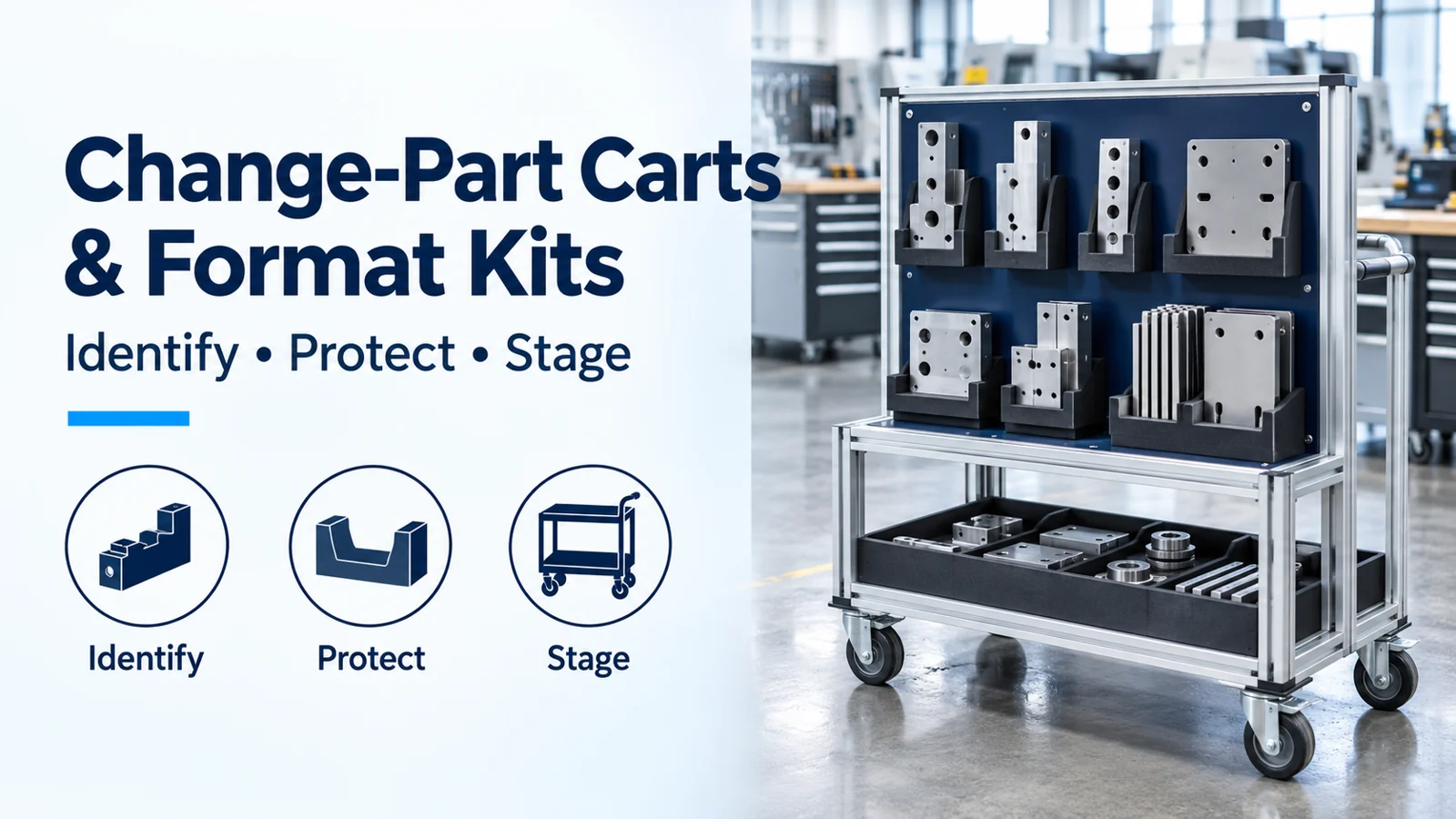
A format kit is the agreed set of removable parts for a particular machine and packaging format. The cart stores and moves that set; a shadow board assigns visible locations to its components. For procurement, compare the part-to-format mapping, loaded storage arrangement and witnessed changeover sequence before comparing cart prices. This guide provides the questions and acceptance records to put into the purchase specification.
- Identify the machine and every format, including parts shared between kits.
- Match each part to its storage position and controlled setup reference.
- Check protection, retention, cleaning access and the loaded travel route.
- Demonstrate preparation, exchange and return accounting with representative formats.
On this page
Start with a format-to-part matrix
List what changes for each format before specifying a cart. On a cartoner, some components are exchanged, some remain installed and are adjusted, and others are shared across jobs. The machine’s format list should identify each category so the cart layout reflects the actual kit.
For a new line, establish covered carton sizes, product arrangements and adjustment scope with the cartoning machine proposal. For product examples, see the blister and bottle cartoners on our pharmaceutical packaging machines page and the lipstick and sheet-mask cartoners on our cosmetic and personal care packaging page. For existing packaging machinery change parts, follow the spare-parts identification checklist: collect machine identity, part markings, available revisions, dimensions and photographs. Similar-looking parts need that same identity check. For a LINEVO cartoning project, the proposal defines the carton formats, change parts and adjustment scope.
| Record | Information to request | Decision it supports |
|---|---|---|
| Machine and format | Machine model, serial number, revision where available, job identity and carton drawing. | Keeps the kit tied to the intended machine and finished pack. |
| Physical part | Part identifier, drawing revision, quantity, station and orientation where relevant. | Distinguishes similar parts and identifies the installed position. |
| Storage position | Named holder or board position, part dimensions, mass and permitted support surfaces. | Defines fit, support, retention and the proposed loading arrangement. |
| Setup reference | Controlled setup sheet or recipe reference, named adjustment points and their settings. | Connects the removable kit with adjustments still required on the machine. |
| Shared tooling | Formats that use the same physical component, its location and reservation rule. | Prevents two kits being marked ready while relying on one shared part. |
| Condition and state | Stored, staged, in use, returned for cleaning or held for inspection. | Makes completeness and readiness checks meaningful. |
Keep the parts list and setup record under the same revision process. R.A Jones describes cartoner changeovers using removable tooling alongside manual adjustments, counters and format-specific calibration sheets. A machine with stored settings can still require physical change parts; where there is no recipe system, identify the controlled setup sheet instead.
Shadow-board poka-yoke: define what the board must reveal
Use readable part identifiers and assigned silhouettes to make kit checks quick. Pair color with text and shape so the identification remains usable when colors look similar or a tag is dirty. The buyer should be able to match a part, its holder and the format register without relying on memory.
Poka-yoke means error-proofing. The Lean Enterprise Institute’s examples include physical shapes that prevent reverse installation and systems that detect omitted parts. A shadow board helps reveal an empty storage position; physically excluding a similar wrong part requires a holder or mounting feature designed and checked for that task. Treat those as separate acceptance requirements.
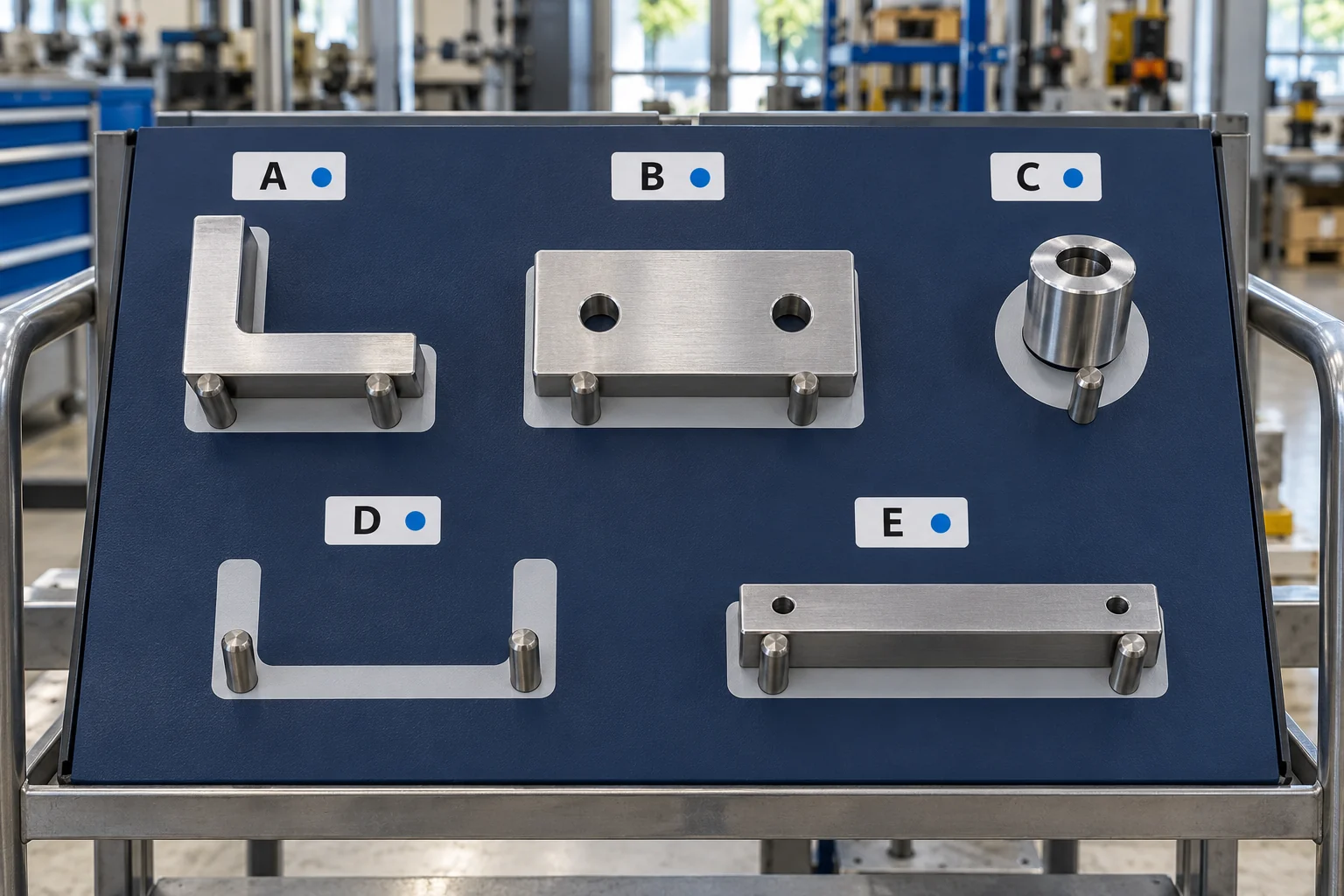
A full board may mean a complete stored kit. During production, empty positions may be correct because their parts are installed. Record the kit state at handover, and account for shared parts separately. A returned kit with an unexplained empty position should be reconciled before it is marked ready for the next job.
Toolless identification and tool-free changeover are different requirements
Ask whether labels can be read with the parts stored and whether removable identity plaques can be changed without tools. Then ask separately which machine fasteners and adjustments are tool-free, which tools remain necessary and how the final setting is checked. Zepf’s cart options include engraved profiles and removable plaques; those identification features do not establish the mounting method on your machine.
Specify durable storage around the part and the route
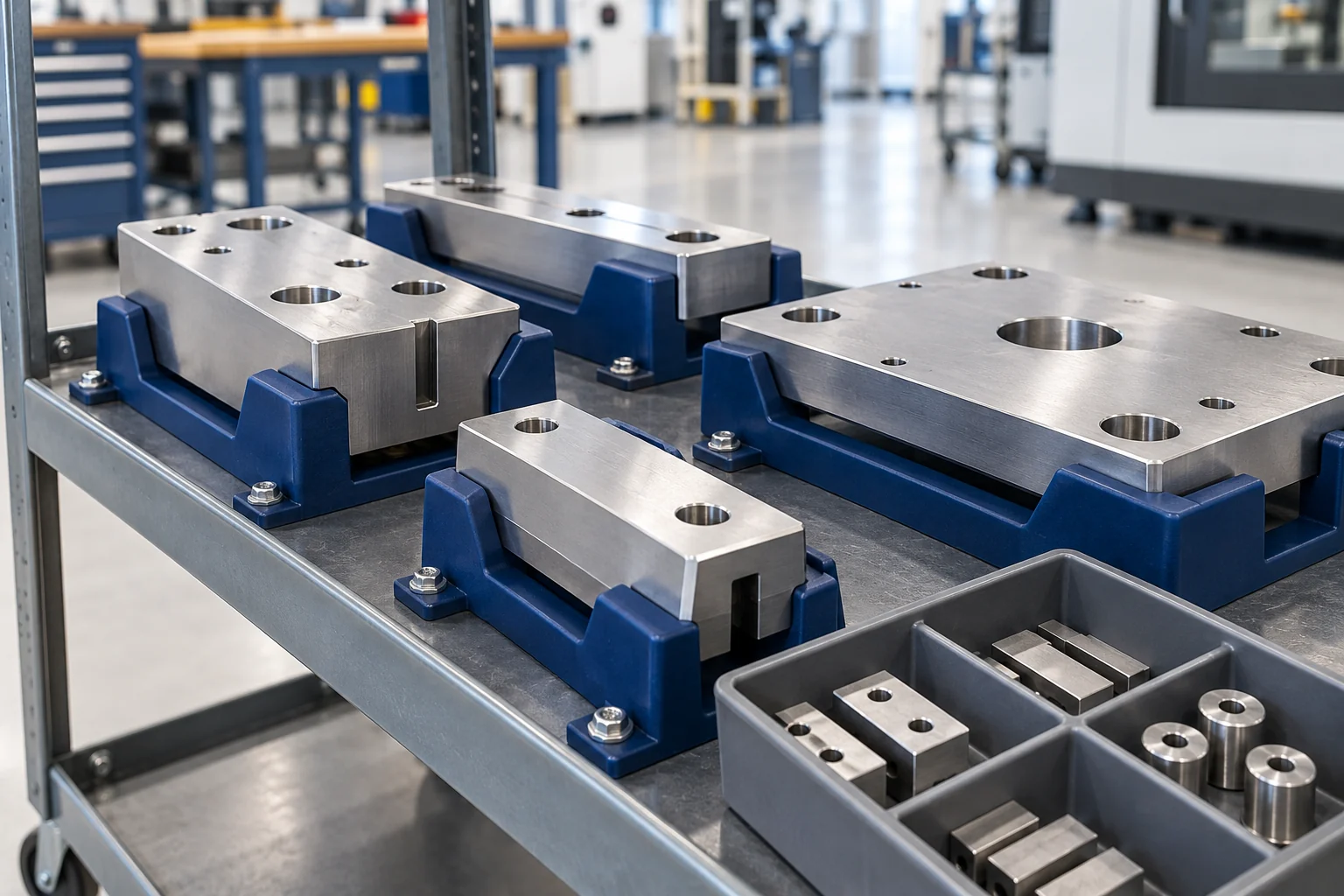
Durable storage for packaging line change parts starts at the contact points. A rigid cart can still damage a part if a holder bears against a sensitive mating face or allows adjacent parts to strike each other. Define permitted support surfaces, separation and retention for the actual component inventory.
| Arrangement | Useful when | Purchase check |
|---|---|---|
| Shelves with divided trays | Parts have stable support surfaces and can be separated in assigned compartments. | Demonstrate retention during movement and readable identity without stacking parts. |
| Adjustable holders | The storage layout must accommodate future tooling changes. | Show how holder positions are fixed, documented and updated when a kit changes. |
| Fitted holders and shadow board | Repeatable locations and rapid visual accounting matter for a defined kit. | Try each part in its location; price replacement inserts and revisions for new formats. |
Compare the total loaded envelope, individual holder loads, stated cart load limits, handles, casters and brakes. Include the actual floor, thresholds, turns, parking area and operator reach. CCOHS handcart guidance explains why moving effort depends on the task and environment as well as the load. A payload rating alone cannot establish that the cart will be practical to move on your route.
State the intended cleaning method and chemicals before selecting frame, board, inserts, labels, casters or covers. Check drainage, access around holders and drying of stored parts. If cleaning on the cart is requested, have the supplier address the complete assembly and the components it carries. Include replacement labels, holders and casters in the maintenance discussion. Septimatech’s storage selection guide identifies fit, protection, mobility and cleaning access as selection considerations.
Use SMED staging to prepare the next kit before the stop
Separate preparation from work that requires the machine to stop. The SMED method distinguishes external setup from internal setup. Where the equipment procedure permits, identifying, checking and positioning the next kit can be organized before the changeover window.
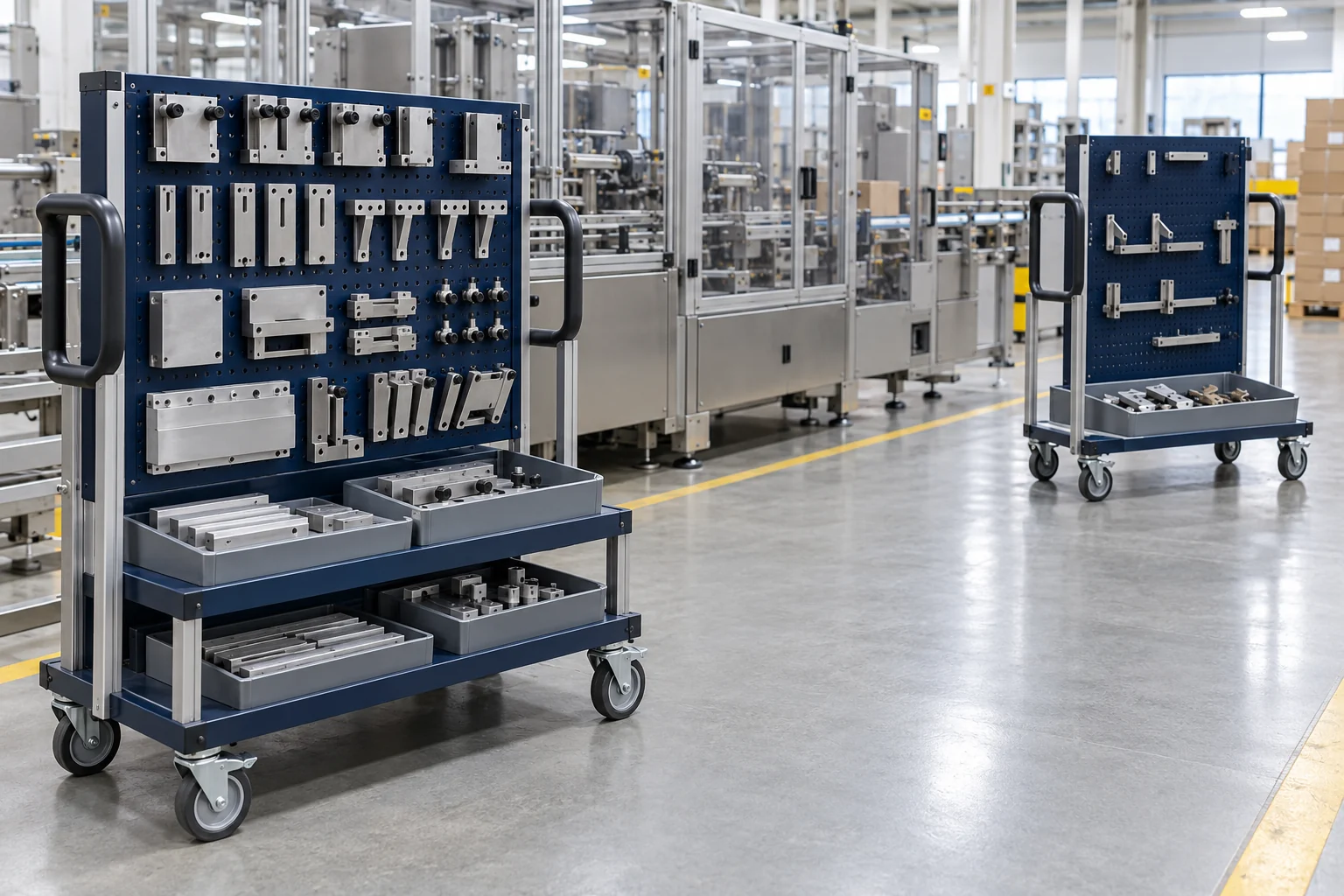
- Before the planned stop: confirm the next format, account for required and shared parts, review condition, and prepare the setup reference.
- During the permitted exchange: follow the installed machine’s procedure and keep outgoing components separate from the incoming kit.
- Before production release: complete the required setup checks and assess the first acceptable output against the agreed criteria.
- After handover: reconcile returned parts, record cleaning or inspection needs, and update kit availability.
Define the timing boundary before setting a changeover target: format pair, staffing, line condition, cleaning scope, start point, first acceptable output and any restart stabilization period. Record searching, transport, stopped-machine work and restart losses separately. Douglas explains the distinction between part exchange and the wider changeover. A cart can improve retrieval and staging, while the complete result also depends on adjustments, cleaning and production restart.
For change part carts for packaging lines, plan storage across the line’s machines as well as across formats. A component shared between two jobs needs a reservation and return rule. Decide the cart quantity from simultaneous kit demand, cleaning turnaround and parking space instead of automatically assigning one cart to every product.
Put a witnessed acceptance checklist into the order
Agree what the supplier will demonstrate with your representative parts and formats. Attach the parts register, layout and acceptance record to the purchase scope so a generic cart photograph cannot stand in for a verified fit.
| Check | Demonstration and record | Resolve before acceptance |
|---|---|---|
| Identity and completeness | Reconcile received part identifiers, revisions and quantities against the agreed kit list. | Unreadable, duplicate or unmatched identifiers; missing items without an agreed disposition. |
| Fit and protection | Place each part in its assigned holder without force; inspect support, separation and retention. | Contact on restricted faces, interference, unsecured parts or inaccessible small items. |
| Recognition | Off-line, present an omitted part and similar candidate parts; demonstrate how the operator detects the mismatch. | A wrong or incomplete kit is marked ready using the proposed check. |
| Loaded movement | Review the supplier’s load envelope and demonstrate the intended loading and travel route under the agreed site assessment. | Movement, braking, stability, clearance or reach issues against the agreed requirements. |
| Cleaning and upkeep | Review cleaning instructions, drainage, label readability and access to replace holders or casters. | Unresolved cleaning compatibility or inaccessible areas required by the agreed cleaning method. |
| Format handover | Demonstrate staging, part transfer, setup-reference checks and return accounting for the selected formats. | Unaccounted shared parts, conflicting revisions or a kit-state handover that leaves availability unclear. |
Keep omitted-part and wrong-part recognition exercises off-line or within an equipment-maker-approved test procedure. Use the installed machine’s instructions for the actual exchange and restart. Record open items with an owner and agreed closure evidence; a visually tidy board is only one part of the acceptance record.
Compare quotation scope beyond the frame
Ask each bidder to mark the frame, boards, holders, labels, kit register, layout drawings, covers, replacement items, additional-format modifications, delivery and any installation or training as included, optional or excluded. Compare totals after aligning those rows. Future format additions can change holder geometry and board layout, so include the update process and its pricing basis in the proposal.
What to send us
Send what you have and mark what is still undecided. Discuss your application with LINEVO.
| Item | Why we need it | Example format |
|---|---|---|
| Machine and format-parts list | Connect the requested changeover to the machine and each kit. | Machine identity, format drawings, part IDs, revisions, quantities and photos. |
| Each part’s mass and support needs | Define the information needed to review storage and movement. | Mass and dimensions for each item, sensitive faces and cleaning conditions. |
| Target changeover time | Review the preparation and stopped-machine work against the same boundary. | Format pair, staffing, cleaning scope and the agreed start/end points. |
| Shared tooling and route | Review kit availability and practical staging space. | Parts shared across jobs, storage locations, route photos and clearances. |