

On this page
What the hookah bottle filling line does
The line takes empty bottles through to filled, capped and labeled ones. A bottle unscrambler sorts the empty bottles and feeds them to the indexing belt, the indexing conveyor carries them to the auger filler, which fills each bottle to a preset value, and a screw capping machine turns the cap on. A labeling machine labels the bottle. The layout drawing also shows aluminum foil sealing and a sorting table for finished bottles; both are confirmed for your bottle in the quotation.
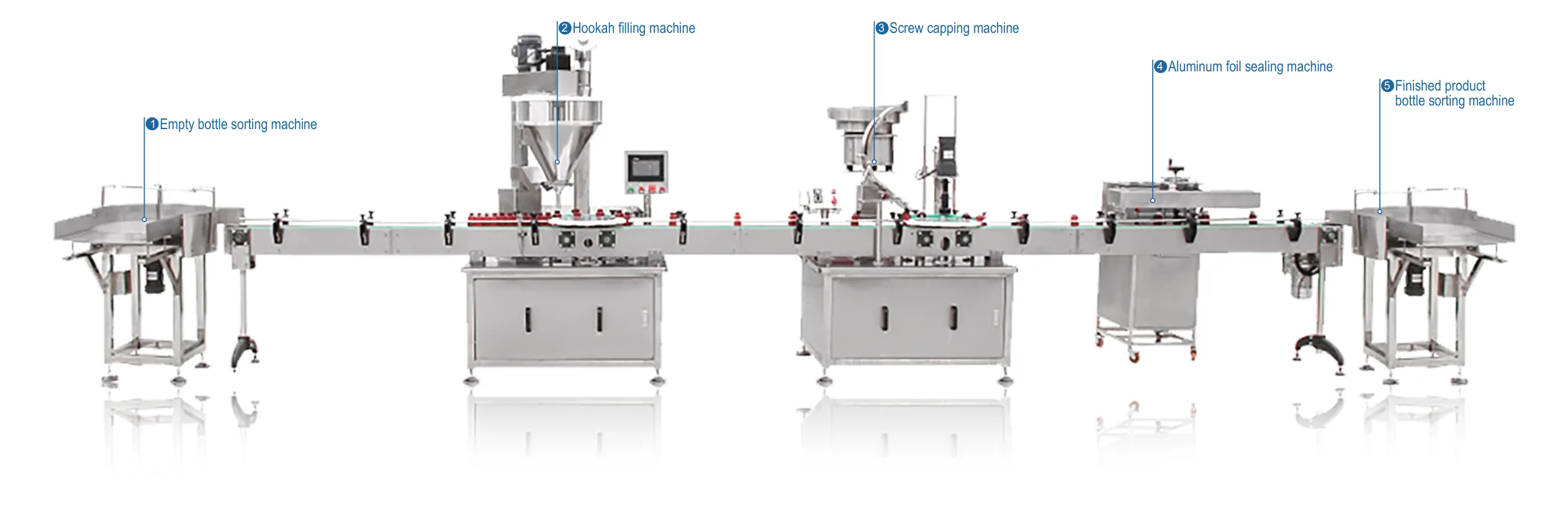
- 1. Empty bottle sorting machine
- 2. Hookah filling machine
- 3. Screw capping machine
- 4. Aluminum foil sealing machine
- 5. Finished bottle sorting machine
Matching the filler, capper and labeler to your bottle
The filler, the capper and the labeler are each set for one bottle. Send the bottle, the cap, the foil if you use one, the label and the fill weight. The auger filler is matched to your shisha tobacco or paste and the fill weight; the capper to the cap; the labeler to the label size and position.
How auger filling works, and what a filler quotation leaves to other stations, is on our filling machines page; label placement on bottles is covered on our labeling machines page.
Bottles or pouches?
Shisha sold in bottles needs this line; shisha sold in pouches goes on a pouch packer. For pouches of 20–100 g there is the vertical LV-320SY, for 100–500 g the horizontal LV-350SY. The hookah application page sets out every route by pack weight and finished unit.
How fast the line runs
No line speed is listed. The rate depends on the fill weight, the bottle and the cap, and the line runs at the pace of its slowest station. The quotation states the bottles per minute for your bottle and which station sets it.
What to send for a hookah bottle line quotation
These details let us match each station to your bottle and state the line rate.
- The material: loose shisha tobacco or paste, with a sample if you can send one
- Fill weight per bottle
- Sample bottles, caps and foil, or their drawings
- Label size and position on the bottle
- Target bottles per minute or per shift
- Room plan, and the voltage, phase and frequency at the line
Applications and materials
Products and industries listed in the source catalog for this configuration. Suitability for your product is confirmed with a sample or product review.
- Shisha tobacco
- Arab shisha tobacco paste
- Turkish shisha tobacco paste
- Other materials of the same kind, confirmed with a sample
Configuration and scope
Catalog reference: hookah-manual-2026. Confirm the quoted configuration and all project-specific options before placing an order.
Listed included equipment
- Bottle unscrambler that feeds empty bottles to the indexing belt
- Indexing conveyor to the filling station
- Auger filler that fills each bottle to a preset value
- Screw capping machine
- Labeling machine
Requirements to review — not confirmed as included
- Aluminum foil sealing and finished-bottle sorting, shown in the layout
Working process
Machine sequence as described in the source catalog. Stations and order can change with the quoted options.
- Step 1 — Bottle unscrambler: sorts the empty bottles and feeds them to the indexing belt.
- Step 2 — Indexing conveyor: carries the empty bottles to the filler.
- Step 3 — Auger filler: fills each bottle to the preset value.
- Step 4 — Screw capping machine: turns the cap onto the bottle.
- Step 5 — Aluminum foil sealing machine: seals the foil under the cap.
- Step 6 — Labeling machine: labels the bottle.
- Step 7 — Finished-bottle sorting: collects the finished bottles.
Specifications and conditions
No reviewed technical ratings are published for this configuration. Output, pack-size range, machine dimensions and utilities depend on your product and format, and LINEVO confirms them in the quotation.
To get figures for your project, send the product details listed under “Review your application” below.
How this fits the Filling Machines process
Filling and sealing machines dose liquids, pastes or powders into cups, cavities or containers and close them. The container, dosing method and sealing method define the scope of a configuration.
This page is one of the catalog configurations in the Filling Machines family. Compare it with the other configurations when your product or pack format differs.
This configuration is also listed on a page that compares the options for the same kind of product or machine.
Questions buyers ask about this configuration
Short answers to what buyers ask most often when they review a configuration.
How do I get output and dimensions for my product?
No reviewed technical ratings are published for this configuration. Output, pack-size range, machine dimensions and utilities depend on your product and format, and LINEVO confirms them in the quotation.
Can I test my product before ordering?
A representative sample test helps resolve material-specific questions before quotation. Please do not ship physical samples until the team has confirmed the quantity needed and where to send them.
Is this the configuration I would receive?
The page identifies a catalog reference configuration. The model, included and optional equipment, formats and performance conditions for your project are confirmed in the quotation and agreement.
What defines the scope of a Filling Machines configuration?
Filling and sealing machines dose liquids, pastes or powders into cups, cavities or containers and close them. The container, dosing method and sealing method define the scope of a configuration.
Supporting information
Product information, listed applications and features, and original images are shared with Dession, another brand within the same company. The catalog source below identifies the reference configuration.
Applications, features and any figures on this page are listed as the source catalog states them, with the conditions shown beside them. They are items to confirm in your quotation, not certifications or guarantees. Project-specific performance and scope are confirmed only in your quotation.
Review your application
Send the following to discuss this configuration. A representative sample test helps resolve material-specific questions before quotation.
- Product name and form (powder, granule, liquid, paste or solid pieces), with a sample or photos
- Target fill weight or volume, or the item count per pack
- Pack type and dimensions, and the packaging material you use
- Target output per minute or per shift
- Site utilities: voltage, phase and frequency, and compressed air
- Any upstream or downstream equipment the machine must connect to
What to send us
Send what you have and mark what is still undecided. We reply within 24 hours.
| Item | Why we need it | Example format |
|---|---|---|
| Product and its behavior | Powder, granule, liquid, paste or solid pieces decide the dosing method and the parts that touch the product. | Free-flowing granules, with a photo of the product |
| Finished pack and fill | The pack style, its size and the fill per pack set the format and the dosing range. | Pillow bag, 100 × 150 mm, 50 g per bag |
| Target output | Output per minute or per shift decides the number of lanes and the model size. | 60 good packs per minute, one shift per day |
| Packaging material | Film or container type affects sealing, forming and the settings we confirm. | Laminated roll film, 250 mm wide, or the film datasheet |
| Site and destination | Power supply, compressed air and destination country decide the electrical and utility scope. | 380 V, 3-phase, 50 Hz, delivery to Germany |