
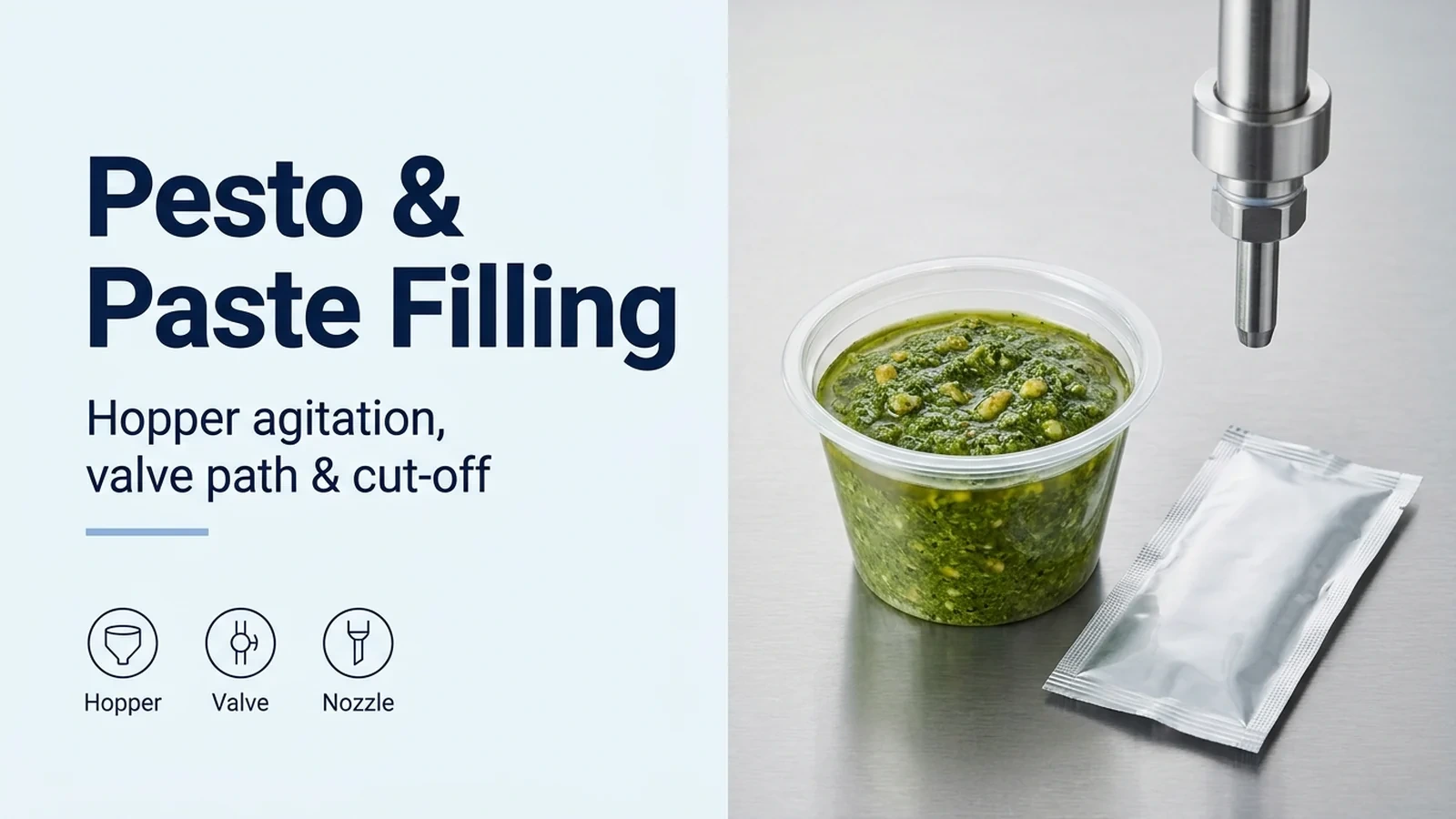
Ideal basil pesto has a smooth but slightly granular consistency produced by interaction among basil particles, nuts, cheese, and the oil phase, while oil separation during storage is a defect that may negatively affect product appearance and acceptability.
A piston filler utilizes a volumetric fill principle by pulling product into the cylinder from a bulk supply during piston retraction and pushing it out through fill heads into waiting containers on the return stroke.
When specifying a pesto filling machine or oil suspension paste filling machine, evaluate the supply hopper, the rotary-valve piston path for particulate sauce, and the nozzle shut-off together. Start with the route table below, then gather the product and pack details for your engineering review.
| Your container and paste format | Route to review | Bring to the review |
|---|---|---|
| Rigid jars, bottles or tubs with herb and nut paste | Volumetric piston filler with agitated hopper and rotary or shuttle valve | Container drawings, paste rheology sheet, particulate dimensions and target fill volume or weight. |
| Preformed portion cups or trays | Servo piston sauce cup fill-seal configuration | Cup drawing, lid film specification, filling temperature and rim cleanliness criteria. |
| Stick packs or four-side seal sachets | Multi-lane rotary-valve piston or lobe-pump sachet filler with suck-back nozzles | Sachet dimensions, laminate structure, particulate size distribution and seal-band check method. |
| Stand-up or flat premade pouches | Rotary premade pouch filler with agitated paste dosing | Pouch drawing, zipper or spout details, filling temperature and seal inspection protocol. |
On this page
Define the pesto and oil-suspension paste brief before selecting hardware
Keep separate entries in your project brief for ingredient additions, oil fraction, particulate dimensions, and target filling temperature. Ask your food technology team to provide the paste composition and consistency check method that the filling review should reference.
In industrial pesto manufacturing, the semi-finished basil-oil-salt emulsion can be stored or directly transformed into pesto sauce by adding Grana Padano cheese, pine nuts, Pecorino cheese, salt, garlic, and, occasionally, citric or ascorbic acid.
Commercial shelf-stable pesto brand P2 contained 35% Genoese basil PDO, sunflower oil, cashews, 10% extra virgin olive oil, 6% Grana Padano PDO, 4% Pecorino Romano PDO, salt, pine nuts, lactic acid, garlic, and ascorbic acid.
Mean nutritional fat content of commercial shelf-stable pesto brands P1 and P2 was 46 g and 48 g per 100 g respectively, alongside 5.0 g and 1.5 g fibre and 3.25 g and 2.4 g salt per 100 g.
Across industrial pesto production batches analyzed on-line, the majority of finished pesto samples had a total lipid content in the 46-49% range, with a 2% prediction error range accepted for specification control.
Tested basil pesto formulations exhibited measured viscosity values of 15,656 vs. 13,814 mPa·s and shear stress values of 695 vs. 681 Pa when comparing hydroponic versus soil-grown basil inputs.
In an industrial pesto quality study, consistency was measured using an ASTM F1080-93 Bostwick consistometer with a 5 × 5 × 4 cm reservoir holding a sample conditioned to 20 °C.
Include your own formulation sheet, lipid fraction, and consistometer conditioning protocol in the enquiry package so the dosing cylinder, hopper agitator, and valve bore are reviewed against your actual paste.
Hopper agitation and level control for pesto oil separation filling
For pesto oil separation filling, specify how the bulk paste is transferred into the filler hopper and how long it stands between cycles. Review mixer residence, paddle geometry, and hopper level sensors together before finalizing the supply tank.
In an industrial continuous pesto processing line, mixing the intermediate basil-salt-oil mixture with remaining sauce ingredients uses three distinct mixers emptied sequentially to maintain a continuous material flux, so residence time had to be established to match intermediate spectra to finished pesto.
When filling products with particulates, an agitator or mixer in the supply tank may be necessary to stop particulates from settling on the bottom or becoming congested in a single area.
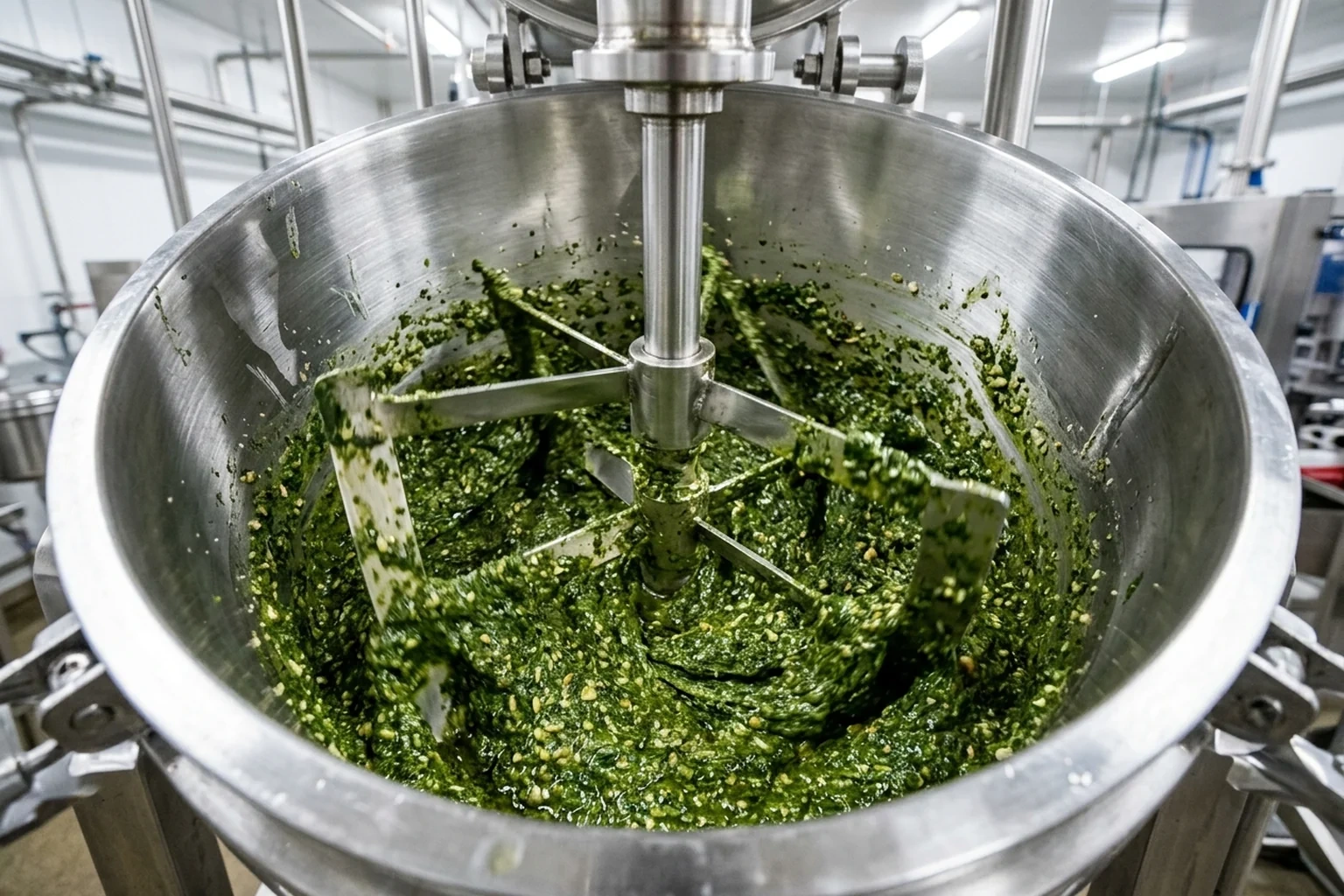
The ControlGMC DVM1000 Volumetric Piston Filler incorporates a built-in mixing hopper to ensure homogeneity in products containing both liquid and solid components (such as chunky soups, vinaigrette, and salsa).
The ControlGMC DVM1000 uses a three-level hopper sensor (where two levels control the feed pump and the third stops the depositor before air intake when product is low) and reaches up to 30 cycles per minute for 5 lb buckets and up to 60 cycles per minute for 1 lb tubs.
LINEVO's Multi-Lane Mustard Sachet Packing Machine for Particle-Rich Sauces includes a double-walled SUS316 stainless-steel jacketed hopper with mixing paddles to support temperature control and particulate suspension, plus SUS316 product pipelines and contact valves with quick-release tri-clamp couplings.
When preparing your hopper specification, state whether your paste requires a jacketed vessel for temperature control, mixing paddles for suspension, and level probes to coordinate the transfer pump.
Rotary-valve, shuttle-valve, and servo piston selection for particulate pastes
Selecting a rotary-valve piston filler for sauce with particulates requires checking valve port clearance against your largest nut, herb, or cheese piece. Compare overflow nozzles, check valves, shuttle valves, and rotary-valve or lobe-pump chambers before locking the dosing architecture.
Thicker sauces with larger vegetable or meat chunks cannot pass through overflow filling machine nozzles; more often than not, a volumetric piston filler is used to allow larger particulates to flow into the bottle or jar.
Volumetric Technologies piston fillers are constructed with 316L/304 stainless steel and USDA/FDA approved materials and handle particulates up to 4" in diameter with gentleness on shear-sensitive products.
Volumetric Technologies Servo Fillers/Depositors achieve fill accuracy within +/- .25 of 1% on homogenous products and use 316L stainless steel contact surfaces.
Volumetric Technologies Servo Piston Fillers provide soft start, fast fill, soft end fill cycles, load cell feedback control, 316L stainless steel construction, and options including hopper product level control, agitated hoppers, and water-jacketed hoppers.
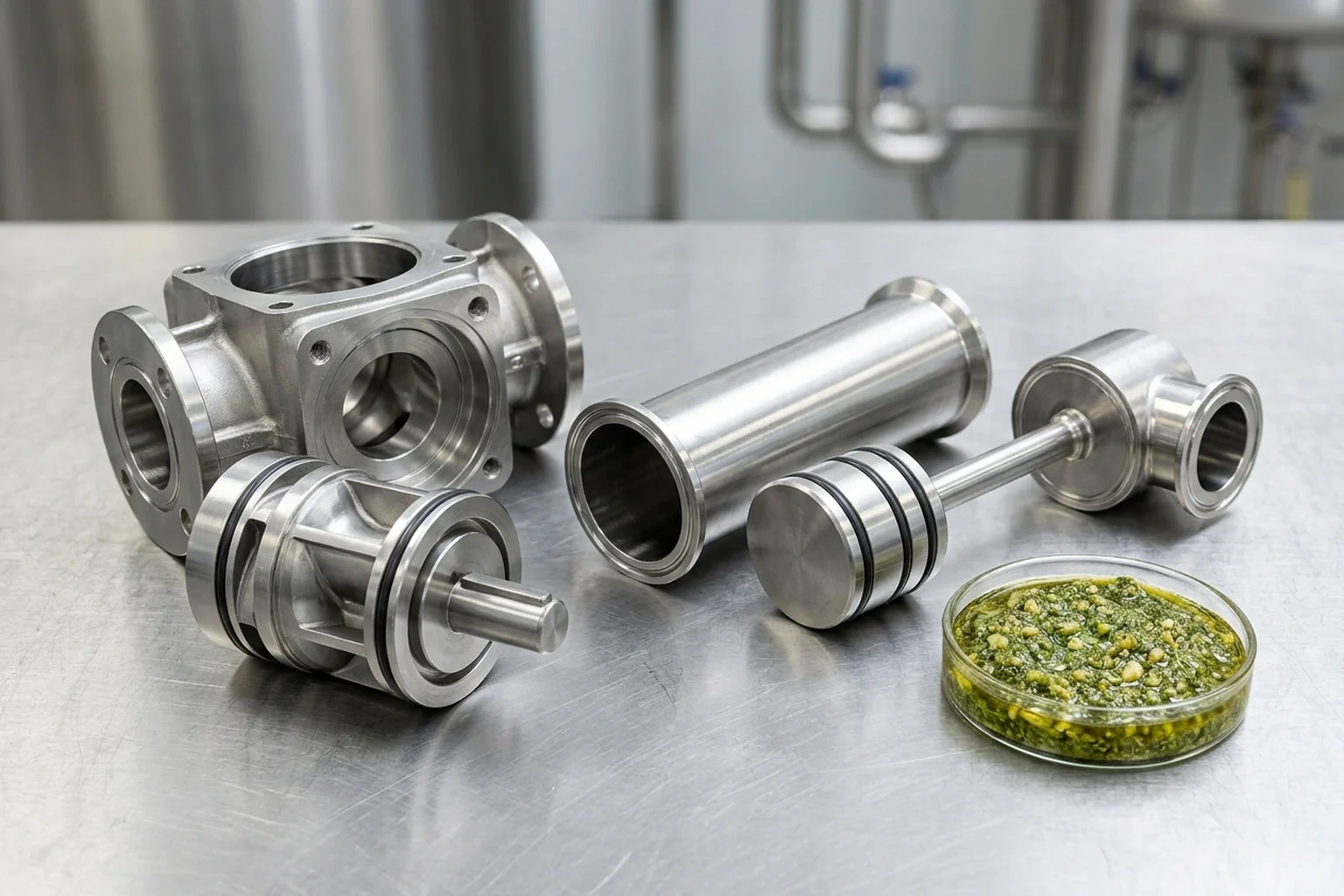
The Kaps-All Model VOL-A compact volumetric piston filler shares core features with the full-sized Model VOL-32 filler and delivers an accuracy rate of ±0.5%.
Kaps-All Model VOL-A is available with either standard check valve type pistons or patented exclusive shuttle valve type pistons.
In the Kaps-All Filling Machines Technical Guide, FILLS-ALL exclusive shuttle valve pistons are designed to handle highly viscous products and products with particulates.
LINEVO's Multi-Lane Mustard Sachet Packing Machine for Particle-Rich Sauces is engineered for multi-lane four-side seal sachet filling of mustard with whole seeds, salsa with vegetable chunks, fruit-infused sauces, particle-heavy dressings, relish, tapenade, chunky salsa, and fiber-rich condiment blends.
LINEVO's Multi-Lane Mustard Sachet Packing Machine for Particle-Rich Sauces uses rotary piston/lobe pump dosing with large-diameter intake valves and pump chambers, and large-bore filling nozzles sized for particulate sauces; product trials assess particle passage and liquid-to-solid distribution.
Begin your dosing review with the filling machine family and compare the multi-lane mustard and particulate sauce sachet machine when your brief includes coarse seeds, herbs, or diced particulates.
Nozzle cut-off, suck-back, and seal-zone protection across pack formats
Drips on the sealing rim or liquid on the seal are failure modes to review; keep product off the rim. Match the nozzle shut-off mechanism to both the paste rheology and the container format.
Volumetric Technologies Vertical Plug Spout Nozzles are produced in 2- and 3-position models in sizes from .375" up to 3", with Ertalyte, Acetal, or Waukesha alloy spool valves, shear edge models, and air-shot-thru piston models for clean fills.
Volumetric Technologies Plug Spout Nozzles include variations with Ertalyte or Waukesha alloy spool valves, shear edge models, angled inlet geometry to reduce product shear, and air-shot-thru piston models to aid in clean fills.
Volumetric Technologies Rotary Cutoff Nozzles are available in 1"-3" sizes and provide a clean cutoff of product flow for thick products with or without particulates, including soup bases or high-salt formulations.
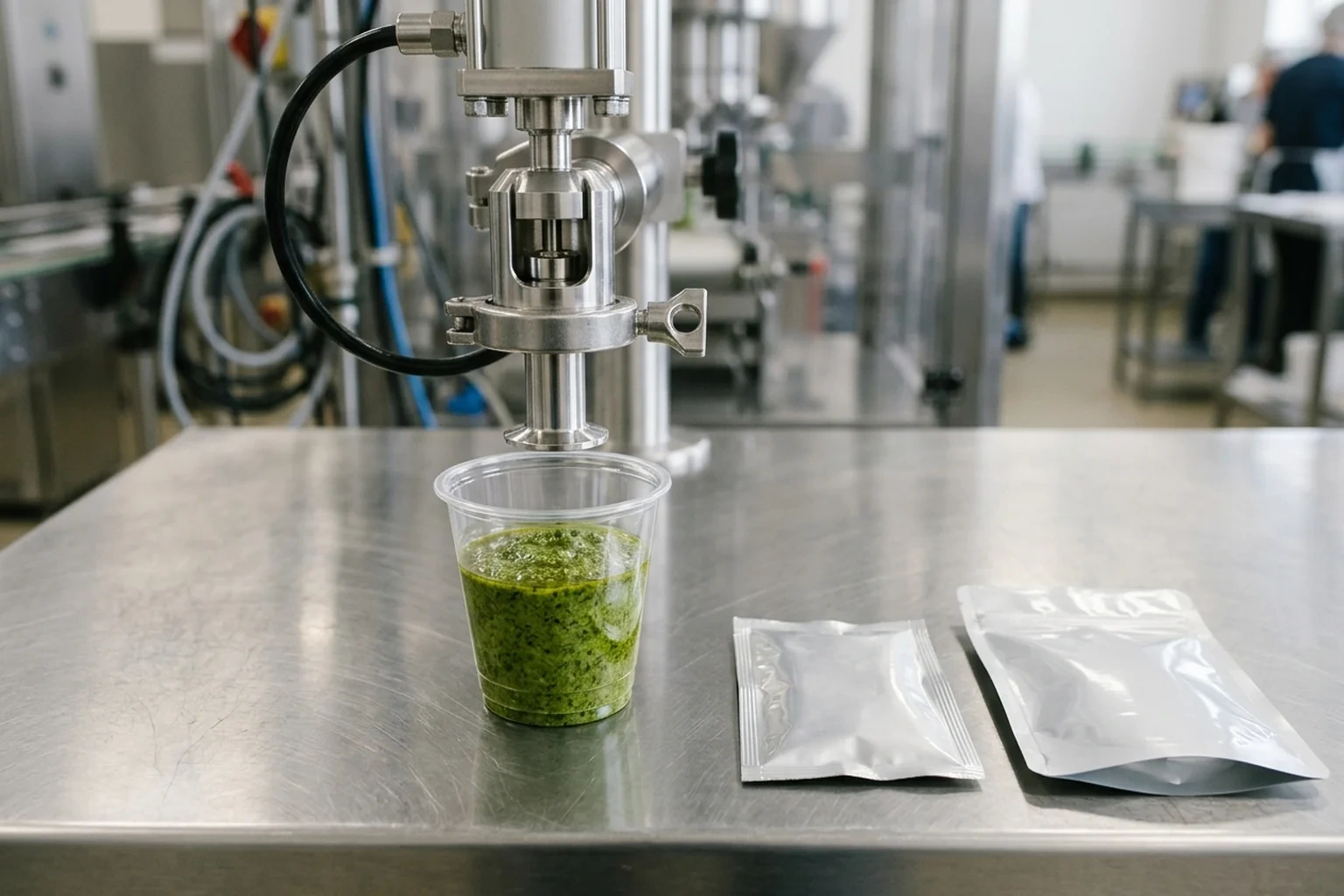
On the LINEVO Filling Machines family page, sauces and condiments in preformed cups are dosed by a servo piston in a sauce cup fill-seal configuration, where the dominant failure mode is drips on the sealing rim and prevention requires reviewing nozzle cut-off with the sauce at its filling temperature.
On the LINEVO Filling Machines family page, liquids, sauces, and gels in stick packs or sachets use pump or piston dosing on liquid and sauce routes, where the dominant failure mode is liquid on the seal and prevention requires reviewing the dose, filling temperature, and nozzle cut-off.
On LINEVO's Liquid and Sauce Stick Pack and Sachet Machines page, rotary-valve piston pumps are paired with pneumatic shut-off/suck-back nozzles and heated jacketed hoppers with agitators so suck-back draws residual product away from the nozzle tip and clears the transverse sealing band before the jaws close.
LINEVO's standard multi-lane liquid and sauce stick pack and sachet configuration covers a 1-50 ml dose range (with piston cylinder sized to target dose) across 2-16 lanes at 20-50 cuts/min using a rotary-valve piston pump with pneumatic shut-off / suck-back nozzle.
LINEVO's standard multi-lane liquid and sauce stick pack and sachet configuration specifies SUS304 or SUS316L contact parts, a jacketed agitated hopper for warm sauces, 220 V / 380 V 50/60 Hz electrical supply, and 0.6-0.8 MPa compressed air.
In the LINEVO Liquid and Sauce Stick Pack and Sachet Engineering Specification Brief, Model LV-500SY / LV-700SY / LV-980SY 4-side seal sachet machines operate with 2-4 / 3-10 / 4-16 lanes and a 5-100 ml filling range, while Model LV-450X has a 650 kg machine weight and 1-30 ml filling range.
In the LINEVO Liquid and Sauce Stick Pack and Sachet Engineering Specification Brief, Model LV-600X is a 4-16 lanes back-sealing stick pack machine for wasabi and mustard with a 1-30 ml customizable filling range, 50-180 mm sachet length, Max 420 mm film width, and 1600 x 1200 x 2100 mm dimensions.
For portion cups, flexible sachets, or retail pouches, compare the sauce cup filling and sealing machine, the liquid and sauce stick pack and sachet machines, and the premade pouch packaging machines alongside the high-speed premade pouch sauce packaging machine.
Net-contents, drained-weight, and seal verification for acceptance trials
Before running a factory acceptance or sample trial on an oil-suspension paste, define how net contents, solid-to-liquid distribution, and flexible seal integrity will be checked across consecutive containers.
Under NIST net-contents gravimetric testing of packages labeled by volume, if the difference between the densities of two sample packages exceeds one division, use the volumetric procedure in Section 3.3, "Volumetric Test Procedure for Non-Viscous Liquids."
In NIST gravimetric testing Step 13, package error is converted from weight to volume by dividing Package Error in Weight by the Average Product Density per volume unit of measure.
For drained-weight verification of solid-liquid products under NIST net-contents procedures, the sieve is inclined at an angle between 17° to 20° from horizontal and allowed to drain into the receiving pan for two minutes without shaking or shifting material.
NIST drained-weight test equipment rules specify a 203 mm (8 in) No. 8 mesh U.S. Standard Series sieve for drained weight of 1.36 kg (3 lb) or less, and a 304 mm (12 in) sieve for drained weight greater than 1.36 kg (3 lb).
Under F88/F88M-15, flexible barrier seal strength test specimens are cut to a width of 0.984 in. [25 mm], 0.591 in. [15 mm], or 1.00 in. [25.4 mm] and tested using Technique A (Unsupported), Technique B (Supported 90°), or Technique C (Supported 180°).
Under F88/F88M-15 flexible barrier tensile seal strength testing, the rate of separation of the jaws must be uniform and adjustable from approximately 8 to 12 in. [200 to 300 mm]/min.
| Review point | Question to answer | Record to request |
|---|---|---|
| Incoming paste and hopper state | Are oil and solids uniformly suspended throughout the hopper cycle? | Paste temperature, consistometer notes, agitator setting and hopper level log. |
| Density and fill consistency | Do consecutive containers maintain uniform weight and oil-to-solid ratio? | Sample weights across the run and drained-solid versus free-oil observations. |
| Particulate integrity | Are pine nuts, herb fragments or cheese pieces intact after passing the valve? | Before-and-after visual comparison of dispensed paste against bulk supply. |
| Nozzle cut-off and seal zone | Are jar necks, cup rims or sachet seal margins free of oil drips and strings? | Seal-zone photographs and nozzle shut-off or suck-back settings. |
| Flexible seal peel check | Do pouch or cup lid seals meet the agreed peel and visual criteria? | Seal-strip pull observations and jaw temperature, pressure and dwell settings. |
| Stop, hold and restart | What happens to the first packs after a planned line pause? | Observations of initial shots after a hold period and any purge requirement. |
Record the hopper level, agitator setting, filling temperature, and nozzle cut-off timing alongside the package check observations before approving the line configuration.
Questions to resolve before quotation
How do I prevent oil separation in a pesto filling machine?
Provide your paste oil fraction, standing separation behaviour, and transfer method so the review can assess whether an agitated hopper and level probes belong in the hopper specification.
Should I specify a check valve, shuttle valve, or rotary valve for particulate paste?
Share the dimensions and texture of your largest nuts, herbs, seeds, or vegetable pieces. Use those particulate details to review valve port clearance, shuttle-valve or rotary-valve selection, and servo piston stroke profiling.
How do I keep pesto oil and herb strands off cup rims and sachet seals?
Specify the container opening or film seal width and the filling temperature. Request a nozzle cut-off review covering plug-spout, rotary-cutoff, or pneumatic shut-off and suck-back nozzles before finalizing the sealing station.
What should I send LINEVO next?
Send your paste formulation sheet, particulate dimensions, filling temperature, target container or film drawing, and required output, then discuss your pesto filling project.
Sources
- PubMed Central — Basil and Industrial Pesto Review.
- PubMed Central — Industrial Pesto Quality Monitoring by NIR and Vision.
- PubMed Central — Domestic Use and Secondary Shelf Life of Commercial Pesto.
- National Institute of Standards and Technology — Checking the Net Contents of Packaged Goods.
- American Society for Testing and Materials — Seal Strength of Flexible Barrier Materials.
- Volumetric Technologies — Piston Fillers, Servo Depositors, and Dispensing Nozzles.
- Liquid Packaging Solutions — Volumetric Piston Fillers and Particulate Sauce Fillers.
- ControlGMC — Volumetric Piston Filler with Mixing Hopper.
- Kaps-All Packaging Systems — Volumetric Piston Fillers Technical Guide.
- LINEVO — Filling Machines; Liquid and Sauce Stick Pack and Sachet Machines; Multi-Lane Mustard Sachet Packing Machine for Particle-Rich Sauces.
What to send us
Send what you have and mark what is still undecided. Discuss your application with LINEVO.
| Item | Why we need it | Example format |
|---|---|---|
| Paste formulation and oil fraction | Which product behaviour should the review cover? | Ingredient breakdown, oil fraction, viscosity notes and standing separation observations. |
| Particulate dimensions | Which valve bore and nozzle clearance should be evaluated? | Herb leaf cut, nut piece dimensions, grated cheese texture and seed or vegetable chunk descriptions. |
| Hopper and temperature conditions | How should the paste be held before dosing? | Infeed transfer method, expected residence window, target filling temperature and agitation preference. |
| Container or film specification | Which pack format and seal zone must stay clean? | Jar neck finish, cup drawing, premade pouch sample or flexible reel laminate structure. |
| Production and changeover brief | What operation are you planning? | Target output, fill range across SKUs, cleaning regime and line utilities. |