
On this page
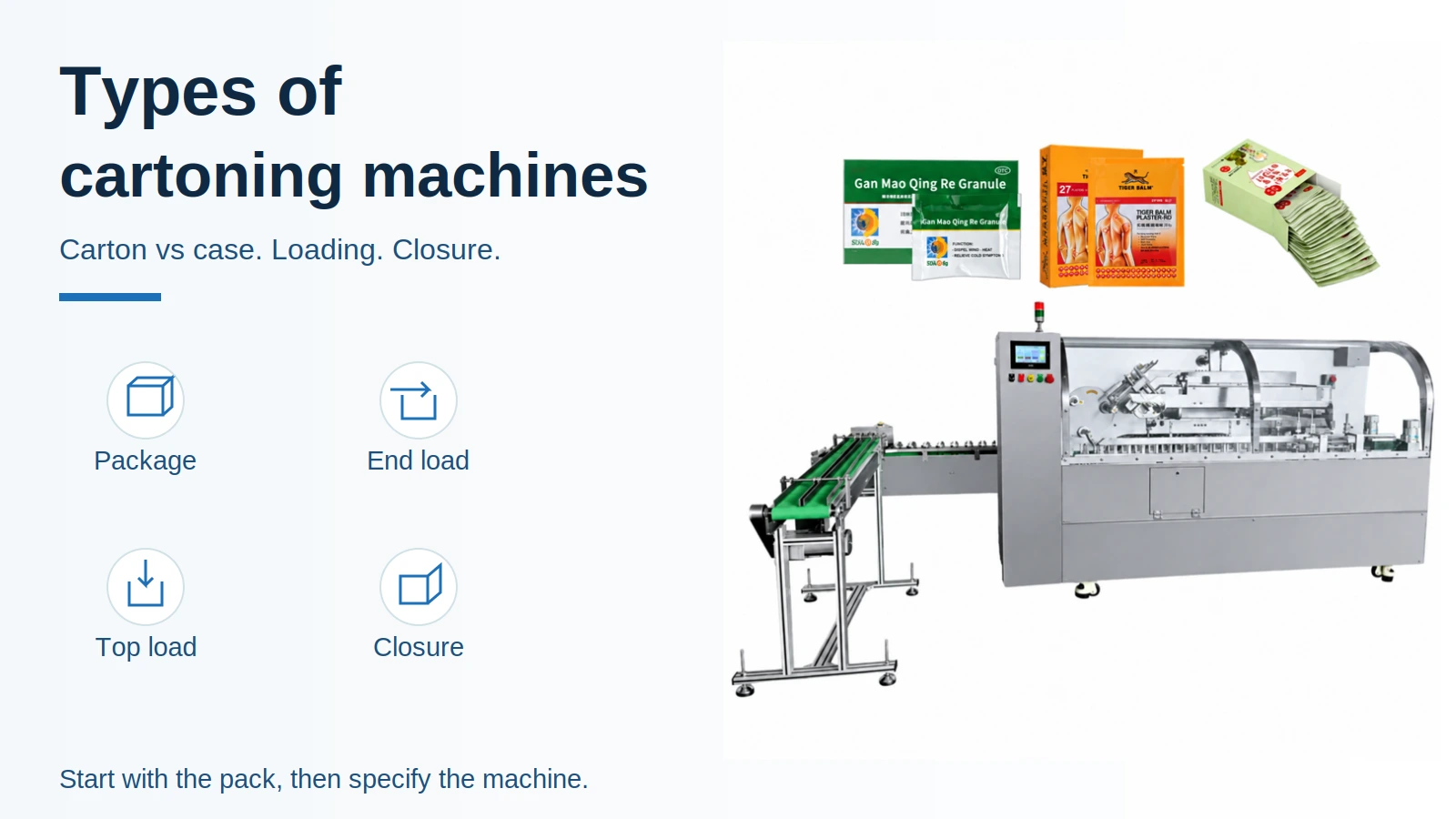
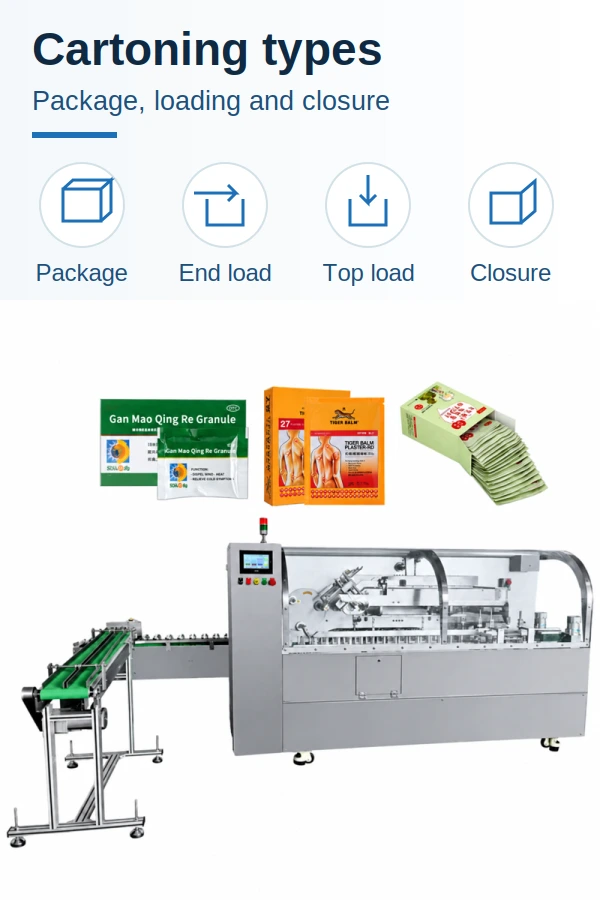
Ordering the wrong type of cartoning machine can leave the product feeder and carton blank incompatible. Specify the package first: a folding-carton cartoner loads the retail pack, while a case packer groups products or cartons into a shipping case.
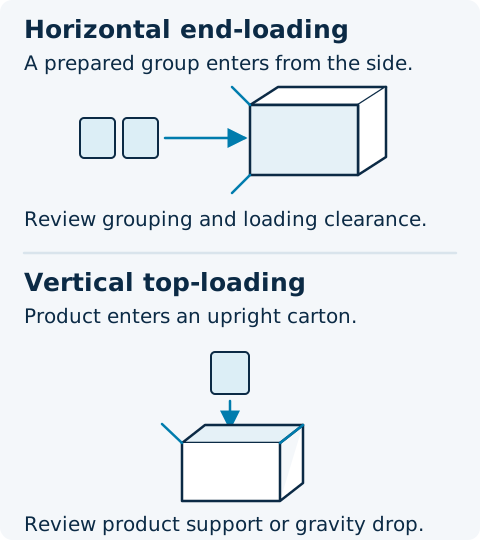
Horizontal cartoners load through an open end; vertical cartoners load from above. Either description still leaves the feeder, carton construction, closing method and automation scope to specify. Start with end-loading when a prepared product or group can enter sideways while retaining its arrangement. Review top-loading when the product must enter an upright carton, using controlled placement or a permitted gravity drop. A corrugated shipping case belongs to a separate case-packing brief, even if a supplier calls both packages a carton. This comparison helps you define those boundaries before selecting one of our cartoning configurations.
| Input | Typical value or condition | Why it matters |
|---|---|---|
| Finished package | Flat blank, erected pack and board construction. | Separates folding-carton loading from shipping-case packing. |
| Product or group | Maximum loaded envelope in mm, count and required orientation. | Defines the opening and support needed during loading. |
| Closure | Tuck flap or glue-flap drawing and a closed sample. | Defines the closing station and material checks. |
| Required output | Accepted cartons/min for each product count and format. | Makes the feeder and cartoner quotation comparable. |
Carton vs case: which package does the machine load?
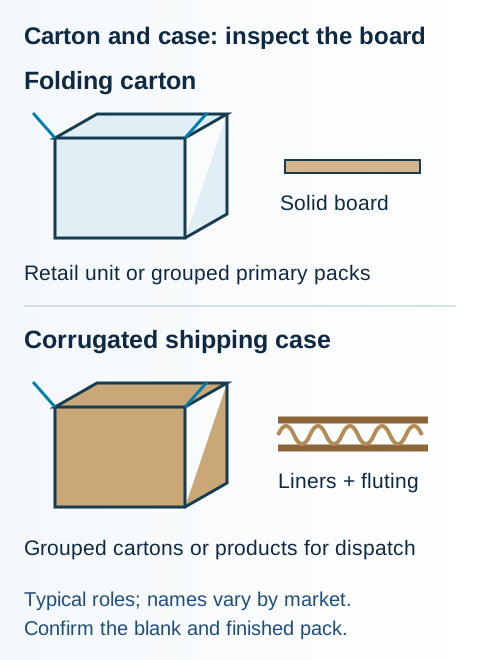
For this equipment comparison, a carton means the folding retail box, typically made from solid cartonboard; a case means the corrugated outer shipper containing products or retail cartons. The names overlap in trade, so a photograph and blank drawing are more useful than the word box on an enquiry.
Corrugated board has flat liners bonded to a fluted medium. That visible construction distinguishes it from solid cartonboard, but it does not by itself identify the required machine: corrugated can also make a retail display, and a case packer can load products directly without an intermediate carton. Specify both the board and the packing task.
| Task | Package and material | What to specify | Dominant Failure Mode & Prevention |
|---|---|---|---|
| Folding-carton loading | Retail box around one product or a counted group; usually solid cartonboard. | Blank, product position, inserts and tuck or glue closure. | Product catches an incompletely opened carton: review blank opening and group clearance on actual samples. |
| Shipping-case packing | Outer corrugated case around products or cartons. | Case style, loading pattern, payload, closure and dispatch conditions. | Load shifts or case deforms: review the packing pattern and filled shipping unit, including closure. |
The automatic cartoning family covers folding-carton configurations. A complete packaging system brief should identify the shipping-case stage separately. Do not assume the cartoner quotation includes case erecting, case loading or palletizing.
Horizontal vs vertical: choose the product entry direction
End-loading suits a product or prepared group that can travel through the carton opening while staying aligned. Top-loading places products into an upright carton. Gravity drop is one top-loading method; controlled placement is another, so vertical does not mean every product must fall freely.
A wrapped-bar group, a blister stack and a loose count of pods impose different handling requirements. Establish what may touch the product, which face must remain upright and whether a stack can lose its arrangement during transfer. Those conditions determine the feeder and loading review.
| Route | Start here when | Condition that can rule it out | Dominant Failure Mode & Prevention |
|---|---|---|---|
| Horizontal end-load | The product or group can be presented to the open end in a controlled envelope. | An unstable group or projecting primary-pack seals cannot pass without snagging. | Group separates or catches a flap: review collation, guidance and the smallest usable opening. |
| Vertical, controlled placement | Product position inside an upright carton must be controlled. | The product, insert and handling tool do not have a clear entry path. | Bottle tips or insert catches: review support and insertion path with assembled samples. |
| Vertical, gravity loading | Counted loose units may drop into the carton and settle acceptably. | Impact sensitivity or required presentation rules out free drop. | Bridging, damaged units or count errors: review chute passage, permitted drop and count verification. |
Our vertical perfume configuration and counted coffee-pod configuration illustrate different top-loading tasks. The counted-pod configuration uses vibratory counting and a gravity chute. For bottles, include the insert and required upright position. The cosmetic packaging guide covers the surrounding product and pack choices; the coffee packaging machines guide and the tea bag cartoning page do the same for coffee and tea.
Tuck vs hot-melt: match the closure to the blank
Select the carton closure independently of horizontal or vertical loading. A tuck closure folds a tab into the carton; hot-melt closing bonds the designed glue flaps. Send the blank drawing and closed sample so the proposal addresses the actual fold sequence and contact surfaces.
The glued manufacturer's side seam of a supplied carton is a different joint from the end closure made by the cartoner. A pre-glued carton can still need tuck closing at its ends. Describe which joint must be closed rather than asking only for a glued box.
| Closure | Inputs to review | Operating-cost items | Dominant Failure Mode & Prevention |
|---|---|---|---|
| Tuck-in | Flap geometry, board stiffness, creases and the finished opening behavior. | Blank rejects, adjustment time and format parts. | Tab misses its receiving space or flap springs open: check blank tolerances and fold guidance on production blanks. |
| Hot-melt glue | Glue-flap overlap, coated contact faces and adhesive matched to the board and process. | Adhesive, energy, cleaning, consumable parts and stoppages. | Incomplete bond or glue in the wrong area: agree the application and compression arrangement, then evaluate closed samples. |
A closure choice alone does not establish tamper evidence or transport performance. Define the required finished-pack behavior and the checks separately. Pharmaceutical projects also need an explicit leaflet, code and inspection brief; use the pharmaceutical packaging guide to place those tasks in the wider line.
Check the loading opening and carton demand
Compare the largest loaded product envelope with the smallest usable carton opening along the actual entry path. Use the finished inner pack, including its seals, caps, leaflets and inserts. Nominal outside carton dimensions cannot establish loading clearance.
For a straight rectangular end-load check, define available opening width W and height H, maximum group width w and height h, all in mm. Remaining width Cw = W − w; remaining height Ch = H − h. With assumed W = 62 mm, w = 58 mm, H = 34 mm and h = 31 mm, Cw = 62 − 58 = 4 mm and Ch = 34 − 31 = 3 mm. These are total geometric remainders, not per-side clearances or recommended settings; flap intrusion, material variation and the transfer path still need review.
Convert primary-pack flow into carton demand using the count per carton: required cartons/min = incoming units/min ÷ units/carton. At 240 wrapped units/min and 8 units/carton, 240 ÷ 8 = 30 cartons/min before stops and rejects. Changing the count to 4 gives 240 ÷ 4 = 60 cartons/min. Agree accepted output and the operating window for each format during line engineering.
For a flow-wrapper connection or stick-pack line, record how products arrive, their spacing, orientation and stop/start behavior. Agree who supplies accumulation, counting and transfers. If finished cartons need film overwrapping, specify that downstream hand-off as a separate stage.
What changes cartoning machine price and operating cost?
Cartoning machine price follows the feeder, carton formats and included stations. Compare quotations against the same product presentation, good output, closure and format set. A hand-fed loading station and an automatically counted line have different scope even if both are described as automatic cartoners.
Horizontal or vertical also does not define intermittent versus continuous motion. Record that separately in the proposal and confirm output on the specified pack. Avoid assigning a speed, footprint or labor advantage to an entire loading category.
| Cost item | Record for each proposal | Calculation or comparison |
|---|---|---|
| Purchase and integration | Machine, feeding, change parts, glue equipment, inserts, coding, checks and transfers. | Mark included, optional and excluded items; include installation scope in both totals. |
| Carton and product loss | Attempted cycles, rejected blanks, damaged products and recoverable contents. | Scrap cost = rejected cartons × blank unit cost + unrecoverable products × product unit cost. |
| Changeovers | Changes/period and measured stop-to-accepted-output minutes/change. | Downtime hours = changes × minutes/change ÷ 60; use the same definition for both machines. |
| Running and maintenance | Labor duties, measured energy, adhesive, cleaning and replacement parts over the same period. | Compare actual consumption and staffing assumptions; list unknowns before totaling. |
For a worked changeover example, assume 20 changes/month. A quoted planning allowance of 30 min/change gives 20 × 30 ÷ 60 = 10 h/month; an alternative allowance of 18 min/change gives 20 × 18 ÷ 60 = 6 h/month. The difference is 4 h/month to validate on the real format change. Convert it to labor cost only for paid time affected, and to lost production only when demand and available capacity make that loss real. Do not count the same recovered output twice.
Cost per accepted carton over a chosen horizon = (purchase + integration + labor + materials + energy + maintenance + justified downtime cost − residual value) ÷ accepted cartons over that horizon. Use the same months, shifts and product mix for both proposals. A changeover saving may matter more on a mixed-format line than on a long single-format run, but the inputs must come from your schedule and the agreed trial.
Prepare the carton drawing, product dimensions and count checklist
Send a matched set of carton and product information so the loading method can be reviewed against the finished pack. Include each format that must run, rather than sending one easy sample and assuming the others fit.
| Item | Why we need it | Example format |
|---|---|---|
| Carton drawing and samples | Check the smallest usable opening, folds, board and closing joint. | Dimensioned PDF in mm, flat blanks and a closed carton. |
| Finished inner product | Review the full loading envelope, projecting seals and handling sensitivity. | Actual wrapped units or bottles; maximum dimensions in mm and photos. |
| Count and arrangement | Define the group, loading direction and any required presentation. | Units/carton and a sketch of layers, orientation and inserts. |
| Closure and added tasks | Separate tuck/glue, leaflets, coding and inspection scope. | Closed sample; insert drawing; required checks and reject behavior. |
| Output and interfaces | Match the feeder, cartoner and adjacent stages. | Good cartons/min per format, changes/shift and upstream equipment details. |
Send your carton drawing, finished-product dimensions and count per carton to discuss loading and quotation scope with our engineering team. Include the closure and any leaflet or insert. For the available product-specific starting points, return to automatic cartoning machines.
Sources
This comparison separates package role, loading direction, closure and automation rather than treating them as competing labels. Our examples use the linked perfume and counted-pod configurations; output, format range and included stations remain specific to the proposed configuration.
FEFCO's corrugated-board explanation describes liners and fluting. Board construction helps identify the material, but the finished pack and loading task still define machinery scope.
ASTM D4169-23e1, Standard Practice for Performance Testing of Shipping Containers and Systems, provides a framework for laboratory evaluation of shipping units under distribution hazards. Its public scope supports reviewing the filled shipping unit, including its closure; it does not set cartoner speed or establish that a retail carton has passed transport testing. Agree the applicable distribution test plan separately.
Discuss your application with LINEVO.
Discuss your carton and product requirements