
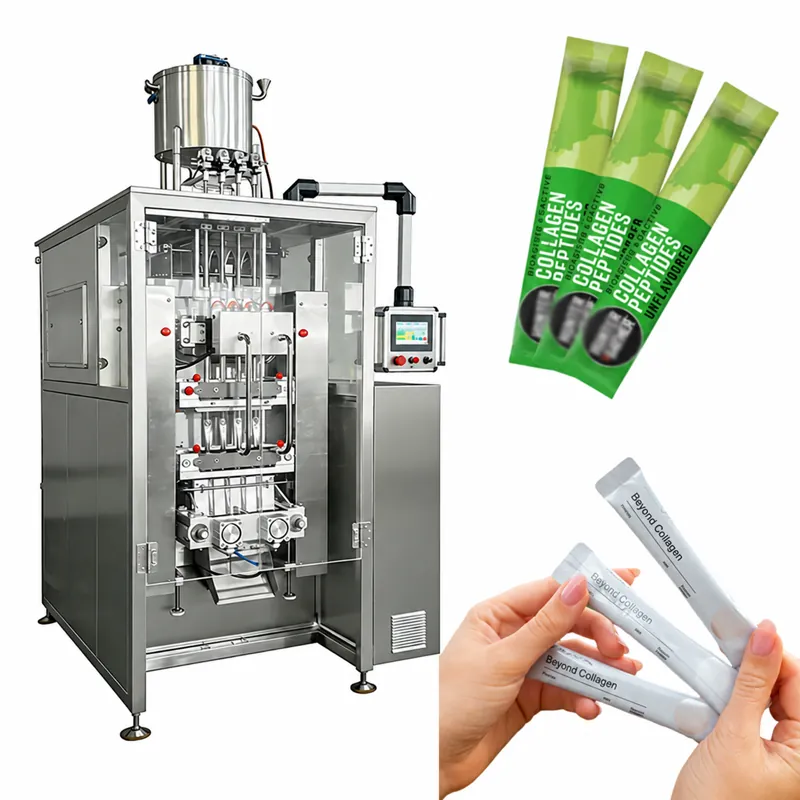
Catalog powder stick pack machine with narrow single-serve pack examples
A mismatched dosing unit or pack format can waste product and leave the machine unsuitable for your line. Compare configurations against your product behavior, dose, finished stick, film, required good output and plant conditions. Use the input tables, US site checks and supplier evidence matrix below to prepare your shortlist. Download the printable checklist to record your values and the items still open.
| Input | Typical value or condition | Why it matters |
|---|---|---|
| Product and dose | Buyer description of flow, dust, viscosity or particles, plus target dose and tolerance | Shortlists auger dosing, pump dosing or a granule unit named for the project |
| Finished pack | Buyer drawing in mm: flat width and overall cut length, including end seals | Names the format the proposal has to cover |
| Film | Buyer film structure, sealing layer and reel drawing | Keeps seal and tooling scope open until the sheet is attached |
| Good output | Accepted sticks in one agreed shift, with the minutes available | Turns a cycle rate into the plant target you will accept |
| Changeovers | Formats, batch sizes and how often they change | Shows whether the final choice should wait for a change-part list |
| Site | Actual voltage, phases, frequency, access, height and cleaning limits | Checks the proposal against the plant, not against a catalog nameplate alone |
| Downstream and cleaning | Discharge, counting, grouping or cartoning, plus the cleaning method | Sets the line boundary and the time that is not spent making sticks |
On this page
What product and dose information shortlists the dosing path?
Material behavior shortlists the dosing path before lane count does. Powders in the published stick pack range are discussed with auger dosing. Liquids, gels and sauces are discussed with pump dosing. Granules need a dosing unit named for that product. A published configuration shows a route. It does not show that your recipe has been run.
| Product | What you write down | What you ask the proposal to name |
|---|---|---|
| Powder | Flow, dust, bridging, bulk density if you have measured it, target dose and the tolerance you will accept | Auger and screw tooling, feeding, agitation if proposed, and any dust control at the sealing area |
| Granule | Particle size, how freely the pieces flow, whether they break, target dose and tolerance | The dosing unit for this granule. Do not copy a powder auger or a liquid pump into the quote without a written scope |
| Liquid, gel or sauce | Viscosity at the filling temperature, particles, foaming, and target volume or weight with tolerance | Pump, nozzle, product supply, and any heating or anti-drip arrangement the proposal includes |
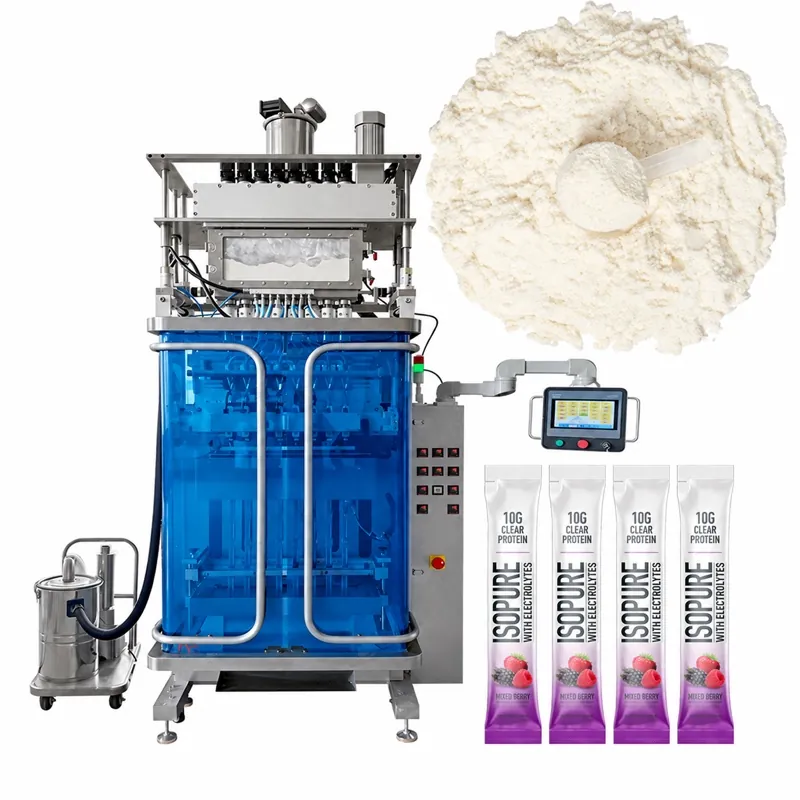
Powder stick pack equipment alongside powder application and pack examples
Use the photograph as a catalog reference for a powder route, then separate it from a trial. The stick pack machines page is the family route for powders, granules and liquids. The powder stick pack and sachet guide lists the powder data that changes screw tooling and dust control. The liquid and sauce guide lists the liquid data that changes the pump and nozzle discussion. The published multi-lane powder stick configuration and the published energy gel stick configuration are route examples. Ask the proposal to say whether that dosing arrangement is the one offered for your product.
Confirm the dosing path on your own product before you treat a catalog configuration as the machine to order. If one frame is expected to run a powder and a liquid, ask for both dosing units in writing. A settings change does not turn an auger into a pump.
Which pack and film records does the proposal need?
Require a dimensioned drawing of the finished stick and a film specification before you compare proposals. Record flat finished width and overall cut length in millimeters, and include both end seals in the length. Film width does not follow from the flat width alone. The tooling drawing has to state the seal allowance.
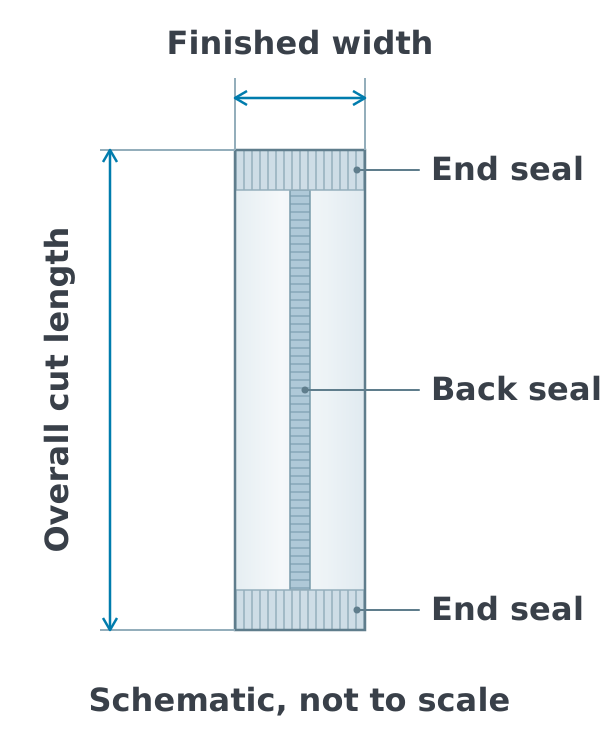
Back view of a stick pack showing finished width, overall cut length, end seals and a back seal
On a roll-film stick machine the web is slit into lanes, formed into a tube, dosed, sealed along its length and at the ends, then cut. The back seal is the lengthwise seal. The end seals sit inside the overall cut length, between the outer cut edges. The figure is a schematic of that back view. It carries no sizes, and it is not a drawing of one LINEVO model.
- Finished flat width, in mm, across the flat pack from edge to edge.
- Overall cut length, in mm, from outer cut edge to outer cut edge, including both end seals.
- End-seal length, if your quality plan measures the seal lands separately from the cut length.
- Back-seal position, tear notch, cut pattern and the opening the user needs.
- Film structure, sealing layer and thickness, from the film data sheet.
- Reel width and reel diameter only when the film drawing or the tooling drawing states them.
- Print registration, if the cut has to follow a printed mark.
- Sample stick ID and film sample ID, so a later trial uses the same materials.
Send the finished-pack drawing with the film data sheet. Ask the supplier to specify the film needed for each lane, seal type and allowances, lane layout, trim and overall reel width in the tooling drawing. Leave reel width and seal settings unresolved until that drawing is agreed; the finished flat width alone cannot determine them.
How should you state accepted output and changeovers?
State the required good sticks per shift, available production minutes, format mix and downstream handling. For a trial, agree a separate observation window and count all finished sticks and rejects within it. Record each stop and its duration in minutes so everyone can see which interruptions the window includes.
Good sticks in an observation window equal the total finished sticks counted minus the rejected sticks counted in that same window. When every active lane releases one stick per cycle, active lanes multiplied by the actual accumulated cycles gives the formed count. Those actual cycles already reflect stopped time, so do not subtract it again. If you start from a running rate instead, multiply sticks per minute by actual running minutes to obtain a count, then subtract rejects. Keep any projection to a longer shift separate and state its assumptions.
| Record | What to write | What it is not |
|---|---|---|
| Required good sticks | The count of accepted sticks and the shift or other window you agree | A catalog cycle rate copied into the cell |
| Available minutes | Define the shift window and planned breaks separately; record trial elapsed minutes and actual running minutes | A full hour assumed when your shift does not provide one |
| Lanes and cycles | Active lanes and actual accumulated cycles during the observation window; label rates separately as cycles/min | Actual accumulated cycles already include the effect of stops; do not deduct stopped time from the resulting stick count |
| Rejects | Count and reason inside the same window | A loss already hidden inside a single speed figure |
| Stops | Stop reason and duration in minutes: changeover, cleaning, film splice or fault; identify excluded breaks | An unspoken assumption that the machine runs without stops |
| Format mix | Each stick size, typical batch size and how often the format changes | One lane count treated as enough for every format |
| Downstream | Loose discharge, counting, grouping or cartoning, and who supplies that unit | Work treated as included because the stick machine makes the stick |
Price and ownership boundaries are a separate comparison. Use the stick pack machine cost and quote-scope guide for that split, and keep this page on whether the configuration fits. If finished sticks must go into cartons, name that interface and read the cartoning machines scope as downstream equipment unless the proposal includes it.
Send the pack drawing, film specification, product and dose, required good output, changeover pattern and site notes through the project brief checklist. LINEVO uses those inputs to review the packaging route and reply with a configuration discussion or the missing information needed to continue. Where material behavior needs checking, the next step is an agreed sample-test plan; agree sample quantities and shipping details before sending materials. We reply within 24 hours.
What should a US plant confirm before ordering?
Confirm the plant you have against the supplier nameplate and installation drawing. Record actual voltage, phases and frequency, the access route, room height, maintenance space, utilities, cleaning limits and who installs and trains. These are inputs from your site. This page does not set an electrical standard and does not promise technicians in the United States.
| Check | What to record | Who confirms it |
|---|---|---|
| Electrical supply | Voltage, phases and frequency at the machine position, plus the supplier nameplate and connection drawing | Plant electrical staff, comparing the drawing with the supply that is actually there |
| Access and space | Door and route into the room, floor limits, footprint, clear height including the feeder, and maintenance clearance | Plant layout, against the installation drawing rather than a catalog photograph |
| Cleaning and product risk | Dust, moisture, allergens or other handling limits, and the cleaning method the plant will use | Plant quality or sanitation, as a requirement the proposal has to answer |
| Utilities | Compressed air or other utilities only where the proposal requires them, and what the plant can supply | Plant utilities, matched to the proposal. Do not add a utility the proposal does not name |
| Interfaces | Upstream product feed and downstream discharge, with a simple layout | Plant engineering and the supplier, on the same drawing |
| Installation and training | Supplier, buyer or local contractor; language; who will operate and maintain the machine; remote or on site | The proposal. Use the installation and training questions so the scope is explicit |
The installation and training planning page is the list of site details, commissioning order and training roles to collect. Whether support is on site or remote, and any separate cost, is agreed for the project. If the nameplate and the plant supply differ, leave the order open until the quotation states the electrical configuration for your supply.
How do you compare supplier evidence?
Use the same evidence list for each supplier. Pending means the required evidence is missing; received means it is available but has not been approved; accepted means you have checked it against the condition in that row. Performance rows need records from your product and film under agreed conditions. Drawings, manuals and parts lists need a scope review rather than a production trial.
| Evidence | Required before review | Accept when |
|---|---|---|
| Configuration and tooling | The proposal names the dosing path and the format tooling included | That named scope matches your product, dose and stick drawing |
| Your materials | Product, film and pack sample IDs are written on the record | The result you accept used those IDs, not a substitute material |
| Dose tolerance | You and the supplier write the target, the tolerance and the measurement method | The recorded doses sit inside that tolerance for the agreed sample |
| Good output | The window, active lanes and cycles are on the same sheet as the stick count | Good sticks meet the target for an observation window of the same duration; any shift projection lists assumptions and remains separate |
| Rejects and stops | The sheet says which stops and rejects are inside the window | The count includes them, with reasons, instead of a single speed line |
| Seal and opening | The check method is agreed: visual, hand, or a leak or drop check you specify | The packs from your film pass that method |
| Changeover | Tasks, parts and the remaining manual work are listed for each format | You can repeat the change with the people and time you actually have |
| Cleaning | Access to product-contact parts and the change procedure are described | The procedure fits the cleaning method your plant requires |
| Manuals | The proposal lists manuals, drawings and the language | The set covers the configuration you are buying |
| Spare and change parts | A named list is requested with the quotation | The list states what is included, what is optional and how later orders are placed |
For example, a proposal that names the dosing unit and tooling moves Configuration and tooling to received. You can accept that row after checking the scope against your brief. Dose tolerance stays pending until its limits and measurement method are agreed, and its result is accepted only after the agreed trial. Approving the configuration documents does not approve performance.
Ask the quotation to name the spare and change parts in scope. The spare and change parts page explains what a later parts request needs from the nameplate and the parts list. It does not set a stock level or a delivery time for this order. If you want a check before shipment, ask the quotation to state whether that check runs your product and film and what is recorded. Agreeing the check is part of the project scope. It is not an automatic inclusion.
When this does not apply
Leave this path when the pack is not a narrow back-sealed stick made from roll film, or when you still lack a representative product and film. Premade pouches belong on the premade pouch filling machines route. Wide flat sachets belong on the sachet packing machines route. If formats will change often and the change parts are not named, defer the final choice until that list exists.
A short trial can confirm behavior within its recorded conditions, but it does not by itself establish sustained output over a full shift. Keep projections and the assumptions about stops, rejects and changeovers separate. If the pack route or production materials are undecided, settle them before accepting a configuration.
What do you fill in on the buying checklist?
Print the checklist and fill it by hand: your values, one column per supplier, and an owner for every item still open. Download the stick pack machine buying checklist (PDF, 10 October 2026). It is a buyer preparation form. It is not a certificate, and it is not a fixed acceptance standard.
- Product, pack and production brief: recipe version, material behavior, dose and tolerance, flat width and overall cut length in mm, film specification, accepted sticks per shift, format mix and downstream handling. A blank means unresolved.
- Site readiness: actual electrical supply, nameplate and drawing review, utilities the proposal requires, access and height, interfaces, cleaning, and who installs and trains.
- Supplier columns: the same evidence rows for each supplier, marked received, pending or accepted, with the document or trial record attached.
- Open items: the missing evidence, an owner, a due date and a decision to proceed, request evidence or defer.
The worksheet does not replace the quotation. It gives purchasing, production and the supplier the same blanks to fill. Keep the completed sheets with the drawing, the film data and the output record so a later reader can see what was still open on the day of the decision.
Questions buyers ask while shortlisting
What is a stick pack machine?
A stick pack machine forms a narrow back-sealed stick from roll film, doses the product, seals the ends and cuts the stick free. The stick pack machines page describes the published family. This guide starts once that pack is the one you intend to buy.
What are stick packs used for?
Stick packs provide single-serve portions of powders, granules and suitable pump-dosed liquids or gels. The published family lists these application routes; confirm the configuration for your product. Match the product on the powder stick pack and sachet guide or the liquid and sauce guide.
What are the options for a small stick pack machine?
Start with your required good sticks per shift and finished stick size, then ask the supplier to identify the appropriate lane count and frame. Single-lane or benchtop projects fall outside the currently published multi-lane series on the stick pack machines page. State that requirement explicitly rather than assuming a listed configuration covers it.
Which is the best packing machine?
The best fit is the configuration supported by evidence for your product, pack, required good output and plant conditions. Use the supplier evidence matrix to compare those requirements and resolve missing records before ordering.
What are the disadvantages of automatic packing?
Automatic packing still needs setup, cleaning, change parts, operator checks and planned stops. Those tasks can remove the expected gain when the product or the formats are not stable. Write them into the shift record before you treat a cycle rate as labor you no longer need.
Is there a printable PDF checklist for buying a stick pack machine?
Yes. The stick pack machine buying checklist is the printable PDF for this decision. Fill it by hand, keep a column per supplier, and assign an owner to each open item. It is one worksheet, not a second buying guide and not a certificate.
Method and sources
Reviewed 10 October 2026. Read the page in decision order: product and dose, finished stick and film, accepted output and changeovers, the plant, then supplier evidence. Mark each supplier row pending, received or accepted. A blank cell means the item is still unresolved, so leave it blank on the checklist rather than filling it from a catalog listing.
LINEVO pages consulted on 10 October 2026 are the stick pack machine family, the powder and liquid application guides, the published powder auger and energy-gel stick routes, sample testing, installation and training, spare parts, the project quotation page and the stick pack cost guide. These manufacturer pages define published routes and project preparation. Product-specific performance still requires the agreed trial record.
The measurement figure is a schematic of a back-sealed stick, not to scale. Its labels follow a general industry description of roll-film stick forming: the web is slit into lanes, formed around tubes, dosed, sealed lengthwise and at the ends, then cut. That description was published on 7 June 2017 and retrieved on 6 October 2026. Use it to see where to measure, and take the width and the length from your drawing. It is not a drawing of a LINEVO model, and it is not a source for a speed or a size.
Ask the quotation for any conformity document your plant requires, and do not treat this page as that document. Ask the supplier for the electrical configuration that matches your measured supply. Service location, remote or on-site support, and response terms belong in the proposal. Your recipe, tolerance, film, drawing, output, utilities and the supplier proposal stay blank until you attach them.
Send the completed brief
Send your product and dose requirements, pack drawing, film specification, good-output target, changeover pattern, site notes and downstream scope using the contact link below. LINEVO reviews the route and configuration inputs, then replies with the next configuration discussion or the information still needed. If product or film behavior needs verification, we discuss a sample-test plan. We reply within 24 hours.
What to send us
Send what you have and mark what is still undecided. We reply within 24 hours.
| Item | Why we need it | Example format |
|---|---|---|
| Product and dose | Shortlists the dosing path and the tolerance the trial has to check | Powder, granule or liquid; flow, dust or viscosity; target dose and tolerance |
| Finished pack | Names the stick the format tooling has to make | Dimensioned drawing in mm: flat width and overall cut length, including end seals |
| Film | Defines sealing and the reel the tooling drawing has to accept | Film data sheet and a film sample ID; reel width only if the drawing states it |
| Accepted output and changeovers | Sets the window for good sticks and shows whether formats should wait | Good sticks per shift, available minutes, formats and how often they change |
| Site | Compares the proposal with the plant that will receive the machine | Voltage, phases, frequency, access, height, utilities and who installs and trains |
| Downstream and cleaning | Sets the line boundary and the cleaning work inside the shift | Loose discharge, counting, grouping or cartoning; cleaning method and product-contact limits |