
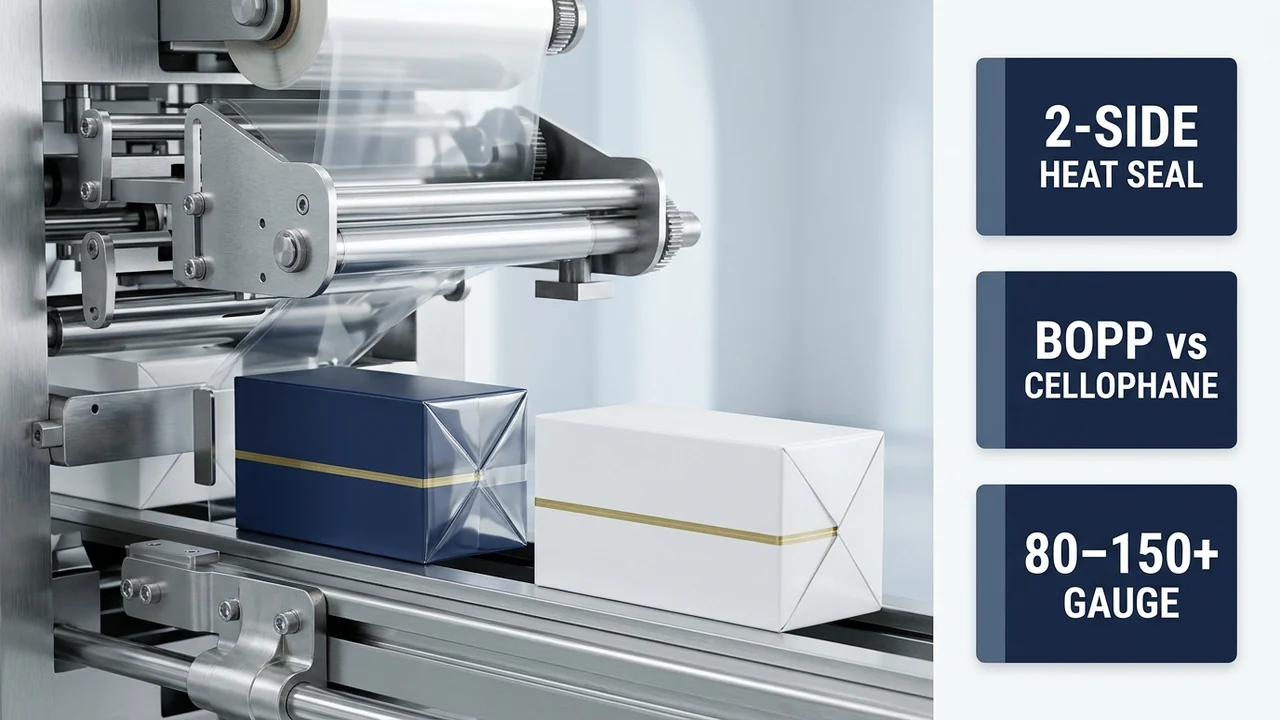
Across the 41 configurations in our cellophane overwrapping machines family—anchored by the LV-BT280 / LV-BT350 Series covering 40–200 × 20–120 × 10–70 mm boxes at 30–80 boxes per minute—film structure directly governs fold crispness, heat-seal bonding, and feeding stability. Confirming heat-seal coating placement, substrate stiffness, and surface friction by datasheet before slitting trial rolls prevents jamming and open end flaps.
| Input | Typical value or condition | Why it matters |
|---|---|---|
| Heat-seal surface requirement | Two-side heat-sealable coating (outer face seals to inner face). | Envelope folds and side lap seams bond opposite film surfaces; one-side flow-wrap film will not seal. |
| Typical thickness range | 80 gauge (20 microns) for food, 100–150 gauge for most cartons, 150+ gauge for perfume, over 200 gauge for bundling. | Not all overwrapping machines handle every film gauge; confirm gauge limits before changing web thickness. |
| Primary substrate families | Heat-set BOPP (0.895–0.93 g/cm³ density, 1300–1800 N/mm² Young's modulus) or regenerated cellulose (cellophane). | BOPP folds crisply like paper; cellulose is wood-pulp-derived, compostable, and needs a confirmed heat-sealable grade. |
| Standard lab test references | ASTM D882 tensile modulus for stiffness (< 1.0 mm film) and ASTM D1894 for static and kinetic COF. | Slip-additive blooming is time-dependent, so film age and surface condition alter feeding friction. |
On this page
What Makes Overwrapping Film Different From Flow-Wrap Film on a Tuck-and-Fold Overwrapper?
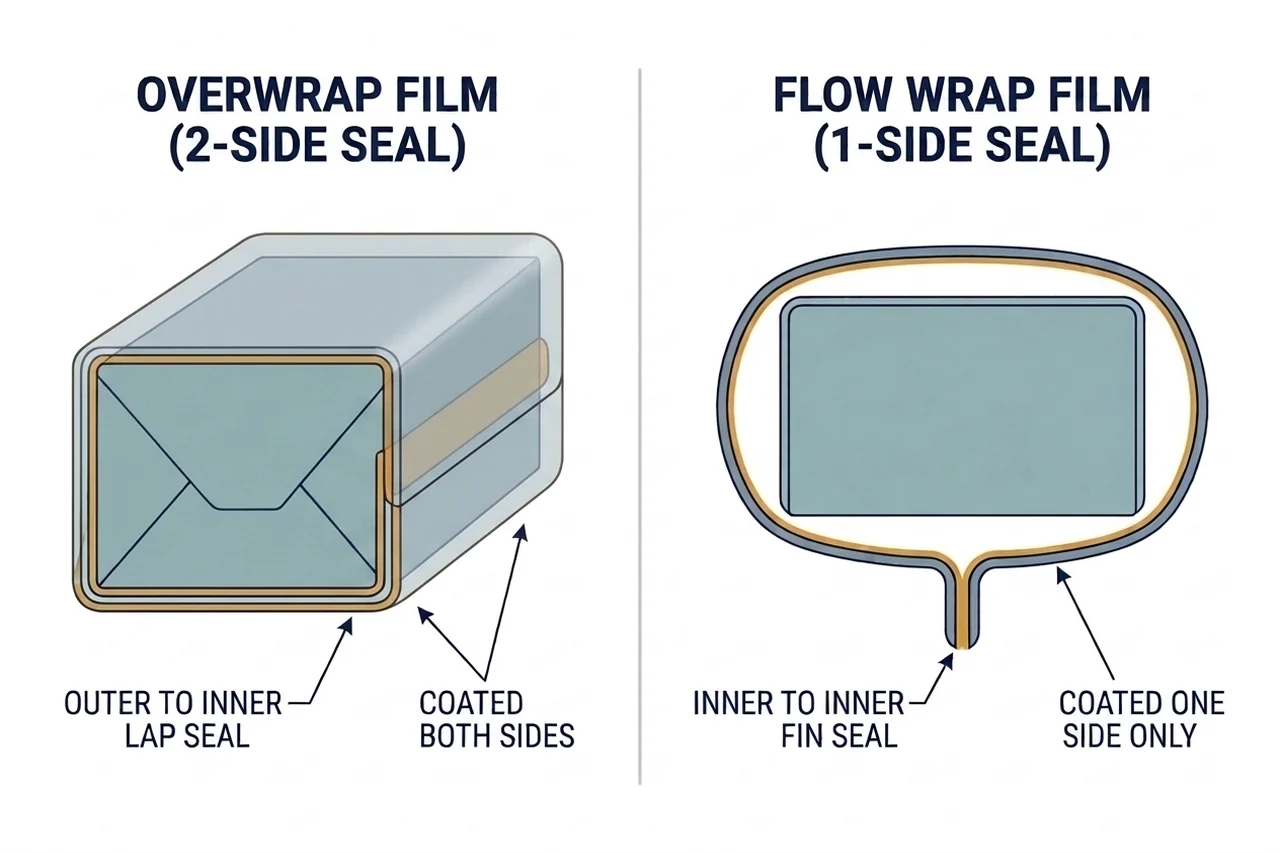
Overwrapping film must be heat-sealable on both sides because a tuck-and-fold overwrapper bonds the outer surface of the film to the inner surface along the longitudinal lap seam and across the triangular envelope end folds. By contrast, flow-wrap film is heat-sealable on one side only because its longitudinal fin seal bonds the inner face to the same inner face.
Because the sealing geometry differs fundamentally, flow-wrap and overwrap films require different amounts and placements of heat-seal coating across the web. On a carton overwrapper, heat is applied selectively to spot-weld the long lap seam and the folded ends rather than crimping a protruding fin or heating the whole pack in a tunnel. If your project evaluates horizontal pillow bags instead of folded cartons, review our flow wrap film COF and jaw temperature guide.
When Is BOPP Overwrapping Film Used vs. Regenerated Cellulose (Cellophane)?
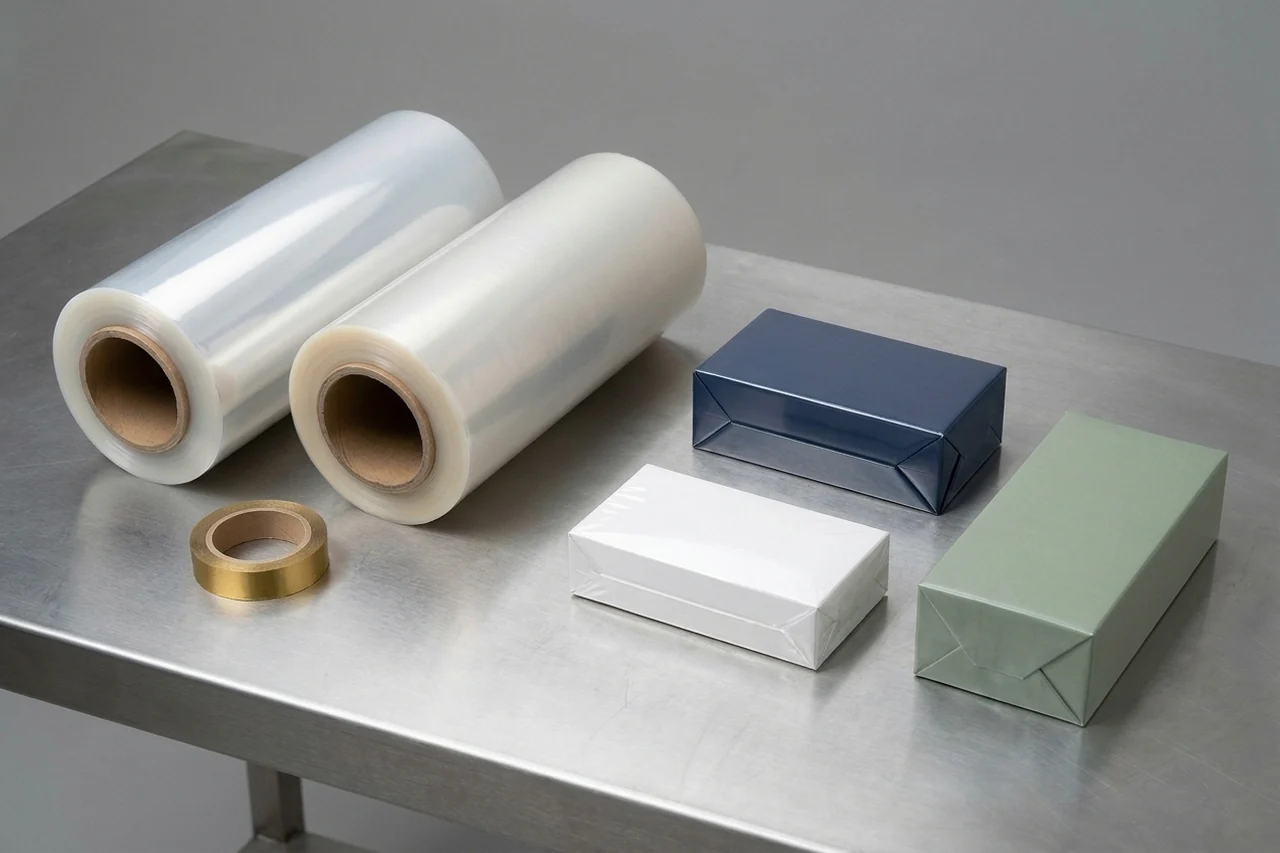
Choose biaxially oriented polypropylene (BOPP) when rigid cartons require crisp paper-like folds, high optical clarity, moisture protection, and stable dimensional control on high-speed overwrappers. Choose regenerated cellulose film (cellophane) when wood-pulp sourcing, biodegradability, compostability, or controlled water-vapor breathability is required—and always confirm a heat-sealable coated grade on the supplier datasheet.
How BOPP film properties support high-speed carton overwrapping
Biaxially oriented polypropylene (BOPP) is produced by extruding polypropylene and stretching it in both the machine direction and across-machine direction, which increases tensile strength and optical clarity. Commercial overwrapping BOPP grades are commonly heat-set on a tenterframe in a constrained state so that shrink properties are removed, keeping folded wraps flat and dimensionally stable.
Polypropylene is petroleum-derived, carries resin density between 0.895 and 0.93 g/cm³, exhibits a Young's modulus between 1300 and 1800 N/mm², and has a commercial isotactic melting point of 160 to 166 °C (320 to 331 °F). Because BOPP is non-reactive, it suits food and pharmaceutical cartons; commercial BOPP webs can be surface-treated, coated with acrylics to modify permeability, metallized, or printed with conventional or soy- and vegetable-based inks, while antistatic additives help polypropylene surfaces resist dust and dirt.
When regenerated cellulose film fits sustainability or breathable pack goals
True cellophane is a thin transparent sheet of regenerated cellulose made from wood pulp and other biomaterials that is compostable and biodegradable. Uncoated cellulose film provides low permeability to air, oils, greases, bacteria, and liquid water while remaining highly permeable to water vapor—making uncoated grades the standard choice for cigar packaging that must breathe in storage—whereas coating with nitrocellulose lacquer adds moisture-proof barrier performance and softening agents such as glycerin prevent brittleness.
Terminology matters during procurement: in the UK and many other countries, Cellophane is a registered trademark of Futamura Chemical UK Ltd, whereas in the USA the word has become genericized and is informally applied even to PVC plastic wraps. Because cellulose film suppliers offer both heat-sealable and non-heat-sealable grades, naming the base material alone never confirms whether a roll will seal on a carton overwrapper—always specify the exact heat-sealable film grade and datasheet.
| Selection property | Heat-set BOPP overwrapping film | Regenerated cellulose film (cellophane) |
|---|---|---|
| Feedstock & end-of-life profile | Petroleum-derived polyolefin polymer; non-reactive for food and pharmaceutical cartons. | Wood-pulp and biomaterial-derived regenerated cellulose; compostable and biodegradable. |
| Manufacturing & fold stability | Stretched in machine and cross-machine directions and tenterframe heat-set to remove shrink; crisp enough to fold like paper. | Cast regenerated cellulose softened with additives such as glycerin to prevent brittleness. |
| Water-vapor & gas/grease barrier | Moisture-protective base film; can be coated with acrylics to alter permeability or metallized. | Naturally low permeability to air, oils, greases, bacteria, and liquid water; high water-vapor permeability unless lacquer-coated. |
| Key physical properties | Density 0.895–0.93 g/cm³; Young's modulus 1300–1800 N/mm²; commercial isotactic melting point 160–166 °C (320–331 °F). | Transparent sheet; cellulose suppliers offer both heat-sealable and non-heat-sealable grades requiring datasheet verification. |
| Typical carton applications | Perfume, cosmetics, tea, playing cards, pharmaceutical boxes, and print-registered retail packs. | Biobased or compostable carton overwraps and breathable cigar packaging. |
How Does Overwrap Film Differ From Shrink Film, and Where Is PVC Still Used?
Overwrapping film folds crisply around rigid rectangular cartons with zero trim waste and localized spot-welded heat seals, whereas shrink film fits loosely around a pack, trims excess edge scrap, and contracts 20% inside a heat tunnel. PVC film remains inexpensive with low gas permeability, but regulatory bans, carbon deposits on sealers, and plasticizer concerns push carton lines toward BOPP or polyolefin films.
Overwrapping film vs. polyethylene and POF shrink film
Unlike tuck-and-fold overwrapping, shrink wrapping places polyethylene film loosely around a product, crimp-seals the perimeter while cutting away excess trim, and shrinks the film roughly 20% in a heat tunnel. Polyolefin (POF) shrink film—commonly supplied in 35, 45, 60, 75, and 100 gauge (1 mil)—adds puncture resistance and clarity for irregularly shaped items or multi-item bundles.
By contrast, tuck-and-fold overwrapping leaves no cut-off excess film, eliminates the heat tunnel, and uses crisper polypropylene film that folds like paper for a tight gift-wrapped finish. Because overwrapping film is not shrunk, converters can print registered graphics and artwork onto the web without heat distortion. Shrink wrap stays preferable for ultra-low-volume runs where changeover setup cost is too high, or for oddly shaped items unsuitable for tuck-and-fold wrapping—compare machine architectures in our types of overwrapping machines guide.
Where PVC overwrap film is still chosen and why many lines replace it
Polyvinyl chloride (PVC) film is light, inexpensive, and offers acceptably low permeability to water vapor and oxygen, which kept it widespread in legacy shrink-wrapping and food-wrap operations. However, PVC has been banned in many countries because it decomposes into harmful products; on production equipment, PVC also performs poorly for bundling, leaves carbon deposits on sealing elements, provides low shrink force, and raises concerns over plasticizer migration into food.
| Comparison factor | Overwrapping film (BOPP / Cellophane) | Polyolefin (POF) / PE shrink film | PVC film |
|---|---|---|---|
| Forming & heat exposure | Mechanical tuck-and-fold with localized heat spot-welding on side lap seam and folded ends; no shrink tunnel. | Loose wrap, perimeter crimp-seal with trimmed excess, then 20% contraction inside a heat tunnel. | Heat-shrunk in a tunnel or stretched as cling wrap; can leave carbon deposits on heated sealing bars. |
| Trim waste & printed artwork | No excess cut-off film; supports print-registered film and undistorted artwork. | Generates cut-off perimeter trim scrap; heat shrinking distorts fine registered graphics. | Trim scrap on shrink lines; low shrink force and poor bundling durability. |
| Typical thickness gauges | 80 gauge (20 microns) to 150+ gauge; over 200 gauge for heavy carton bundling. | POF commonly 35, 45, 60, 75, and 100 gauge (1 mil); heavy PE scales higher for bulky loads. | Thin cling and light shrink gauges chosen primarily for low material cost. |
| Best-fit production role | Rigid rectangular boxes needing crisp folds, premium retail finish, and clean tear-tape opening. | Oddly shaped packages or ultra-low-volume runs where dedicated format change parts are uneconomical. | Legacy low-cost shrink wrapping where local restrictions, carbon buildup, and plasticizer migration do not exclude PVC. |
How Do Film Thickness, Stiffness, and Surface Friction Affect an Overwrapping Machine?
Film gauge, tensile stiffness, and surface friction govern whether cut sheets push cleanly through the folding chute without curling, wrinkling, or static cling. Most retail cartons run between 100 gauge and 150 gauge, while food packs start at 80 gauge (20 microns), luxury perfumes reach 150 gauge or higher, and carton bundling exceeds 200 gauge—verify machine gauge limits before switching.
Gauge-to-micron sizing and machine thickness boundaries
Overwrapping film thickness is specified in gauge or microns (100 gauge ≈ 25.4 μm, so 80 gauge equals roughly 20 μm and 120 gauge equals roughly 30 μm). Under ASTM D882, tensile test methods cover thin plastic sheeting and films under 1.0 mm (0.04 in.) thick, while Terminology D883 defines film as sheeting having a nominal thickness no greater than 0.25 mm (0.010 in.). Because not all overwrapping machines handle every film gauge, confirm the knife assembly, push-feed guides, and heater capacity with your machine builder before shifting to ultra-thin or heavy bundling webs.
| Film thickness (gauge) | Metric thickness (microns) | Typical overwrapping application | Machine & feeding checkpoint |
|---|---|---|---|
| 80 gauge or greater | 20 μm or greater | Standard food cartons and lightweight retail boxes. | Verify sheet stiffness and antistatic control so thin cut sheets do not curl under the knife or push guides. |
| 100 to 150 gauge | 25 to 38 μm (commonly 30 μm at 120 gauge) | Majority of standard retail carton overwrapping applications. | Core working band balancing crisp fold memory, feed rigidity, and predictable heat-seal transfer. |
| 150 gauge or higher | 38 μm or higher | Luxury perfumes, cosmetics, and high-end scented candle cartons. | Higher stiffness gives sharp gift-wrap corners; confirm heater plate dwell time and fold-plow clearance. |
| Over 200 gauge | Over 50 μm | Multi-carton bundling wraps requiring higher structural strength. | Confirm machine gauge capability, cutter blade durability, and dedicated bundle pushers. |
Evaluating film stiffness (ASTM D882) and friction/antistatic slip (ASTM D1894)
Within BOPP alone, commercial films span softer, more flexible grades through stiffer, crisper grades tailored for tuck-and-fold chutes. Under ASTM D882, the tensile modulus of elasticity serves as an index of the stiffness of thin plastic sheeting, providing a repeatable way to compare candidate reels of identical dimensions before factory trials.
Surface slip is equally critical across metal folding plows and heated side plates. Under ASTM D1894, static and kinetic coefficients of friction measure a film sliding over itself or over another surface—including optional elevated-temperature testing above 23 °C by heating the test plane while keeping the sled at ambient temperature. Because slip-additive blooming is time-dependent, ASTM D1894 warns that friction readings are sensitive to film age and surface condition; pairing fresh, properly stored rolls with antistatic additives helps polypropylene resist dust and track straight through the wrapper. To align film handling with machine frame selection, see our overwrapping machine buying guide.
What Carton Products Rely on Overwrap Packaging and How Should You Prepare Trial Reels?
Rigid rectangular cartons across perfume, cosmetics, pharmaceuticals, tea, chocolate, playing cards, cigarettes, and media cases rely on overwrapping film to keep boxes clean, unitize multi-packs, deter pilferage, control odor, and provide tamper-indicating protection. Prepare trial runs with filled production cartons, full film datasheets, tear-tape specs, and a wrapped reference sample so tooling and seal temperatures are validated together.
Retail carton categories and tamper-evident requirements under 21 CFR 211.132
Retail overwrapping protects cartons by keeping packages clean, combining smaller packs into multi-packs, blocking insects, resisting grease and water, controlling odor transfer, carrying barcodes or graphics, and providing tamper-indicating seals. Across our 41 cellophane overwrapping machine configurations, the LV-BT280 / LV-BT350 Series wraps rigid boxes measuring 40–200 × 20–120 × 10–70 mm at 30–80 boxes per minute—spanning perfume, cosmetic, skincare, pharmaceutical, supplement, healthcare, tea, chocolate, face mask, condom, playing card, cigarette, and CD or DVD cartons.
For over-the-counter human drug cartons sold in the United States, 21 CFR 211.132 defines a tamper-evident package as one having one or more indicators or barriers to entry which, if breached or missing, can reasonably be expected to provide visible evidence to consumers that tampering has occurred. The rule specifies that a tamper-evident package may use a secondary-container or carton system and must be distinctive by design or employ an identifying characteristic such as a pattern, name, registered trademark, logo, or picture. To coordinate film optics with opening-strip placement on regulated cartons, review our cosmetic versus pharmaceutical carton overwrapping and tear-tape guide.
Preparing film reels, tear tape, and cartons for a sample trial
Selected configurations in the LV-BT280 / LV-BT350 Series use PID temperature control on the side and end sealing elements, and each box size within the series envelope requires dedicated folding and pushing tooling. Before finalizing your quotation or shipping materials for sample testing, collect the following items or submit your format brief via request a quote:
- Film technical datasheet confirming two-side heat sealability, exact substrate (heat-set BOPP or heat-sealable cellulose grade), gauge/microns, and antistatic or slip treatment.
- Production film reels from the intended converter lot rather than aged stock, noting that ASTM D1894 slip properties vary with film age and surface condition.
- Tear-tape specification (if used), including strip position, color, and any printed identifying mark.
- Several filled production cartons per box size with dimensional tolerances, plus a wrapped reference sample or end-fold photos showing the expected seam and corner finish.
Frequently Asked Questions
Why can you not run standard flow-wrap film on a 3D carton overwrapping machine?
Flow-wrap film is heat-sealable on one side only because a horizontal pillow-pack fin seal bonds the inner face to the same inner face. A tuck-and-fold carton overwrapper requires film that is heat-sealable on both sides because the overlapping longitudinal lap seam and envelope end folds press the outer surface against the inner surface.
What thickness of BOPP overwrapping film is most common for retail cartons?
Most retail carton overwrapping requirements fall between 100 gauge and 150 gauge, while food cartons commonly start at 80 gauge (20 microns), 120 gauge equals 30 microns, luxury perfumes and scented candles often use 150 gauge or higher, and multi-carton bundling can exceed 200 gauge. Confirm your overwrapper's supported gauge range before changing thickness.
Is cellophane the same material as BOPP overwrapping film?
No. BOPP is a petroleum-derived, biaxially stretched, heat-set polypropylene film, whereas true cellophane is a transparent regenerated cellulose film made from wood pulp that is compostable and biodegradable. Because the term cellophane has become genericized in the USA while remaining a registered trademark in the UK and other countries, always verify the base substrate and heat-sealable grade on the supplier datasheet.
When should a packaging line choose shrink film instead of carton overwrapping film?
Shrink film fits ultra-low-volume runs where dedicated carton format change parts are too costly, or oddly shaped packages that cannot be folded neatly with tuck-and-fold plows. For regular rigid rectangular boxes where crisp paper-like folds, zero trim scrap, no heat tunnel, and undistorted print-registered artwork matter, two-side heat-sealable overwrapping film is the better fit.
Does clear overwrapping film alone satisfy 21 CFR 211.132 tamper-evident rules for OTC drug cartons?
Under 21 CFR 211.132, an OTC drug tamper-evident package may use a secondary carton system, but it must be distinctive by design or incorporate an identifying characteristic such as a pattern, name, registered trademark, logo, or picture so it cannot be duplicated with commonly available materials, along with a prominent consumer labeling statement referencing that feature.
Sources
- eCFR — 21 CFR 211.132: Tamper-evident packaging requirements for over-the-counter (OTC) human drug products
- ASTM International — ASTM D1894: Standard Test Method for Static and Kinetic Coefficients of Friction of Plastic Film and Sheeting
- ASTM International — ASTM D882: Standard Test Method for Tensile Properties of Thin Plastic Sheeting
- Wikipedia — Polypropylene (BOPP orientation, density, Young's modulus, melting point, and antistatic additives)
- Wikipedia — Cellophane (regenerated cellulose, water-vapor permeability, nitrocellulose lacquer, and trademark status)
- Wikipedia — Shrink wrap (tenterframe heat-setting of BOPP, POF gauges, and PVC trade-offs)
- Wikipedia — Plastic wrap (PVC barrier properties and plasticizer migration concerns)
- Wikipedia — Overwrap (retail overwrap protective and tamper-indicating functions)
What to send us
Send what you have and mark what is still undecided. Discuss your application with LINEVO.
| Item | Why we need it | Example format |
|---|---|---|
| Overwrapping film datasheet & trial roll | Confirms two-side heat sealability, substrate (BOPP or heat-sealable cellulose), gauge, and slip/antistatic treatment. | Converter TDS listing two-side sealable coating, 100–150 gauge thickness, roll width, and core size |
| Filled production cartons & tolerances | Checks every box against the 40–200 × 20–120 × 10–70 mm LV-BT280 / LV-BT350 envelope and sizes dedicated change parts. | Several filled, glued production boxes per SKU with L × W × H in mm rather than empty mockups |
| Tear-tape & visual finish reference | Aligns easy-open strip position, identifying print, and expected fold appearance before machining format parts. | Tear-tape width, color or print pattern, strip location, and photos or a physical wrapped reference box |
| Target speed & upstream infeed | Confirms operating rate within the 30–80 boxes/min range and coordinates hand-fed vs. inline cartoner transfer. | Required boxes/min per format, single box vs. bundle layout, and plant electrical supply |