
The 2026 Packaging State of the Industry Report, published by PMMI in August 2026, examines market size, 2025 benchmarks, and 2026–2031 forecasts. On unPACKed with PMMI Season 9 Episode 221 ("Packaging Machinery in an Uncertain Market", published October 28, 2026, duration 15:20, hosted by Sean Riley with guest Packaging Specialist Vanessa Lopez of Interact Analysis), Lopez explains that the packaging machinery market continues to grow despite tariffs, high borrowing costs, and economic uncertainty, and notes that packaging has historically outpaced manufacturing because the majority of packaging revenue is focused in food and beverage, while companies are being more strategic with a stronger focus on ROI and improving existing facilities.
- North American food benchmark: Food remained the largest U.S. packaging machinery end market at approximately 44% of total shipment value in 2025, estimated at $5.1 billion in 2025 and projected to reach approximately $7.1 billion by 2031.
- Flexibility over single-format speed: More SKUs, shorter runs, changing package formats, and greater product variety are pushing manufacturers away from dedicated equipment toward systems designed for faster changeovers.
- Parts and OEM services separation: Aftermarket parts demand is driven by customers extending the lifespan of machines operating on the floor for over 30 years and some nearly 40 years, while services growth is largely due to workforce constraints, high turnover, and less experienced workers.
- Readable diagnostics: AI simplifies sophisticated motor and sensor data so operators can identify issues.
On this page
What PMMI’s 2026 State of the Industry Data Signals for Food Packaging Buyers
PMMI’s 2026 Packaging State of the Industry Report is based on 2025 PMMI membership and supplier surveys, 20+ supplier interviews, and datasets from US Census, FRED, BLS, and Interact Analysis through mid-2026. All figures in the report and its September 14, 2026 press release measure the United States and Canada and serve as a North American market signal.
In the United States, US domestic shipments of packaging machinery were valued at $11.7 billion in 2025. Imports of packaging machinery into the United States totaled $3.8 billion during 2025, and major players announced 48 investments into new or existing plants during 2025.
In Canada, Canadian domestic packaging machinery shipments reached approximately $1.2 billion in 2025, up 3.6% from 2024, and are expected to approach $1.3 billion in 2026 and $1.4 billion in 2027. Food represents the largest Canadian end market, accounting for 43.6% of 2025 packaging machinery value. Canada imported approximately $504 million in packaging machinery in 2025, with the U.S. representing its largest source at 30% of imports, and Canada exported approximately $550 million in packaging machinery, with 91% of those exports destined for the United States.
| Market indicator | Benchmark figure | Procurement takeaway for food buyers |
|---|---|---|
| U.S. domestic shipments (2025) | US domestic shipments of packaging machinery were valued at $11.7 billion in 2025. | Capital continues flowing into automation projects with a stronger ROI focus. |
| U.S. imports and plant investments (2025) | Imports of packaging machinery into the United States totaled $3.8 billion during 2025, alongside 48 announced investments into new or existing plants. | Companies are being more strategic, with a stronger focus on ROI and improving existing facilities. |
| U.S. food end-market share (2025–2031) | Food accounted for approximately 44% of the U.S. total at $5.1 billion in 2025 and is projected to reach approximately $7.1 billion by 2031. | Food lines anchor long-term equipment demand. |
| Canadian domestic shipments (2025–2027) | Canadian domestic shipments reached approximately $1.2 billion in 2025 (up 3.6% from 2024), approaching $1.3 billion in 2026 and $1.4 billion in 2027, with food at 43.6% of 2025 value. | |
| Canada–U.S. machinery trade (2025) | Canada imported approximately $504 million in packaging machinery in 2025 (30% from the U.S.) and exported approximately $550 million (91% destined for the United States). |
Interviews conducted for the PMMI study point to SKU proliferation, emerging AI applications, workforce constraints, tighter capital discipline, sustainability and regulatory requirements, and rising input costs as forces influencing equipment decisions. The report analysis highlights retrofit and asset-preservation strategies, end-of-line automation such as robotic palletizers and AMRs, and stronger parts-and-services demand.
SKU Proliferation, Viral Foods, and GLP-1 Recipe Shifts Move Flexibility Up the List
Social-media-driven demand and changing consumer preferences are accelerating the need for machinery capable of frequent changeovers and handling a greater variety of package formats, including single-serve and grab-and-go options. More SKUs, shorter runs, changing package formats, and greater product variety are pushing manufacturers away from dedicated equipment toward systems designed for faster changeovers and greater operational flexibility.
On unPACKed with PMMI Episode 221, when host Sean Riley asked about trends that blow up on TikTok or social media such as cottage cheese driving more SKUs, faster changeovers, and smaller runs, Vanessa Lopez of Interact Analysis stated: “I feel that we are entering an age where creating machines that are more flexible might be the best way forward.”
Lopez also explains that GLP-1 trends mainly cause a shift in the recipe, such as adding more protein, and slight modifications to machinery, as companies look to do more with what they already have.
In secondary packaging, Vanessa Lopez cites cartoning machines and shrinkflation—loading smaller cartons without having to make big changes to the machine—and notes that flexibility might be moving up the list of the most important things machinery manufacturers can offer, with host Sean Riley agreeing. At the end of the line, case erecting, packing, and sealing are converging into integrated systems, while robotic palletizing is gaining traction in applications with frequently changing SKUs, case sizes, and pallet configurations. Extended Producer Responsibility policies and single-use plastic restrictions are also increasing demand for machinery accommodating a broader range of substrates and formats, alongside modular and upgradeable systems.
Translate flexibility into concrete VFFS and cartoner changeover checks
On the unPACKed podcast ahead of PACK EXPO 2026, PMMI Vice President Jorge Izquierdo highlights mix-adjusted throughput attainment, which shows whether equipment performs across the SKU mix, including changeovers, sanitation, and staffing conditions. To evaluate mix-adjusted performance before ordering, separate the adjustments stored in the controller from the physical change parts swapped on the machine.
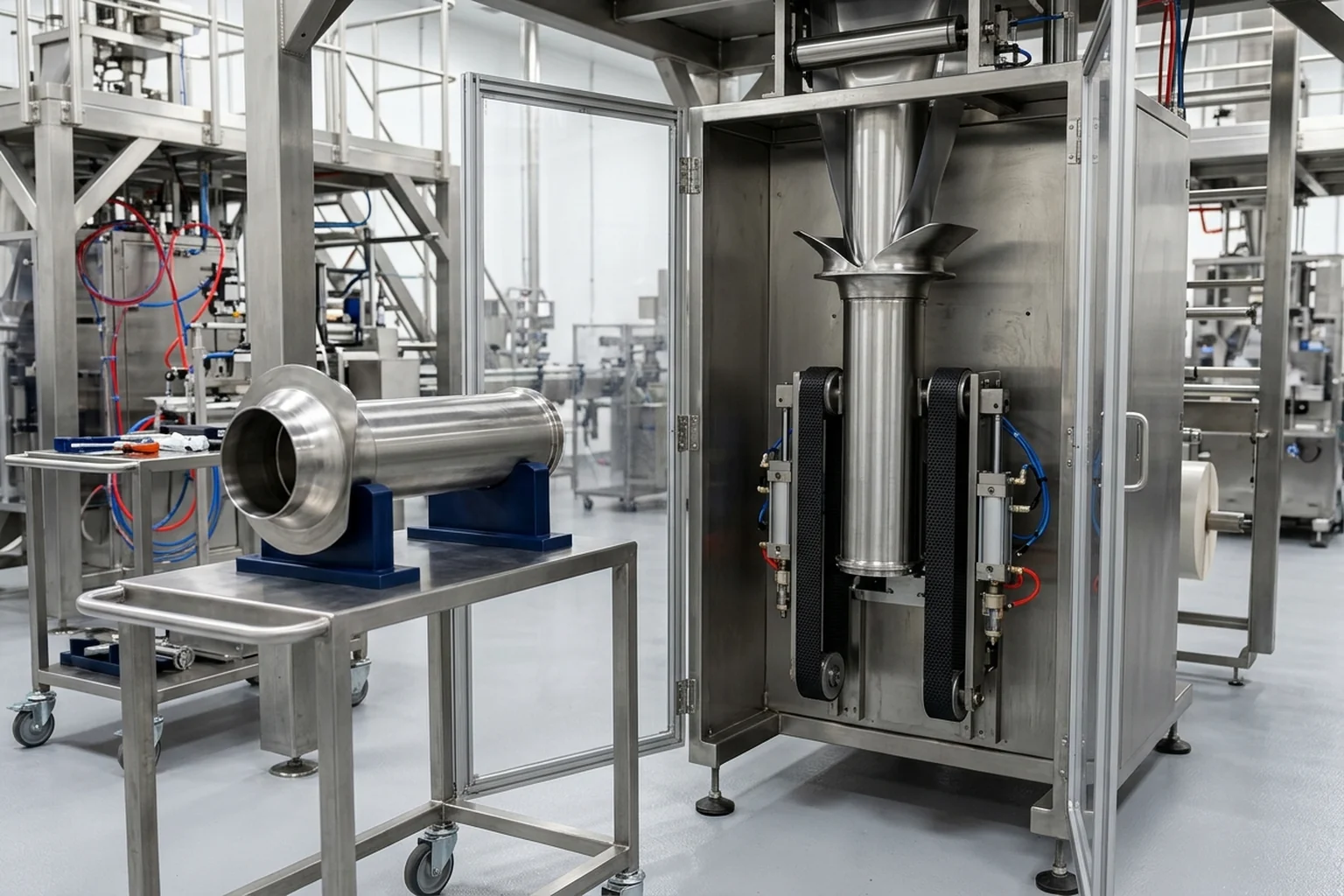
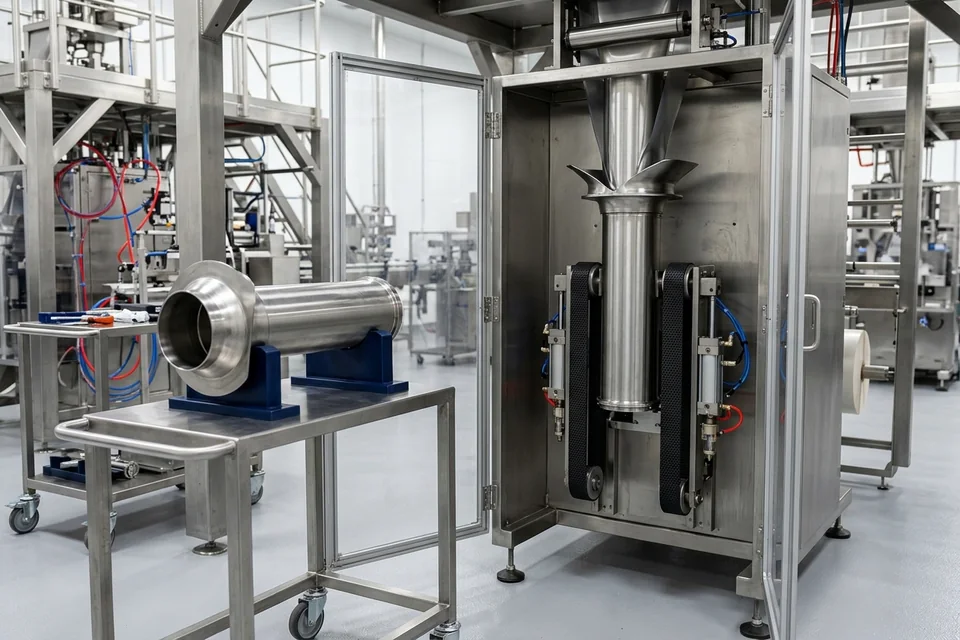
On our snack, chips, and nuts vertical packing machines, the baseline VFFS system with multihead weigher (vffs-multihead) specifies 30–70 bags/min packing speed, 80–350 mm bag length, 60–240 mm bag width using a dedicated forming collar and tube per bag width, and ±0.3–1.5 g weighing accuracy. On the same guide, the chips configuration with nitrogen flushing covers 100–2000 g fills, including 500 g and 1 kg family bags, with bag lengths of 150–400 mm, bag widths of 100–280 mm, and packing speeds of 20–45 bags/min.
When comparing high-speed baggers on our continuous-motion VFFS packaging machines guide, continuous-motion VFFS cross-seals while film travels downward with synchronized following jaws, whereas intermittent motion pauses the film for the cross-seal. For secondary packaging on our automatic cartoning machines and our packaging change-part carts and format kits checklist, a format kit is the agreed set of removable parts for a particular machine and packaging format, mapped in a format-kit register alongside controlled setup sheets or recipe references and SMED external setup staging.
| Machine platform | Parameter or adjustment scope | Physical change parts required |
|---|---|---|
| Baseline VFFS with multihead weigher (vffs-multihead) | Covers 80–350 mm bag length, 60–240 mm bag width, 30–70 bags/min packing speed, and ±0.3–1.5 g weighing accuracy. | Each finished bag width uses a dedicated forming collar and tube. |
| Nitrogen-flushed chips VFFS configuration | Covers 100–2000 g fills (including 500 g and 1 kg family bags), 150–400 mm bag lengths, 100–280 mm bag widths, and 20–45 bags/min. | Dedicated forming set for each bag width. |
| Automatic cartoning machine | Controlled setup sheet or recipe reference with named adjustment points for running smaller or larger cartons. | Carton chain, product bucket, and folding guide parts for each carton size. |
Parts and Services Demand Under 30–40 Year Machine Lifespans and Operator Turnover
PMMI’s 2026 State of the Industry analysis highlights stronger parts-and-services demand alongside retrofit and asset-preservation strategies. On unPACKed Episode 221, Vanessa Lopez separates parts demand from services demand because the two grow for different operational reasons.
Lopez states that parts demand is driven by customers looking to extend machine lifespans—with some machines operating on the floor for over 30 years and some nearly 40 years—by making small changes. By contrast, Lopez states that services growth is largely due to customer workforce constraints, high turnover, and less experienced workers, causing users to look to machine OEMs with in-house teams to bridge the servicing gap.
That workforce pressure is quantified across PMMI’s end-user interviews: PMMI Vice President Jorge Izquierdo states that 95% of interviewed end users find it difficult to find skilled operators, 60% expect that to get worse, and more than 10% of productivity is lost due to workforce issues. PMMI’s Aftermarket Parts & Services Report, published in March 2025 and based on 132 surveys and interviews of OEMs and end users, likewise examines standard versus critical spares, remote access, cybersecurity, technician availability, training, and upgrades/retrofits linked to predictive maintenance.
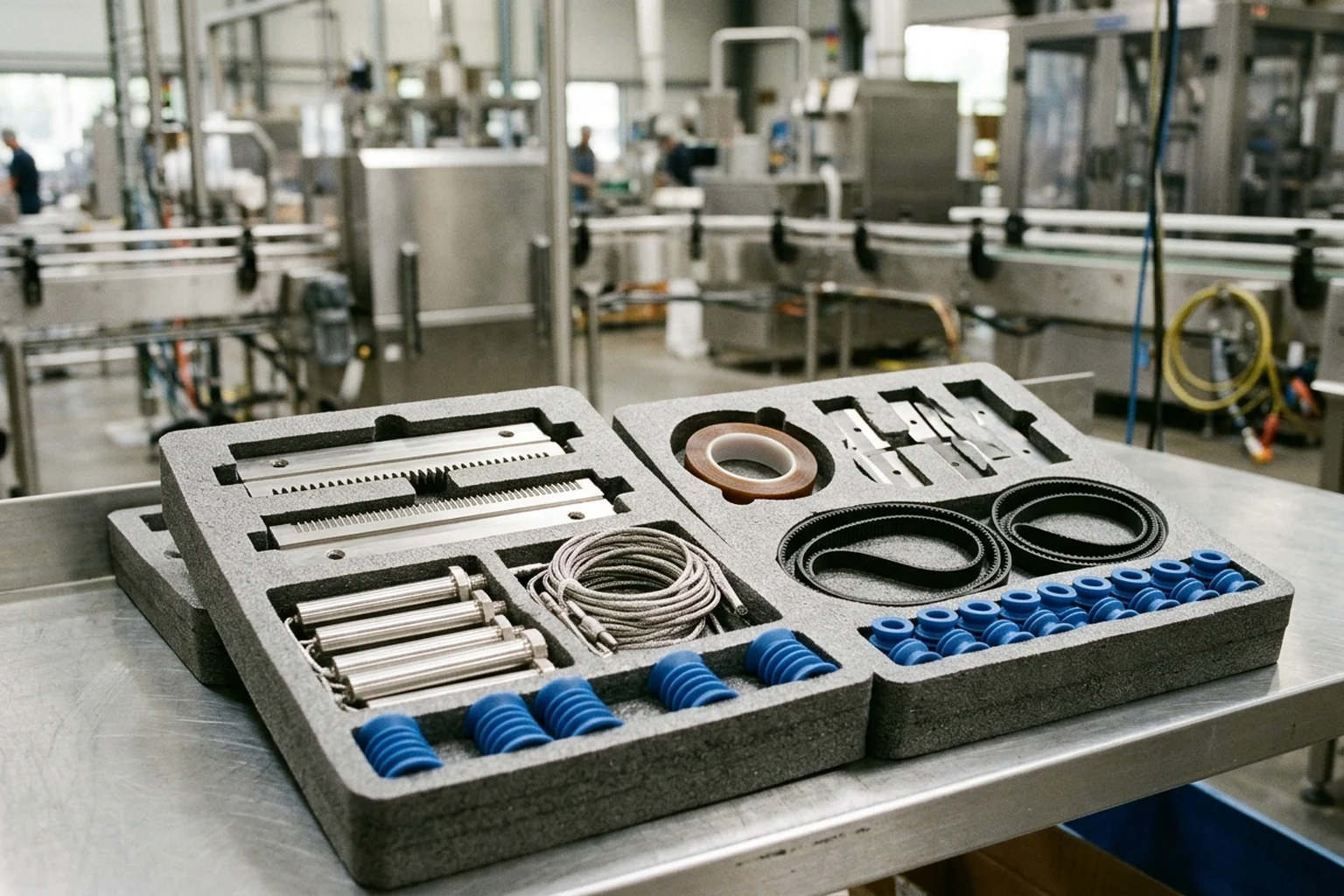
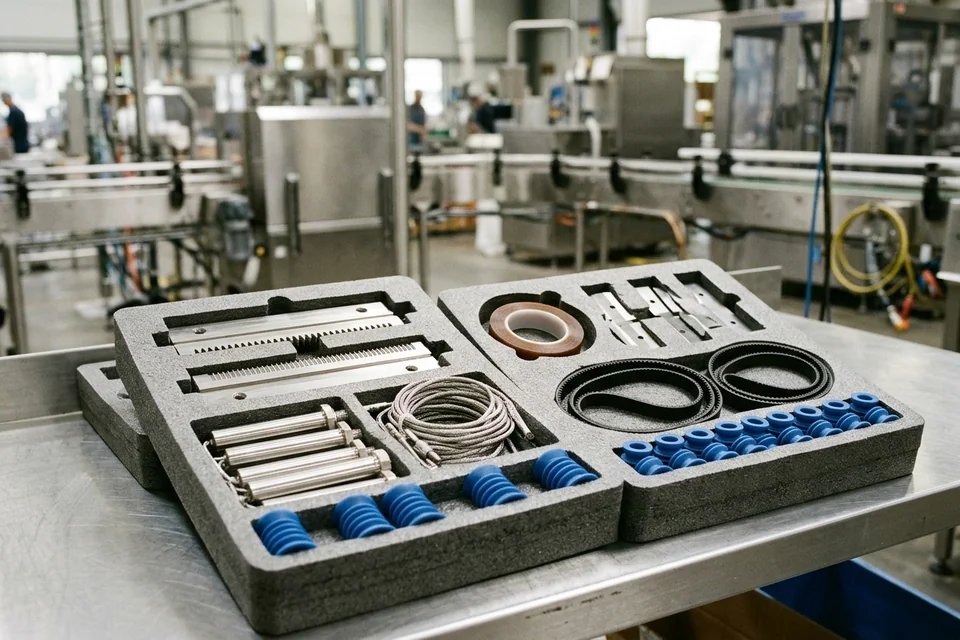
Buyer checklist for spare parts, commissioning handover, and operator training
For overseas food manufacturers and contract packagers, aftermarket continuity starts before the machine leaves the factory. On our packaging equipment spare and change parts service and our installation and operator training program, we structure parts identification, commissioning handover records, and remote video commissioning support around the exact machine serial number and format list.
- Stock critical wear parts with the initial shipment: On our spare parts page, typical wear parts to keep in stock include heat-sealing jaws, heating elements, temperature sensors, PTFE sealing cloth or tape, cutting knives and perforation blades, film pulling belts and conveyor belts, suction cups, seals and O-rings, and springs, bearings, and fuses.
- Specify format change parts per SKU: VFFS change parts use a forming set for each bag width, and cartoner change parts use carton chain, product bucket, and folding guide parts for each carton size.
- Keep a commissioning handover record: At the end of commissioning, record the settings for each format, the parts replaced or adjusted, and the acceptance results so newer operators can repeat changeovers accurately.
- Combine role-based training with remote video support: Pair operator, maintenance, and supervisor training with remote video technical guidance for installation, operation, and fault diagnosis.
AI-Assisted Diagnostics and Readable Maintenance Alerts for Lean Plant Teams
On unPACKed Episode 221, Vanessa Lopez contrasts preventative maintenance, which means regularly checking the machine, with predictive maintenance, where a sensor on a motor detects operation out of its normal functionality and AI simplifies sophisticated data to identify issues. Preventative maintenance remains a common service-model practice, while predictive approaches are gaining ground because software can translate raw component signals into clear operator actions.
Previously, maintenance teams hesitated when monitoring tools delivered complex data streams without explaining how to act on them. Early AI use cases identified in PMMI’s 2026 State of the Industry report include capturing institutional knowledge from retiring employees, developing specifications using previous projects, real-time troubleshooting, and augmenting a constrained workforce. PMMI VP Jorge Izquierdo also highlights QR codes on machines linking operators directly to manuals or training videos at the point of use.
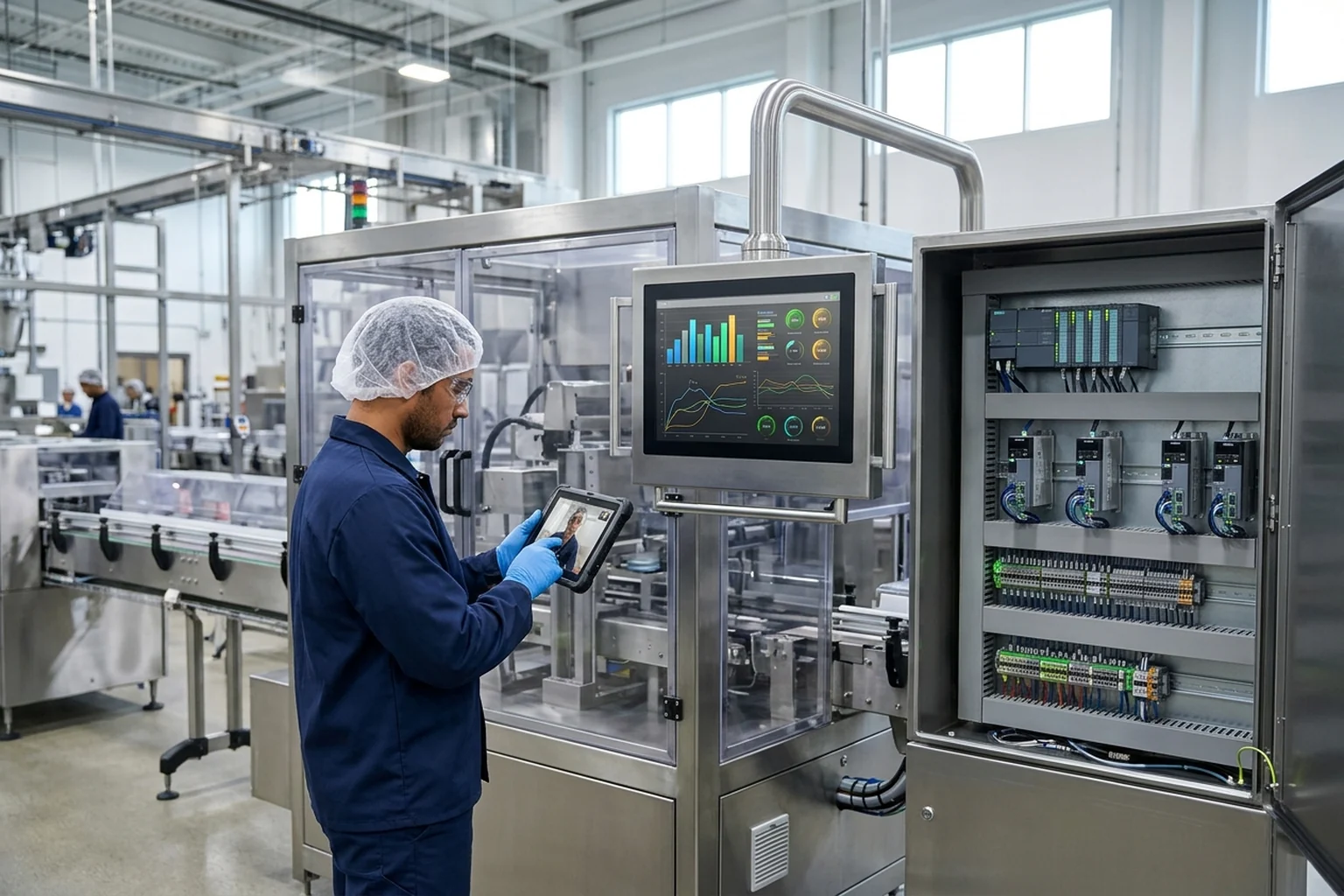
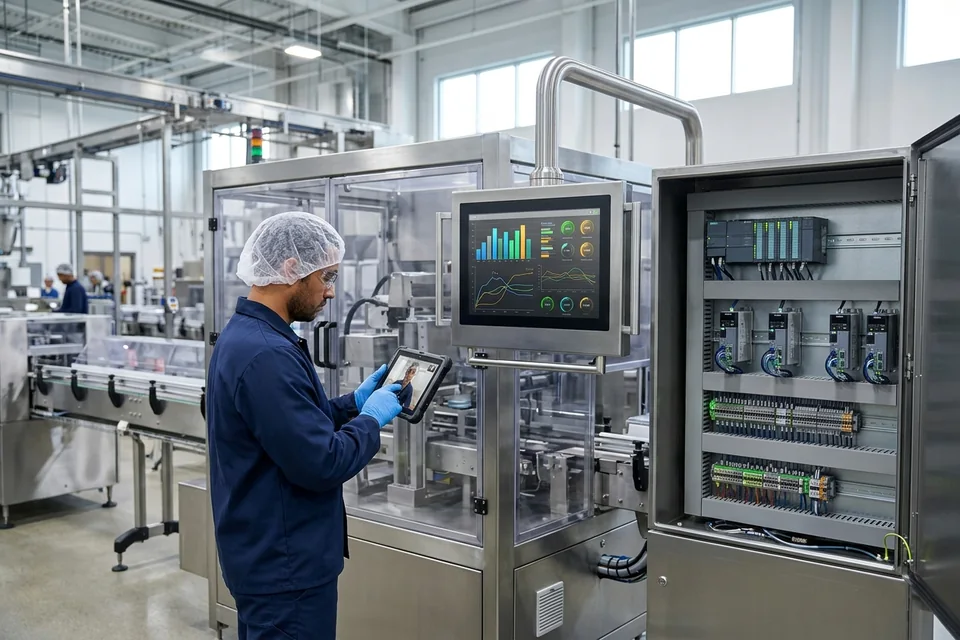
What to check in the machine control architecture and HMI screen layout
When evaluating a supplier’s electrical and diagnostic setup, verify which control hardware is installed and how fault states are presented to operators. LINEVO machines use Siemens PLC/HMI controls and Omron temperature controllers across applicable platforms, with English HMI configurations, electrical drawings, and remote video support for setup, parameter adjustment, fault diagnosis, and maintenance.
Trade Uncertainty and Dual Sourcing: De-Risking Overseas Packaging Equipment Procurement
PMMI’s Q1 2026 Tariffs Quickie Survey was published in April 2026 based on a PMMI membership Quickie Survey of 62 member respondents collected Q2 2025–April 2026. Because those 62 member respondents are PMMI equipment suppliers, the survey captures how machinery manufacturers themselves are managing component costs.
In PMMI’s Q1 2026 Tariffs Quickie Survey, 80.6% of Q1 2026 respondents reported they have been impacted by recently imposed tariffs, 87.8% of Q1 2026 respondents cited increased cost of procurement for imported parts as a tariff impact, and 83.0% of Q1 2026 respondents selected dual sourcing and supply chain diversification to reduce costs. On unPACKed Episode 221, Vanessa Lopez explains that in the United States policies might change in four years or less and making big changes to a supply chain can take a few years in itself, leading to a wait-and-see mentality where possible.
For food brands and co-packers comparing international machinery suppliers as part of a dual-sourcing strategy, de-risking the purchase comes down to transparent engineering specifications and pre-shipment verification. LINEVO is the international project and systems engineering division of the Dession manufacturing group in Foshan, Guangdong, China, manufacturing since 2013 with a 15,000+ m² factory area, 10 machine families, and 5,000+ customers worldwide.
- Standardized controls and sanitary materials: Specify Siemens PLC/HMI controls and Omron temperature controllers across applicable platforms, SUS304 stainless steel product-contact parts (with SUS316 options), and an ISO 9001 quality management framework.
- U.S. plant power and utility coordination: For U.S. projects, LINEVO reviews electrical supply, utilities, line signals, and mechanical handoffs before build and configures machines for 60 Hz plant power.
- Pre-shipment Factory Acceptance Testing (FAT): Define FAT product and film trials, dose and seal checks, and feeding and discharge verification before the machine is crated.
- Recommended spare-parts list: Agree a recommended spare-parts list with the quotation and decide which wear and change parts (forming sets; cartoner chain/bucket/guides) to keep on site from the start.
How to Use These Benchmarks When Shortlisting a Packaging Machine Supplier
Before comparing headline prices across quotations, audit each proposal against the same operational checklist used across our packaging project buyer resources. Sending a structured RFQ package lets our engineering team verify format compatibility, changeover hardware, and lifecycle support up front.
- 1. Map every SKU to its physical format kit and recipe settings: List every bag width, bag length, carton size, and target fill weight in your current and upcoming SKU schedule. Confirm which changes are handled by stored HMI parameters (such as adjusting VFFS bag length within 80–350 mm on vffs-multihead or 150–400 mm on the nitrogen chips configuration) and which require swapping a dedicated forming collar and tube or cartoner chain, bucket, and folding guide parts.
- 2. Size required running speed from net productive shift time: On our snack packaging guide, required running rate equals target shift packs divided by net productive minutes; for 7,200 accepted bags over 360 net productive minutes, the line must sustain 20 accepted bags/min, and running cost per good pack equals period running costs divided by accepted packs. Deduct planned changeovers and sanitation before comparing machine cycle ratings.
- 3. Lock the first-shipment wear-and-spare-parts kit: Require an itemized wear-parts list with the quotation—covering heat-sealing jaws, heating elements, temperature sensors, PTFE sealing cloth or tape, cutting knives and perforation blades, film pulling belts and conveyor belts, suction cups, seals and O-rings, and springs, bearings, and fuses—matched to your shift schedule.
- 4. Specify FAT trials, commissioning handover records, and remote video support: Confirm 60 Hz plant power for U.S. installations, English HMI screens, electrical drawings, pre-shipment FAT runs on your film and product, a written per-format commissioning handover record, and remote video support for operator training and fault diagnosis.
Ready to benchmark your next food packaging line? Send us your current SKU and bag or carton format list, your target changeover window, the age and downtime log of your current machines, and your remote-diagnostics or operator-training requirements to receive a matched configuration and spare-parts scope.
Sources
Industry market benchmarks, survey findings, and first-party equipment specifications referenced in this guide:
- PMMI — 2026 Packaging State of the Industry Report (published August 2026).
- PMMI — 2026 State of the Industry Press Release: PMMI’s 2026 State of the Industry Report Reveals a Packaging Machinery Market Driven by Flexibility, Automation, and New North American Opportunities (September 14, 2026).
- PMMI — Q1 2026 Tariffs Quickie Survey Report (published April 2026; 62 PMMI member equipment supplier respondents collected Q2 2025–April 2026).
- unPACKed with PMMI Podcast — Season 9, Episode 221: Packaging Machinery in an Uncertain Market (published October 28, 2026; host Sean Riley, guest Vanessa Lopez of Interact Analysis).
- unPACKed with PMMI Podcast — The State of Packaging Ahead of PACK EXPO 2026 (published September 16, 2026; featuring PMMI Vice President Jorge Izquierdo).
- PMMI — 2025 Aftermarket Parts & Services Report (published March 2025; 132 surveys and interviews of OEMs and end users).
- LINEVO First-Party Engineering & Application Documentation — Snack, Chips, and Nuts Vertical Packing Machines, Continuous-Motion VFFS, Packaging Change-Part Carts and Format Kits, Spare and Change Parts, Installation and Training, and About LINEVO (2026).
What to send us
Send what you have and mark what is still undecided. Discuss your application with LINEVO.
| Item | Why we need it | Example format |
|---|---|---|
| Product and its behavior | Powder, granule, liquid, paste or solid pieces decide the dosing method and the parts that touch the product. | Free-flowing granules, with a photo of the product |
| Finished pack and fill | The pack style, its size and the fill per pack set the format and the dosing range. | Pillow bag, 100 × 150 mm, 50 g per bag |
| Target output | Output per minute or per shift decides the number of lanes and the model size. | 60 good packs per minute, one shift per day |
| Packaging material | Film or container type affects sealing, forming and the settings we confirm. | Laminated roll film, 250 mm wide, or the film datasheet |
| Site and destination | Power supply, compressed air and destination country decide the electrical and utility scope. | 380 V, 3-phase, 50 Hz, delivery to Germany |