


On this page
Cartoning machines in the pharmaceutical industry
A pharmaceutical cartoner is the secondary packaging step after the blister machine or the bottle line. It opens a carton blank, loads blister cards, strips or bottles together with a folded leaflet, and closes the carton. Coding and inspection stations confirm that each carton carries the right product, leaflet and batch data before it leaves the line.
This LINEVO configuration cartons tablets and other solid dosage forms packed in blisters or bottles. Applications include tablets, capsules and softgels for pharmaceutical and nutraceutical production. Configuration review covers automatic leaflet folding and insertion, optional vision inspection for OCR and barcodes, logic that stops a carton from being closed without its leaflet, digital-dial format settings, and mirror-polished SUS316L contact parts on a SUS304 frame. Our engineers select the required functions and materials for your production line.
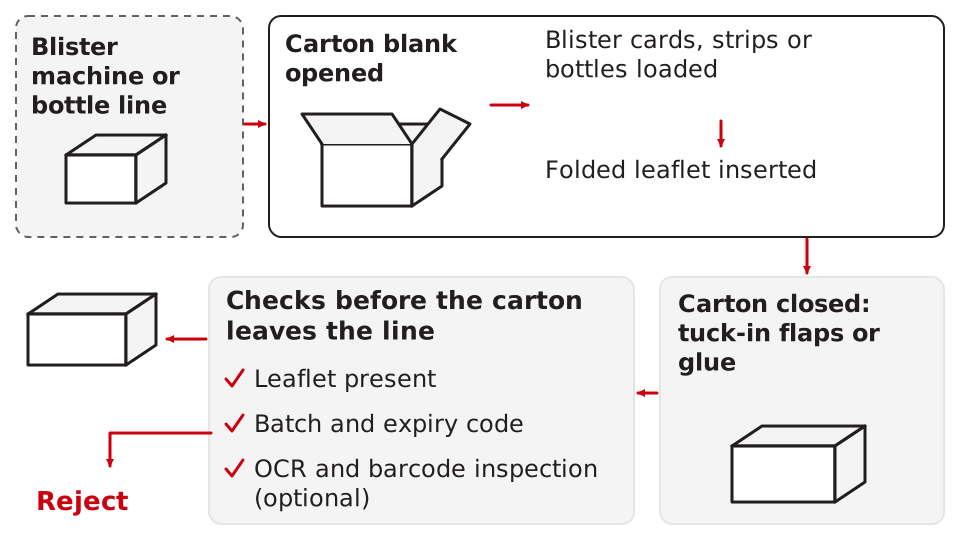
What the cartoner handles is set by your primary pack. Describe each format you run:
- Blister cards and strips: card dimensions, the number of cards per carton, and whether they are stacked or placed side by side.
- Bottles: diameter, height and cap, and whether the bottle is loaded upright or lying down.
- Leaflets: flat sheet size, paper weight and fold pattern, or whether the leaflet arrives pre-folded.
- Cartons: carton drawing, board, closure (tuck-in flaps or glue) and the areas left free for coding.
Leaflet insertion, coding and vision inspection
The leaflet, coding and inspection stations set most of the scope of a pharmaceutical cartoner, so define them before comparing quotations. For each station, say what it must do, what it checks and what happens to a carton that fails.
- Leaflet: folding from a flat sheet or feeding a pre-folded leaflet, the fold pattern, and where the leaflet sits in the carton. Confirm how a missing leaflet is detected and how that carton is rejected.
- Coding: what must be printed or embossed on the carton (batch, expiry, barcode or serial number), on which flap or face, and whether the coder is part of the quoted scope or supplied by another party.
- Vision inspection: optional OCR and barcode inspection are reviewed for the configuration. State what the camera must read or verify, and agree how a failed carton is rejected and counted.
- Records: say which production counts, reject counts or alarms your quality team needs from the machine, and confirm what the control system displays.
Which LINEVO pharmaceutical cartoner to start with
Our pharmaceutical cartoning portfolio covers four configurations. Start with the primary pack and the checks your line requires, then review the feeding, loading and inspection arrangement with representative samples.
| Configuration | Pack formats | Equipment and engineering options | Start here when |
|---|---|---|---|
| This configuration | Tablets, capsules and softgels in blisters or bottles | Leaflet folding and insertion, optional OCR and barcode inspection, SUS316L contact parts | One cartoner must take blister and bottle formats with leaflet and code checks |
| Tablet and blister pack cartoner | Aluminum-plastic blisters, medicine bottles, strip packs and healthcare kits | Leaflet folding and insertion, tuck-in or hot-melt glue closure | Blister and strip packs are the main format, or the closure type is still open |
| LV-GS150 bottle and Alu-PVC blister cartoner | Pharmaceutical bottles and Alu-PVC blister packs | LV-GS150 configuration with speed, power, weight and dimension specifications | You want a model with listed values as the starting point |
| Tablet and capsule cartoner with vision inspection | Tablets, capsules, softgels and supplements from blister or bottle lines | Camera check of carton contents and leaflet insertion, rejection of non-conforming units | Verifying what is inside each carton is the main requirement |
Pharmaceutical cartoning questions
Which cartoner fits tablets in bottles and which fits blisters? Blister cards and bottles are handled differently at the infeed and loading station, so a machine set up for one needs different format parts for the other. If you run both, send both formats and ask which parts change between them. The comparison above shows where each LINEVO configuration starts.
What documentation can be supplied for a regulated project? The documents supplied, and their form, are agreed in the quotation. List what your quality team expects, for example drawings, manuals, spare-parts lists, material records for product-contact parts and qualification protocols. Your quality team defines the applicable regulatory requirements and qualification protocols during project review.
What output can I expect? We define output for your application. It depends on the carton size, the number of blisters or bottles per carton, the leaflet and the closure. Ask for a rate tied to your pack, and check whether each quotation counts cartons or blisters per minute.
How long does a format change take? Format review covers digital-dial settings for changing carton size and dosage configuration. Ask which parts change, which settings are made by dial and how long the change takes for your formats; that time is confirmed in the quotation.
What should I send for a quotation? The blister card or bottle dimensions and count per carton, the carton drawing and board, the leaflet size and fold, the closure, the coding and inspection requirements, the upstream blister or bottle machine and its output, the room and cleaning requirements, and site utilities. Samples of the smallest and largest format help most.
Applications and materials
This configuration serves the following products and applications. Our engineers review product behavior and pack requirements with representative samples.
- Tablets, capsules and softgels in blister packs or bottles, cartoned with a folded leaflet.
- Pharmaceutical and nutraceutical co-packers and health and wellness brands, confirmed with pack samples.
Configuration and scope
We develop the equipment configuration, tooling and integration around your product, pack format and production requirements.
Configuration items for engineering review
- Automated Cartoning Line for Tablets and Solid Dosage Forms (Blister/Bottle)
Machine features
Review these features with our engineering team to select the configuration for your product and packaging requirements.
- Constructed from mirror-polished SUS316L stainless steel (contact parts) and SUS304 frame, designed with no-dead-corner geometry to facilitate rapid, thorough sanitization and validation.
Application questions to review
Our application review addresses the handling and packaging challenges below. Product trials help establish the settings and equipment choices for your material.
- High Risk of Packaging Errors in Solid Dosage Lines: Vision inspection and “No-Leaflet-No-Box” logic check selected packaging conditions during cartoning. Detection settings and reject handling are validated with the carton, leaflet and product.
Specifications and conditions
Our engineers develop an application-specific specification covering output, pack-size range, machine dimensions and utilities for your product and packaging format.
Request a specification review with your product details, pack format and target output.
How this fits the Automatic Cartoning Machines process
Cartoning machines open carton blanks, load products and leaflets, and close each carton with tuck-in flaps or glue. Carton dimensions, the loading method and upstream integration define the scope of a configuration.
This machine is part of our Automatic Cartoning Machines portfolio. Explore the configurations for other products and pack formats, or discuss a tailored arrangement with our engineering team.
This configuration is also listed on a page that compares the options for the same kind of product or machine.
The linked guides explain how this type of machine works and how to choose one.
Questions buyers ask about this configuration
Short answers to what buyers ask most often when they review a configuration.
How do I get output and dimensions for my product?
Our engineers develop an application-specific specification covering output, pack-size range, machine dimensions and utilities for your product and packaging format.
Can I test my product before ordering?
A representative sample test helps resolve material-specific questions before quotation. Please do not ship physical samples until the team has confirmed the quantity needed and where to send them.
Is this the configuration I would receive?
We configure the machine around your product, pack formats and production requirements. Our engineering review defines the model, equipment, options and operating conditions for your project.
What defines the scope of a Automatic Cartoning Machines configuration?
Cartoning machines open carton blanks, load products and leaflets, and close each carton with tuck-in flaps or glue. Carton dimensions, the loading method and upstream integration define the scope of a configuration.
Engineering support
LINEVO engineers develop machine configurations and packaging-line interfaces around your production task. We bring application review, equipment selection and technical support into one project.
Product and packaging-material trials focus on the functions that matter for your application. Our team helps with configuration, operation, parameter adjustment and maintenance planning.
Review your application
Send the following to discuss this configuration. A representative sample test helps resolve material-specific questions before quotation.
- Product name and form (powder, granule, liquid, paste or solid pieces), with a sample or photos
- Target fill weight or volume, or the item count per pack
- Pack type and dimensions, and the packaging material you use
- Target output per minute or per shift
- Site utilities: voltage, phase and frequency, and compressed air
- Any upstream or downstream equipment the machine must connect to
What to send us
Send what you have and mark what is still undecided. Discuss your application with LINEVO.
| Item | Why we need it | Example format |
|---|---|---|
| Product and its behavior | Powder, granule, liquid, paste or solid pieces decide the dosing method and the parts that touch the product. | Free-flowing granules, with a photo of the product |
| Finished pack and fill | The pack style, its size and the fill per pack set the format and the dosing range. | Pillow bag, 100 × 150 mm, 50 g per bag |
| Target output | Output per minute or per shift decides the number of lanes and the model size. | 60 good packs per minute, one shift per day |
| Packaging material | Film or container type affects sealing, forming and the settings we confirm. | Laminated roll film, 250 mm wide, or the film datasheet |
| Site and destination | Power supply, compressed air and destination country decide the electrical and utility scope. | 380 V, 3-phase, 50 Hz, delivery to Germany |