
On this page
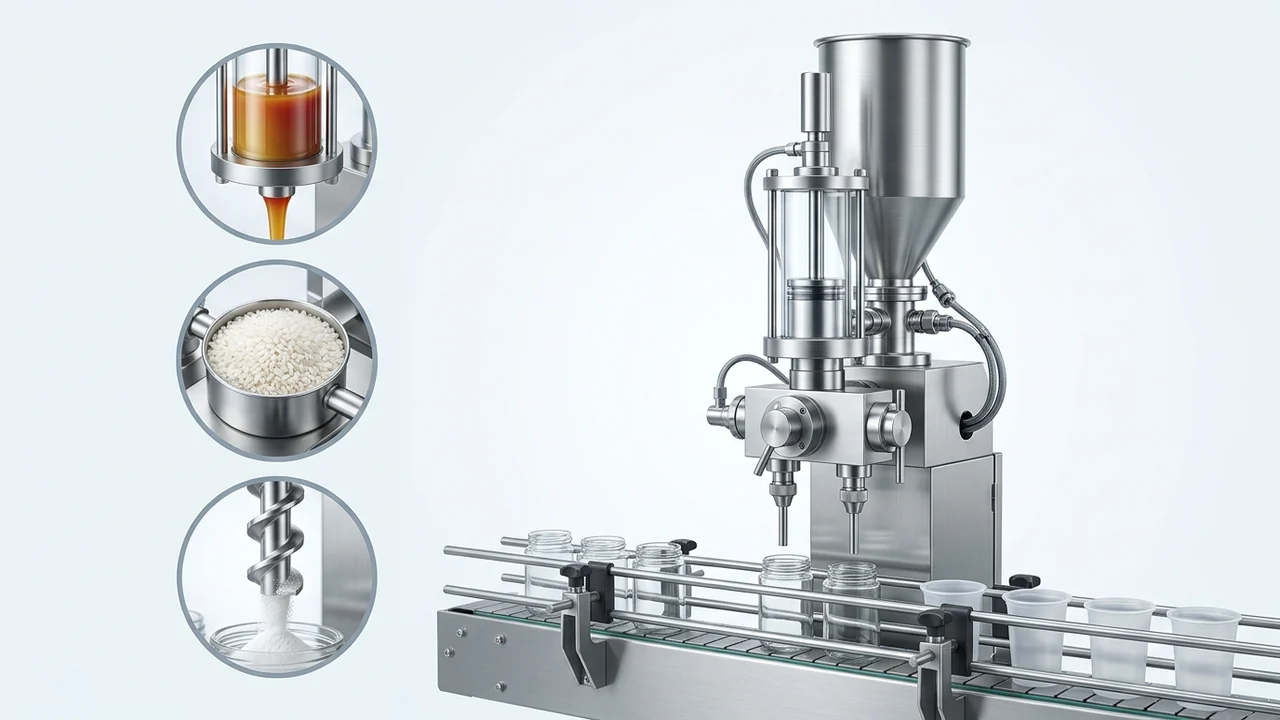
A volumetric filler is a packaging machine that dispenses a fixed geometric volume of liquid, paste, granule, or powder into each container rather than filling by weight or level. Match gravity, piston, volumetric cup, or auger mechanisms to viscosity and bulk density stability, and switch to gravimetric weighing whenever density drift exceeds net-weight tolerance.
Across rigid cups, jars, bottles, stick packs, and vertical bags, choosing between a volumetric filling machine, a fill-to-level liquid filler, and a gravimetric weigher depends on how reliably a fixed volume converts into your labeled net contents. Review viscosity at filling temperature for liquids, bulk density stability for powders and granules, and container headspace before locking in hardware on your filling machines scope.
What Is a Volumetric Filler and How Does It Differ From Level Filling?
A volumetric filler is defined in the USDA FSIS TPSP Glossary as a filler machine that fills containers by a volume of product rather than by weight or level, and may also be referred to as a pocket filler. Because it meters a fixed geometric displacement on every cycle, every container receives the same product volume even when glass or molded plastic containers vary slightly in interior capacity.
By contrast, overflow or fill-to-level liquid fillers bring every bottle to a uniform visual fill height regardless of minor interior container volume discrepancies. With volumetric dosing, two containers with slight wall-thickness differences can show minor headspace differences while holding the exact same dispensed volume. In packaging inspection, headspace is the portion of a container not occupied by the product, so container drawings must account for both target dose volume and required headspace below the rim or closure.
Regulatory net-quantity labeling reinforces this engineering boundary. Under FDA 21 CFR 101.7, packaged foods declare net quantity in terms of fluid measure when the food is liquid—expressed at 68 °F (20 °C) for ambient foods and 40 °F (4 °C) for refrigerated foods—and in terms of weight when the food is solid, semisolid, viscous, or a mixture of solid and liquid. Section 101.7 recognizes only reasonable variations caused by moisture loss or gain in distribution or unavoidable deviations in good manufacturing practice, meaning a volumetric filler labeling by weight must maintain tight density stability or pair with weight control.
| Dosing method | Primary control variable | Container volume variation effect | Typical regulatory and process fit |
|---|---|---|---|
| Volumetric filler (pocket, piston, gravity, auger) | Fixed geometric volume or calibrated displacement per cycle. | Equal volume in every container; minor visual fill-height differences if interior capacity varies. | Liquids declared by fluid measure at 20 °C (68 °F) or 4 °C (40 °F), plus stable-density pastes, granules, and powders. |
| Overflow / fill-to-level filler | Visual liquid height inside the container. | Uniform visual fill line across clear bottles; dispensed volume shifts slightly with interior container variation. | Free-flowing thin liquids in transparent retail bottles where shelf appearance drives fill height. |
| Gravimetric filler (AGFI / net weight) | Direct product mass measured by automatic weighing modules. | Independent of container internal volume; compensates for bulk-density or aeration changes. | Solid, semisolid, viscous, or mixed foods declared by net weight under 21 CFR 101.7 when density shifts. |
How Does the Volumetric Filling Process Work Across Liquid and Dry Dosing?
Every volumetric filling process follows a repeating four-step cycle: supply product to a metering zone, isolate a fixed geometric volume or timed flow window, discharge that dose through a nozzle or funnel into the pack, and replenish for the next cycle. The hardware inside the metering zone changes according to whether the product flows by gravity, requires positive-displacement pressure, or moves as dry granules or cohesive powder.
On a volumetric piston filler, a linear actuator drives a piston back and forth inside a metering cylinder while a switching valve at the cylinder end directs flow. On the return stroke, the valve opens to the infeed hopper or supply tank to draw fresh product into the cylinder; on the forward stroke, the valve switches to the outfeed side and pushes the measured volume through the filling nozzle. Adjusting the piston stroke length sets the displaced fill volume, and operators can set a reduced secondary filling speed near the end of the stroke to prevent splashing without changing the overall dispensed volume.
Dry volumetric systems isolate volume mechanically without liquid valves. A volumetric cup or pocket filler sweeps free-flowing granules from an overhead hopper into rotating telescopic measuring pockets before releasing each measured pocket down a discharge chute. An auger filler meters powder through controlled screw rotation from an agitated hopper through a funnel, while gravity liquid fillers hold low-viscosity liquids in a tank above the nozzles and peristaltic pumps move liquid through flexible tubing.
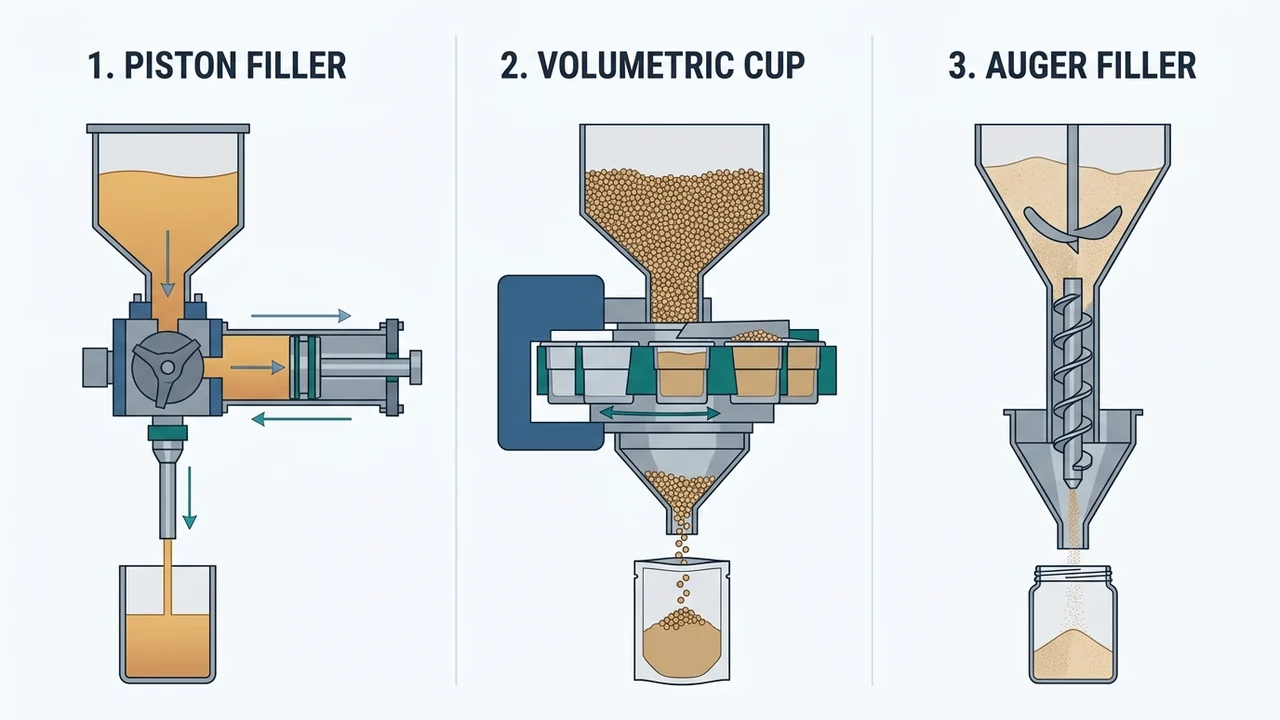
| Volumetric filler type | Metering principle | Best product behavior | Dominant failure mode and prevention |
|---|---|---|---|
| Gravity filling machine | Overhead supply tank above nozzles releases liquid by gravity flow. | Thin, low-viscosity, free-flowing liquids with consistent flow resistance. | Viscosity or head-pressure drift alters dose; confirm stable temperature and liquid viscosity. |
| Volumetric piston filler | Reciprocating piston in a metering cylinder with switching valve and adjustable stroke. | Semi-viscous to thick liquids, sauces, honey, creams, and pastes (5 mL to 5 L single cycle). | Splashing or rim dripping; use secondary reduced fill speed and matched anti-drip nozzle cut-off. |
| Peristaltic / positive pump filler | Peristaltic tubing or rotary pump displaces liquid per revolution. | Viscous fluids or honey cap cavities where tubing isolation aids cleaning. | Stringing into sealing rims; validate nozzle geometry and cut-off with the actual closure cavity. |
| Volumetric cup (pocket) filler | Fixed or telescopic measuring pockets fill from hopper and drop measured dry volume. | Uniform, free-flowing granules such as roasted coffee beans or dry grains. | Weight drift from granule size or bulk-density shifts; verify consistent particle grading. |
| Volumetric auger filler | Calibrated helical screw revolutions meter powder from an agitated hopper through a funnel. | Cohesive, semi-free-flowing, or fine powders such as matcha or seasoning blends. | Bridging, dust at seals, or density-driven mass drift; match agitation, dust extraction, and weighing. |
Volumetric Filling vs. Gravimetric Filling: How Do They Compare?
Volumetric filling meters fixed geometry and infers mass from product density, whereas gravimetric filling measures product mass directly during dosing. Under OIML R 61-1:2017, an automatic gravimetric filling instrument (AGFI) fills containers with a predetermined and virtually constant mass of product from bulk—including liquids—by automatic weighing using feeding devices and weighing modules, with accuracy classes specified for the product nature, installation, operating environment, and fill mass.
For dry products and irregular pieces, selective combination weighing instruments—defined in OIML R 61-1:2017 as AGFIs with multiple weighing modules that compute and combine selected loads into one fill—outperform volumetric pockets whenever piece size or packing density varies. Buyers comparing dry granular lines should review our multihead weigher selection guide alongside volumetric cup and auger routes.
Why Bulk Density Drift Breaks Volumetric Net-Weight Tolerance
In materials science, bulk density (also called apparent density) is the mass of many particles divided by total bulk volume. Crucially, bulk density is an extrinsic property that changes depending on how a powder or granule is handled—pouring, conveying, vibration, aeration, or hopper settling all shift how much mass occupies the same geometric volume.
The math makes the selection boundary unmistakable. In volumetric auger dosing delivering 5 mL per revolution over 10 revolutions, a powder at 0.50 g/mL yields a 25 g dose. If bulk density falls to 0.45 g/mL under the same volume and revolutions, the fill drops to 22.5 g—a 10% shortfall. On a 25 g target with a ±0.5 g tolerance (a 2% allowance), any bulk density shift larger than 2% at unchanged effective volume breaks tolerance, requiring gravimetric weighing or density compensation.
How Automatic Checkweighers Verify Volumetric Lines
Plants that run volumetric fillers on net-weight packages frequently add downstream weight verification. NIST Handbook 44 (2024) Section 2.24 governs Automatic Weighing Systems, establishing Class III tolerances in scale divisions (starting at ±0.5e acceptance and ±1e maintenance for 0 to 500 divisions, widening up to ±2.5e acceptance and ±5e maintenance above 4000 divisions) and default operating temperature limits of −10 °C to 40 °C (14 °F to 104 °F). Section 2.24 ties automatic checkweigher package checks directly to NIST Handbook 133 Appendix A Maximum Allowable Variations (MAVs) for both weight-labeled packages (Table 2-5) and liquid- or dry-volume packages.
| Selection factor | Volumetric filling | Gravimetric filling (AGFI) | Engineering decision rule |
|---|---|---|---|
| Core measurement basis | Displaced volume (mL or L) via stroke, pocket, or screw turns. | Direct mass (g or kg) via load cells or selective combination modules. | Use volumetric for stable-density fluid measure; use gravimetric when net weight must hold across density shifts. |
| Sensitivity to bulk density shifts | High: a 0.50 to 0.45 g/mL drop causes a 10% weight loss at fixed volume. | Low: weighing modules measure actual mass on every discharge. | Switch to weighing or load-cell feedback whenever density shift exceeds target tolerance (such as 2% on 25 g ±0.5 g). |
| Governing metrology reference | USDA FSIS volumetric definition; FDA 21 CFR 101.7 fluid-measure rules at 20 °C (68 °F) or 4 °C (40 °F). | OIML R 61-1:2017 AGFI requirements and NIST Handbook 44 Section 2.24 Class III systems. | Confirm whether packages are audited against NIST Handbook 133 weight MAVs or volume MAVs. |
| Inline verification strategy | Periodic sample checks or inline Class III automatic checkweigher with trend feedback. | Integrated load-cell weighing per cycle with audit checks. | Verify operating ambient stays within −10 °C to 40 °C (14 °F to 104 °F) unless rated otherwise. |
When Should You Choose a Volumetric Piston Filler Over a Gravity Filler?
Choose a volumetric piston filler over a gravity filling machine whenever product viscosity—defined in the USDA FSIS glossary as resistance to flow in a fluid or semifluid, measured by viscometers in centipoise (CPS) or mPa·s—is too high or too temperature-sensitive for free gravity discharge. While gravity fillers rely on an overhead tank above the nozzles for thin liquids, honey, sauces, condiments, and thick pastes change viscosity with temperature, so the product name alone does not define a dosing route.
Volumetric piston cylinders span manual benchtop builds through automated multi-head lines delivering 5 mL to 5 L in a single cycle, and multi-shot counters can trigger repeated strokes—such as five 5 L fills totaling 25 L in one action—for bulk containers. Because both stroke length and forward/return stroke speed are adjustable, adding a slower secondary filling speed at the end of the stroke suppresses splashing without altering total dispensed volume.
Matching nozzle cut-off to the container rim is equally critical on viscous foods. On our sauce cup filling and sealing configuration, a servo piston doses preformed cups prior to thermal foil sealing, where nozzle cut-off at filling temperature prevents rim drips that would compromise seal integrity. For cap cavities and spoon caps, our honey cap-cavity filling configuration offers servo volumetric piston or peristaltic pump alternatives matched against stringing at the cavity rim; for oil-suspension pastes containing herbs or particulates, review our pesto and oil-suspension paste filling guide to specify agitation and valve geometry.
When Do Volumetric Cup and Auger Fillers Fit Dry Products?
Volumetric cup (pocket) fillers fit free-flowing, uniform-density granules that drop cleanly into measuring pockets under gravity, whereas volumetric auger fillers fit fine, dusty, semi-free-flowing, or cohesive powders that require rotating helical flights and hopper agitation to feed reliably. Both routes meter volume, so both require stable bulk density unless paired with load-cell feedback or replaced by gravimetric weighing.
For roasted coffee beans and similar uniform granules on vertical baggers, LINEVO offers a vertical coffee bean packaging configuration with a measuring cup system alongside multihead-weigher options on our VFFS machines family. When packaging fine powders into rigid closures, our matcha powder cap-cavity micro-filling configuration pairs a servo micro-auger with hopper agitation, load-cell feedback, dust extraction, and thermal foil sealing. For screw-flight geometry, cut-off tooling, and powder-flow classification across bags and sticks, see our dedicated auger filler guide.
| Dry product behavior | Recommended dosing route | Critical mechanical check | When to add weighing or switch to AGFI |
|---|---|---|---|
| Free-flowing uniform granules (coffee beans, dry grains) | Volumetric measuring cup (pocket filler) on VFFS or container line. | Verify uniform particle size and smooth pocket release without bridging. | Switch to selective combination multihead weigher when piece mass or bulk density varies. |
| Fine, dusty, or cohesive powders (matcha, seasoning) | Volumetric servo auger filler with matched hopper agitation. | Confirm micro-funnel clearance, dust extraction, and seal-area cleanliness. | Add load-cell feedback or gravimetric auger control when density drift exceeds tolerance (such as 2%). |
| Mixed-size or fragile particulates | Automatic gravimetric filling instrument (selective combination weigher). | Validate gentle discharge drop height and hopper release. | Avoid volumetric cups because void space between irregular pieces shifts fill mass. |
What Drives Volumetric Filler Cost in a Packaging Quote?
Volumetric filler quotation price is driven by the dosing mechanism, number of filling heads or lanes, container carriers and format change parts, product-contact metallurgy, and whether closing or downstream equipment is included in the same scope. Comparing two machinery quotes without normalizing product properties, format count, output rate, and auxiliary scope produces misleading capital comparisons.
Operating economics extend beyond the initial machine invoice. When comparing volumetric and gravimetric configurations over the same production period, buyers must track product giveaway in accepted packs, rejected pack materials from underfills or contaminated seals, and measured changeover and cleaning minutes. A lower upfront filler price can cost more over a year if bulk-density drift forces higher overfill margins or frequent manual stops.
| Cost category | What drives the quotation scope | Operating loss to record over the same period |
|---|---|---|
| Dosing unit and metallurgy | Gravity, servo piston, peristaltic pump, measuring cup, or servo auger; SUS304 vs. SUS316 product-contact parts; heating or agitation. | Product consumed during startup, calibration, and washdown between batches. |
| Heads, lanes, and format tooling | Number of heads or lanes plus carriers, nozzles, pockets, or funnels for every container format. | Measured changeover and cleaning minutes per SKU switch until the first acceptable fill. |
| Closing and line integration | Integrated thermal foil sealing, capping, coding, checkweighing, conveyors, and hand-off signals. | Rejected packs caused by seal contamination, rim drips, or under/over-weight rejects. |
| Accuracy and verification scope | Volumetric head alone vs. load-cell feedback, inline Class III checkweigher, and sample trial/FAT scope. | Product giveaway in accepted packs required to stay inside net-quantity tolerances. |
What Should Buyers Verify When Comparing Volumetric Filler Manufacturers?
When auditing volumetric filler manufacturers for food, beverage, or personal-care lines, buyers should verify sanitary design compliance, control-platform maintainability, and pre-order sample validation on actual product and containers. Under FDA 21 CFR 117.40, food-handling equipment must be adequately cleanable against allergen cross-contact and contamination, use corrosion-resistant food-contact surfaces, feature smoothly bonded seams that minimize particle accumulation and microbial growth, and keep gravimetric, pneumatic, closed, and automated systems cleanable in sanitary service.
LINEVO has manufactured packaging machinery since 2013 across a 15,000 m² facility in Foshan under an ISO 9001 quality management framework covering design, manufacturing, and inspection. Product-contact parts are built in SUS304 stainless steel with SUS316 options for corrosive, cosmetic, or washdown applications, paired with Siemens PLC/HMI controls and Omron temperature controllers across applicable platforms.
Before approving a quotation, run sample testing with both your representative product and production containers. Sending product without its cup, jar, bottle, or closure leaves nozzle clearance, cavity fit, and headspace unresolved—and testing viscous sauces or honey without filling-temperature viscosity data or powders without measured bulk density hides the exact variables that govern volumetric accuracy.
| Input to supply | Required units or details | Engineering decision it locks in |
|---|---|---|
| Liquid viscosity and temperature | Viscosity in mPa·s or CPS at filling temperature in °C, plus measurement method and foaming behavior. | Separates gravity flow from servo piston or peristaltic pump sizing and nozzle cut-off. |
| Powder or granule bulk density | Measured bulk density in g/mL, flow description, and expected handling or batch variation. | Determines volumetric cup vs. auger tooling and whether density drift requires gravimetric weighing. |
| Container, closure, and headspace | Dimensioned container drawings in mm, opening diameter, foil or lid spec, and physical samples. | Confirms carrier tooling, nozzle insertion clearance, and acceptable headspace. |
| Target dose, tolerance, and output | Target fill in mL or g, permitted deviation, audit method (weight vs. fluid measure), and required good packs/min. | Sets cylinder stroke or screw range, head/lane count, and inline checkweigher requirement. |
| Sanitary, controls, and scope boundary | SUS304 or SUS316 contact metallurgy, 21 CFR 117.40 cleaning method, PLC/HMI needs, and upstream/downstream hand-offs. | Separates a standalone volumetric station from an integrated fill-seal or packaging line. |
Compare cup, cap-cavity, and integrated dosing routes on our filling machines overview, or send your viscosity, bulk density, and container checklist through our quotation preparation page to scope a matched configuration and sample trial.
Frequently Asked Questions
What is the main difference between a volumetric filler and an overflow liquid filler?
A volumetric filler dispenses the exact same product volume into every container regardless of small variations in container interior volume, which can leave slight visual fill-height differences. An overflow or fill-to-level filler fills every container to a uniform visual height, allowing slight volume differences between containers.
When should I switch from volumetric filling to gravimetric filling?
Switch to an automatic gravimetric filling instrument (AGFI) or add load-cell feedback whenever product bulk density shifts more than your net-weight tolerance allows. For example, on a 25 g target with ±0.5 g tolerance (2%), a bulk-density drop from 0.50 g/mL to 0.45 g/mL causes a 10% weight shortfall at fixed volume, making pure volumetric control unsuitable.
What fill volume range can a volumetric piston filler handle?
Volumetric piston fillers span manual through automated builds covering 5 mL to 5 L in a single stroke by adjusting piston stroke length. For larger bulk containers, multi-shot counters can trigger repeated cycles—such as five 5 L strokes delivering 25 L in one operation.
How do FDA labeling rules affect choosing fluid volume vs. net weight dosing?
Under FDA 21 CFR 101.7, liquid foods declare net quantity in fluid measure—expressed at 68 °F (20 °C) for ambient foods and 40 °F (4 °C) for refrigerated foods—while solid, semisolid, viscous, and mixed foods declare in terms of weight, with only reasonable GMP and moisture variations permitted.
What sanitary standards apply to food-contact volumetric filling machines?
Under FDA 21 CFR 117.40, food filling equipment must be adequately cleanable against allergen cross-contact and contamination, built with corrosion-resistant food-contact surfaces (such as SUS304 stainless steel with SUS316 options) and smoothly bonded seams, and designed so gravimetric, pneumatic, closed, and automated paths stay sanitary.
Sources
Regulatory texts, metrology standards, and materials-science references cited in this guide:
- USDA FSIS — Thermal Processing of Shelf-Stable Products (TPSP) Glossary (volumetric/pocket filler, viscosity, centipoise, and headspace definitions).
- eCFR — FDA 21 CFR 101.7 Declaration of Net Quantity of Contents (fluid measure vs. net weight rules, 68 °F / 20 °C and 40 °F / 4 °C volume temperatures, and reasonable GMP variations).
- eCFR — FDA 21 CFR 117.40 Equipment and Utensils (cleanability, corrosion-resistant food-contact surfaces, smooth seams, and automated/pneumatic/gravimetric system sanitation).
- NIST Handbook 44 (2024) — Section 2.24 Automatic Weighing Systems (Class III automatic checkweigher tolerances, default temperature limits, and NIST Handbook 133 Appendix A MAV links).
- OIML R 61-1:2017 — Automatic Gravimetric Filling Instruments, Part 1 (automatic gravimetric filling instrument and selective combination weighing definitions and accuracy-class specification).
- Wikipedia — Bulk density (apparent density definition and extrinsic handling dependence of powders and granules).
Discuss your application with LINEVO.
Send your product and container brief