

A row of empty unbranded bottles, a jar, a vial and a tub on a workbench, each with blank white labels in a different position.
LINEVO does not publish a labeling machine price list, and this page gives no amounts. The cost of an industrial labeler is set by its scope: the containers it handles, where each label goes, the confirmed labeling method, the number of labeling stations, the conveyor, any coder, inspection and reject, a shrink tunnel for sleeves, format parts, line integration, installation, training and spares. Two quotes are comparable only when both were written for the same containers and labels and every one of those lines carries a status. The worksheet below records that status for two quotes, with the evidence and the owner of each open question.
| Input or item | Where it comes from | Why it matters |
|---|---|---|
| Container set | Samples or dimensioned drawings of every container size you run, and its surface condition at the labeler | Sets the guides, spacing and holding parts, and whether one machine covers every size |
| Label locations | A drawing of each label on each container: front, front and back, wrap-around, top, or sleeve | Each location has to be mapped to a station in the quote |
| Labeling method | Self-adhesive, glue-applied, shrink sleeve or print-and-apply, confirmed in writing | A different method is a different machine |
| Target output | Your containers per minute and shift pattern | Output depends on the container, the label size and the labels per container, so it is quoted for your case |
| Coding and inspection | The code content and position, and what must be checked and rejected | Decides whether a printer, camera and reject device are needed and who supplies them |
| Line interface | The machines before and after the labeler, conveyor heights and signals | Decides who supplies the conveyor and who owns acceptance of the combined line |
| Project services | Installation, training and spare parts you need | These are arranged per project and can be quoted separately |
On this page
Why do two labeling machine quotes rarely price the same purchase?
Because a labeler quote can cover anything from a label applicator alone to a full line section. On the LINEVO automatic labeling machines page, the quotation scope changes with the number of labeling stations or sides, coding and vision options, integration with filling and capping, and a shrink tunnel for sleeves. No price list or speed figures are published for those configurations, so each one is quoted for the case.
The boundary between a part and a machine matters as much. One labeling equipment manufacturer's product overview, retrieved October 15, 2026, says an applicator generally includes the unwinder, label sensor, dispensing system, base unit and rewinder, and no system for supplying products. Its complete labeling machines add a transport system that brings products to the labeling station and passes them on, with optional separation, alignment, stabilization and rejection of bad products. Supplier terms differ, so treat that as a distinction to check rather than a naming rule.
If one quote is for a labeling head that mounts on your existing conveyor and the other is for a machine with its own transport, the lower total may simply leave out the conveyor, guides and reject.
Step 1 — Which containers and label locations must every quote cover?
Send the same container set and label drawings to every supplier, and keep that version as the shared basis. The container range sets the guides and holding arrangement, and decides whether one machine covers every size you run.
- Container set: every size and shape, as filled and capped samples or dimensioned drawings. Round, square, flat and tapered containers are held and turned differently, as the bottle labeling application guide explains.
- Surface at the labeler: dry, chilled with condensation, or oily after filling. The LINEVO sauce, edible oil and beer configurations name oil residue, cold storage and humid air as conditions that cause labels to peel or bubble.
- Label locations: front only, front and back, wrap-around, top surface or full sleeve, drawn on each container.
- Label roll details: label size, core inner diameter, roll outer diameter, winding direction and gap, from your label printer.
LINEVO's catalog shows how much the container changes the configuration: compare the square edible oil bottle labeler, the honey jar and glass container labeler and the flat bottle labeler for shampoo. Each lists a different container and label layout, and its figures are confirmed in the quotation.
Step 2 — Is the labeling method confirmed, and how many stations are quoted?
Record the method and the station count as two separate lines, and leave each one unknown until the quote states it. A label location tells you where a label goes; it does not tell you how the machine applies it or how many labeling heads it uses.

A roll of blank white labels on a glossy backing liner, with one label partly peeled, beside an unbranded glass jar and a tape measure.
The method changes the machine. Self-adhesive labels come on a backing liner and are peeled off at the labeler; glue-applied labels need cold glue or hot-melt applied by the machine; shrink sleeves are cut from a printed tube and shrunk onto the container; print-and-apply labels are printed just before they are applied. The LINEVO catalog names wrap-around, front-and-back, full-wrap, partial and top-surface labels and shrink sleeves, but does not state the adhesive method for most configurations, so the method is confirmed in the quotation.
Station count needs its own line for the same reason. One labeling machine manufacturer's bottle labeling page, retrieved October 15, 2026, describes wrap-around labeling with two labels carried on one carrier tape, while a labeling-machine page archived October 8, 2026 describes front and back labels applied by separate applicators. Ask each supplier to state how many stations the offer includes and which label each station applies.
Step 3 — Does the quote include container handling or only an applicator?
Ask each supplier whether the offer includes the conveyor, infeed spacing, guides and any stabilization, or whether the labeling unit relies on transport you already have. Container handling is a supplied subsystem on many labelers, and it is where two quotes most often differ without saying so.
LINEVO's small vial label applicator shows what to look for. Its source listing describes a servo-driven synchronous conveyor and a V-block stabilization system that keep small vials steady, and the page treats each as an item to confirm in the quotation. A tube labeler page archived October 6, 2026 likewise describes an integrated conveyor and product guides as part of that machine.
- Supplied or existing transport: who supplies the conveyor through the labeler, and its length and height.
- Infeed and spacing: how containers arrive and are separated before the label station.
- Holding and stabilization: guides, belts or other parts that keep each container steady, for every size in the set.
- Outfeed: where labeled containers go, and who supplies the transfer to cartoning or case packing.
Step 4 — Are coding, inspection and reject separate lines in each quote?
Split them into three lines: what is printed, what is checked, and what happens to a failed container. A quote can include a coder while leaving the camera, the reject device or the integration of either one unstated.
The LINEVO vial configuration lists an interface for ink-jet or thermal-transfer printers and for vision detection of label presence, print quality and batch or expiry data. That page asks buyers to state which data must be printed and checked, confirm whether the printer and camera are included, optional or supplied by another party, and agree how failed vials are rejected. An interface is not the same as a supplied printer or camera.
Public manufacturer pages show the same split. One wrap-around labeler for healthcare products, described on a page retrieved October 15, 2026, can be supplied with a choice of printing and control systems and one of several reject stations, or configured without printers and control systems. Its monitoring systems check print, variable text and codes, and sensors check that labels were applied.
If your labels carry batch coding, serialization or barcode verification, the pharmaceutical ampoule and vial labeling line is the LINEVO catalog configuration that lists those functions. Its listing is a starting point for review, not a statement that a particular regulatory requirement is met.
Step 5 — For shrink sleeves, is the tunnel in the same offer?
Only if the quote says so. A shrink sleeve applicator cuts the sleeve and places it on the container; the heat tunnel that shrinks it onto the container is a separate unit. A shrink sleeve equipment maker's FAQ, retrieved October 15, 2026, makes this distinction and lists steam, radiant and convection tunnels, conveyor integration, optional infeed timing or spacing parts, and controls as parts of a complete system.

Three unbranded plastic bottles on a steel table: one bare, one inside a loose blank sleeve, and one with a white sleeve shrunk tight, beside a stack of flat sleeves.
The LINEVO beverage bottle shrink sleeve labeling machine lists steam or hot-air tunnel control as a source-listed feature to confirm, and the shrink sleeve labeling line lists sleeve application with a shrink tunnel. Either way, the quotation confirms the tunnel, its heat method and the utilities your site has to provide.
- Tunnel: included, optional or excluded in each offer.
- Heat method: steam, hot air or another method, as the quote states.
- Heat source and utilities: whether steam generation is supplied, and what power, air or steam your site must provide.
- Sleeve material: the sleeve film, seam and printed sleeve, tested on your bottle.
Step 6 — Who supplies format parts, line integration, training and spares?
Name them in writing per container size and per service, because each can sit inside the total, beside it as an option, or outside the offer altogether.
- Format parts: a new container or label can need new guides or holding parts. The LINEVO vial configuration lists tool-less mandrels for changing vial diameter as an item to confirm. Ask which parts and settings are included for every container in the set, and how each change is made.
- Integration owner: a standalone labeler needs its own infeed and spacing; an integrated line needs conveyor heights, signals and buffers planned between machines. Name who supplies the conveyors, who connects the signals and who signs off the combined line. If filling is part of the project, see filling machines and plan your packaging system.
- Installation and training: whether support is remote or on site, the languages and documentation required, the schedule and any separate costs are agreed for the project, as described on installation and training.
- Spares: ask for a recommended spare parts list with the quotation, and mark which parts are supplied with the machine and which are only recommended.
The labeling quote scope worksheet
Copy both tables into your own sheet or print the page. Fill the shared requirement once, then give every row one inclusion status per quote, from the offer's own wording:
- Included: named in the offer and covered by its total.
- Excluded: stated as outside the supply.
- Optional: offered at an extra amount or as a choice.
- Unconfirmed: not mentioned, or mentioned without saying whether it is supplied. A blank cell is unconfirmed.
- Not applicable: only with a reason tied to the confirmed process, such as a confirmed self-adhesive method for the tunnel row.
Inclusion and technical confirmation are different things. A coder can be included while the code content and inspection boundary are still open, so record the quote revision and date, the supplier's written confirmation and any open question in the evidence column.
| Item | Shared requirement | Quote A: scope / status | Quote B: scope / status | Evidence / owner / open question |
|---|---|---|---|---|
| Container set | Every container size, as samples or drawings, with surface condition at the labeler | |||
| Label locations | Drawing of each label on each container | |||
| Method confirmed / unknown | Self-adhesive, glue-applied, shrink sleeve or print-and-apply, as stated in the quote | |||
| Station count | Stations quoted, and which label each one applies | |||
| Conveyor | Supplied or existing transport, infeed spacing, guides and stabilization | |||
| Coder | Code content and position; printer supplied or interface only | |||
| Inspection | What is checked, where, and how failed containers are rejected | |||
| Sleeve tunnel | Only for a confirmed shrink sleeve process: tunnel, heat method, heat source and site utilities | |||
| Format parts | Parts and settings for every container and label in the set | |||
| Integration owner | Who supplies upstream and downstream conveyors, connects signals and accepts the combined line | |||
| Training / spares: installation and training | Remote or on site, languages, documents, schedule | |||
| Training / spares: spare parts | Parts supplied with the machine, and parts only recommended | |||
| Inclusion status | Every row above carries a status for both quotes |
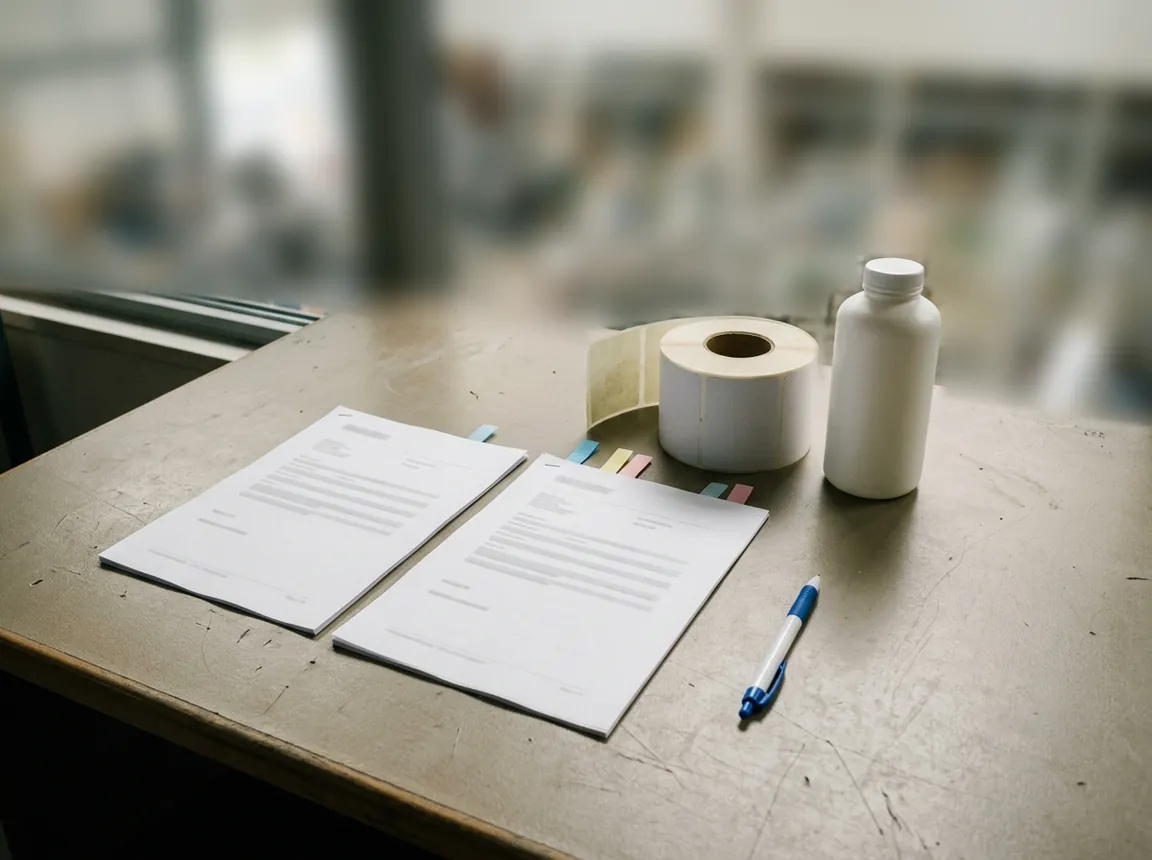
Two stapled documents side by side on a desk with a pen, colored tabs, a roll of blank labels and an empty white bottle.
| Open item | Quote | Question sent | Responsible person | Closure document |
|---|---|---|---|---|
| 1 | ||||
| 2 | ||||
| 3 | ||||
| 4 |
When can you compare the two totals?
Compare the totals only after every row carries the same status on both quotes, or each difference has been listed and answered. Until then, ask the suppliers in writing and note where each answer appears.
- Unconfirmed on one quote, included on the other: ask the first supplier to state the line, then mark it again.
- Optional: keep that line and its amount beside the total it belongs to, instead of folding it in.
- Excluded: the line is outside that offer, so decide who supplies it and add it to the open items.
- Different method or station count: the offers describe different configurations. Ask both for the same method and label layout, or treat them as separate options.
Prices, delivery, installation, training and acceptance criteria are confirmed in the quotation, not from a price list.
When this worksheet does not apply
- Desktop label makers and label printers: a different product from an industrial labeler.
- Label stock, ink and cost per label: this page does not budget consumables.
- Manual and tabletop labelers: not covered by this worksheet.
- Choosing a machine type from scratch: start with the labeling machine overview, then come back to compare quotes.
- Return on investment or payback: this page does not estimate them.
What to send, and what happens next
Send the worksheet with your container set, label drawings and roll details, the method if you know it, the code content and checks you need, any shrink sleeve details, the machines before and after the labeler, your target output and your site utilities. Mark anything undecided as open. The team uses that record to confirm the configuration and its scope lines in the quotation.
If container or label samples are needed, agree the quantity and address before shipping, as described in sample-testing preparation.
Method and sources
LINEVO scope statements come from the automatic labeling machines page, the small vial, pharmaceutical line and beverage shrink sleeve configuration pages, and the installation and training, spare parts and sample-testing pages, reread on October 15, 2026. Catalog listings are items to confirm, not included equipment or tested performance.
Public manufacturer pages supply only the scope distinctions credited in the text: a labeling equipment overview, a healthcare wrap-around labeler page and a bottle labeling page from one labeling machine maker, and a shrink sleeve systems page from another, all retrieved October 15, 2026; and a tube labeler page and a labeling-machine page archived October 6 and October 8, 2026. Their speeds, ratings and prices were not used. Photographs on this page show unbranded containers, sleeves and documents; they are not records of a LINEVO test or a customer installation.
What to send us
Send what you have and mark what is still undecided. We reply within 24 hours.
| Item | Why we need it | Example format |
|---|---|---|
| Container set | Keeps every quote on the same sizes and holding parts | Filled, capped samples of each size, or dimensioned drawings; quantity agreed before shipping |
| Label locations and roll details | Each label has to be mapped to a station, and the station set up around your roll | Label drawing on each container; label size, core, roll diameter, winding direction |
| Labeling method | Self-adhesive, glue-applied, shrink sleeve or print-and-apply change the machine | Self-adhesive paper labels on a roll, or "not decided" |
| Coding and inspection | Decides the coder, camera and reject lines | Batch and expiry printed on the label; label presence checked; failed units rejected |
| Line interface | Sets the conveyor scope and who owns the combined line | Filler and capper upstream, case packer downstream, conveyor height |
| Target output | Output is quoted for your containers and labels | Containers per minute and shifts per day |
| Site and services | Sets tunnel utilities, installation, training and spares | Power, compressed air, steam if available; on-site or remote support; training language |