


On this page
Label applicator machine for boxes and cartons
This LINEVO configuration applies labels to the top surface of food boxes and cartons as they move along a conveyor. Applications include food boxes, snack cartons, lunch containers and ready-meal packaging with promotional, nutritional or branding labels. Start here when the label goes on the top face; side and two-face labeling are reviewed per project, as described below.
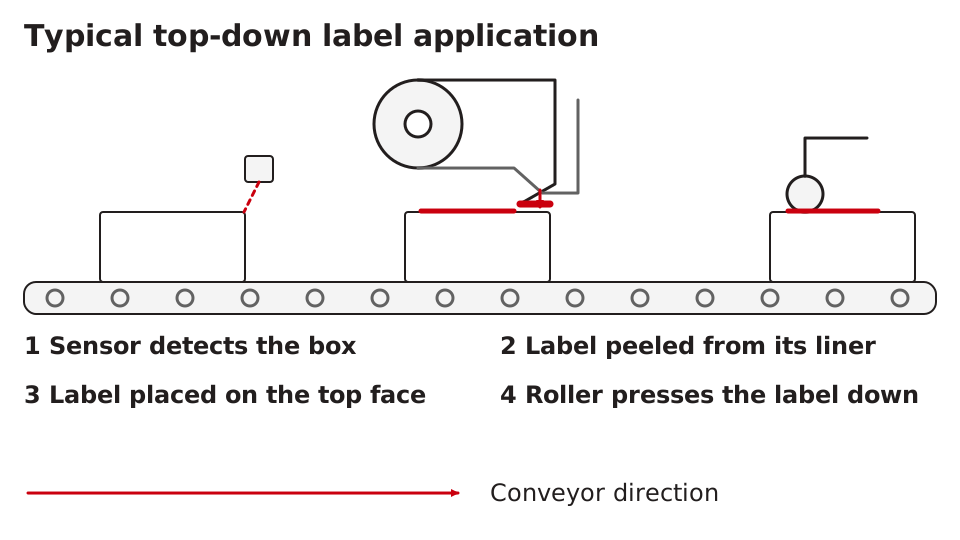
In a typical top-down setup, a sensor detects each box, the label head peels a label from its liner and places it on the top face as the box passes, and a roller presses it down. Engineering review covers the synchronized conveyor, box-position sensing and multi-stage pressure rollers for large labels, selecting the arrangement for your boxes and labels.
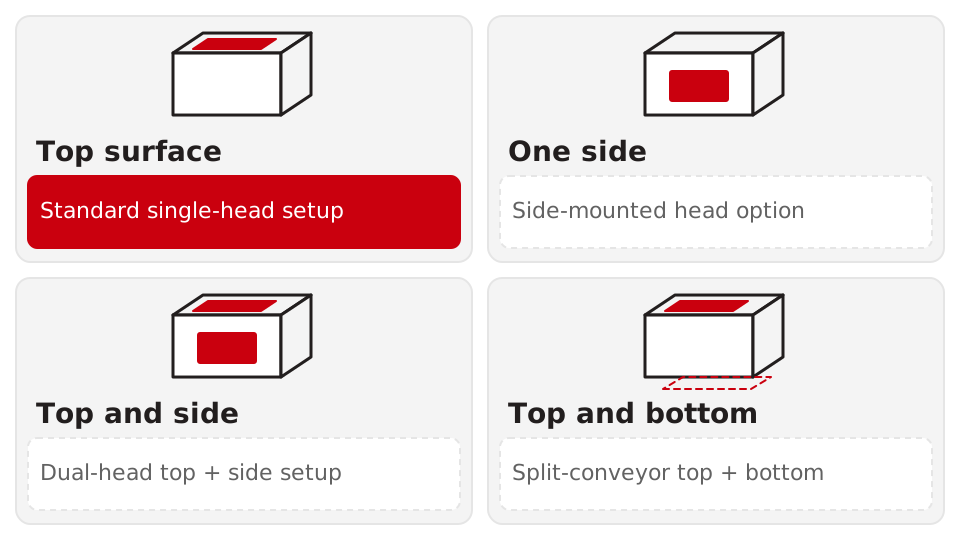
Top, side or top-and-bottom labeling
Each label position needs its own labeling head and a way to hold the box steady at that face. Choose the configuration by where the labels go, then confirm it with your boxes.
| Label position | What it needs | Status for this configuration |
|---|---|---|
| Top surface | A label head above the conveyor and a flat, stable top face | Standard single-head top-surface arrangement |
| One side | A side-mounted head, with guides or belts that hold the box against it | Configured with a side-mounted labeling head |
| Top and side | Two heads working in step on one conveyor | Configured with dual heads; compare the box labeling line below |
| Top and bottom | Access to the underside, for example a gap between two conveyors with a head below | Configured with split-conveyor bottom head and top applicator |
If labels go on more than one face, or labeling must run in step with a cartoner, coder and checkweigher, compare the industrial box labeling line. The line configuration covers top or side labeling under one PLC for snack boxes, frozen meal cartons and dried food packages.
What decides label placement on boxes
Label placement on a box depends as much on the box and the feed as on the label head. Check these points with samples before agreeing a placement tolerance.
- Box range: the smallest and largest box, and how much boxes of one size vary. Send production boxes, not hand-made samples.
- Top face: flaps, tuck lids, bulging or a sealed film lid change how flat the label surface is. Mark the label zone on a drawing.
- Board surface: coated, varnished or textured board affects adhesion and trapped air. The pressure-roller arrangement is reviewed with your board and label.
- Label: size, material, adhesive type, roll core and outside diameter, and the gap between labels on the liner.
- Feed: how boxes arrive (spacing, orientation, from a cartoner or by hand) and the target boxes per minute.
- Coding and checks: review integration with ink-jet or thermal-transfer printers and vision detection of label presence and print quality. Say what must be printed or checked, and whether that equipment is included, optional or supplied by another party.
- Format changes: review digital-dial settings and tool-less parts for changing box size or label position. Ask which parts change and how long the change takes for your formats.
Box labeling questions
Can one machine apply top and side labels? This configuration labels the top surface. A second head for a side label is reviewed per project, and the box labeling line is the other starting point when several faces carry labels.
Is top-and-bottom labeling possible on the same line? It needs a way to reach the underside of the box while it keeps moving. Whether that can be built for your box size and label is an engineering question, so send box samples and the label positions.
What placement accuracy can I expect? We establish placement tolerance with your box and label and define the measurement method during engineering review.
What output can I expect? We define output for your application. It depends on box length, label length, the gap between boxes and the label position, so ask for a rate tied to your formats.
What should I send for a quotation? Production boxes of each size, label samples or the label specification with a drawing of the label position, the codes to print, the target boxes per minute, the upstream and downstream equipment, and site utilities.
Applications and materials
This configuration serves the following products and applications. Our engineers review product behavior and pack requirements with representative samples.
- Food boxes, snack cartons, lunch containers and ready-meal packaging that carry a label on the top surface.
- Promotional, nutritional and branding labels for food manufacturers and packaging centers, confirmed with box and label samples.
Configuration and scope
We develop the equipment configuration, tooling and integration around your product, pack format and production requirements.
Configuration items for engineering review
- Precision "Top-Surface" Labeling Engine
- servo-driven synchronous conveyor mechanisms
Application questions to review
Our application review addresses the handling and packaging challenges below. Product trials help establish the settings and equipment choices for your material.
- Air Bubbles on Large Labels: The machine features a multi-stage pressure-roller system that applies uniform, gradual force across the entire label, ensuring a smooth, premium finish that enhances packaging value.
Specifications and conditions
Our engineers develop an application-specific specification covering output, pack-size range, machine dimensions and utilities for your product and packaging format.
Request a specification review with your product details, pack format and target output.
How this fits the Automatic Labeling Machines process
Labeling machines apply self-adhesive labels to bottles, jars, cans or boxes as they pass along a conveyor. Container shape, label positions and coding or inspection options define the scope of a configuration.
This machine is part of our Automatic Labeling Machines portfolio. Explore the configurations for other products and pack formats, or discuss a tailored arrangement with our engineering team.
The linked guides explain how this type of machine works and how to choose one.
Questions buyers ask about this configuration
Short answers to what buyers ask most often when they review a configuration.
How do I get output and dimensions for my product?
Our engineers develop an application-specific specification covering output, pack-size range, machine dimensions and utilities for your product and packaging format.
Can I test my product before ordering?
A representative sample test helps resolve material-specific questions before quotation. Please do not ship physical samples until the team has confirmed the quantity needed and where to send them.
Is this the configuration I would receive?
We configure the machine around your product, pack formats and production requirements. Our engineering review defines the model, equipment, options and operating conditions for your project.
What defines the scope of a Automatic Labeling Machines configuration?
Labeling machines apply self-adhesive labels to bottles, jars, cans or boxes as they pass along a conveyor. Container shape, label positions and coding or inspection options define the scope of a configuration.
Engineering support
LINEVO engineers develop machine configurations and packaging-line interfaces around your production task. We bring application review, equipment selection and technical support into one project.
Product and packaging-material trials focus on the functions that matter for your application. Our team helps with configuration, operation, parameter adjustment and maintenance planning.
Review your application
Send the following to discuss this configuration. A representative sample test helps resolve material-specific questions before quotation.
- Product name and form (powder, granule, liquid, paste or solid pieces), with a sample or photos
- Target fill weight or volume, or the item count per pack
- Pack type and dimensions, and the packaging material you use
- Target output per minute or per shift
- Site utilities: voltage, phase and frequency, and compressed air
- Any upstream or downstream equipment the machine must connect to
What to send us
Send what you have and mark what is still undecided. Discuss your application with LINEVO.
| Item | Why we need it | Example format |
|---|---|---|
| Product and its behavior | Powder, granule, liquid, paste or solid pieces decide the dosing method and the parts that touch the product. | Free-flowing granules, with a photo of the product |
| Finished pack and fill | The pack style, its size and the fill per pack set the format and the dosing range. | Pillow bag, 100 × 150 mm, 50 g per bag |
| Target output | Output per minute or per shift decides the number of lanes and the model size. | 60 good packs per minute, one shift per day |
| Packaging material | Film or container type affects sealing, forming and the settings we confirm. | Laminated roll film, 250 mm wide, or the film datasheet |
| Site and destination | Power supply, compressed air and destination country decide the electrical and utility scope. | 380 V, 3-phase, 50 Hz, delivery to Germany |