
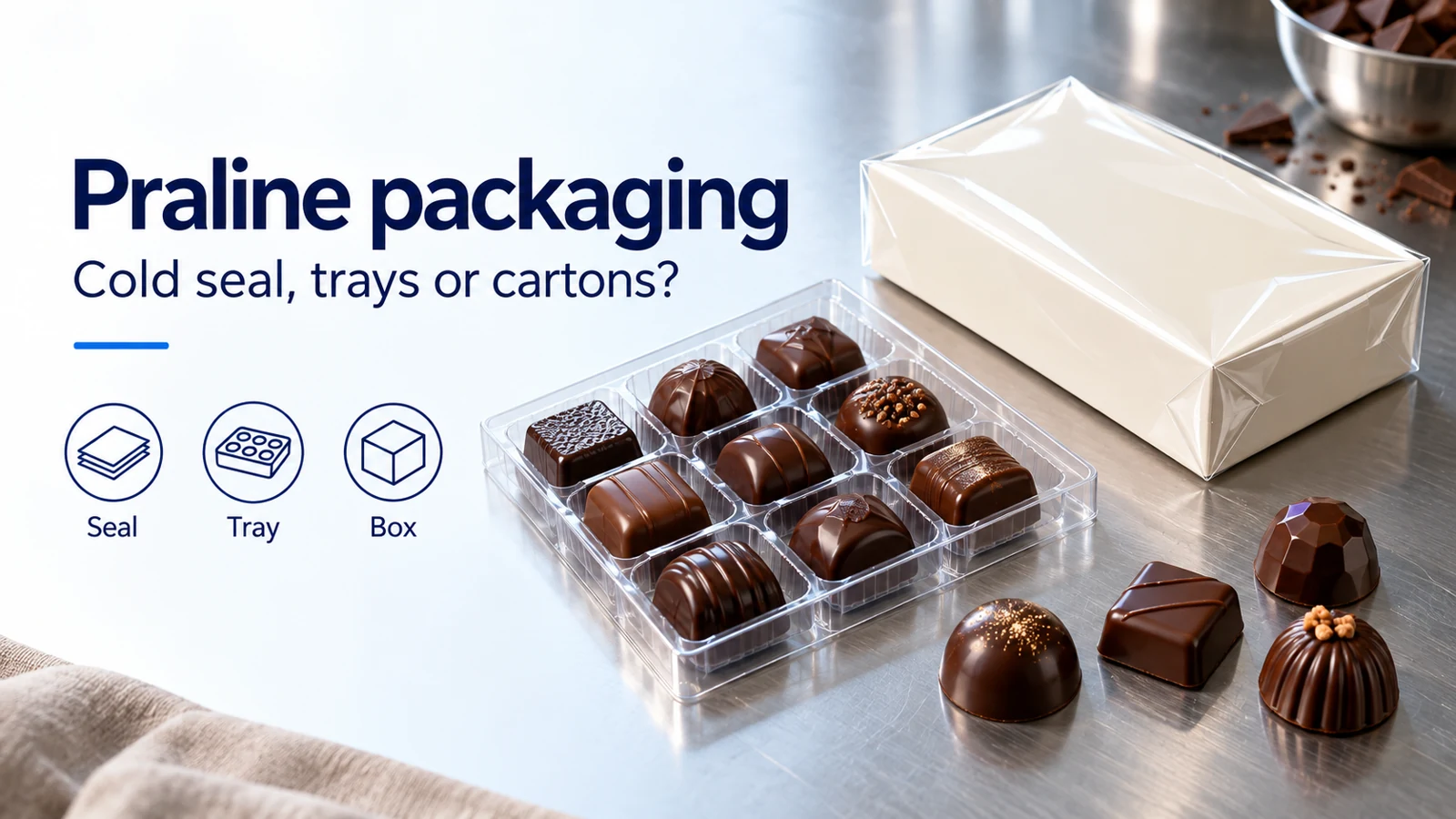
Cold-seal film uses a coating that bonds under pressure and can be considered for heat-sensitive products.
For a praline or molded chocolate packaging line, review the seal, the placement into the pack and the finished-box presentation separately. Start with the route questions below, then assemble the product and material samples for review.
| Your intended pack | Route to review | Bring to the review |
|---|---|---|
| Individual wrap or wrapped group | Cold-seal flow wrapping | Chocolate samples, filling details, proposed heat limits and film specification. |
| Pralines arranged in cavities | Tray loading and cartoning | Tray drawing, assortment layout, carton and lid samples. |
| Outer film on a finished box | Chocolate box overwrapping | Filled box sample, outer-film specification and proposed seal finish. |
On this page
Define the heat brief before choosing the machine
Keep separate entries for chocolate storage, product temperature during packing and the sealing material’s operating conditions. Ask your product team to specify the acceptable surface appearance, filling condition and proposed product-temperature limit for the sample review.
The ideal temperature for storing pure chocolate is between 12 and 18°C (54-64°F).
At higher storage temperatures, chocolate will soften and lose its gloss.
As a rule, chocolate products should be stored in an area with a maximum relative humidity of 70%.
Condensation when products return to room temperature can result in sugar bloom.
Ensure the packaged chocolate products have returned to room temperature before opening the packaging.
Use the storage guidance when planning sample conditioning and storage. For the packing trial, record the incoming product temperature and room conditions alongside the agreed product acceptance criteria. Keep the sealing settings in a separate field.
Cold-seal flow wrapping: review the film and tooling together
The dried coldseal coating seals only to itself by pressure.
No heating is required to obtain adhesion; the two coated substrates are pressed together.
A release lacquer or release layer on the opposite side permits storage in reels or stacks without sticking together.
Coldseals are typically handled within a temperature range of 15 to 25 °C.
Use that handling range in the coldseal material discussion. Ask for the selected coating’s processing instructions and the proposed seal acceptance method.
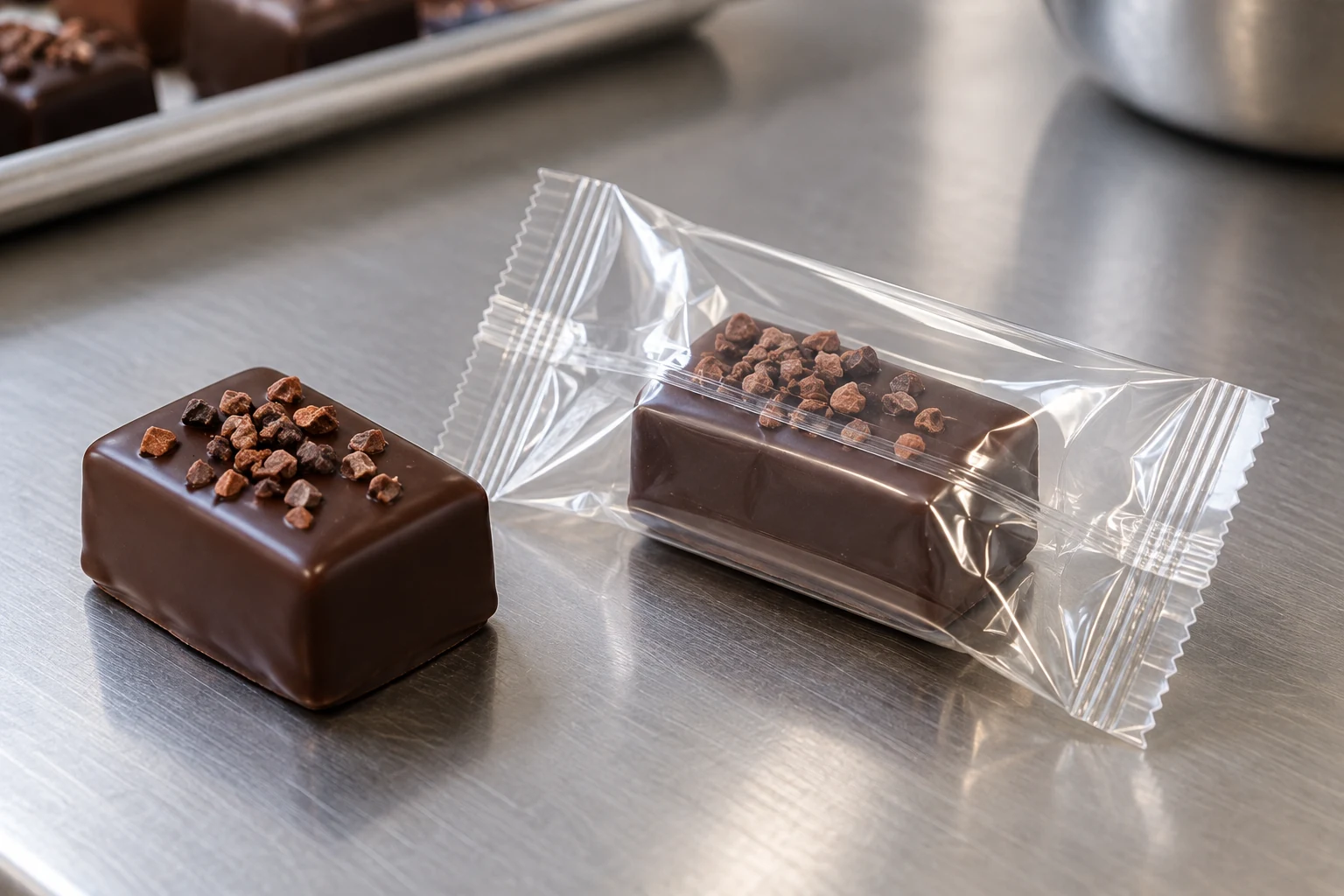
The film and tooling must match: bring cold-seal requirements into the selected configuration’s tooling review before ordering film.
We engineer horizontal flow wrapping machines for moulded pralines, chocolate bars, cavity trays, and multi-piece confectionery assortments, configuring pressure-activated cold-seal rollers and temperature-controlled infeed beds to protect heat-sensitive fillings.
Review our chocolate bar packaging machine and send us your cold-seal film reel specification alongside praline dimensions so we can run a pressure-seal trial on your exact recipe before you order.
Tray and carton: specify placement as well as the box
For a cavity-tray assortment, start the discussion with the intended chocolate position in every cavity. Review the tray-loading operation and the carton arrangement together.
On our automated confectionery tray-loading lines, pick-and-place vacuum or soft-gripper heads transfer moulded pralines from the cooling belt directly into thermoformed PET or paperboard cavities delivered by an automatic tray denester.
Filled trays are indexed individually or stacked in dual layers with a protective cushion sheet before entering the horizontal cartoner, where the outer carton or tuck-in lid is formed and closed.
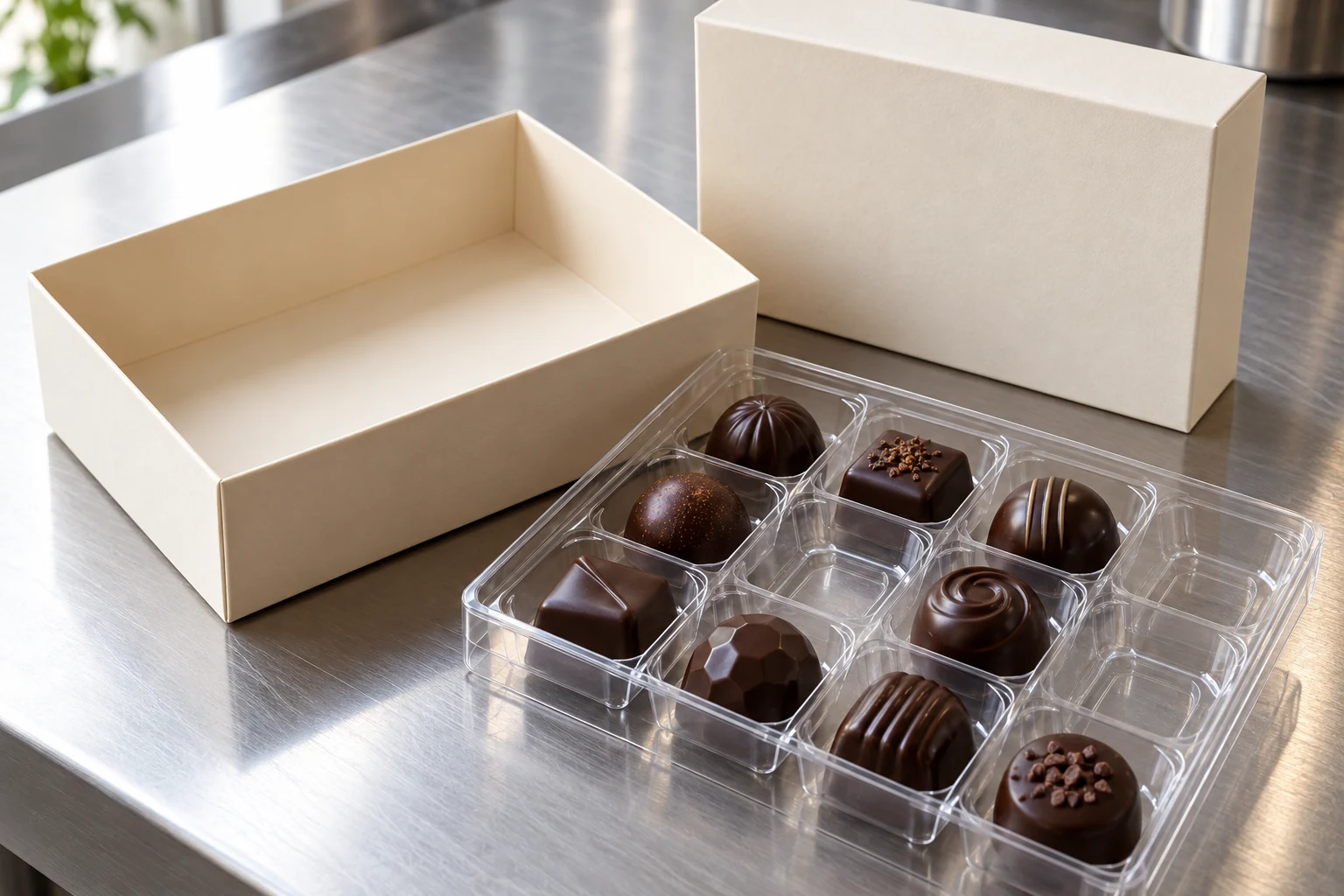
If a thermoformed tray is skewed at the loading station, a praline can land on the cavity ledge instead of seating cleanly inside the pocket, scarring the chocolate surface or jamming the lid closer.
To prevent damaged pieces and incomplete boxes, optical and vision sensors verify tray positioning at infeed and inspect cavity completeness at outfeed, while quick-change suction cups and compliant gripper tools handle different praline shapes and toppings gently.
Our automatic cartoning machines integrate with upstream tray denesters and pick-and-place loaders to pack chocolate bars, blister trays, and boxed praline assortments. Submit your cavity-tray drawing, assortment layout, and carton blank samples for a complete line layout review.
Chocolate box overwrapping: review the outer seal
An overwrapping machine wraps a rectangular box in a tight film envelope with folded, heat-sealed ends.
Include the box-overwrap sealing operation in your heat review. Specify the finished box, the intended film and the acceptable end-fold appearance.
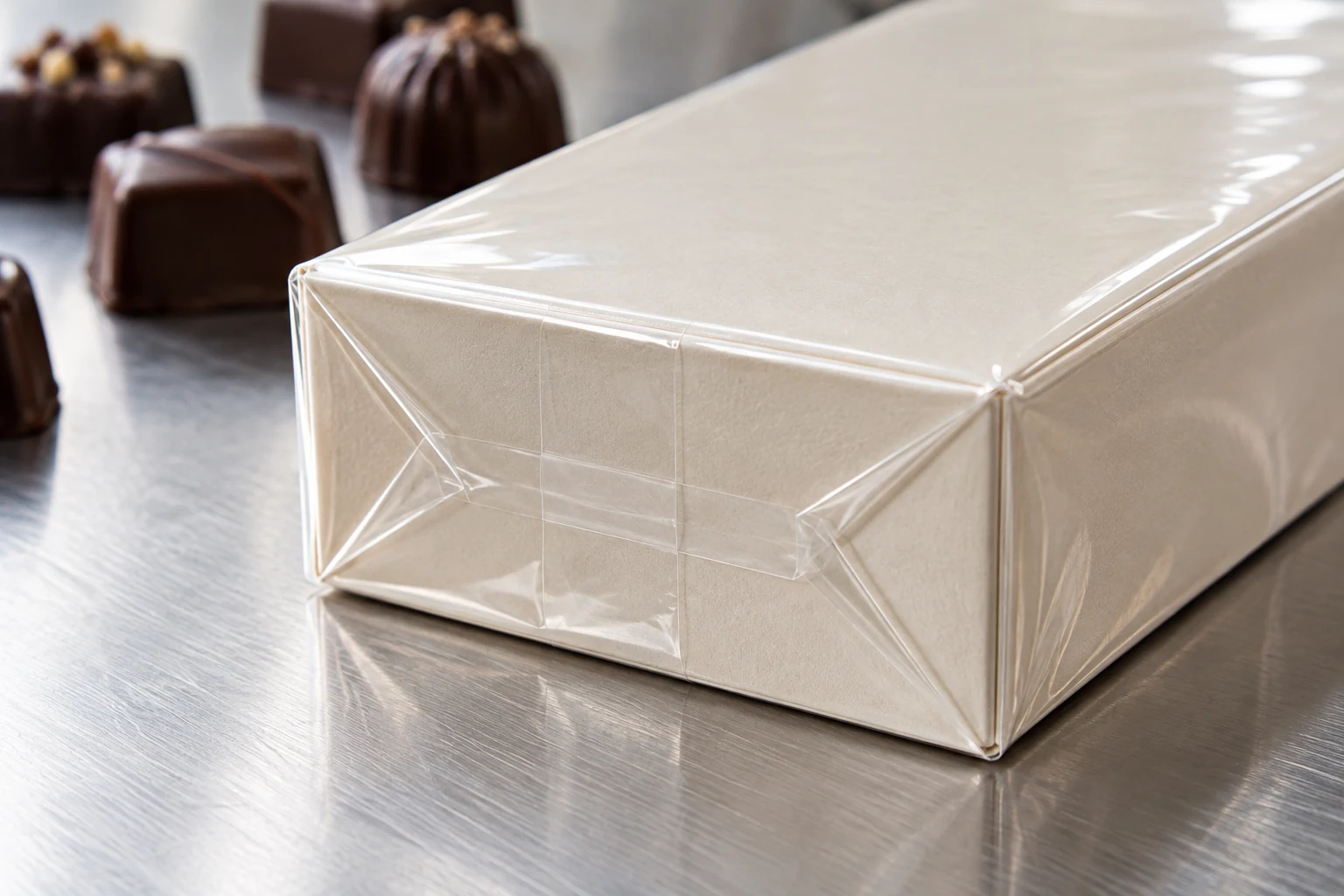
Explore the cellophane overwrapping family and the chocolate box overwrapping machine. Send the actual box construction and proposed outer film with your enquiry.
Use a sample review to decide the route
If product handling or sealing needs evaluation, discuss a sample test before shipping material.
Agree the review questions before the run. Record the product variant, film or tray, carton and operating conditions with the observations.
| Review point | Question to answer | Record to request |
|---|---|---|
| Incoming chocolate | What are the product and room conditions at infeed? | Product-temperature readings, room conditions and filling description. |
| Sealing | Does the finished seal meet the agreed pack criteria? | Selected film, machine settings and seal-check results. |
| Surface and filling | Are gloss, decoration, shape and filling condition acceptable after the run? | Before-and-after sample photographs and inspection notes. |
| Stop and restart | What is observed after the agreed stop-and-restart sequence? | Sequence used and observations of retained samples. |
| Tray placement | Is every chocolate seated in its intended cavity? | Tray-position and assortment-completeness observations. |
| Finished box | Are carton fit, lid closure and outer-film folds acceptable? | Filled-box samples and the agreed appearance checklist. |
Compare the trial observations against your intended pack and acceptance criteria. Choose the configuration after completing the film/tooling and product-handling review.
Questions to resolve before quotation
What temperature should I put in the praline brief?
Provide your product team’s proposed packing limit, incoming chocolate temperature and expected room conditions. Identify the filling and surface decoration. State the storage conditions separately.
What should I ask about cold-seal compatibility?
Ask for a review of the selected film, coating instructions and tooling against your intended product and pack. Include the proposed seal-check criteria.
What should I send for a tray-and-carton enquiry?
Send the chocolate samples, tray drawing, assortment layout and carton and lid samples. Specify the requested loading and inspection operations.
What should I send LINEVO next?
Send your chocolate heat limits, filling details, preferred seal method and room conditions. Add product photographs, target pack format and intended output, then discuss your praline packaging project.
What to send us
Send what you have and mark what is still undecided. Discuss your application with LINEVO.
| Item | Why we need it | Example format |
|---|---|---|
| Chocolate and filling | Which product should the review cover? | Product photographs, filling description and decoration details. |
| Heat and room conditions | Which conditions should the sample run use? | Proposed product heat limits, incoming temperature and room conditions. |
| Seal and packaging material | Which seal method and material should be evaluated? | Preferred seal method, film specification and pack sample. |
| Tray and carton arrangement | Which finished pack should be evaluated? | Tray drawing, assortment layout, carton and lid samples. |
| Production brief | What operation are you planning? | Intended output, product variants and changeover requirements. |