
On this page
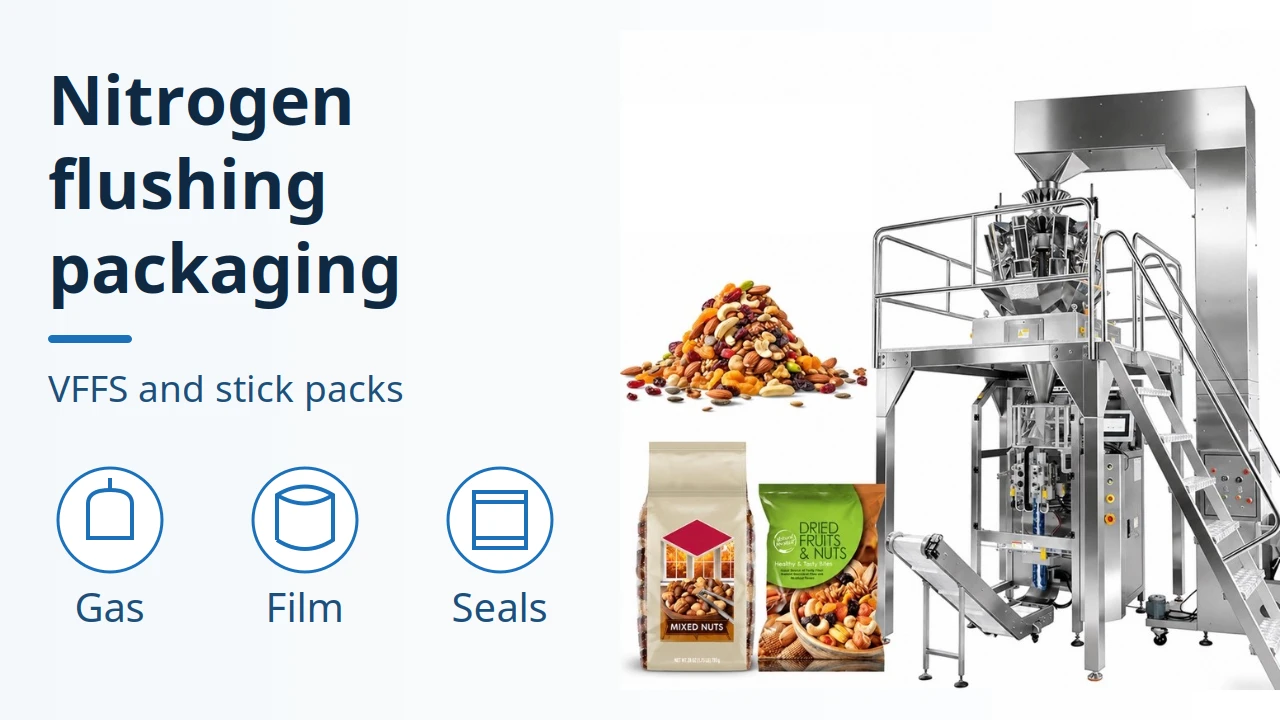
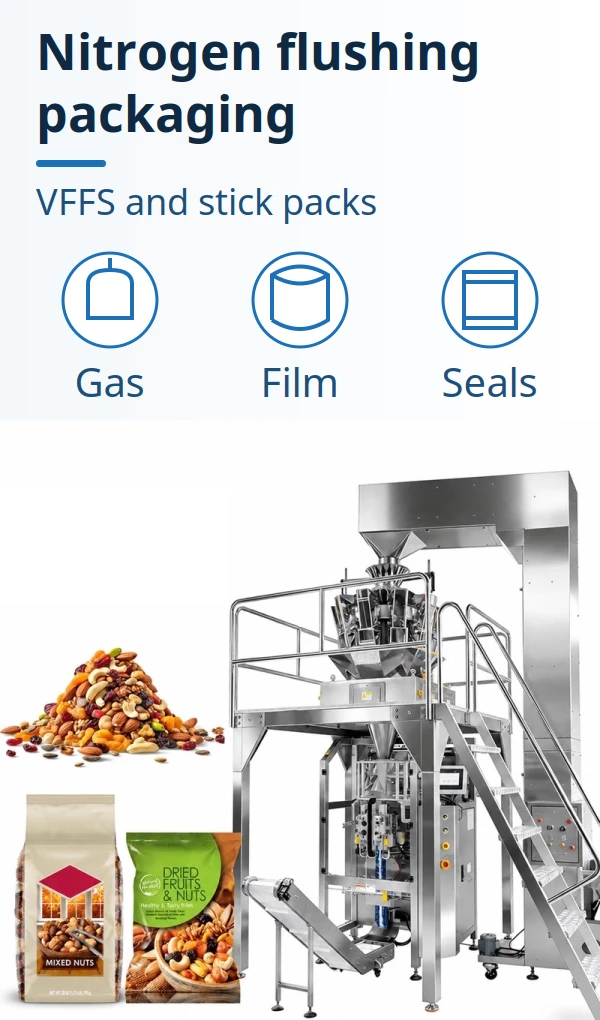
A nitrogen line can waste gas while its finished packs still contain too much oxygen. Nitrogen flushing packaging replaces air before sealing; choose the bagging route, film and trial conditions together to control the atmosphere in the finished pack.
For dry snacks, nuts, coffee and oxygen-sensitive single-dose powders, start by defining the finished pack and an agreed residual-oxygen limit at a stated measurement time. VFFS forms the bag from roll film; multi-lane stick pack equipment repeats forming, dosing and sealing across narrow lanes; a premade pouch machine handles bags supplied ready-made. Each route needs a gas arrangement matched to the product and closure sequence. Measure oxygen in sealed packs at the required good output, then verify retention through storage. Gas supply purity alone cannot establish finished-pack oxygen or shelf life.
| Input | Typical value or condition | Why it matters |
|---|---|---|
| Product and dose | Product sample, fill weight and powder or particle behavior. | Determines dosing, settling and seal-area contamination checks. |
| Pack geometry | Finished drawing, bag format and expected free gas space. | Defines the route and the space being flushed. |
| Residual oxygen | Your maximum O₂, sampling method and time after sealing. | Makes the acceptance condition measurable. |
| Shelf life and storage | Required duration, temperature, humidity and quality endpoint. | Sets the retention study rather than an assumed shelf-life claim. |
| Film structure | Laminate, sealing layer, OTR and WVTR with test conditions. | Separates initial flushing from later oxygen and moisture ingress. |
| Output and utilities | Accepted packs per minute; gas supply specification and metering basis. | Links the flushing trial to a usable production rate and gas budget. |
What does nitrogen flushing change inside the pack?
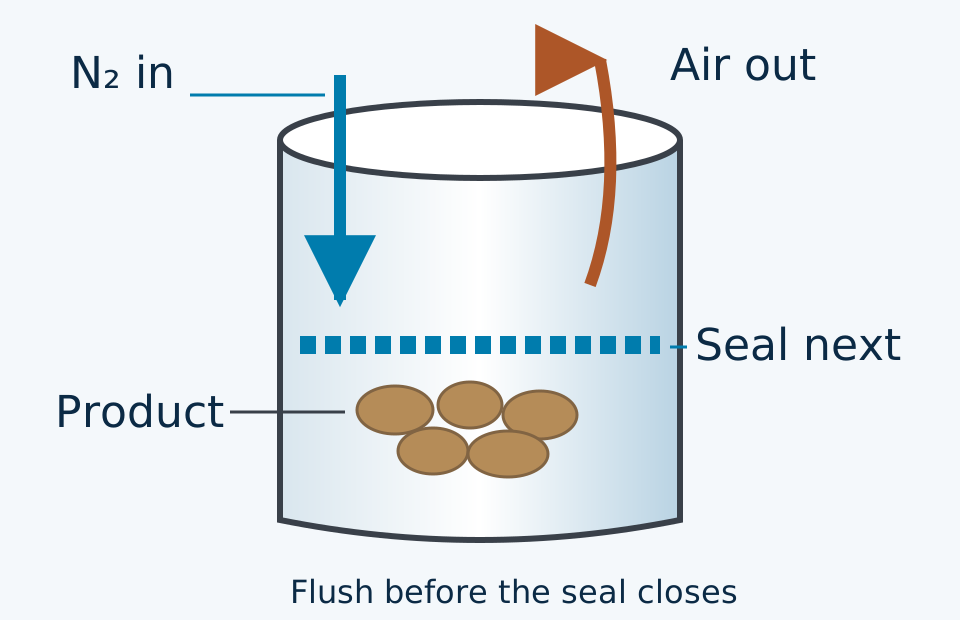
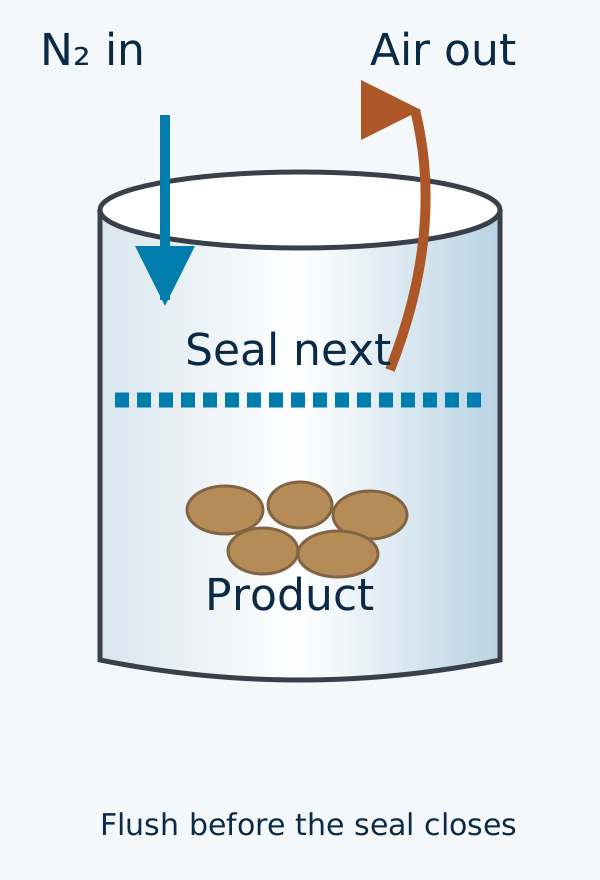
Nitrogen flushing displaces air before the package closes. It is one way to create modified atmosphere packaging, or MAP. A modified atmosphere packaging machine can also use gas mixtures selected for other products; the term does not identify a single bagging mechanism or a universal gas recipe.
In a form-fill-seal process, the film becomes a tube, the product enters, and gas replaces air before the individual pack is sealed. The supply gas and the trapped atmosphere are different measurements: air can remain around the product or mix back into the opening before closure. WITT’s MAP white paper describes this tube-flushing sequence and the separate roles of gas supply analysis and package sampling.
For chips and nuts containing fats, reducing oxygen exposure helps address oxidation. Coffee also needs oxygen protection; its roast, rest period and degassing behavior belong in the brief. Use the coffee packaging guide to discuss the pack and valve requirements. A fresh-pack oxygen reading is a process check, while the product’s retained quality over its storage period is a separate acceptance question. For dry kibble and treats, the pet food packaging machines page compares roll-film bags with ready-made pouches; add any gas-flushing requirement to that brief.
Which route fits a vertical bag, stick pack or premade pouch?
Choose the route from the finished pack, then ask how nitrogen reaches the product space before closure. Gas flushing is specified per configuration, so confirm the gas arrangement and its oxygen result on the machine you are quoted.
| Route | Start here when | Configuration to review | Dominant Failure Mode & Prevention |
|---|---|---|---|
| VFFS bag | Chips, nuts or coffee need a bag formed from roll film. | Doser/weigher, forming set, gas delivery and transverse sealing sequence. | Air remains in a bulky fill or product crosses the seal: check gas access, settling and a clear sealing zone together. |
| Multi-lane stick pack | A narrow single-dose powder pack is required. | Lane-specific forming, auger dosing, gas distribution and sampling access. | One lane retains more oxygen or traps powder in its seal: evaluate each lane and confirm dosing cut-off and gas balance. |
| Premade pouch | The required zipper or stand-up pouch arrives ready-made. | Pouch opening, gas access, filling and final top closure. | Poor opening or air entry before sealing: verify the opening and closure sequence with the actual pouch. |
Our VFFS family includes a chips-with-nitrogen configuration with a 20–45 bags/min range, subject to bag volume and gas flushing volume. The quoted output and oxygen acceptance must be checked together on your product and film; the range is not an oxygen specification.
The stick pack family includes a probiotic powder configuration with multi-point nitrogen flushing and independent multi-lane auger dosing; its output and gas settings are specified per project. For a probiotic project, supply the formulation owner’s oxygen, moisture, storage and viability requirements; the gas option alone cannot establish strain survival. The powder stick pack and sachet guide helps define the dose and powder-handling inputs.
For a ready-made bag, compare the premade pouch route. Confirm nitrogen integration for the proposed pouch, opening and filling arrangement. A zipper does not replace the final closure that must retain the atmosphere before the consumer opens the pack.
Which film and seal evidence should you request?
Request the full laminate specification and conditioned barrier data, then assess the sealed pack. The film’s oxygen transmission rate, or OTR, describes oxygen passing through a material under stated test conditions. Water vapor transmission rate, or WVTR, describes moisture transmission. A material name or metallic appearance cannot supply either value.
Ask the film supplier for the layer structure, thickness, sealing layer and test temperature and humidity. AMETEK MOCON’s OTR method note distinguishes dry-condition D3985 testing from controlled-humidity F1927 testing, and explains that temperature and moisture sensitivity can change transmission. Compare reports under matching conditions before choosing a barrier for coffee, nuts or hygroscopic powder.
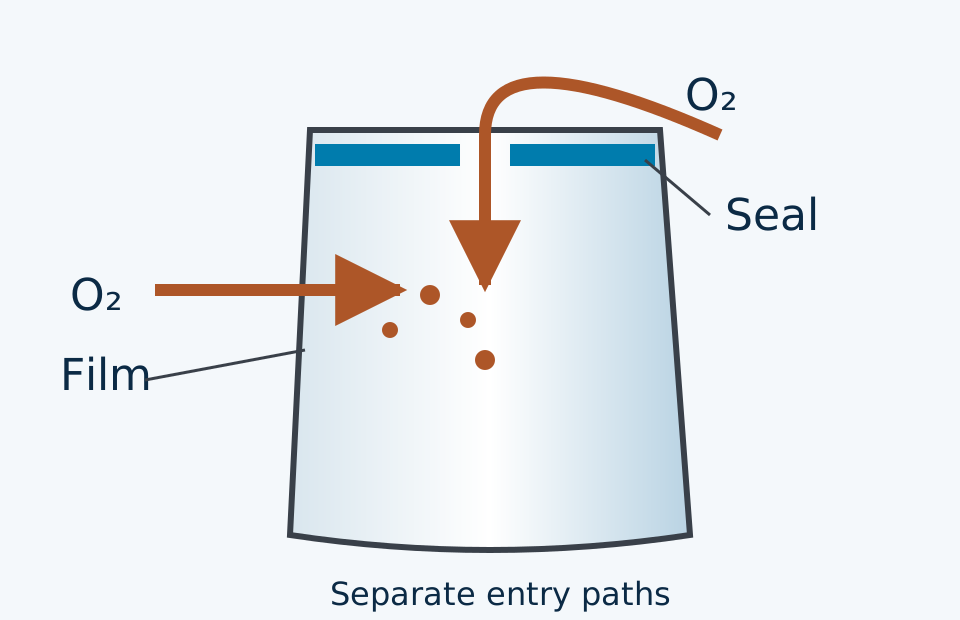
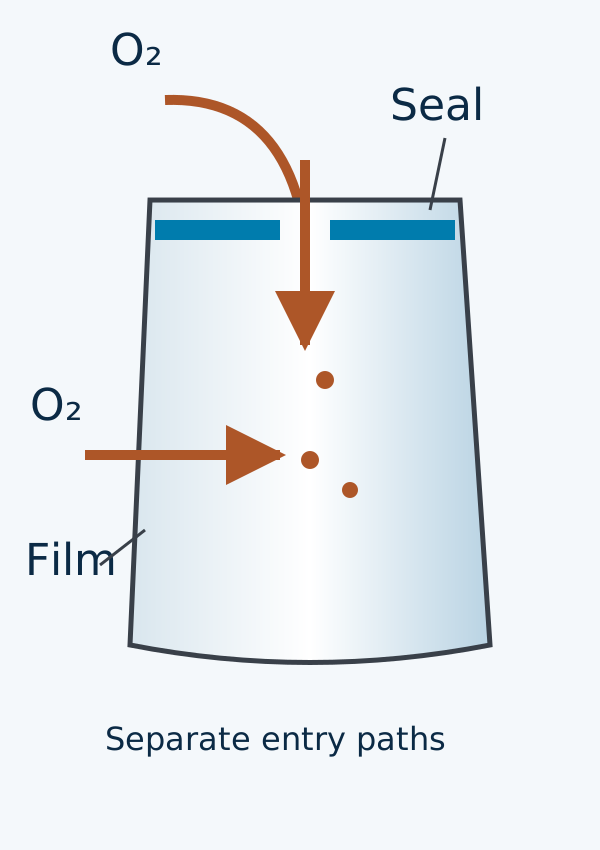
ASTM F88/F88M measures the force needed to separate a seal-containing strip and records the failure mode; use the same technique when comparing results. It sets no universal pass force, leak limit or shelf-life duration, so agree the seal-strength value and a finished-pack leak assessment separately for your pack.
During trials, record product in the seal area, wrinkles and pack damage alongside the oxygen result. Film changes require another sealing review because the usable sealing conditions belong to the actual laminate. For powders, review dust control and dosing cut-off with seal cleanliness rather than trying to compensate for a contaminated seal by increasing gas flow.
How should the flushing trial be accepted?
Agree the oxygen limit, measurement time and sampling method before running the trial. Record the supply gas separately from the finished-pack readings, and define accepted output using packs that meet all agreed fill, seal and atmosphere criteria.
- Identify the product lot, dose, pack drawing and film lot. Record storage conditions and the endpoint used to judge retained product quality.
- Record supply purity, flow and pressure at the agreed measurement points, along with the metering conditions. Confirm the analyzer is suitable for the available headspace and the selected sampling method.
- Sample every active stick pack lane separately. Include start-up, steady production, planned stops and restarts; retain lane identity and time after sealing in the record.
- Check fill, seal cleanliness, leak assessment and residual oxygen at the required accepted output. Keep rejected packs and their reasons in the yield record.
- Retain packs for the agreed storage study and assess oxygen, package integrity and product quality at the planned intervals. The formulation owner defines any probiotic viability endpoint.
Keep these limits product-specific. A single percentage for chips, coffee and probiotic powder would hide differences in the product, headspace, storage and measurement method. Use sample testing preparation to arrange the material and film evidence for configuration review.
How much gas does each accepted pack consume?
Divide total metered gas for a defined period by accepted packs from that same period. Include start-up purge, gas used during stops and restart rejects. A lower flow setting can cost more per saleable pack if the accepted output also falls.
Gas volume (m³) = average metered flow (L/min) × elapsed minutes ÷ 1,000. Gas per accepted pack (L/pack) = gas volume (m³) × 1,000 ÷ accepted packs. Use the same reference pressure and temperature for both flow and volume; a totalizing meter avoids treating a nominal flow setting as consumption.
For example, a 420-minute shift averaging 60 L/min, purge and stops included, uses 25.2 m³ and yields 12,000 accepted packs: 2.10 L/pack. A second setup that uses 21.0 m³ over the same 420 minutes but yields 9,000 accepted packs consumes 2.33 L/pack. Lower total gas use does not mean lower gas per accepted pack; compare only runs that meet the same product, fill, seal and oxygen acceptance conditions.
| Cost item | Record for that period | Comparison rule |
|---|---|---|
| Nitrogen supply | Metered volume, delivery or generation costs, supply basis and service costs. | Use actual gas charges or generation energy and allocated ownership cost; avoid counting both as the same supply cost. |
| Film and product loss | Rejected packs, film mass and unrecoverable product. | Separate start-up, lane faults and steady-run rejects; charge each loss once. |
| Changeover and stops | Elapsed downtime, labor and restart purge. | Count restart gas in the gas total and lost output in accepted production; do not add a second gas allowance. |
| Quality and maintenance | Sampling labor, analyzer service and agreed maintenance. | Include the work needed to keep the chosen atmosphere and seal conditions measurable. |
Conversion cost per accepted pack = (gas supply + consumed packaging + product loss + labor + energy + allocated equipment and maintenance cost) ÷ accepted packs, all for the same period and with overlapping charges removed. Keep product purchase cost outside the comparison unless both proposals use the same accounting scope.
Check the downstream rate too. When sticks are counted into cartons, the cartoning family helps define the transfer and loading scope. Agree whether a downstream stop pauses filling and gas, how restarts are handled, and where rejected packs leave the line before accepting a full-line output claim.
Nitrogen flushing project checklist
Copy these fields into your project brief. Enter an agreed requirement or mark it open; the example formats show how to describe the input without prescribing an operating value.
| Item | Why we need it | Example format |
|---|---|---|
| Product and fill | Review dosing, settling and contamination at the sealing zone. | Product name; sample; g/pack; powder behavior or particle description. |
| Pack and lanes | Select the route and gas-access review. | Drawing in mm; VFFS, stick or premade pouch; lane requirement if known. |
| Target residual oxygen | Define an atmosphere acceptance condition. | Maximum O₂ %; time after sealing; sample method; lane identity. |
| Shelf life | Define what the retained-pack study must establish. | Required duration; storage temperature/humidity; quality or viability endpoint. |
| Film structure | Review barrier and sealing requirements. | Layer structure/thickness; seal layer; OTR/WVTR reports and conditions; film sample. |
| Packaging speed | Assess atmosphere and seal quality at usable output. | Accepted packs/min and packs/shift; planned stops and changeovers. |
| Gas supply | Review utilities and the consumption comparison. | Supply specification; purity; available pressure/flow and reference conditions; metering method. |
| Acceptance record | Make supplier trials comparable. | Fill tolerance; seal/leak checks; oxygen sampling plan; storage review intervals. |
Send your product, pack drawing, oxygen and shelf-life requirements, film specification and accepted-output target through the project brief page. Our engineering team can review the configuration and confirm whether a sample trial is needed. Keep undecided gas and material fields open for that review.
Sources
Machine data: Our VFFS chips-with-nitrogen configuration and stick pack probiotic powder configuration. Gas flow, pressure, residual oxygen and output for your setup are written into the quotation and verified in the sample trial.
Process and test references: WITT, White Paper – Modified Atmosphere Packaging (nitrogen, snacks and nuts, coffee, form-fill-seal machines, gas analyzers); AMETEK MOCON, ASTM D3985/F1927 Oxygen Transmission Rate Test Methods (2023); ASTM F88/F88M-23, Standard Test Method for Seal Strength of Flexible Barrier Materials.
Discuss your application with LINEVO.
Discuss your nitrogen flushing project