
On this page
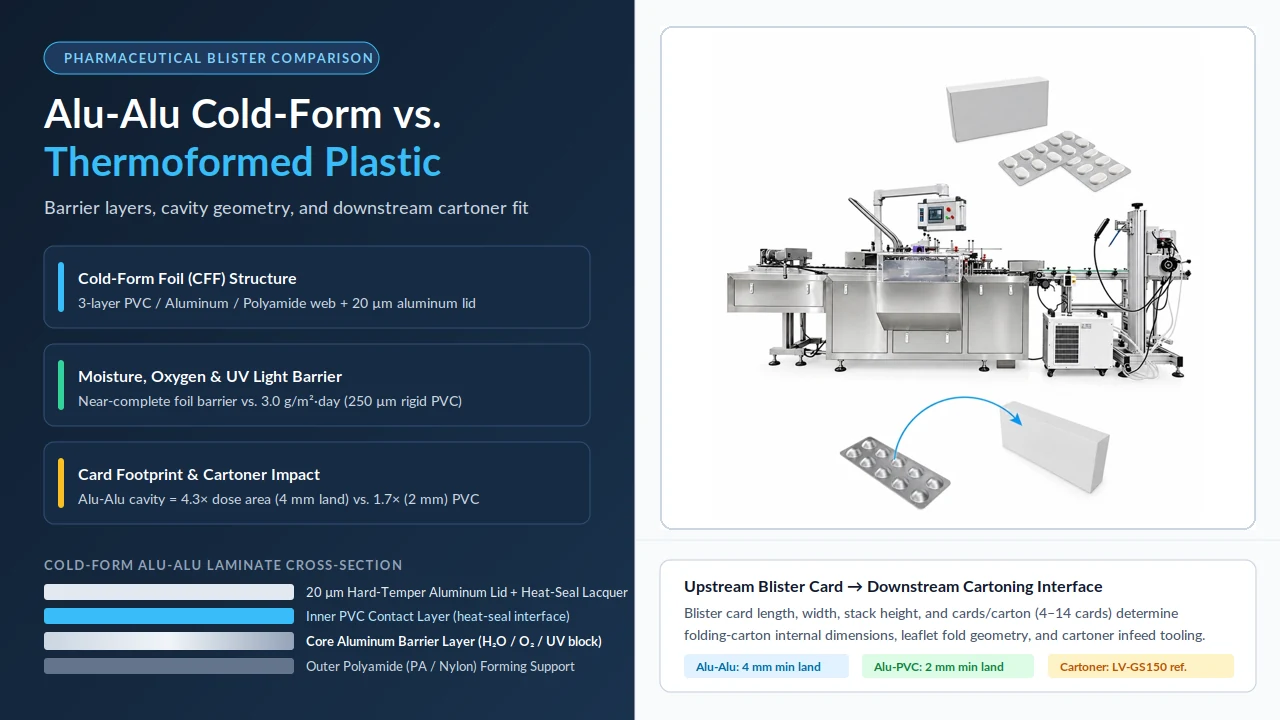
Alu-Alu blister packaging seals each tablet or capsule between a cold-stamped 3-layer PVC/Aluminum/Polyamide forming laminate and a 20 μm push-through aluminum lidding foil. It delivers a near-complete barrier to water vapor, oxygen, and UV light for moisture-sensitive solid oral dosage forms, trading off opacity, slower forming speed, and larger blister cards compared with thermoformed plastic blisters.
Across oral solid dose lines for pharmaceutical packaging machines and health supplement packaging machines, moisture and oxygen sensitivity dictate whether tablets or capsules require cold-form foil or a thermoformed barrier film such as rigid PVC, PVDC-coated PVC, PCTFE, or COC. Because aluminum cold forming creates wider sloped cavities and broader welding lands, choosing Alu-Alu directly enlarges blister card length, width, and stack height feeding into downstream cartoning machines.
| Input | Typical value or condition | Why it matters |
|---|---|---|
| Forming web architecture | 3-layer PVC/Aluminum/Polyamide cold form foil (CFF) with PVC on the inside vs. 200–300 μm rigid PVC, PVC/PVDC, PVC/PCTFE, or COC. | Sets cold-stamping vs. thermoforming tooling, opacity, barrier grade, and minimum pocket-to-pocket seal land; both seal to standard 20 μm hard-temper aluminum push-through lidding foil. |
| Moisture & gas barrier | Near-complete barrier to water vapor, oxygen, and UV light on Alu-Alu vs. 3.0 g/m² per day WVTR on 250 μm rigid PVC. | PVDC, PCTFE, and COC narrow the moisture gap to 0.06–0.65 g/m² per day while keeping transparent cavities. |
| Measured cavity & card geometry | 170 mm² mean Alu-Alu cavity (4.3× dosage-form area) and 4 mm minimum seal land vs. 98.1 mm² (1.7× area) and 2 mm land on plastic/aluminum cards. | Larger Alu-Alu cards expand carton internal dimensions across typical 4–14 card retail packages. |
| Downstream cartoner interface | Upstream blister forming feeds secondary cartoners such as LV-GS150 (25–35 cycles/min) and 3D overwrappers such as LV-BT280 / LV-BT350. | Confirm blister card L × W, stack height, cards per carton, folding carton blank, folded leaflet size, and defect-sensor checks before tooling. |
What Is a Pharmaceutical Blister Package Made Of?
Under the U.S. FDA Container Closure Systems guidance, a pharmaceutical blister package consists of two primary components: a forming film (which can be a single film, a coated film, or a multilayer laminate) and a lidding material. The lidding material is usually a laminate incorporating a barrier layer such as aluminum foil, coated with a print primer on the outside and a sealing agent such as a heat-sealing lacquer on the product-contact side.
In both cold-formed and thermoformed push-through packs, the sealing agent on the lidding foil contacts both the solid oral dosage form and the forming film during heat sealing. The standard push-through lidding web is 20 μm pinhole-free hard-temper aluminum foil, engineered to remain brittle enough for thumb push-through dispensing while maintaining a continuous barrier.
The forming web defines the pack category. Cold form foil (CFF) uses a 3-layer PVC/Aluminum/Polyamide laminate with the PVC layer positioned on the inside in contact with the product. By contrast, thermoformable blister webs start from unplasticized rigid PVC—typically 250 μm (0.25 mm) thick within a 200 to 300 μm range—or add barrier layers via PVDC emulsion coatings, PCTFE film lamination, or halogen-free cyclic olefin copolymer (COC) multilayer constructions.
Why Are Moisture-Sensitive Medicines Packed in Aluminum Foil?
Moisture-sensitive solid oral dosage forms require aluminum foil because water vapor can alter the decomposition rate of the active drug substance or change the dissolution rate of the tablet or capsule, while light and reactive gases accelerate degradation. Cold form foil blisters provide a near-complete barrier to water and oxygen, and their opaque construction blocks ultraviolet (UV) rays to support extended product expiry dates.
Peer-reviewed pharmaceutical packaging research (PubMed Central barrier review) confirms that aluminum foil-based systems remain the reference blister solution when very low permeability to gases and moisture is required, serving as the primary barrier element inside multilayer structures engineered for seal integrity, forming robustness, and controlled opening. In regulatory testing cited by the FDA guidance, USP <671> evaluates water vapor permeation of single-unit and unit-dose containers for tablets and capsules across five acceptance standards (Class A through Class E), while USP <661> tests containers heat-sealed with a foil laminate inner seal against USP <671> acceptance criteria.
Plain rigid PVC leaves a wide moisture gap for hygroscopic formulations. A 250 μm PVC sheet exhibits a typical Water Vapor Transmission Rate (WVTR) around 3.0 g/m² per day at 38 °C (100 °F) and 90% RH, along with an Oxygen Transmission Rate (OTR) around 20 mL/m² per day. Worse still, deep-drawn thermoforming can thin a 250 μm PVC web down to 50 to 100 μm inside cavity corners, increasing water vapor transmission precisely where the tablet sits.
| Forming web structure | Typical gauge / construction | Typical WVTR (g/m² per day) | Oxygen & UV light performance |
|---|---|---|---|
| Rigid unplasticized PVC | 200–300 μm sheet (most commonly 250 μm / 0.25 mm); thins to 50–100 μm in deep pockets | ~3.0 g/m² per day | OTR ~20 mL/m² per day; transparent unless pigmented or UV-filtered |
| PVC / PVDC duplex & triplex | 250 μm PVC / 40–120 gsm PVDC; triplex adds 25 μm PE for deeper draws | 0.25–0.65 g/m² per day | OTR 0.1–1.0 mL/m² per day; transparent thermoformable barrier |
| Super Barrier Coating (SBC) PVDC triplex | 250 μm PVC / 25 μm PE / 120–180 gsm SBC PVDC | 0.06–0.11 g/m² per day | Over twice the moisture and oxygen barrier per gram coating weight vs. historic PVDC |
| PVC / PCTFE duplex & triplex | 250 μm PVC laminated to 15–150 μm PCTFE (optional PE middle layer) | 0.06–0.40 g/m² per day | Lowest water vapor permeation among plastic blister films; highest plastic film cost |
| Cyclic olefin copolymer (COC) | Multilayer COC with PP, PE, or PETg (chlorine- and halogen-free) | 0.20–0.35 g/m² per day | Moisture barrier with deep-cavity thermoforming stability; halogen-free |
| Cold-form Alu-Alu (CFF) | 3-layer PVC (inside) / Aluminum / Polyamide laminate + 20 μm aluminum lid | Near-complete water barrier | Near-complete oxygen barrier plus opaque UV light protection |
How Does Alu-Alu Packaging Differ From Thermoformed PVC Blisters?
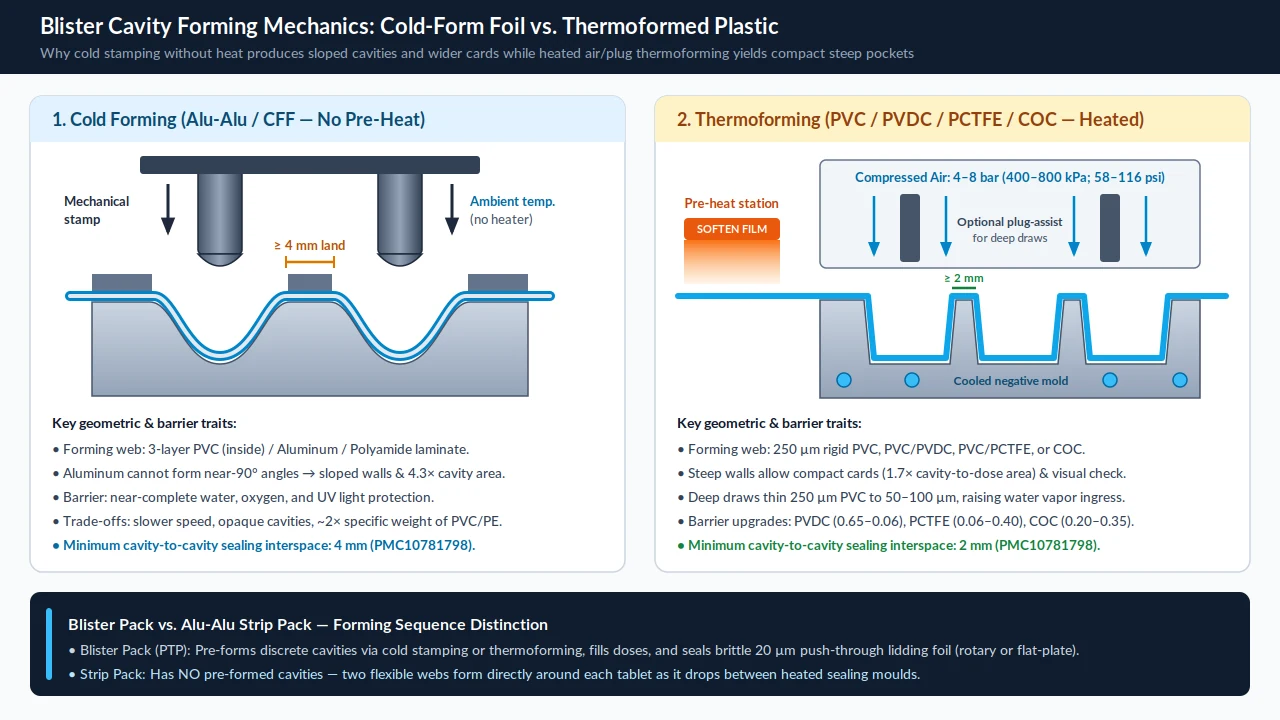
Cold-form Alu-Alu packaging outperforms thermoformed PVC and coated plastic blisters on moisture, oxygen, and light protection, but it introduces three operational trade-offs: slower forming line speed, complete cavity opacity that prevents visual tablet checks, and substantially larger blister cards because aluminum cannot be stretched to near 90-degree cavity angles.
Why do Alu-Alu blister cards occupy more space than plastic blisters?
A peer-reviewed analysis of 45 frequently prescribed blister-packaged solid oral dosage forms in Falconnier-Williams et al. (PMC10781798)—covering 13 aluminum-aluminum blisters and 32 mixed aluminum-plastic or plastic blisters—quantified that footprint penalty directly. Across the 13 Alu-Alu products, mean cavity area measured 170 mm² (± 52.4), which was 4.3 times larger than the 41.6 mm² (± 17.8) dosage forms inside them. Across the 32 mixed and plastic blisters, mean cavity area was 98.1 mm² (± 46.0), only 1.7 times the 63.6 mm² (± 32.8) dosage forms.
Cavity spacing compounds that area growth. The study established a technical minimum welding interspace of 4 mm between cavities for aluminum-aluminum blisters compared with 2 mm for thermoformed plastic-aluminum composite blisters, and found that 69% of overall blister card material went to interspaces rather than pockets. Combined with larger chambers, Alu-Alu production is more energy-intensive than thermoforming and carries roughly twice the specific weight of PVC or polyethylene, increasing transport mass and carton volume.
How do opacity, usability, and barrier selection interact?
Thermoformed plastic blisters keep every dose visible through transparent cavities, supporting visual inspection and compact pocket layouts. Because Alu-Alu cavities are opaque and substantially wider than the enclosed tablet, the PMC10781798 review notes that older patients more frequently report difficulty pushing tablets intact through blister foil when the dosage form is much smaller than its cavity. Lines should therefore specify cold-form Alu-Alu where stability data demands near-complete barrier protection, and evaluate PVDC, PCTFE, or COC thermoformed webs when transparency and compact card dimensions are needed alongside enhanced moisture protection.
| Comparison factor | Cold-form Alu-Alu (CFF) | Thermoformed plastic (PVC / PVDC / PCTFE / COC) | Dominant failure mode & prevention |
|---|---|---|---|
| Moisture, oxygen & UV barrier | Near-complete barrier to water vapor, oxygen, and UV light. | Ranges from 3.0 g/m²/day WVTR (250 μm PVC) down to 0.06 g/m²/day (SBC PVDC or PCTFE). | Hygroscopic tablet degrades in plain PVC: verify USP <671> Class A–E water vapor permeation before selecting film. |
| Cavity-to-dose area ratio | 4.3× dosage-form area (170 mm² mean cavity for 41.6 mm² dose). | 1.7× dosage-form area (98.1 mm² mean cavity for 63.6 mm² dose). | Oversized Alu-Alu card jams existing carton tooling: lock blister card dimensions before freezing carton dielines. |
| Minimum seal land between cavities | 4 mm technical minimum welding interspace. | 2 mm technical minimum welding interspace. | Under-sized land causes cold-form pinholes or weak heat seals: preserve full 4 mm aluminum land and run in-process leak testing. |
| Visibility & patient opening | Opaque; oversized pockets can hinder intact push-through for older patients. | Transparent for visual product inspection and compact push-through alignment. | Missed empty cavity on opaque Alu-Alu web: specify inline fill verification upstream before lidding seal. |
| Production speed & material mass | Slower forming speed, higher forming energy, ~2× specific weight of PVC or PE. | Faster thermoforming cycles and lower card mass per dose. | Cartoner speed mismatch after switching to Alu-Alu: size cartoner rate to actual accepted blister cards/min. |
Alu-Alu Blister vs. Alu-Alu Strip: How Do Forming Methods Differ?
An Alu-Alu blister pack pre-forms discrete semi-rigid cavities into a cold-form laminate before filling and sealing a brittle push-through lidding foil, whereas a strip pack has no pre-formed thermoformed or cold-formed cavities and instead forms directly around each tablet as it drops into the sealing area between sealing moulds.
That forming difference changes both opening mechanics and card rigidity. Pharmaceutical blister packs are widely called push-through packs (PTP) because they pair a brittle 20 μm lidding foil with a semi-rigid formed cavity that collapses under thumb pressure to press the tablet or capsule out cleanly. Strip packs omit the rigid pre-formed pocket altogether, relying on continuous perimeter sealing around each dropped dose between opposing sealing dies.
| Feature | Alu-Alu blister pack (cold-form PTP) | Strip pack |
|---|---|---|
| Cavity creation | Pre-formed cavities stamped cold into a 3-layer PVC/Aluminum/Polyamide laminate prior to dosing. | No pre-formed cavities; flexible webs form directly around the tablet as it drops between sealing moulds. |
| Dispensing mechanics | Push-through pack (PTP): thumb collapses the semi-rigid cavity and breaks brittle 20 μm aluminum lidding foil. | Tear-open perimeter pouch seal around each unit dose rather than push-through collapse. |
| Card rigidity & stacking | Semi-rigid blister card with defined pocket height and 4 mm minimum welding land for stacked carton feeding. | Flexible flat strip contoured tightly around each tablet with different stacking stiffness in carton magazines. |
How Does an Alu-Alu Blister Machine Form Cavities Without Heat?
An Alu-Alu cold-forming blisterline presses the 3-layer PVC/Aluminum/Polyamide laminate directly into a cavity mold using a mechanical stamp at ambient temperature so the aluminum elongates and holds its formed shape without pre-heating, before filling each dose and sealing the lidding foil via a rotary or flat-plate sealing station.
By contrast, a thermoforming blisterline unwinds plastic film through a pre-heating station to soften the web, forms pockets into a negative mold at 4 to 8 bar (400 to 800 kPa; 58 to 116 psi)—adding a mechanical plug-assist for deep draws or tight tolerances—and cools the mold so the plastic sets rigid again. Both formats run as integrated form-fill-seal blisterlines, and FDA container-closure guidance notes that leak testing is routinely performed on flexible packages as part of in-process controls.
How Do Blister Packs Feed Into Downstream Cartoning?
Upstream blister thermoforming and cold-forming machines sit ahead of secondary packaging, discharging finished blister cards into a blister cartoner that erects each folding carton, loads the counted blister stack with a folded patient leaflet, checks for defects, and closes the flaps before optional 3D box overwrapping.
Card geometry from upstream forming governs every downstream station. Across the 45 frequently prescribed solid oral dosage forms analyzed in PMC10781798 (13 aluminum-aluminum and 32 mixed blisters), packages held 4 to 14 blister cards per package (mean 7.06 ± 2.97) with 5 to 25 doses per card (mean 16.0 ± 6.86). Switching a tablet from thermoformed PVC (1.7× cavity ratio, 2 mm land) to cold-form Alu-Alu (4.3× cavity ratio, 4 mm land) widens the blister card and increases nested stack volume, which can push the carton outside an existing cartoner or overwrapper format window.
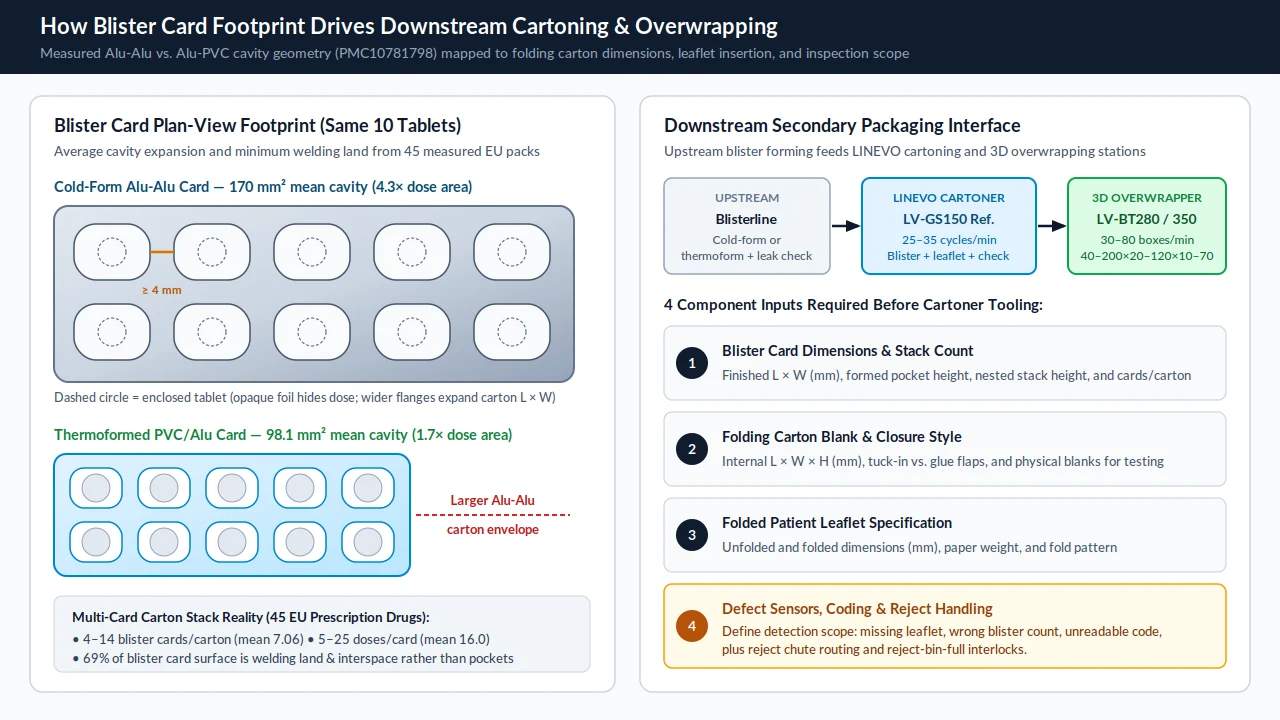
For secondary pharmaceutical packaging, our LV-GS150 bottle and blister cartoning machine runs at 25–35 cycles/min within a 1540 × 1375 × 2270 mm footprint at 500 kg, with loading direction configured per project from actual blister size and count per carton. Compare horizontal and vertical carton loading layouts in our types of cartoning machines guide. If closed cartons continue into tamper-evident film wrapping, the LV-BT280 / LV-BT350 3D overwrapper covers a standard box window of 40–200 mm long, 20–120 mm wide, and 10–70 mm high at 30–80 boxes/min within a 2100 × 850 × 1500 mm, 550 kg footprint.
Before ordering carton blanks or confirming a cartoner configuration, prepare four component drawings and physical samples for sample testing or submit them through our packaging project brief. Specifying required defect checks upfront—including missing leaflet, wrong blister count, absent label, or unreadable code, plus sensor selection and reject-bin handling—prevents rework during commissioning.
| Interface item | Measured data or sample to supply | Downstream station impact confirmed |
|---|---|---|
| Blister card geometry & count | Card length and width (mm), formed pocket height, nested stack height, and blister cards per carton (e.g., 4–14 cards) | Sets cartoner infeed buckets, stacking magazine, and loading direction on models such as LV-GS150. |
| Folding carton blank & closure | Internal carton dimensions (mm), supplier blank layout, and tuck-in or glue flap closing style | Confirms carton erection clearance and whether closed boxes fit the 40–200 × 20–120 × 10–70 mm overwrapper window. |
| Patient leaflet specification | Unfolded and folded leaflet dimensions (mm), paper stock, and fold pattern | Matches leaflet folder magazine and synchronized insertion alongside the blister stack. |
| Defect checks & reject routing | Required checks for missing leaflet, wrong blister count, absent label, or unreadable code, plus reject-bin interlock | Separates standard sensors from optional vision readers and defines automatic reject handling. |
Frequently Asked Questions
Engineering teams comparing cold-form Alu-Alu blisters against thermoformed plastic films review laminate layer order, water vapor transmission rates, cold-stamping cavity geometry, strip-pack differences, and downstream blister-to-carton sizing before releasing tooling drawings.
What layers make up cold-form Alu-Alu blister packaging?
Cold form foil (CFF) forming web is a 3-layer PVC/Aluminum/Polyamide laminate with the PVC layer on the inside in contact with the tablet or capsule, sealed to a push-through lidding web whose most common construction is 20 μm pinhole-free hard-temper aluminum foil with heat-seal lacquer inside and print primer outside.
Why is an Alu-Alu blister card larger than a thermoformed PVC card for the same tablets?
Aluminum cannot be cold-stamped into near 90-degree cavity angles without rupturing. In the PMC10781798 analysis of 45 frequently prescribed blister-packaged solid oral dosage forms, Alu-Alu cavities averaged 170 mm² (4.3 times the dosage-form area) with a 4 mm minimum welding interspace, compared with 98.1 mm² (1.7 times the dose area) and a 2 mm minimum interspace on thermoformed plastic-aluminum cards.
Can thermoformed plastic films match Alu-Alu moisture protection?
Standard 250 μm rigid PVC has a WVTR around 3.0 g/m² per day at 38 °C and 90% RH and thins to 50–100 μm in deep pockets. Upgrading to SBC PVDC triplex (0.06–0.11 g/m² per day) or PCTFE laminates (0.06–0.40 g/m² per day) dramatically lowers moisture transmission while preserving transparency, whereas cold-form Alu-Alu provides a near-complete barrier to water, oxygen, and UV light.
How does an Alu-Alu blister differ from an Alu-Alu strip pack?
A blister pack pre-forms discrete semi-rigid cavities via cold stamping or thermoforming so tablets push through brittle lidding foil, whereas a strip pack has no pre-formed cavities and forms directly around each tablet as it drops between heated sealing moulds.
What inputs do engineers need to configure a blister cartoner?
Provide blister card length, width, stack height, and cards per carton; folding carton internal dimensions, blank layout, and closing style; unfolded and folded leaflet dimensions and fold pattern; and required defect checks such as missing leaflet, wrong blister count, or unreadable batch code alongside target cycles/min.
Sources
- U.S. FDA — Guidance for Industry: Container Closure Systems for Packaging Human Drugs and Biologics
- Falconnier-Williams et al. (2024) — Untapped options to reduce waste from blister packaging for tablets and capsules (European Journal of Clinical Pharmacology, PMC10781798)
- PMC13027902 — Aluminum foil barrier architectures in pharmaceutical blister packaging
- Wikipedia — Blister pack
Discuss your application with LINEVO.
Send your blister card & carton brief