
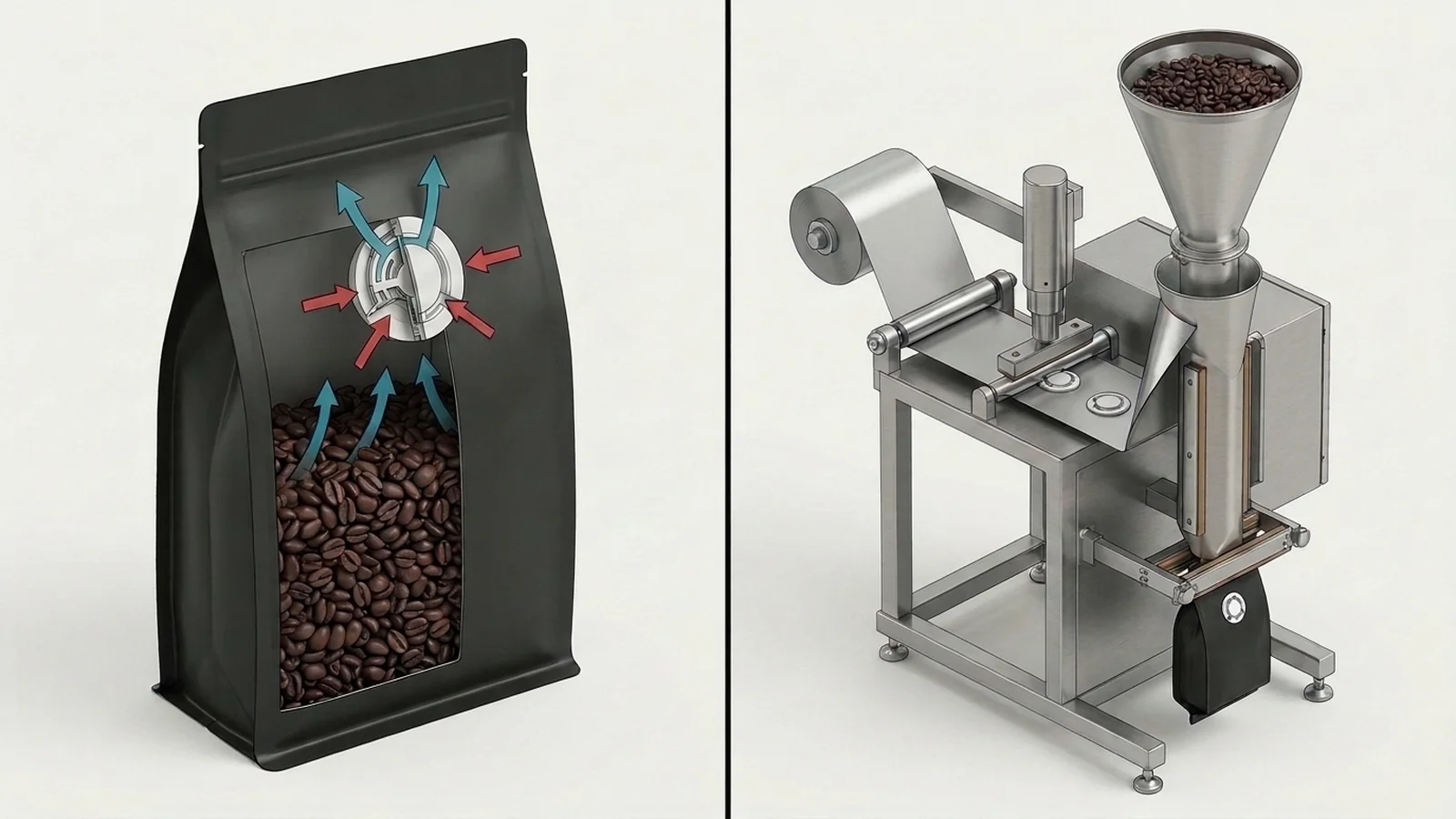
A coffee degassing valve is a one-way pressure-relief check valve on a multi-layer barrier bag that releases excess carbon dioxide and other roast gases from inside the sealed package without letting outside air enter. Without a vent path, gas generated after roasting builds internal pressure that can swell and damage or burst a sealed barrier container, whereas leaving a container open exposes roasted coffee to atmospheric oxygen.
Deciding whether a coffee packaging line needs a valve applicator separates into two engineering questions: whether roasted coffee keeps releasing enough carbon dioxide during the sealed distribution window to pressurize the pack, and whether your line forms bags from roll film on vertical form fill seal machines with an inline punch-and-heat-seal applicator or fills ready-made valve bags on premade pouch filling machines.
| Coffee state and pack format | Valve and machine route | Mismatch and trial check |
|---|---|---|
| Freshly roasted whole beans in roll-film pillow, quad-seal, or valve bags | Unfiltered polyethylene heat-seal one-way valve punched and heat-sealed inline before bag forming on a vertical bean bagger | Confirm valve type, barrier film laminate, and valve position on the bag together. |
| Roasted beans in ready-made stand-up pouches | Pouch supplied with a one-way valve already heat-sealed or attached by adhesive, opened and filled on a premade pouch packer | Verify in a sample trial that the actual pre-valved pouch opens and fills cleanly. |
| Freshly ground coffee still releasing residual CO2 in barrier bags | One-way valve with an interior nonwoven filter to prevent fine coffee particles from blocking the vent, paired with auger dosing and dust extraction | Keep coffee dust off the sealing jaws so powder on the seal area does not create leaking packs. |
| Roasted whole beans or ground coffee requiring low initial headspace oxygen | Separate nitrogen flushing supply specified alongside valve application on the quotation | State any residual-oxygen acceptance target as its own quotation line and verify on your film and pack. |
On this page
Why Does Roasted Coffee Degas and How Long Does Release Last?
During roasting, thermally driven chemical reactions generate gases of which a large fraction is carbon dioxide (CO2); part escapes during roasting while part stays trapped inside the porous bean structure and leaves steadily during storage or more abruptly during grinding and extraction. Printed multi-layer barrier laminate bags have largely replaced steel cans for consumer coffee beans and ground coffee, creating sealed barrier packs where carbon dioxide pressure builds up unless a pressure-relief valve vents excess gas while blocking outside air.
Before one-way degassing valves were adopted, post-roast gas release could generate enough internal pressure to make a sealed package fail, forcing manufacturers to hold roasted coffee prior to packaging. As Jessey A. Cowell (2018) documents in a University of Guelph food-science thesis, tempering beans for several hours before packaging slows manufacturing while exposing coffee to oxidation, inducing headspace vacuum strips aroma volatiles, and integrating a one-way valve regulates internal pressure so roasted coffee can be packaged immediately after cooling, provided the valve itself is properly sealed.
Post-roast degassing rate and total gas volume depend strongly on roast degree, storage temperature, and whether beans remain whole:
- In a time-resolved gravimetric study of whole roasted Arabica coffee across nine roasting profiles (Smrke et al. (2018), also hosted as an open-access PDF), degassing was measured for at least 400 h and roast degree had a stronger impact than roast speed: whole-bean weight losses were 2.7, 2.5, and 2.8 mg/g for slow, medium, and fast light roasts; 4.7, 5.6, and 6.6 mg/g for medium roasts; and 8.5, 10.0, and 11.9 mg/g for dark roasts. Weibull fits in Table 1 gave the dark fast profile a 153 h scale, 0.85 shape, and 12.67 mg/g infinite-time release versus a 377 h scale, 1.00 shape, and 3.44 mg/g for the light medium profile, and a medium-speed light roast held at 35 °C lost 3.4 mg/g over 800 h while still degassing at 2 μg/g per hour 1 month after roasting.
- In a storage packaging study (Smrke et al. (2022) PDF), freshly roasted coffee held approximately 1% of its weight as CO2 and whole-bean degassing lasted about one month. Roasted Arabica whole beans packaged under nitrogen in 1 kg OPP/Al/PE bags with an integrated one-way valve and rested 3 weeks held approximately 70% CO2 by volume and less than 0.5% O2, rising to around 77% CO2 at 9 weeks while O2 remained close to zero; fully emptying the bag into another container or closing an opened pack with tape allowed O2 to reach ambient 21% within a week as CO2 dropped to essentially zero.
How Does a One-Way Valve Vent CO2 and Block Oxygen?
A coffee bag valve operates as a miniature check valve, allowing gas to flow in only one direction. Two differential pressures govern its operation: cracking pressure, also called opening pressure, is the minimum upstream-to-downstream pressure differential at which the first indication of flow occurs, while reseal pressure, also called closing pressure, is the differential during closing at which there is no visible leak rate. In a diaphragm check valve, a flexing rubber diaphragm stays normally closed until upstream internal pressure exceeds downstream atmospheric pressure by the set differential, then flexes back to its closed seat once positive pressure subsides.
On a coffee button valve, an injection-molded polyethylene body and cover house a rubber diaphragm, a thin sealant oil layer, and an interior nonwoven filter over the punched film vent hole. The rubber diaphragm alone does not form an airtight seal; surface tension and adhesion of the oil layer between the diaphragm and the vent-hole rim seal the opening until internal package pressure overcomes both oil adhesion and external atmospheric pressure. By contrast, a low-profile adhesive valve can pass CO2 bubbles through the sealant oil while the vent channel remains closed when internal pressure disrupts liquid surface energy without exceeding oil-to-substrate adhesion. Reliable resealing matters because exposing roasted and ground coffee to 21% atmospheric oxygen increases deterioration rate roughly 20-fold relative to low-oxygen storage (Cardelli and Labuza (2001)), so any valve that is improperly sealed, poorly assembled, or dislodged during application or transport compromises package barrier integrity.
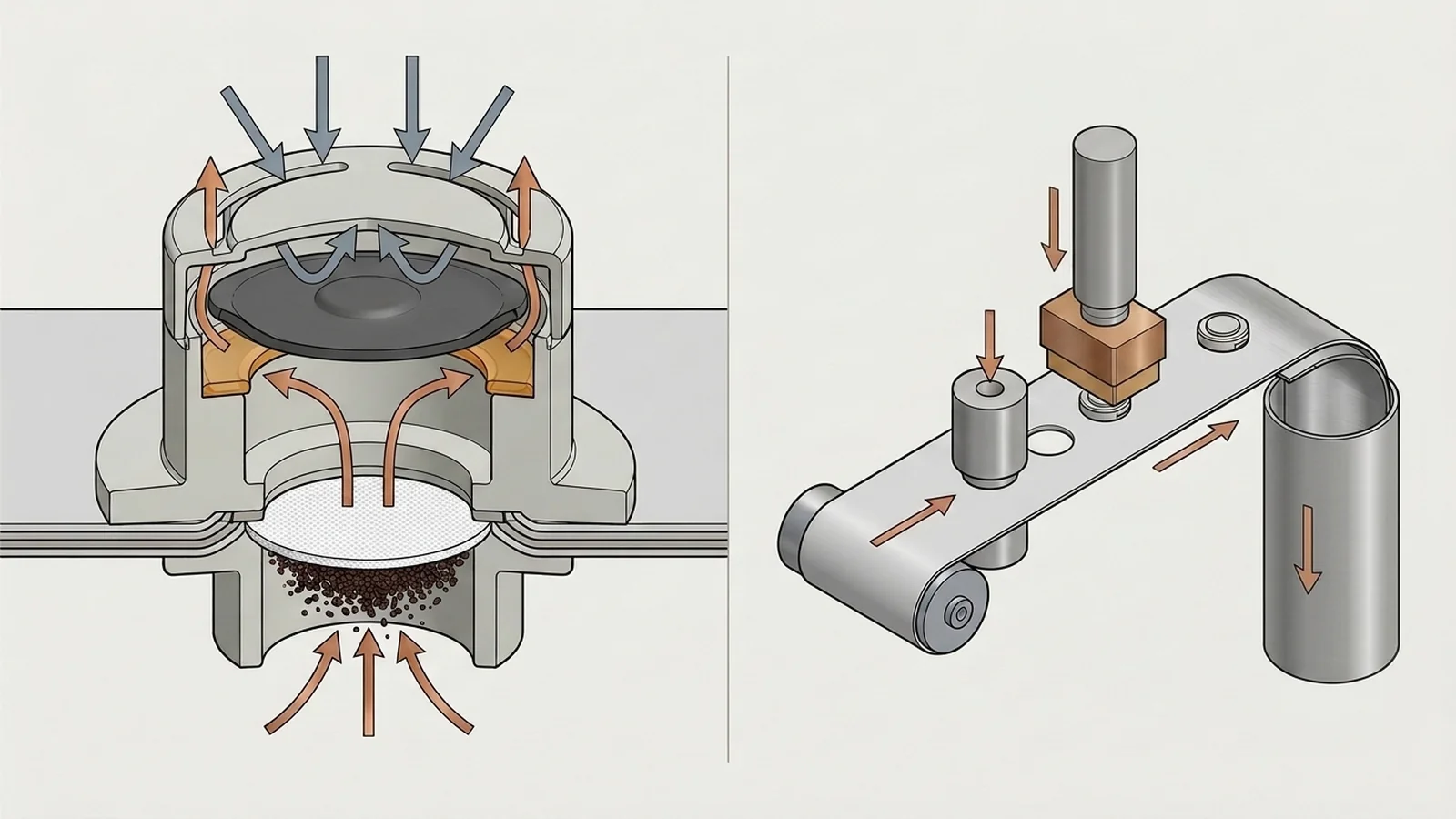
Commercial coffee degassing valves open in the 2 to 7 mbar range depending on valve geometry, joining method, and sealant-oil viscosity, so request the exact opening and closing pressure datasheet for the model your line will run. On Wipf WICOVALVE coffee-pouch specifications, for example, the membrane lifts off the seal flange at 3.5 ± 1.5 mbar to vent gas and closes again as overpressure falls to a closing pressure of at least 0.1 mbar so the sealant blocks oxygen back-diffusion across repeated cycles; its product tables rate polyethylene heat-seal valves W006 (bean, unfiltered) and W016 (ground, filtered) at 2–5 mbar opening pressure, and polyethylene ultrasonic valves W103 (bean, unfiltered) and W113 (ground, filtered) at 3–7 mbar.
| Valve hardware or experimental series | Reported pressure or shift | Engineering scope and selection note |
|---|---|---|
| WICOVALVE coffee-pouch membrane specification | Opening lift-off at 3.5 ± 1.5 mbar; closing pressure at least 0.1 mbar | Cycle band allowing roast CO2 release while maintaining oil-film reseal against oxygen back-diffusion. |
| WICOVALVE heat-seal PE valves W006 and W016 | 2–5 mbar opening pressure (W006 unfiltered for beans; W016 filtered for ground coffee) | Applies to polyethylene bodies joined by direct-contact heat sealing onto roll film or pouches. |
| WICOVALVE ultrasonic PE valves W103 and W113 | 3–7 mbar opening pressure (W103 unfiltered for beans; W113 filtered for ground coffee) | Applies when the polyethylene valve body, barrier film, and ultrasonic welding horn are matched as a set. |
| Cowell (2018) silicone-oil viscosity series (20, 70, 160, and 1100 mPa·s) | 6:4 and 0:1 oil blends raised mean first opening pressure on coarse grounds by 17% and 100% (low-profile) and 23% and 82% (button) versus 1:0 low-viscosity oil | Subsequent button-valve openings settled below the initial break-in pressure and rose with higher oil viscosity. |
Whole Bean vs Ground Coffee: When Do You Need a Filtered Valve?
Grinding destroys larger internal macropores inside roasted beans and accelerates CO2 release dramatically. Wang and coauthors, cited in the Smrke (2018) gravimetric paper, measured residual CO2 losses during grinding of 26–30% for coarse, 33–38% for medium, and 45–59% for fine grind sizes, while Smrke and coauthors found that up to 75% of trapped gas escaped during and within 90 s after grinding freshly roasted coffee, leaving a smaller remaining gas volume and a shorter degassing duration than whole beans.
Even after grinding losses, freshly roasted ground coffee packed before residual gas dissipates can still pressurize a sealed barrier bag. When a ground-coffee bag carries a valve, specify a filtered valve model (such as W016 for heat sealing or W113 for ultrasonic welding) whose interior nonwoven filter keeps fine coffee particles from fouling the oil film and blocking the vent hole, whereas whole-bean configurations use unfiltered bodies (such as W006 or W103).
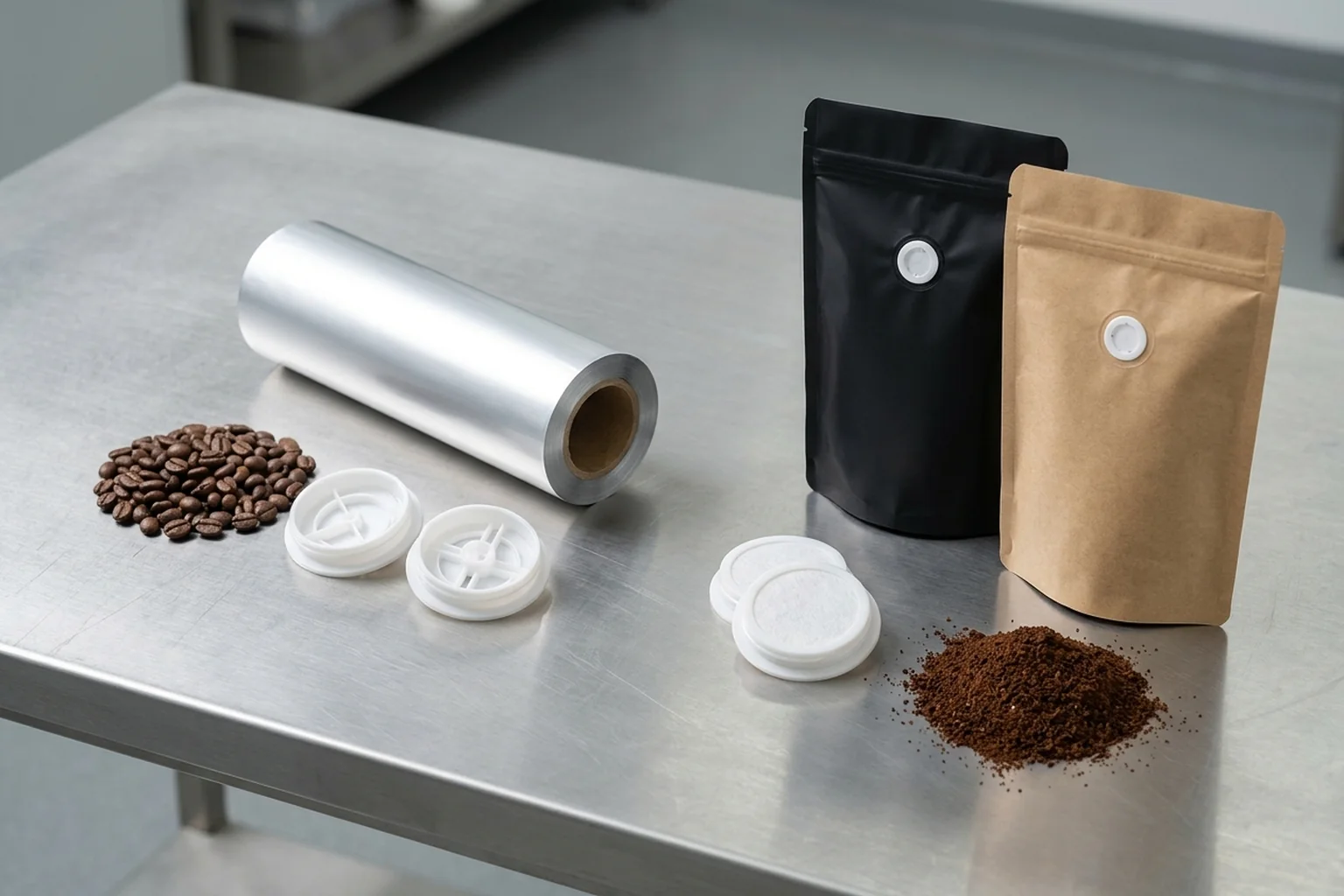
On our coffee packaging machines, product form also separates dosing and seal protection: whole beans are oily, can carry static, release CO2 after roasting, and can run on vertical bean baggers fitted with a degassing valve applicator, while ground coffee is fine and can stick and instant coffee is dusty and absorbs moisture. Our powder configurations therefore pair auger dosing with dust extraction because coffee dust on the seal area causes leaking packs even when the valve itself reseals properly. Where low initial oxygen is required at sealing, review flushing hardware and residual-oxygen targets separately in our nitrogen flushing packaging guide.
Inline Roll-Film Valve Applicator vs Pre-Valved Ready-Made Pouches
We route roasted coffee beans down two bag-making architectures: forming pillow, quad-seal, or valve bags from roll film on a weighing bagger in our vertical form fill seal machines family (where a degassing valve applicator is an optional device alongside gas flushing, date coding, hole punching, and gusseting for roasted coffee valve placement and aroma protection), or filling ready-made stand-up pouches on premade pouch filling machines.
On our vertical bean configurations, the inline applicator punches the flat film web and heat-seals the one-way valve in place before the bag is formed rather than applying valves by hand; send the valve type you purchase, the barrier film, and the valve position on the bag so we confirm all three together against valve or seal mismatch. On our premade pouch row, ready-made stand-up pouches are opened and filled on a premade pouch packer without a pouch-punching valve station on the filler: coffee pouches arrive with one-way valves already heat-sealed or attached by adhesive by the pouch converter, and we verify clean pouch opening and filling with your actual pouches and product during sample testing.
Flexible coffee packaging lines attach one-way degassing valves through three joining methods:
- Direct-contact heat sealing (used on our inline roll-film bean baggers) presses a heated sealing die along a controlled dwell time, temperature, and pressure profile to bond a polyethylene valve flange (such as W006 or W016, 2–5 mbar opening pressure) directly to a clean inner polyethylene sealant layer.
- Ultrasonic welding joins compatible polyethylene valve bodies (such as W103 or W113, 3–7 mbar opening pressure) onto barrier film in under one second when the valve flange, film laminate, and tuned ultrasonic horn are matched as a set; over-welding thins the flange until the perimeter cracks, whereas under-welding or web-thickness drift leaves incomplete seals.
- External pressure-sensitive adhesive placement punches a vent hole, doses sealant oil, and presses an adhesive-backed low-profile valve onto the outer bag panel on standalone applicator stations.
Checklist for Specifying Valve Type, Position, and Quotation Scope
A standalone bagger, a bagger fitted with a valve applicator, and a complete coffee packing line cover different engineering scopes, so request valve application, nitrogen supply, and any residual-oxygen acceptance target as separate quotation lines. Before locking tooling, ask your valve supplier for the opening pressure and closing pressure of the exact valve you will buy, check whether your coffee will still generate enough gas during sealed shipping to reach that opening differential, and schedule sample testing on your actual film or ready-made pouches.
| Specification item | Decision to record | Where it routes next |
|---|---|---|
| Coffee state, roast degree, and post-roast hold | Whole bean or ground coffee, light to dark roast degree, and time elapsed between roasting, grinding, and sealing | Determines whether residual CO2 release during sealed storage requires a one-way relief path. |
| Valve type and interior filter | Unfiltered valve body for whole beans versus interior nonwoven-filtered valve body for ground coffee, plus stated opening and reseal pressures | Prevents fine grounds from plugging the diaphragm seat while matching the joining method. |
| Pack format and joining route | Roll-film bag with inline punch and direct-contact heat-seal applicator versus converter-supplied ready-made valve pouch | Routes to vertical form fill seal machines for rollstock or premade pouch filling machines for ready-made bags. |
| Valve position and film laminate | Exact panel coordinates on the bag drawing, laminate composition (for example OPP/Al/PE), and heat-seal layer compatibility | Checked together during sample testing to prevent punch misalignment or flange leaks. |
| Nitrogen flushing and headspace target | Whether inert gas flushing and a measured residual-oxygen target belong in the project alongside degassing valve application | Itemized on separate quotation lines; see the nitrogen flushing packaging guide and coffee packaging machines. |
Frequently Asked Questions
What is the vent hole in a coffee bag used for?
The punched hole in the barrier film provides the exit passage beneath the valve body so excess roast gas inside the bag can reach the flexing diaphragm or oil channel and escape. That hole has to align directly under a properly sealed valve; an uncovered film hole or a dislodged valve turns into an open leak that admits atmospheric air.
Does ground coffee need a one-way degassing valve?
Grinding releases a large share of trapped CO2 within 90 seconds as bean macropores break, so degassed grounds release less gas over a shorter period than whole beans, whereas freshly roasted and ground coffee packed immediately can still build pressure inside a sealed barrier bag. When your roast-to-seal schedule keeps active gas in ground coffee, pair an interior-filtered valve with auger dosing and seal-zone dust extraction.
Does a one-way degassing valve replace nitrogen flushing?
No: a one-way valve relieves post-roast CO2 overpressure and closes at its reseal pressure to block outside air from diffusing back in, whereas nitrogen flushing displaces oxygen inside the bag before the seal closes. In unopened nitrogen-flushed 1 kg whole-bean valve bags, the headspace after three weeks held about 70% CO2 and less than 0.5% oxygen, and by the end of nine weeks of storage CO2 was around 77% while oxygen stayed close to zero, whereas emptying the bag or closing an opened pack with tape let oxygen reach 21% within one week.
Can a premade pouch filling machine apply degassing valves inline?
Our inline hole-punch and heat-seal valve applicator mounts on roll-film vertical bean baggers ahead of the bag former. For ready-made stand-up pouches run on our premade pouch packers, order pouches with the one-way valve already heat-sealed or adhesive-mounted by your pouch converter, then send sample pouches to verify clean opening and filling.
Sources
- Smrke et al. (2018), Time-Resolved Gravimetric Method To Assess Degassing of Roasted Coffee, Journal of Agricultural and Food Chemistry (DOI)
- Smrke et al. (2018), Time-Resolved Gravimetric Method To Assess Degassing of Roasted Coffee (University of Oregon PDF archive)
- Smrke et al. (2022), Effects of different coffee storage methods on coffee freshness after opening of packages, Food Packaging and Shelf Life (University of Oregon PDF archive)
- Cowell, J. A. (2018), One-way Degassing Valve Behavior & Function in The Acceptability of Stored Coffee, MSc Thesis, University of Guelph
- Cardelli, C. & Labuza, T. P. (2001), Application of Weibull Hazard Analysis to the Determination of the Shelf Life of Roasted and Ground Coffee, LWT - Food Science and Technology, 34(5), 273–278
- Wikipedia: Check valve
What to send us
Send what you have and mark what is still undecided. Discuss your application with LINEVO.
| Item | Why we need it | Example format |
|---|---|---|
| Coffee form, roast degree, and hold time before packing | Sets whether post-roast carbon dioxide release continues inside the sealed bag and whether an interior valve filter is needed. | Dark or light whole beans packed immediately after cooling, or medium-grind coffee packed after grinding. |
| Valve datasheet and joining type | Matches the inline sealing station or pouch converter specification to the exact valve body and pressure band. | Polyethylene heat-seal valve model, filter presence, and manufacturer opening and closing pressure bands. |
| Roll film or ready-made pouch specification | Determines inline web punching and heat sealing before bag forming versus filling a pre-valved ready-made pouch. | OPP/Al/PE rollstock laminate structure and valve position on the panel, or sample ready-made stand-up valve pouches. |
| Nitrogen flushing and quotation scope | Separates a standalone bagger, a bagger with a valve applicator, nitrogen supply, and complete packing line interfaces. | Inline valve application, nitrogen flushing availability, and any residual-oxygen acceptance target to test. |