
Illustrative almonds and walnut halves beside flexible bags on a kitchen counter.
For packaged nuts, follow the product’s date and storage instructions, and reclose or transfer the contents as directed after opening. Diamond’s official FAQ recommends refrigeration after opening to help prevent off flavors and rancidity. For an unopened commercial bag, oxygen protection is a package-system question: Almond Board guidance identifies product, storage environment and packaging as interacting shelf-life factors.
- Opening a nitrogen-flushed pack exposes the contents to the surrounding air.
- Oxygen protection needs both appropriate film and intact seals.
- A nitrogen option on a machine is not a measured shelf-life result for your recipe.
On this page
How long do nuts last under stated storage conditions?
Use a condition-specific storage statement rather than a single number for all nuts. Fresh nuts, roasted snacks and seasoned mixes are different products. The UC Agriculture and Natural Resources article on storing fresh nuts provides a useful bounded reference for home-stored walnuts, almonds, pecans and pistachios; it is not a commercial nitrogen-bag specification.
| Source and scope | Published storage statement | Boundary |
|---|---|---|
| UC ANR: walnuts, almonds, pecans and pistachios | Up to one year in a refrigerator at 40°F or lower | Clean, moisture-free, odor-tight packaging; fresh nuts in the article’s handling context |
| UC ANR: chestnuts | Different storage guidance from the nuts above | Do not apply the same interval to chestnuts |
| Diamond packaged nut products | Use its printed best-before date and refrigerate after opening | Manufacturer guidance for its own products, not every snack blend |
| Commercial roasted or seasoned retail bag | Use the actual product’s printed date and instructions | Recipe, process and packaging must match the supporting validation |
The UC ANR reference also gives distinct frozen-storage intervals, showing why temperature and nut type must travel with any number. For a retail snack, use the brand’s instructions rather than replacing the printed date with a fresh-nut storage table. Record when the bag was opened so the original sealed-pack context is not confused with household handling.
Why can nuts deteriorate inside a bag?
Nuts contain oils that can develop rancid flavors as quality deteriorates. Refrigeration and suitable closed storage help preserve flavor, but neither a pouch shape nor a shiny film proves that the contents are protected. For commercial packaging, ask what the complete package does against the deterioration route identified for the actual nut product.
| Change or concern | Packaging question | Practical record |
|---|---|---|
| Oxidative flavor deterioration | How much oxygen remains and can enter the finished pack? | Gas measurement plan and film oxygen-transmission information |
| Moisture exposure | What moisture barrier does the film provide? | Converter data and storage humidity conditions |
| Loss of enclosure after opening | How should this product be reclosed or stored? | Consumer instruction and opening date |
| Visible contamination or mold | Is this product fit to keep? | Discard affected food rather than using packaging claims as a reassurance |
Diamond connects refrigerated storage with preventing off flavors or rancidity. The Almond Board separately emphasizes that cut and roasted almonds need more moisture and oxygen protection than other almond forms. This is a reason to define the product form in the brief, not to rank every nut species by a claimed deterioration speed.
How do nitrogen-flushed bags protect nuts?
Nitrogen flushing replaces part of the air in the pack to reduce oxygen exposure. For roasted almonds, the Almond Board names nitrogen flushing and vacuum packaging as approaches for oxygen protection. The effect still belongs to the whole package: the film, the closure, the product and the storage environment all need to match the intended use.
| Part of the package system | Role to review | Question before purchase |
|---|---|---|
| Gas flushing | Reduce oxygen initially present around the nuts | Where is gas introduced and how is the resulting pack atmosphere measured? |
| Film oxygen barrier | Limit subsequent oxygen transmission through the wall | What is the complete laminate’s transmission value and test condition? |
| Seal integrity | Close paths where air could enter at the seams | Which filled-pack seal test and acceptance criteria are agreed? |
| Storage conditions | Keep the package within the conditions supporting the product claim | What temperature, humidity and handling apply during distribution? |
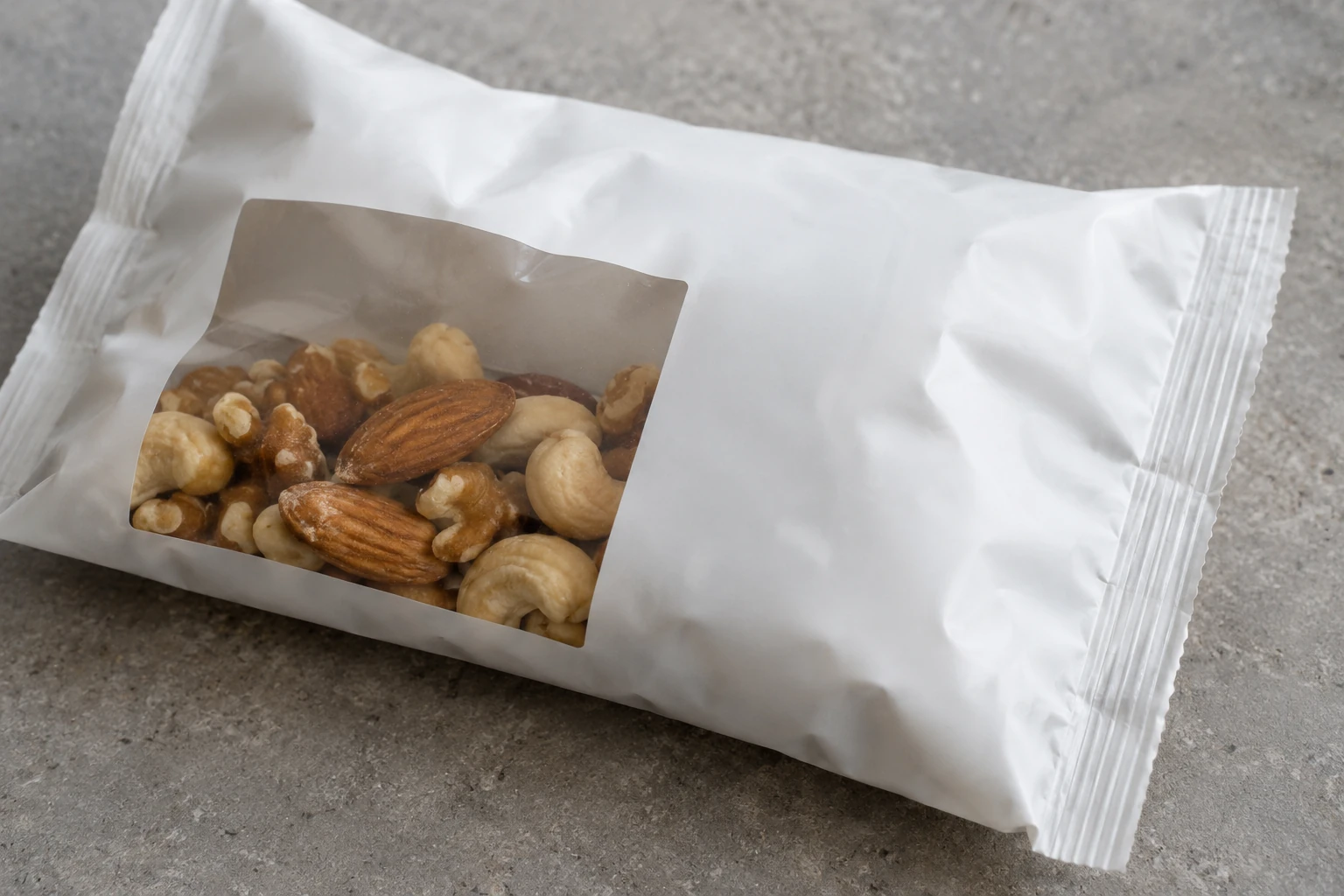
Illustrative nut pillow bag with its end seal, film folds and space around the contents visible.
Headspace is the unfilled space in the closed bag. Record the pack dimensions, fill level and proposed gas arrangement together, because these define the package to be evaluated. A residual-oxygen reading is a measurement at a particular point and time; agree when to take it and how to record the pack identity.
After a consumer opens the pack, surrounding air reaches the nuts. Reclosing does not recreate the original packing atmosphere. Use the brand’s after-opening advice. For equipment, the snack and nuts VFFS guide treats nitrogen flushing as an option to review, not a universal storage-life promise.
What film, seal and headspace evidence should a brand keep?
Keep a record that can connect each measured package to its product and production settings. Film data describe a supplied material; pack measurements describe the filled and sealed sample. The two records answer different questions. Use an actual snack bag and the film data sheet when reviewing the VFFS family’s protection options.
| Record | Useful fields | How it supports review |
|---|---|---|
| Product description | Nut type; raw or roasted; pieces or whole; seasoning; target fill | Identifies the product for the packaging comparison |
| Laminate data | Layer structure; oxygen/moisture transmission conditions; sealing window | Lets the converter’s material information be matched to the bag |
| Filled-pack sample | Finished size; fill position; seal condition; sample identification | Shows the enclosure being evaluated |
| Gas measurement | Method; sampling point/time; pack identity; result | Separates a measured result from the mere presence of a gas fitting |
| Storage evaluation | Product, pack, conditions, observation times and acceptance criteria | Supports the brand’s own claim under stated conditions |
If seasoning or fines appear near a seam, record the affected pack and filling conditions before adjusting the process. A seam must close across its full intended band. Agree inspection and any leak-test method with the packaging team; a nominal jaw setting is not evidence that every filled bag has the same enclosure.
Use the sample-testing service to discuss which production inputs and observations belong in a machinery trial. A short filling/sealing trial and a storage evaluation have different purposes. Keep the agreed scope clear so a machinery acceptance record is not later presented as proof of a consumer shelf-life claim.
Why do batch numbers and date codes matter?
A readable date and a batch identity make a storage claim usable. The date tells the consumer what the producer intends; the lot code helps the brand identify the corresponding production and packaging records. They do not replace the original evidence, but without the link a packet or bag becomes harder to assess.
- Agree the date wording and how it relates to the producer’s product specification.
- Keep the print location clear of the cut or fold that could make it unreadable.
- Record which film lot, product lot and packing run produced the sampled bags.
- Check legibility on finished bags after sealing, cutting and normal handling.
A brand may use an encoded production number rather than a readable calendar date. Follow its decoding instructions. Diamond publishes its own date-code explanation in the official FAQ; that explanation cannot decode another brand’s bag. For equipment planning, include the code layout in the project brief checklist.
If you make these packs
LINEVO publishes an oxygen-barrier vertical nut packaging configuration with nitrogen flushing. The catalog lists a multi-point inline nitrogen-flushing assembly and multihead combination-weigher synchronization as items to review for the quoted configuration; confirm their scope rather than treating them as standard included equipment. Numerical specifications for this configuration are on request; the listing supplies no residual-oxygen or storage-life figure.
| Catalog route | Published fact | Boundary to keep in the quotation |
|---|---|---|
| Nut VFFS configuration with nitrogen flushing | Inline flushing assembly and multihead-weigher synchronization are listed as review-required configuration items | Confirm both items’ actual supply/interface scope, gas arrangement, film and measurement requirements in the quotation |
| VFFS system with multihead weigher | Separate nuts and dried-fruit reference configuration | Its numerical ratings do not become ratings for the nitrogen-flushing configuration |
| Snack and nuts application guide | Compares product feeding, film and gas options | Whole chips, nut pieces and sticky fruit can need different handling |
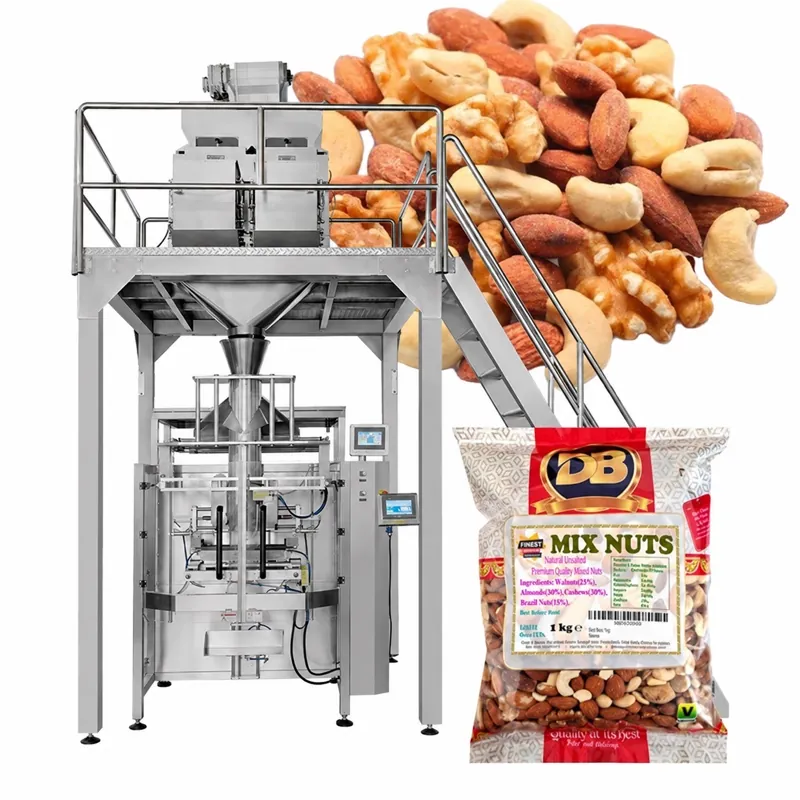
Authorized catalog image of a vertical multihead-weigher nut packaging configuration with packaged nut examples.
Tell the team whether your product is whole nuts, cut nuts or a mix, and describe any fragile, dusty, oily or sticky components. The vertical form fill seal family explains the roll-film forming route. If you buy finished empty bags, compare the premade pouch family instead of assuming the same bag handling.
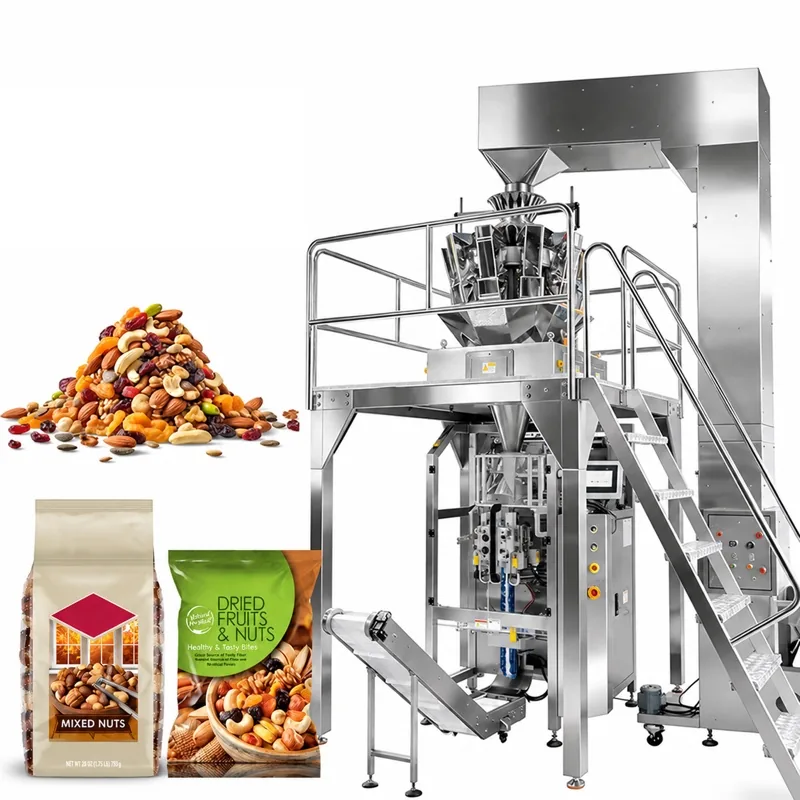
Catalog image of a VFFS machine with multihead weigher and nuts or dried-fruit examples.
Prepare bag dimensions, target fill, film structure and the desired good output before discussing model scope. Use the snack and nuts selection guide for the feeding and format questions, and the sampling service information to agree what samples are needed. LINEVO can review individual stations; define the boundary with any existing upstream or downstream equipment.
When this explanation does not apply
The oxygen-protection discussion concerns nut quality and packaging decisions. It does not determine whether a recalled, visibly moldy or contaminated product is safe, and it does not describe treatment of foodborne illness. Follow the product’s instructions and relevant official advice for those circumstances. Nitrogen flushing is not evidence that a food has been sterilized.
Chestnuts, raw home-harvested nuts and seasoned retail snacks should not share an assumed storage interval. A vacuum bag is also a different package condition from a nitrogen-flushed bag. Use the nut type and packaging description to select the applicable source and test plan.
Nut storage FAQ
How long can I keep my Diamond of California nuts?
Until the best-before date printed on each package: Diamond’s official FAQ guarantees flavor up to that date and recommends refrigeration after opening. Apply that guidance to Diamond products; the fresh-nut refrigerator table above covers a separate household-storage context.
Can I eat expired nuts?
Check them first. FDA describes Best if Used By as a flavor and quality date rather than a safety deadline and advises checking food past that date for spoilage. Discard nuts that smell or taste rancid, show mold or have changed noticeably in color or texture; an intact bag does not reverse those changes.
How long do nuts stay fresh in the fridge?
UC ANR gives up to one year for the four fresh-nut types listed in the storage table above, at 40°F or lower in clean, moisture-free, odor-tight packaging. A processed retail snack instead follows its own label and after-opening instructions.
Can you freeze nuts to make them last longer?
Yes. UC ANR lists freezer storage at 0°F or lower for a year or more for almonds, two years or more for walnuts and pecans, and three years for pistachios, in clean, moisture-free, odor-tight containers. These figures concern fresh nuts stored at home; a packaged retail snack follows its own label.
How can I read the date code on Diamond packages?
Diamond explains its example 10120107331 as three internal digits, a two-digit packing year, a three-digit day of that year, and three more internal digits. In that example, 20 is 2020 and day 107 is April 16. This identifies packing, not a universal expiry date; other brands may use different formats.
Can nuts go stale or bad if you do not seal the container?
Yes: open storage exposes them to surrounding air and moisture. Reclose or transfer them as the product instructions recommend. A household reclosure does not restore the original nitrogen atmosphere; the nitrogen section above explains that change.
Methods and sources
Official sources checked 8 October 2026: Diamond nut storage and code FAQ; Almond Board on shelf-life factors and packaging; and UC ANR on storing fresh nuts (9 November 2020). FDA on quality dates (content current as of 5 March 2024) was checked on 9 October 2026 for the expired-nuts answer. The UC reference concerns specified nuts and storage conditions. The Almond Board’s almond guidance is not a numerical life claim for every nut species.
Machine facts come only from the linked LINEVO catalog and application pages. Related reading: premade pouch types explains purchased-bag routes; what is flow wrapping explains a different horizontal wrapping process. No LINEVO trial, residual-oxygen figure or measured storage extension is claimed here.
We reply within 24 hours.
Discuss your packaging project