
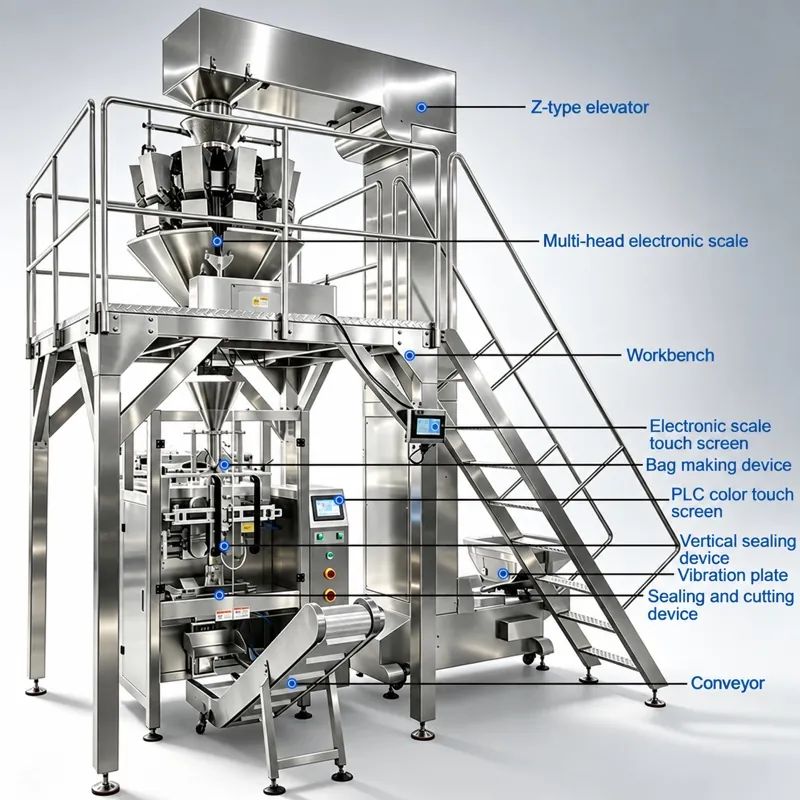
Catalog VFFS system with a multihead weigher above a vertical bagger, support platform and discharge conveyor.
| Input | Typical value or condition | Why it matters |
|---|---|---|
| Motion definition | Cross-sealing while film moves; configuration confirmation required. | Distinguishes continuous motion from a servo-driven stop-and-seal cycle. |
| Product behavior | Your product, including fragile, sticky or dusty variants. | Dosing and settling must leave the seal area clear. |
| Bag and film | Finished bag drawing and actual film specification. | Forming and sealing requirements are specific to the pack and material. |
| Dosing timing | Dose, tolerance and how each portion is released. | The bagger cannot compensate for a portion that is not ready. |
| Required output | Your target good bags per minute or per shift. | A production requirement is different from a machine cycle figure. |
| Quotation status | Motion, output, options and utilities are on request for the proposed setup. | This page supplies selection criteria, not a rated continuous-motion model. |
On this page
How continuous-motion VFFS sealing works
Continuous motion means the cross-seal is made while the film continues to travel, with the sealing jaws following the film during contact. Intermittent motion pauses the film for that cross-seal. Observe this part of the cycle rather than judging the mode from a servo motor, a conveyor that keeps running or the word continuous in a process description.
In either route, roll film passes over a forming shoulder, wraps around the forming tube and receives a longitudinal seal. A measured portion enters from above. The transverse jaws make the end seals that separate successive bags, with cutting and discharge completing the pack. The vertical form fill seal family covers this broader process and its product and dosing routes.
| Observation | Intermittent motion | Continuous motion |
|---|---|---|
| Film during cross-sealing | Pauses for the cross-seal. | Travels while the cross-seal is made. |
| Cross-jaw contact | Seals the film during its pause. | Follows the moving film during sealing contact. |
| What to request | An explanation of film indexing and the sealing pause. | An explanation or available motion record showing film travel and jaw following together. |
| What a servo label establishes | Drive/control wording; the cycle still needs identifying. | Drive/control wording; the cycle still needs identifying. |
Cross-sealing concepts: intermittent motion pauses the film tube between sealing jaws; continuous motion moves the film downward while the jaws follow it.
Following motion requires coordination between the film and the jaws during the sealing contact. Continuous motion does not define one particular jaw path: different mechanisms can provide that following action. Ask which mechanism the proposed configuration uses and how it makes the cross-seal, rather than specifying a path from a generic diagram.
What the LINEVO catalog currently describes
The current LINEVO catalog contains continuous-servo descriptions, but those descriptions do not establish that the film keeps moving during cross-sealing. They are configuration clues to review with the team. No continuous-motion supply mode, jaw path or output rating is confirmed by this page.
| Published configuration | Catalog wording or detail | What still needs confirmation |
|---|---|---|
| VFFS system with multihead weigher | Continuous servo sealing wording; the process also mentions continuous or intermittent servo pull belts. | Which film and cross-jaw motion applies to the configuration being quoted. |
| Gummy and bulk candy weighing configuration | Continuous servo-driven VFFS wording; servo control of pulling, forming and horizontal sealing. | Whether the film travels during horizontal sealing, and how the jaws follow it. |
| Coffee bean VFFS configuration | Continuous servo-driven wording; independent servo control of film pulling, tracking and end-sealing jaws. | Actual motion mode, pack options and the conditions for the proposed setup. |
| Chips weighing and bagging configuration | Continuous servo-driven wording; multi-axis management of film pulling, tracking and jaw sealing. | Cross-seal motion, gentle handling and any gas-flushing conditions for your product. |
These entries are application references rather than a verified group of continuous-motion models. Their source-listed features are items to confirm in a quotation. A bag-forming photo, an independent servo loop or a multi-axis description does not show what happens to the film when the jaws close.
When requesting a continuous VFFS bagger, identify the application closest to yours and add the explicit question: does the film keep moving during cross-sealing on the proposed machine? Ask the team to identify the configuration and the available evidence. If the answer is still open, keep motion mode marked as open instead of treating the feature name as a completed technical specification.
Choose between continuous and intermittent motion
Continuous motion is worth evaluating when the cross-sealing pause is a relevant bottleneck and the product, film and connected equipment can support the required cycle. Keep intermittent motion in the comparison when those conditions are unresolved or when another part of the process limits output. There is no universal bags-per-minute threshold that makes the decision.
Start with the good output your production plan needs and the point that currently prevents it. If a weighed portion arrives late, a product bridges in the chute or filled material remains in the seal area, changing the bagger motion alone does not settle the problem. The following matrix is a selection framework based on those conditions; it is not a record of LINEVO trial results.
| Selection input | Continuous motion deserves review when… | Keep comparing when… | Decision record |
|---|---|---|---|
| Production requirement | The sealing pause is relevant to the target and portions are ready consistently. | Required output is already met, or feeding/dosing is the limiting step. | Good-output target, operating schedule and current bottleneck. |
| Product release and settling | Each portion reaches the bag and clears the sealing zone in time. | Sticky pieces trail, fragile pieces break, or dust reaches the seal. | Product behavior, drop path and unresolved handling questions. |
| Film and seal requirements | The actual material can be assessed against the proposed sealing contact. | A new film or contaminated seal area has not been reviewed. | Film datasheet, representative roll and seal evaluation requirements. |
| Pack range and changeovers | The required bag formats and changes fit the proposed configuration. | Many formats or special features remain undefined. | Bag drawings, fill range and required change parts. |
| Connected equipment | Dosing, inspection and discharge interfaces can be defined for the target. | Upstream shortages or downstream stops are unresolved. | Included, optional and open equipment plus interface responsibilities. |
For fragile chips, nuts and loose snacks, the snack packaging selection guide helps define the product path and finished bag. Product behavior should guide the dosing discussion: multihead weighing, auger filling and cup dosing are catalog routes, not evidence that every route is available with the same motion mode.
Review the complete packaging system scope alongside the bagger. Confirm what happens if a portion is not ready, if inspection rejects a bag or if downstream equipment stops. Record those interfaces before using a nominal bagger figure to plan a whole line. Format changes, cleaning and the operating schedule belong in that same discussion.
Send the product, finished bag, film details and required good output with the motion question. The team can review the applicable route, identify missing conditions and discuss whether a sample review is needed. A reply starts that review; it does not establish a speed or a completed test.
When this does not apply
This continuous-motion selection framework does not settle a project whose packaging route or film-and-jaw motion is still unknown. It also does not transfer a result from one product, pack or material to another. Resolve those boundaries before selecting on the continuous label.
- Unconfirmed motion: a source-listed continuous-servo feature remains a question for the proposed configuration; it is not a verified machine classification.
- Premade packaging: a purchased pouch, zipper or spout changes the route discussion. Compare premade pouch filling machines when the intended pack arrives ready-made.
- Horizontally supported product: a product or tray carried through a wrapper belongs in a flow wrapping machine comparison. This page concerns a vertical bagger receiving product from above.
- Unresolved product or film behavior: sticking, dust, product damage, sealing-window uncertainty and format changes need review in their own right.
- Unreviewed protection or cleaning requirements: motion mode does not establish gas performance, shelf life, hygienic construction or a washdown build.
The separate box motion versus rotary end-seal comparison addresses horizontal wrapping mechanisms. A similar mechanism name does not transfer that article’s configuration conclusions to this vertical application. Here the first confirmation is whether the film moves during cross-sealing, followed by the actual mechanism and conditions.
Continuous does not mean a line can never stop. Missing product, faults, cleaning and downstream interruptions still need a defined response. Nor does intermittent automatically mean low-quality sealing, a lower purchase price or suitability only for small plants. Those comparisons require the quoted scope and intended operating conditions.
Confirm motion and output under your conditions
A useful configuration review brings the film-and-jaw explanation together with the intended product, bag and film conditions. Where a trial is needed, agree what it will measure and what records are available before sending samples. A still photograph cannot resolve the cross-sealing motion.
| Review item | Ask for or agree | Keep with the answer |
|---|---|---|
| Film and jaw motion | Does film continue to move during cross-sealing? How do the jaws follow it? | Configuration identity and any available explanatory drawing or motion record. |
| Product and pack | Which representative product, fill, tolerance and bag format are being reviewed? | Product batch/condition, dimensions and required options. |
| Material and registration | Which film and print requirements are included? | Film specification, roll information and registration requirements. |
| Seal acceptance | How will formed packs and seals be evaluated? | Agreed checks, acceptance criteria and observations. |
| Output definition | Are formed cycles or accepted bags counted, over what period? | Timed run, stops, rejects and the equipment included. |
| Records and remaining questions | Which written records, photos, video or packed samples can be supplied? | Agreed deliverables, conditions and unanswered items. |
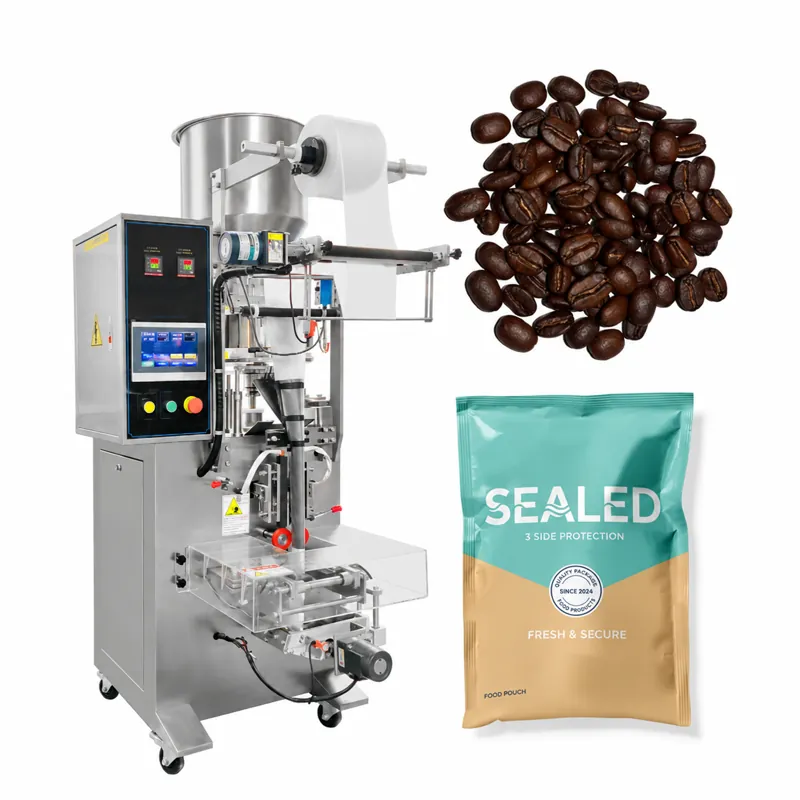
Catalog vertical bagger with a hopper, film roll and guarded lower sealing area, beside coffee beans and a bag example.
Use the sample testing preparation page to agree representative material, quantities, handling conditions and shipping instructions. A trial is useful when a product or film question cannot be settled from the brief alone. It is a separately agreed step, not an assumed demonstration at a headline speed.
For an output record, define the start and end of the counting period, accepted bags, rejects and stoppages. Record whether the run includes the feeding, dosing, inspection and discharge equipment intended for the project. Keep film, product, bag, settings and configuration together with the result so that a later format change does not silently inherit an unrelated figure.
A short run helps answer the agreed questions. It does not by itself establish long-term output, the result with a different batch or material, or the performance of equipment outside the trial. If continuous-motion evidence or representative test equipment is unavailable, record that limitation and agree what remains to be confirmed in the quotation and acceptance criteria.
The packaging project brief collects the information needed for that discussion. Ask for clarification, an identified configuration or a proposed review step according to what is actually available. Do not assume an existing video or drawing proves the requested product and film conditions.
Questions buyers ask before a configuration review
Additional procurement questions need configuration-specific answers. The questions below cover information that changes the review without inventing a utility rating, maintenance schedule or price.
Can continuous-motion VFFS handle powders?
Powder suitability depends on dosing, product behavior and the sealing conditions of the proposed setup. The LINEVO VFFS family lists auger-based powder applications, but that does not confirm continuous-motion availability for them. Include flow behavior, dust, dose tolerance and the intended bag in the brief; identify any powder reaching the seal area as an issue to review.
Can this VFFS motion be used for liquids?
Liquid dosing is outside the configurations listed in the current LINEVO VFFS family. That is a limit of this public catalog scope, not a claim about all VFFS equipment. Send the liquid, viscosity, fill temperature, particulates and intended pack so the team can consider the appropriate filling route before discussing its motion.
What maintenance should be considered before choosing continuous motion?
Maintenance requirements must come from the proposed configuration. Ask about access, cleaning, wear parts, inspection tasks and the applicable documentation; do not assume a service interval from the motion label. The spare-parts preparation page explains how machine identification and part information support that discussion.
What should be checked if output or seals become inconsistent?
Document the conditions and recent changes before requesting configuration-specific help. Record the affected product, bag and film, any changed settings, visible seal defects, stops and reject pattern. Useful photos or available run records should identify those conditions. This is a support brief, not an instruction to alter jaw timing, temperature or other machine settings without the relevant guidance.
What operator information is needed for a configuration review?
Describe the intended operating, changeover and cleaning arrangements and the training needed. Name who will operate the equipment and who will maintain it, without assuming a fixed staffing count. Use the installation and training planning page to define responsibilities and support for the actual configuration.
How much power does a continuous-motion VFFS machine consume?
Power consumption and utility requirements are on request for the proposed configuration. Motion type does not supply an electrical rating. State the available voltage, phase, frequency and compressed-air conditions, and identify any gas supply or connected equipment. Ask the quotation to distinguish the bagger requirements from the complete system requirements.
What determines the quotation for a continuous-motion VFFS configuration?
The confirmed configuration and included scope determine the quotation. Dosing, handling, bag formats, film review, change parts, controls, utilities, inspection interfaces and support arrangements all belong in the comparison. Motion availability is an open item until confirmed. Compare proposals using the same inputs and included equipment rather than assuming a universal price premium for continuous motion.
Takeaway: Submit operating and procurement requirements as named questions; obtain utilities, support and commercial scope for the actual configuration.
What to send us
Send what you have and mark what is still undecided. We reply within 24 hours.
| Item | Why we need it | Example format |
|---|---|---|
| Product and release behavior | Selects dosing and highlights sticking, dust, breakage or settling questions. | Product photo; usual and difficult variants; dose and tolerance. |
| Finished bag and format range | Defines forming, sealing and required change parts. | Bag drawing with finished dimensions, fill and required features. |
| Film and sealing information | Allows review of material, registration and the intended seal requirements. | Film datasheet, roll details and representative printed material if needed. |
| Required good output and schedule | Defines the production requirement without confusing it with a cycle rating. | Your good-bags target, shifts and changeover pattern; mark estimates. |
| Motion question and current bottleneck | Makes film-and-jaw confirmation and the reason for considering continuous motion explicit. | Does film move during cross-sealing? Include available run records with conditions. |
| Site, cleaning and equipment interfaces | Defines utilities, operating arrangements and who supplies each connected unit. | Available power/air; cleaning method; upstream and downstream equipment list. |
| Open items and desired review record | Lets the team identify missing information and agree the next review step. | Configuration clarification, sample-review questions or motion evidence to discuss. |