
Flow wrapping in short
A flow wrapper, also called a horizontal form fill seal (HFFS) or pillow packing machine, works in four stages. Products are fed lying down at a steady pitch, film from a single reel is folded into a tube around them, fin seal wheels join the film edges underneath, and rotary jaws seal and cut the tube between products. It suits items that are already a unit, such as a bar, a stack of biscuits, a sponge or a tray of dumplings. On the LINEVO LV-250B/D the source catalog lists bag widths of 30–110 mm and film up to 250 mm wide; the output for your product is confirmed with your product and film, not read from the listed 40–230 bags per minute.
- Pack length follows the cut length; pack width and height follow the forming box, so a product with a very different cross-section may need another forming box.
- Check the infeed first: a wrapper can only wrap well if each product arrives in position and at a steady pitch.
- A flow wrapper seals film around the product; it does not shrink it. A tight, shrunk-on finish is shrink wrapping, which needs shrink film and heat.
- A VFFS machine makes a similar pillow bag, but drops loose, dosed product into it from above. Flow wrapping is for products that can lie flat on a conveyor.
How does a flow wrapper work, step by step?
A flow wrapper turns a flat reel of film into sealed packs in one continuous pass. Each stage controls one part of the pack, so the table shows what happens at each stage, what it decides about the pack, and what you need to confirm for your own product.
| Stage | What happens | What it decides | What to confirm for your product |
|---|---|---|---|
| 1. Infeed | Products are placed on a conveyor with pushers, by hand or from an automatic feeder, and carried into the film at a fixed pitch. | Whether every product reaches the film in the right position, which is the first thing to check when packs come out wrong | Product size range, orientation, whether it is fragile or sticky, and how products leave your line |
| 2. Film forming | Film unwinds from one reel. On printed film a sensor reads the registration mark so the print lands in the same place on every pack. The forming box folds the film into a tube around the product. | Pack width and height, and where the print sits | The film reel and the forming box needed for each product size |
| 3. Fin seal | Fin seal wheels press the two film edges together under the product and seal them lengthwise. | The long seal on the underside of the pack | Heat-seal or cold-seal film, and the seal settings on your film |
| 4. End seal and cut | Rotary end-seal jaws close across the film tube in the gap between two products, seal it and cut it, so each stroke completes a pack. | Pack length, set by the cut length, and the end seal pattern | Finished pack length, end seal pattern and any easy-open feature |
| Discharge | A conveyor carries the finished packs away. Coding and gas flushing are listed as options on some configurations. | What happens to the packs next | Code position and content, any gas flushing target, and the next machine, such as a cartoner |
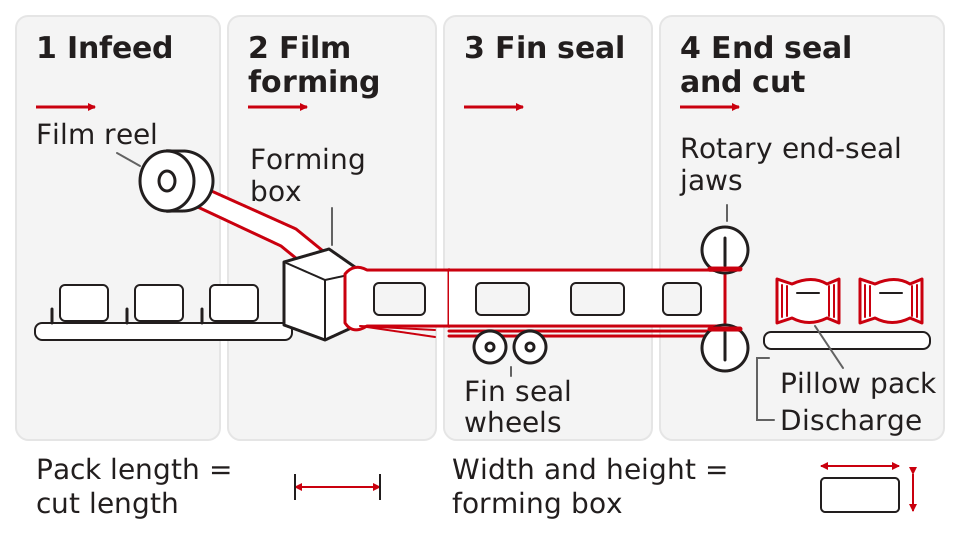
How this looks on the LV-250B/D
The source catalog for the LV-250B/D horizontal pillow flow wrapper describes the same sequence in its own words: parameters are set on a touch screen, products go onto a stainless conveyor, a bag maker forms the bag shape, a back sealing device seals the film, a cutting device cuts each bag and a belt conveyor carries the packs out. Its listing gives bag widths of 30–110 mm, a maximum film width of 250 mm and 40–230 bags per minute. These are catalog ranges without product-specific trial conditions.
What drives the motions
Wrappers differ in how these motions are driven. One LINEVO candy wrapper, fed from a rotary disc, lists an independent three-servo drive for the horizontal motion, the film pulling and the end-seal jaw. The drive and infeed of each wrapper type in the range are compared on the flow wrapping machines page, so they are not repeated here.
The finished pillow pack
The result is usually called a pillow pack or pillow bag: one seal along the back and a sealed end on each side of the product. A vertical form fill seal machine makes a pillow bag with the same three seals, but forms it vertically and fills it from the top. In the standard flow wrapper layout the film comes from above and the fin seal sits underneath; some layouts feed the film from below, so the product rests on it from the start.
What does the film have to do on a flow wrapper?
The film has three jobs on a flow wrapper. It must seal by the method the machine uses, it must be wide enough to wrap the product with room for the fin seal, and printed film must carry a registration mark the sensor can read. The LINEVO catalog does not name film materials for its wrappers, so the film is reviewed for each project rather than picked from a list.
Seal by heat or by pressure
Heat-seal film is closed by heated fin seal wheels and end-seal jaws. Cold-seal film carries a pressure-sensitive coating on the seal area and is closed by pressure, which keeps heat away from chocolate and other heat-sensitive products. Cold seal needs suitable seal tooling, so decide which film you will use before the configuration is fixed.
A width that matches the pack
The film wraps the product's width and height and leaves enough for the fin seal, so the film width follows the pack cross-section. The machine's maximum film width limits the largest pack: 250 mm on most LV-250B/D and LV-250X listings, 350 mm on the LV-250B/D high-speed candy configuration, and 50–120 mm on the disc-feeding candy wrapper.
Print that stays in register
On printed film, the sensor reads the printed mark so the film is cut and sealed in the right place on every pack. Send a sample of the printed reel with its mark.
What to ask your film supplier for
- The film structure and sealing layer, or the cold-seal coating
- The thickness
- The reel dimensions
- Whether the film is printed, and where the registration mark sits
Seal temperature, pressure and speed are then set on that film rather than copied from another product. If the product needs gas flushing, define the target and how it will be checked, because it is an option on some configurations, not a standard part of every wrapper. Choosing the film structure itself is a matter between you and your film supplier and is not covered on this page.
Which products suit a flow wrapper?
A flow wrapper suits products that arrive as one unit per pack, or as a fixed group or kit, and can be fed lying down at a steady pitch. Some answers below point to a different machine family; others only point to a configuration detail to confirm with a sample.
| Question | If yes | If no |
|---|---|---|
| Is each pack one item, or a fixed group you can place by hand or by feeder? | A flow wrapper is a candidate. LINEVO configurations cover bars, biscuits and wafers, candy and lollipops, bread, mooncakes, instant noodles, ice lollies, honey spoons, fruit and vegetables, frozen dumplings on trays, sponges, toothbrushes, slippers, sanitary napkins and cutlery kits. | Loose product that has to be weighed or dosed, such as snacks, granules or powder, belongs on a vertical form fill seal machine with a weigher, auger or cups. |
| Can the product lie flat and be pushed along a conveyor without tipping or sticking? | A standard infeed with pushers can work. | Soft, loose or irregular items may need film fed from below, or a tray. Confirm it with a sample of your product. |
| Does the product fit the listed ranges? | The LV-250B/D and LV-250X listings give a bag width of 30–110 mm, a bag length of 45–190 or 90–330 mm and a product height up to 40 or 70 mm, depending on the listing. These are catalog ranges, not trial results. | Send the dimensions anyway: a larger or smaller pack is reviewed against the other configurations in the family. |
| Is the product heat-sensitive, like chocolate? | Consider cold-seal film, and confirm the seal method and tooling with samples of your product and film. | Heat-seal film is the usual starting point. |
| Do you want a sealed film pack around each item, rather than a tight folded film on a rigid box? | Flow wrapping. | A tight folded film on a carton or box is cellophane overwrapping. |
| Is the product sold in a film pack, rather than a stand-up pouch with a zipper or spout? | Flow wrapping, or VFFS for loose product. | Finished pouches are opened, filled and sealed on a premade pouch machine. |
| Do you want the film sealed around the product, rather than shrunk tight around it with heat? | Flow wrapping. | A shrunk-on finish, around one item or a bundle, is shrink wrapping, which is not among the LINEVO machine families. |
Flow wrap, shrink wrap and VFFS: what is the difference?
The three methods differ in how the product meets the film and how the pack is closed. A flow wrapper seals a film tube around a product lying flat. A shrink process puts film over or around the item and then heats it so it shrinks tight. A VFFS machine forms a bag vertically and drops dosed, loose product into it. The table is compiled from the LINEVO catalog and a public reference on shrink wrap; it is not based on our own tests.
| Method | How the product meets the film | How the pack is closed or fitted | Typical pack | In the LINEVO range |
|---|---|---|---|---|
| Flow wrap (HFFS) | The product lies flat on an infeed conveyor, and a film tube is formed around it | A fin seal along the back and a seal at each end; the film is sealed, not shrunk | A pillow pack around one item, a fixed group, a kit or a tray | Yes: 27 configurations in the flow wrapping family |
| Shrink wrap | Film is put over or around the item, often by automated equipment: flat film wrapped and tacked with heat seals, or a pre-formed shrink bag | Heat from a tunnel on a conveyor, or from a hand-held heat gun, shrinks the film tightly over the item | Bundles and multipacks of several items, and an overwrap on cartons, boxes, cans and pallet loads | No: shrink wrapping is not one of the nine LINEVO machine families |
| Vertical form fill seal (VFFS) | Loose product is weighed or dosed and falls into the bag from above | The film tube is sealed along its length, filled from above, then sealed and cut across | Pillow, gusseted, quad-seal and vacuum bags of snacks, coffee, grains, frozen food and powders | Yes: 60 configurations in the VFFS family |
Where to start: if each product is already a unit and you want it individually sealed in film, start with flow wrapping. If the product is loose and sold by weight, start with VFFS. If you need film that shrinks tight with heat around an item, a bundle of packs, a carton, a group of cans or a pallet load, you are looking at shrink wrapping, which is not among the current LINEVO machine families. A tight folded film on a rigid box, like the film on a perfume or tea box, is overwrapping rather than any of the three.
Three misreadings to check before comparing machines
Early mistakes with flow wrapping usually come from reading a catalog range, or one sample, as if it described your own pack. Check these three before you compare offers.
“The listed speed is my output”
The LV-250B/D listing gives 40–230 bags per minute without product-specific trial conditions. Good output, meaning packs per minute that meet your agreed specification after rejects and stoppages, depends on how steadily products arrive, on the product itself and on the film. Ask for output to be stated for your product and film, and run a sample test where feeding or sealing is uncertain.
“One wrapper runs every size”
Changing the pack length is a setting, because it follows the cut length. A significant change in width or height may need another forming box and an infeed adjustment. List every product size you plan to run, so the forming boxes and change parts for each one appear in the quotation.
“The machine supplier picks the film”
The wrapper is set up around a film you choose with your film supplier, and the seal temperature, pressure and speed are set on that film. A change of film is therefore something to check on the machine, and moving from heat-seal to cold-seal film needs suitable seal tooling.
What to send if flow wrapping looks right
If the pack you need and the way your product can be fed suit flow wrapping, the next step is to check it against a specific configuration. Send these four items, and mark anything you have not decided as open:
- Product: minimum and maximum dimensions, photos or samples, whether it is fragile, sticky or heat-sensitive, and whether a tray is used or several items go into one pack
- Film: your film supplier's specification (structure or seal coating, thickness, reel dimensions) and a printed sample with its registration mark
- Pack size: the finished pack length, width and height you want, or a finished pack sample
- Target output: the good packs per minute or per shift you need, and how products reach the wrapper today
The team reviews which wrapper type fits and whether a sample test is needed, and comes back with a configuration proposal or a sample-test plan to discuss. To see the wrapper types and configurations first, go to the flow wrapping machines page.
Questions buyers ask about flow wrapping
Is a flow wrapper the same as a horizontal form fill seal machine?
Yes. Flow wrapper, horizontal form fill seal (HFFS) machine and pillow packing machine all name the machine described on this page. Its vertical counterpart is the VFFS machine, which forms bags and fills them from above instead of wrapping products that lie flat.
What does an operator do on a flow wrapper each day?
On the LV-250B/D, settings are entered on a touch screen. Training for LINEVO wrappers covers running the machine, changing the cut length and forming box, cleaning and routine maintenance. Sealing jaws, cutting knives, heating elements and belts are the typical wear parts to keep in stock or in view.
Can a flow wrapper put several items in one pack?
Yes, if each component has its own feeding arrangement. LINEVO configurations include disposable cutlery kits that combine a knife, fork, spoon, napkin and condiment sachets, and instant noodles packed with seasoning sachets. List every component and its position in the pack.
How this page was put together
This is an explanation compiled from published sources, not a record of our own trials. The machine stages, figures and product lists come from the LINEVO flow wrapping and VFFS family pages and from the source catalog records for the LV-250B/D and the other wrappers in the range (catalog revision of September 2026). Every figure is a catalog listing without product-specific trial conditions. The shrink wrap row of the comparison is based on the Wikipedia entry “Shrink wrap”, read on 7 October 2026. Film materials, prices and the history of the process are not covered.
Last updated: 7 October 2026.